Tuesday, November 24, 2015

Goodyear Tire & Rubber Co.:Unlawful Payments and Bribes (2007-2011)

The popular Goodyear Co. blimp
Controversy
The Goodyear Tire & Rubber Company, was founded on August 29, 1898, is the first manufacturer of tires. The Company’s business is to develop, manufacture, distribute and sell tires and related products and services across the world. The Company operates in four segments: North America; Europe, Middle East and Africa (EMEA); Latin America, and Asia Pacific. The segments in Europe, Middle East and Africa develops, manufactures, distributes and sells tires for automobiles, trucks, buses, aircraft, motorcycles, earthmoving and mining equipment, and industrial equipment throughout Europe. In the Middle East and Africa, products are manufactured under the Goodyear, Dunlop, Debica, Sava and Fulda brands and other house brands. During 2007 to 2011, the two Goodyear holdings subsidiaries made over $3.2 million in unlawful payments and bribes of over $1.5 million were paid to employees of local government-owned businesses, law enforcement agencies, tax and other local authorities for the purpose of making tire sales. Goodyear recorded this in its books back in 2012 as $10, 000 transactions. These bribes were brought to the attention in July 2011 through an anonymous tip left on a confidential ethics hotline by an employee.
Goodyear did not detect or prevent these improper payments because it failed to conduct adequate due diligence when it acquired Trendsetters, and failed to implement adequate Foreign Corrupt Practices Act (FCPA) compliance training and controls after the acquisition. An investigation was done internally and by SEC and in February 24, 2015, the U.S. Securities and Exchange Commission (SEC) publicized that they had reached an agreement with Goodyear Tire &Rubber Co. Goodyear would pay more than $16 million to settle charges of Foreign Corrupt Practices Act (FCPA) accounting violations. These charges against Goodyear are considered commercial bribery and official corruption by Goodyear’s subsidiaries in Kenya and Angola. The bribery payments was falsely recorded in the books and records of Trendsetters and Trentyre as legitimate business expenses, which were then consolidated into Goodyear’s books and records is a violation. 
Richard J. Kramer, CEO of Goodyear Co. as of 2010

Stakeholders 
The stakeholders in this case include the employees and their families, customers and more uniquely the Kenyan business and government officials. The direct stakeholders were the employees that had knowledge of what was happening and thought it was unfair and unethical. Looking at this case from the employee’s point of view, all employees want to work for an employer or a company that is ethical and fair in their practices and if they can see the unethical behavior just for profit, they will question if they are valued as employees for this company. Moreover; the Kenyan business owners that are taking bribes to help their businesses be competitive among their peers carry these tires even if they have knowledge of the quality of the product. Next we have the customers who are buying from these businesses because they are carrying more of the Goodyear brand tires on their shelves. They do not have a clue whether the product is of good quality but do not have many choices on the shelves. If the product is faulty they have to come back and repurchase which is dishonest. The last stake holder in this case is the government officials of Kenya because they are contributing to the unethical behavior in the country. They are the ones that should be eliminating big cooperation like Goodyear from coming into their country and corrupting local businesses. 

Individualism

Individualism according to Milton Friedman states the only goal of a business is to profit within the constraints of the Law. Tibor Machan also view individualism as “classical individualism” which means the only direct goal of the business is to profit and their primary obligation the business person has is to maximize profit (power p slide, 3).
In this case we clearly see this was Goodyear tire company main goal, Individualist would say that this theory was followed because they not only paid local business but they went to the extreme when they paid the Kenyan and Angolan government officials over $3.2 million in illicit payments for profits. Individualism pose that motivation of investors is to invest in socially responsible businesses.
The primary concern was why Goodyear tire was involved in such unethical manner of bribery, which prompted failure to make and keep accurate books and records. Under Individualism, employees were not being treated ethically. Goodyear primary goal was to profit and that was shown in the rise of sales.


Goodyear Co. employee
Utilitarianism
Utilitarianism identified with the theory of maximizing the overall act or of producing the greatest good for the greatest number. The Acts that accomplish this aim are good; those that do not are bad. This theory states that it is a consequentialist ethics, good and bad act are determined by their consequences. Ultimately, Utilitarian’s consider the cost and benefits of actions for all affected not just the company involve but the stakeholders (Salazar, 20).
The cost and benefit for stakeholders affected are the government officials and the business owners. The benefit the business owners had is gaining cash for promoting the Goodyear brand of tires. The second stakeholders were the government officials because they were the ones that were pocketing the cash for not reporting this fraudulent act and finally, the company and their shareholders because they were the ones gaining more, they pay out cash to sustain high sales of their products. But in the end they were reported and the consequences were not worth the unethical act.

Kantianism

Immanuel Kant develops the theory Kantianism and it poses the theory of being rational and having good will. He believes that act rationally don’t act inconsistently in your own actions or consider yourself exempt from rules. He also believed that be motivated to good will, seek to do what is right because it is right (PP slide pg1) Categorical Imperative, states that a person decides whether an action is permissible or impermissible, so therefore, the formula of the categorical imperative is the Formula of Humanity that explain it is wrong to take advantage of people for your personal gain.
In Goodyear case this theory shows how this company failed the categorical imperative because they used the employees of local government-owned businesses and other local authorities for their own benefits. As a result this action is considered impermissible. This is exemplified when the two Goodyear subsidiaries made over $3.2 million in illicit payments, and the bribery payments were falsely recorded as legitimate business expenses. Both the payments and the resulting revenue were consolidated into Goodyear’s financial reports. This could have been avoided if this company was being ethical in their business practice.
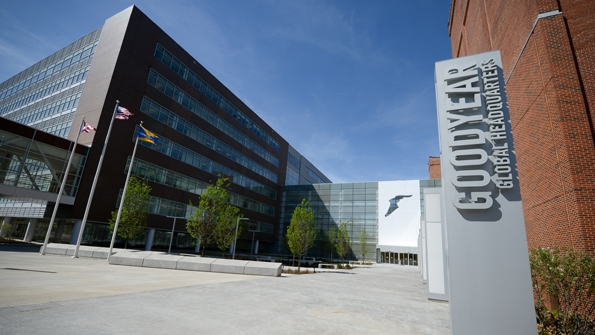
Goodyear Co. Global headquarters in Akron, OH
Virtue Theory
Virtue theory focuses on the rationality on the person being virtuous or not. If the traits that allow “the market to work at full efficiency” is equal to those that “allow the market to work harmoniously in society”, then the virtues of a business person is equal to the virtues of a citizen (Point slide pg. 2). The four main virtues of business are Courage, Honesty, Temperance/Self Control, Justice/Fairness and they depend on the thing’s function or the thing’s circumstances. Aristotle believes that rationality is what differentiates or shapes characteristics of people or business. So individuals need to be rational to function and if it achieves its function then it will be happy. So if we live honest and virtuous lives we will function well.Comparing the Goodyear tire company case to the virtues we can clearly see that they did not act courageously because they failed to implement the necessary rules that could have avoided this controversial issue. Instead management engages or failed to detect those illicit payments to employees of local government-owned businesses and other local authorities (manatt.com). Secondly they failed to report their actions according to the law by hiding these payments by falsely recorded as legitimate business expenses, this shows that they were not honest in their behavior. They were no temperance because they failed miserably by not implementing the rules to govern the business. If management was engaging in this behavior there was no reasonable expectation set for the employees to follow. The last virtue is justice, Goodyear Tire Company showed no justice because they did not care whom they were hurting in order to gain profits. Their practices were not fair because they were using bribes to get ahead of their competitors. They also had no empathy for their competitors because they did what they did to make sure they were considered the top selling brand tire company.

Justified Ethics Evaluation
My view in this case is; this issue could have been avoided if Good Year Tire Company had mandated a company policy. When they had taken over the subsidiaries in these countries they should restructure the organization. If not; training or seminars should have been done when they took over letting all employees be aware of their motto or mission statement. Also advising the consequences if any these policies were broken. These actions that was done to make high tire sales was unethical and it effected all parties involve. Also shame on these countries law officials for encouraging this by taken part of this act, knowing it will impact their economy. The local business and the customers that is getting hurt in the process of these bribery. So when they had acquire these companies they should have look at their financial books to make sure they are in good order because maybe this was the same reason that cause the previous owners to fail in creating profitable and ethical business. Nevertheless; even though this issue has cause them a great deal of financial stress, they were able to show integrity by admitting this issue did occur and work internally to make the necessary corrections and also working with SEC to aid in resolution.

References

 Desjardins, Joseph. (2014). “An Introduction to Business Ethics” (5th Ed.).  New York, NY McGraw Hill Companies Inc.

Dulaney, Chelsey.  “Goodyear Tire to Pay $16 Million to Settle African Bribe Charges “The Wall Street Journal.  Web.  24 Feb, 2015. http://www.wsj.com/articles/goodyear-tire-to-pay-16-million-to-settle-sec-charges-over-african-bribes-1424796482.
Fons, Randall J. &Serfoss, Nicole K. “With No Civil Penalty, Goodyear FCPA Settlement Highlights Benefits of Cooperation and Remedial Actions”, Web. 3 March, 2015. http://www.mofo.com/~/media/Files/ClientAlert/2015/03/150303GoodyearFCPA.pdf?utm_source=Mondaq &utm medium=syndication & utm_campaign=View-Original
Salazar, Heather. The Business Case Manual: The Authoritative Step-by-Step Guide to Understanding and Improving the Ethics of Any Business. Print.
Libby, John F.  &Wolff Jacqueline C .Manatta Jones Global Strategies, LLC, Web 19 March, 2015.   
https://www.manatt.com/corporate-investigations-and-white-collar-defense/The-SECs-Settlement-with-Goodyear-Cautionary-Tale.aspx


DirecTV: False Advertising and Negative Claims (2015)

Controversy 
Rob Lowe starring in a DirecTV commercial

DirecTV has made many false claims and advertisements as of recently. These false claims had been made in a recent series of TV commercials that included a character by the name of Rob Lowe. The claims were made to show the superiority of DirecTV over their competition who are the cable TV providers. They have also been accused of false advertisement in a recent package deal that they have made available to their customers. This package deal as well as the commercials attracted the likes of new customers. These customers were in a sense conned, because everything that they expected was not what they got. Many Claims were made in the Rob Lowe commercial series, such as:

  • "With DirecTV you get 99% signal reliability"
  • “With DirecTV you get 1080p picture quality and Dolby 5.1. The industry’s best picture quality and sound” 
  • “Up to 1080p picture quality” 
  • “DirecTV is #1 in customer satisfaction over all cable TV providers” 
  • “DirecTV is ranked higher than cable for over 10 years” 
  • “DirecTV is the undisputed leader in sports which means you can watch all the games you want to” 
  • “When it comes to sports, with DirecTV, you can have them all” 

Most of the claims are considered to be false, this is why the National Advertising Division has had to take action against DirecTV. These claims were to show the superiority over the competitors who provided cable television, the competitor to DirecTV that complained about these claims was Comcast. Comcast took great offense to the commercial series as it also depicted them in a negative light. The commercials showed two versions of Rob Lowe, the Rob Lowe with satellite TV which is the type of provider DirecTV is was the "better" version, and the one with cable TV was the inferior version of himself.
The package deal that DirecTV had also promoted, left out major details to its customers. The Federal Trade Commission came after DirecTV due to this false advertisement. They claimed that DirecTV had, “…deceptively advertising a discounted 12-month programming package because it fails to clearly disclose that the package requires a two-year contract. In addition, DIRECTV does not clearly disclose that the cost of the package will increase by up to $45 more per month in the second year, and that early cancellation fees of up to $480 apply if consumers cancel the package before the end of the two-year period” (FTC). In both situations DirecTV is suckering and conning customers into joining them, only to benefit themselves. 
DirecTV logo

Stakeholders

The stakeholders in this situation are the customers who are being conned into signing up with DirecTV, as well as the Marketing Department of DirecTV because they are the ones now facing these issues at a hand.

Individualism

The main goal in Individualism is to maximize the profits of the owners of the company and the stockholders. Though the main goal is to maximize profits, one must do so while operating within the laws and rules. In this case DirecTV did not operate within the laws and rules, they took illegal actions in order to profit. They did so by false advertisement and false claims. They attempted to maximize profits in the Rob Lowe commercial series by downplaying cable TV providers to show the superiority of Satellite TV. With the package deal, they attempted to bring in new customers by offering a great deal, but left out vital details which in turn made the deal a not so good deal for the customer. In both cases, they attempted to maximize profits in and unlawful way making this unethical.

Utilitarianism

The happiness of all conscious beings should be maximized according to the theory of utilitarianism. DirecTV didn't take into consideration the impact that these false claims and advertisements would have on the customers. They only cared about their happiness and to achieve that was to gain more customers to gain more profits. In the end the customers were left unhappy because they realized what they were conned into doing. Under utilitarianism these cases are deemed unethical.

Kantianism

The values of Kantianism are: rational decision-making, autonomy of individuals, and honesty and freedom. To be ethical in the Kantian point of view would be to, "always act in way that respect and honor individuals and their choices. Don't lie, cheat, manipulate or harm others to get your way"(salazar). Also, one must make decisions based off of "Good Will". In Both cases DirecTV failed to make decisions according to the principles of Kantianism, deeming them unethical.

Virtue Theory

DirecTV headquarters in El Segundo, CA
To be ethical under Virtue Theory is to completely fulfill all four-virtue characteristics. Those four-virtue characteristics are: Courage, Honesty, Temperance/Self Control, and Justice/Fairness. DirecTV showed courage by taking risks in making false claims and false advertisements, although those risks were not for the right ideas or actions. Honesty was not shown by any means, they lied and manipulated customers into subscribing with the company. Under temperance, DirecTV failed to realize that the expectations and desires were not reasonable. The claims made in the false advertisements were unreasonable. DirecTV was also very unfair to their customers, they hid many vital details from them, which lead to them profiting more from their customers which is extremely unfair. Since these cases failed to meet the expectations under virtue theory, again they are deemed unethical.

Justified Ethics Evaluation

In my opinion, always being ethical in a business environment is extremely important, and in this case I believe that DirecTV doesn't complete grasp the importance of it. They have been charged with similar issues in the past, and don't seem to realize that its time for a change. Although they are extremely successful at what they do, they are shinning a negative light upon them. They are only concerned with the companies interest and not about their customers. Overall under all theories, DirecTV was considered unethical. They need to address the issues that they create for themselves and implement new processes to fix them.

REFERENCES:

"DirectTV Pulls Rob Lowe Ad Campaign After Complaints of False Claims." PRNewser. N.p., n.d. Web. 24 Oct. 2015.

"FTC Charges DIRECTV with Deceptively Advertising the Cost of Its Satellite Television Service." FTC Charges 

     DIRECTV with Deceptively Advertising the Cost of Its Satellite Television Service. N.p., n.d. Web. 24 Oct. 2015.

"Laughter: It's the Best Medicine, but Not the Cure for False Advertising | Lexology." Laughter: It's the Best Medicine, 
     but Not the Cure for False Advertising. N.p., n.d. Web. 24 Oct. 2015.

"NAD Recommends DirecTV Discontinue Certain Claims in 'Rob Lowe' Ads Following Comcast Challenge; DirecTV to        Appeal." Advertising Self Regulation Council RSS. N.p., n.d. Web. 24 Oct. 2015.

Salazar, Heather. The Ethics Business Case Manual. N.p.: n.p., n.d. Print.
     24 Oct. 2015.

The Satellite Company Advertises a 12-month Plan for as Little as $19.95. "DirecTV Charged with False Advertising." 
     CNNMoney. Cable News Network, n.d. Web. 24 Oct. 2015.

Enbridge: Northern Gateway Pipeline (2015)

Enbridge Inc. logo
Controversy
Enbridge has proposed that they want to invest in a 5.5-billion dollar project called the
Northern Gateway Pipeline. This is a project where they plan to build a pipeline that would start in Alberta and extend all the way to the west coast of British Colombia. The project would consist of two pipelines. One of them would be used to transport oil from Bruderheim, Alberta to the port of Kitimat, British Colombia.While this project would create many job opportunities, there are some concerns and ethical issues that go along with this. One of these issues is how these pipelines could spill and create environmental problems. Environmentalists are concerned about how an oil spill could pollute the air, and also nearby lakes that are in are the surrounding regions. It could also effect many rivers in the area, destroy wildlife habitats and release large amounts of green house gasses. Another ethical issues that it posses is that once the oil gets to the coast of British Colombia, it has to be transferred overseas. While making this journey it has to navigate across some rough waters. The ships will have to take the route that passes the Great Bear Rainforest. This is a big issue because Canada’s government has pledged to keep this area safe no matter what the costs is. If a ship were to sink and an oil spill were to happen it would be tough to clean it up because of the rough waters and the narrow channels) Its easy to see how some environmentalists don’t want this pipeline to go through with some things that have happened in Enbridge’s history.


Stakeholders
Stakeholders are people who have interest or are affected by the decisions made by Enbridge. The stakeholders in this specific case that would be the most affected would be environmental organizations because they have the concern and responsibility to do the right thing. If they see something hazardous that could potentially affect the environment they have to say something. For example they have to view possible threats that the oil could bring if a pipe explodes like polluting the air, wildlife habitat, and rivers and streams. The next ones to be affected would be landowners and right-of-way communities. These people will be directly affected because these pipelines would go directly through their property or community. Others who could possibly be affected would be company management, stockholders in the company, and countries who are in need of oil.

The Northern Gateway pipeline drawn on a map
Individualism
Individualism, according to Milton Friedman says that the only goal that a business has is to profit. While doing this, one must act accordingly to the constraints of the law and abide by all the rules and regulations. The other way of viewing individualism is called “classic individualism.” This is a theory that a person by the name of Tibor Machan thought of. He proposes that the only direct goal in business is to profit and the Primary obligation a businessperson has is to maximize profit. When analyzing individualism, Enbridge’s Northern Gateway Pipeline fits perfectly because the only goal they wanted to achieve is to make a big profit by sending as much oil overseas and to the United States as possible.

Utilitarianism
Utilitarianism states that you must maximize happiness in yourself and in other people who are affected by the specific action. Utilitarian ‘s approach is to consider all the benefits and actions for all people who are involved, not for just for a specific company or individual. In this specific case with Enbridge, they do not follow Utilitarianism in the least bit. All Enbridge wanted to do when they were about to build the pipeline was make as much money as possible. Enbridge didn’t care about what anybody thought or making people happy, they just wanted to get oil and a lot of it. In order for this to happen they were about to go through small towns, private property, and uncharted territory. This didn’t make the people, who lived in the small towns happy, nor the environmentalists and the people who owned the private property happy at all.

Kantianism
The Northern Gateway Pipeline
in the process of being built

Immanuel Kant founded Kantianism and its main theme is to focus on rationality and good will. There are four principals of Kantianism and they are respect people, act rational, help others make rational well thought out decision, and act in good will. Kant also talks about how it’s wrong to exploit people for someone’s own advantage. When viewing this theory and relating to this specific case, it is clear that they did not follow this and failed categorical imperative because they were going to use people to get what them wanted. An example of this would be how they were going to use people’s private property to make it better and more convenient for Enbridge. Another example would be how they were going to go through Indian tribal communities to get what they want. This is the same thing they weren’t acting rational or in good will. They were only thinking about themselves and how it would benefit Enbridge in the end.

Virtue Theory

The four main virtues of character are as follows: courage, honestly, temperance, and justice/fairness. The first characteristic is courage. Enbridge showed courage trying to make the company better and also helps Canada’s economic status by trying creating a lot of jobs, but they were going to do it in the wrong way that wasn’t ethical. The second characteristic is honesty. I feel like Enbridge followed the honesty characteristic because they never really lied about anything. They told everybody what they were going to do. People may have disagreed but they never lied about anything. The next characteristic is temperance. This is where Enbridge had to have realistic expectations. I believe they had realistic expectations, but in the end people thought it was to risky to take the chance. The last virtue characteristic is justice. They are represented as quality products, fair practices, and good ideas. There is no doubt they had a good idea trying to create more oil for countries in need and they obviously had quality products they would use during this project that would transfer the oil through these pipelines. The last characteristic is what the lacked in and that is fair practices. As talked about before they weren’t being fair because all they did was care about themselves and try to get rid of whole towns and take advantage of peoples private property. Enbridge almost followed every characteristic but they lacked this last one.
Al Monaco, CEO of Enbridge Inc. since 2012

Justified Ethics EvaluationI think Enbridge had the right intentions. They were trying to better the company first, but they were also trying to make Canada have more economic growth, and this project would be much more than they have seen in a long time. This would create over 1500 more jobs, and the amount of oil they could produce would be much more than the expense of this project. They were trying to find a way to generate there oil more effectively, so they don’t have to keep getting it somewhere else and they can be self-reliant. In these things I feel like they had the right intentions.
There are some things I don’t agree with what they planned to do at all. When Enbridge said they were going to run pipes right through towns and local tribal towns without consent was a little to far. They even said they were going to take bulldozers and just demolish them if they didn’t let the pipes go through. It almost seemed like they had no disregard for people or even the environment at all. It only seemed like they cared for themselves at some points. I agree with what they were trying to do but in some of the ways in which they were trying to do it made no since to me. They could have tried to create alternative routes in order to avoid these towns but they just threatened them instead.

References
"A "Yes" to Enbridge's Pipeline Is a "No" to Ethics in Canada." The Huffington Post. Web. 24 Nov. 2015.
     http://www.huffingtonpost.ca/will-braun/bc-pipeline-protest_b_1635692.html

News, C. (2012, January 11). Northern Gateway pipeline: Benefits vs. concerns. Retrieved October 25, 2015
     http://www.cbc.ca/news/canada/northern-gateway-pipeline-benefits-vs-concerns-1.1135312

Northern Gateway: Why environmentalists believe it’s not worth the risk. (2014, June 20). Retrieved October 25, 2015
     http://globalnews.ca/news/1396386/northern-gateway-why-environmentalists-believe-its-not-worth-the-risk/

Northern Gateway: Timeline. (2014, June 17). Retrieved October 25, 2015.
     http://globalnews.ca/news/1384346/northern-gateway-timeline/

Salazar, Heather. The Business Ethics Case Manual: The Authoritative Step-by-Step Guide to understanding and 
     improving the Ethics of Any Business. Print.

"The Council of Canadians." Enbridge Northern Gateway. Web. 24 Nov. 2015.
     http://canadians.org/enbridge