Showing posts with label Talcum. Show all posts

Friday, May 6, 2022

Johnson and Johnson: False Bankruptcy Hurts People (October 2021)


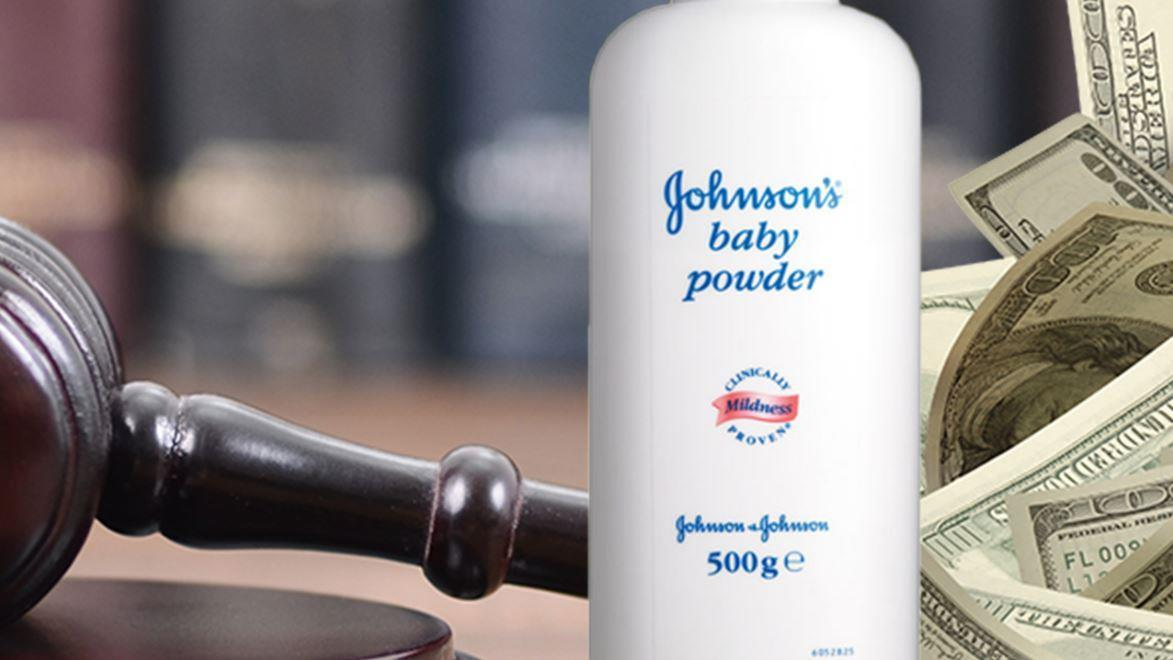
Pictured: Johnson & Johnson’s Talcum Powder involved in thousands of lawsuits.


Ethics Case Controversy

Johnson & Johnson is a multibillion-dollar company in the pharmaceutical industry that produces medical devices, pharmaceuticals, and consumer packaged goods. Johnson & Johnson is responsible for the household items that many of us are familiar with, including Band-Aid, Tylenol, Neutrogena, Johnson’s Baby, and countless more. In October 2019, the U.S. Food and Drug Administration found asbestos in one of the containers of their talc-based baby powder retailers to pull this product off of their shelves. Talc and asbestos can naturally form together in talc mines, causing asbestos contaminated products with very little way of filtering it out. Asbestos contamination in talc products can lead to cancers such as mesothelioma and ovarian cancer. For over a century, consumers have used talcum powder, otherwise known as baby powder, to perfume, dry, and protect their own and their children’s skin. Not only has Johnson & Johnson denied that their talcum powder causes cancer, but the company has known that this harmful substance was in their product since as early as the 1970s. In an investigative report by Reuters, they revealed that, “J&J didn’t tell the FDA that at least three tests by three different labs from 1972 to 1975 had found asbestos in its talc,” (Reuters). The company has faced around 38,000 lawsuits claiming the asbestos in Johnson’s baby powder caused ovarian cancer and mesothelioma in consumers (NPR). Spokespeople from the company made statements that claimed that the company had made sure through many tests that the ingredients in the powder are safe. One stated, “Our [powder] has been routinely tested and confirmed to be asbestos free by a range of independent laboratories, universities and global health authorities''. In an attempt to quiet the angry public the company has spent around 2 billion dollars in costs and settlements (Jolly 1). Despite the enormous backlash that the company was experiencing, in an effort to maintain their profits and buy themselves time, the company took to doing some immoral financial actions. 

            In October 2021, Johnson & Johnson filed for bankruptcy under the weight of thousands of lawsuits. This quiet tactic effectively puts a hold on all outstanding and unresolved lawsuits that Johnson & Johnson was facing concerning the contaminated talcum powder. The company’s legal maneuver of filing for bankruptcy was controversial to many people. Johnson & Johnson worked with the bankruptcy court to set up a trust fund of $2 billion to resolve outstanding and future claims. By doing so, the company will save billions of dollars and allows them to settle claims through the trust fund instead of litigating them individually. Johnson & Johnson is not facing the problem head on, but rather trying to get out of the claims anyway they can without having to take responsibility for the health risk they put their consumers in. In addition, Johnson & Johnson transferred all of the potential liability linked to the talcum powder cases into a subsidiary, called LTL. This way, Johnson & Johnson could keep their valuable assets separate and the subsidiary absorbs the liabilities as a protective maneuver.  The company claimed that their choice in actions would help resolve claims in an efficient and equitable manner. However, their strategy halted the cases, allowing them to remain on hold for months or even years. Anger and frustration sparked from families that were seeking compensation from Johnson & Johnson’s contaminated products. Companies facing similar situations have found openings in state and federal law such as creating and pushing a new subsidiary into bankruptcy, which Johnson & Johnson did.
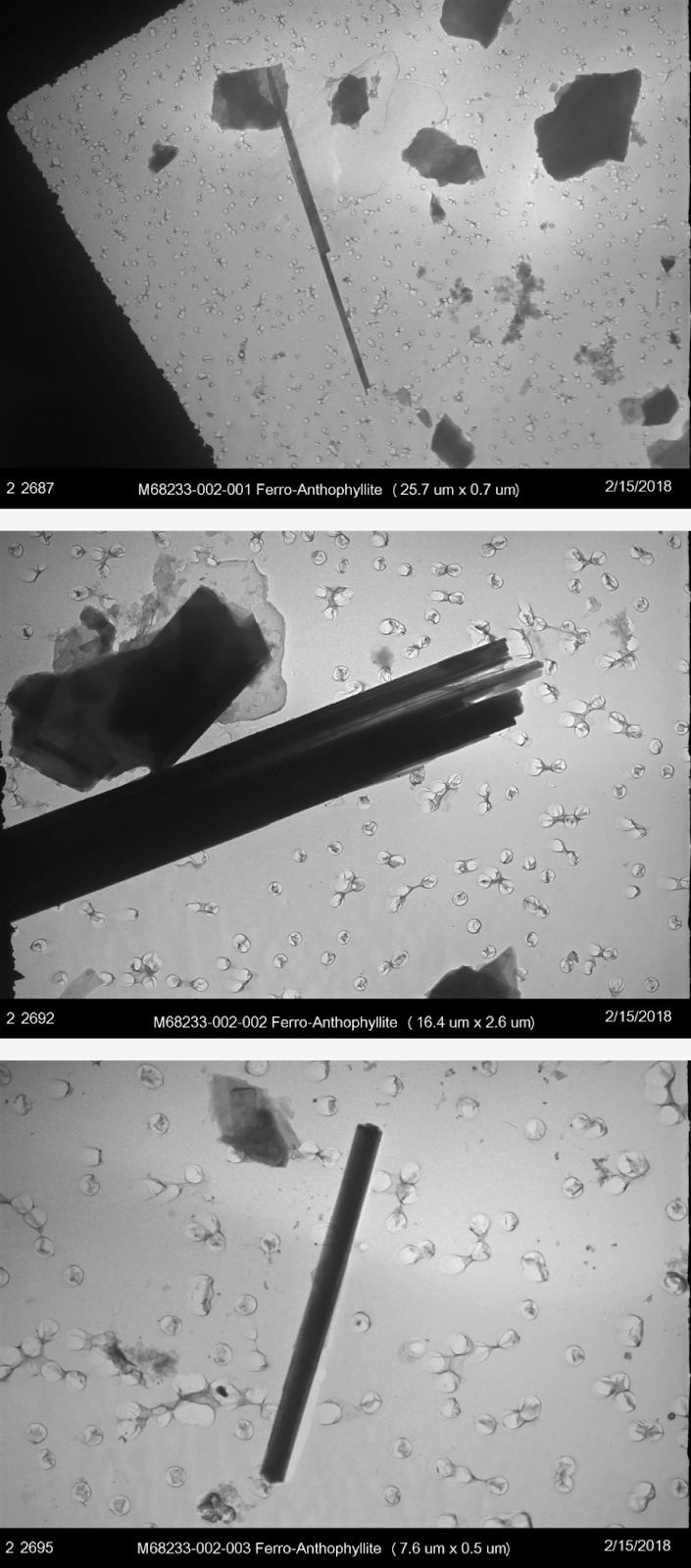
 

Pictured: A telltale needle-like shape of asbestos found in a 1978 bottle of J&J baby powder.

 At age 22, Hanna Wilt realized that she was not able to walk right, her first symptom of an aggressive cancer called mesothelioma. Her illness rapidly advanced after unsuccessful treatment, causing Hanna not only fear, but outrage towards the company responsible for making her sick. Her lawsuit against Johnson & Johnson was suddenly blocked weeks before her passing at age 27. Wilt used Johnson & Johnson’s talcum powder every day, sometimes even multiple times a day. Wilt was angry that the company had known about the powder contamination and kept the information from customers. “This powerful group of people, they lied and were able to potentially ruin so many people’s lives,” said Wilt (NPR). Hanna’s mother, Hope, knew that seeking justice would not have saved her daughter’s life, but she did not want a company like this to get away with their actions that have caused so many families heartache. Tens of thousands of people have filed these baby powder cases and have still not received justice for the company’s actions. Not only did Johnson & Johnson deny responsibility that their talcum powder caused mesothelioma and ovarian cancer in consumers, but they used an ethically controversial tactic to get themselves out of it. Hanna Wilt is not the only one that has died from the effects of using this product and many others are seeking justice from the company who claimed false bankruptcy as a maneuver around responsibility. 

Pictured: Johnson & Johnson’s headquarters in New Brunswick, NJ.

In an episode of The Weekly about the case on Hulu, an interview of a woman, Patricia Schmitz, discussed how she was diagnosed with mesothelioma, after realizing that she too had used the baby powder for most of her life and filed a lawsuit against the company. Her lawyer, Mark Lanier, discussed his research and similar cases that found that a known material found within Talc mines (Talc being a main component of baby powder) was asbestos. This was also a very hard substance to identify and remove because the material was scattered within the Talc mines. When he dug further into the company’s internal files he found that there were actually tests done on samples of the powder that showed a positive match to asbestos found within the talc in the product. Using the results he found within Johnson & Johnson’s result, as well as within his own tests, they found traces of asbestos in the products as well as within the tissue of the bodies of the individuals that were affected. He argued that they had in fact done tests but created the tests in such a way that they knew they could not accurately pick up traces of the asbestos because they were not sensitive enough. Documents dating back to the 50s even show that results of tests done on the talcum powder show that it contained asbestos. The company has known about the dangers and the contaminants of its products for upwards of 70 years and had lied to the public and refused to acknowledge the dangers of it. In the result of Patricia’s case, Johnson & Johnson was required to pay her $4.8 million and the Justice Department had opened up an investigation of the company as a result of all of the suits filed against them (The Weekly).

Timeline
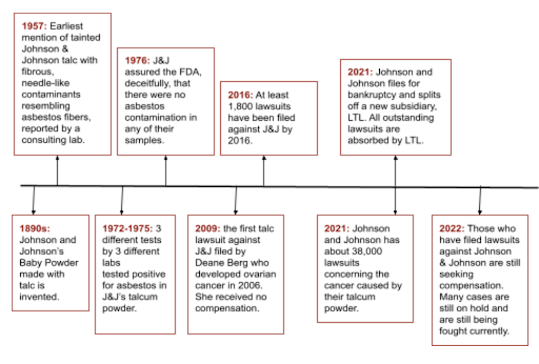
Stakeholders

Johnson & Johnson has a large number of key stakeholders in their company but there are three that hold the most stake within the company. First and foremost is their Executive Chairman and CEO Alex Gorsky. Alongside him is the second largest stakeholder who is the Chief Executive Officer Joaquin Duato (JNJ). Coming in as the third largest stakeholder of their company is the investment group The Vanguard Group Inc. who holds over $36 billion dollars within the company. In addition to these stakeholders, future shareholders, current shareholders, consumers of Johnson & Johnson products as well as the general public all play a major role in those who have a stake within the company. Shareholders are affected by the outcomes of lawsuits filed against a company which they have billions invested into because it could impact their return on investment. These groups and people could lose all of their money put into the company if the company were to file for bankruptcy. The consumers and general public that use Johnson & Johnson’s products are affected because they are either looking for justice for wrongs committed against them from using the products and they are also important to future consumers' well-being if the products are a danger to their health. Justice must also be served to those who have suffered as a result of the product.

Individualism

When it comes to defining “Individualism” Professor Salazar states “Business actions should maximize profits for the owners of a business, but do so within the law.” (Salazar 17). This definition explains how a business, like Johnson and Johnson, makes its decisions to best serve its long-term interests of maxing profits. Therefore, it could be argued that the company decided to make this bankruptcy choice because in the long term they believe they will be able to sort out all these lawsuits and will bring closure to them and the families affected, without having to spend millions in fines. On the other hand, it can be argued that using this “Texas two-step" method to pause the lawsuits was not in their best interest because when all is said and done many individuals and their families were harmed in this process and the company will lose a lot of their reputation and could eventually lose out on profits over time. A business that believes in individualism would only want its workers to focus on how to maximize the goal of the company, which any companies' main goal is profit. This would lead to Johnson and Johnson agreeing with the individualism theory because they are solely focused on making a profit, and stalling these cases allow them the time needed to figure out how they can get out of it while losing the least amount of money.

Is this situation ethical? No, obviously because many people have potentially been harmed using its product they knowingly put on shelves with dangerous chemicals. This case has way too many stakeholders involved that will for the most part all be negatively affected. Johnson and Johnson cannot view this in an individualistic way of just wanting to act in their self-interest to earn profits because people’s lives and health are on the line. But this potentially is how they are handling the situation, only caring about their profit, and trying to hide their wrongdoings. However, they are performing all of this within the laws, as unethical it may still be, this is all legal. Professor Salazar also writes, “Since laws can be changed, these laws simply represent that the business will abide by commonly agreed-upon standards” (Salazar 18). The previous quote explains how those who believe in the theory of individualism do so and believe as long as they are acting within the laws, they can do just about anything in order to maximize profits. 

In conclusion, the theory of individualism would find the circumstances of this case permissible as the company is acting to maximize their profits within the laws. Unfortunately, it is in a very unethical manner, but the main goal of a company is to profit and what Johnson and Johnson is doing is stalling the lawsuits to give them more time to figure out how to get out of this without losing too much money and their reputation. When thinking about it, they are certainly acting in an individualistic way because they are only worried about their self-interests, profits, and paying no attention to the irreversible damage they have potentially caused to a number of families. 

Virtue Theory

Being a virtuous person can be described as behavior showing high moral standards. Therefore virtue theory in relation to companies and their customers, owners and all who work for that company, have a moral obligation or duty to consumers of its products. This includes being honest, transparent, and fair in their business practices. Johnson & Johnson did not use virtuous and ethical business practices in handling the lawsuits made against them in recent years as well as simply being an ethical company to their millions of customers for decades before the scandal was released. When a company knows of the dangers of its products and they continue to withhold those warnings from their consumers that is an immoral and unethical use of power. “A warning on the product that has even a chance to cause harm or illness to those using it would be the least that a company could do in the way of being ethical and just” (The Weekly). For upwards of 70 years Johnson & Johnson has been a household name of purity and safe products to be used for babies as well as adults. It is the company’s responsibility to uphold these values and promises of the quality and safety of their products to customers. When there is even a shadow of a doubt that a product is dangerous and can cause harm to those who will use it, especially one marketed as being used on babies, the company has an ethical and moral standard that they must inform these people. Then at least the people using it can make their decision based on weighing the risks with the rewards of buying the product. 

Utilitarianism 

A utilitarian would view Johnson and Johnson’s way of handling the situation as the opposite of their belief. Utilitarianism is described as in simple terms, the greater good for the greater number of people. In this case, Johnson and Johnson did not care about the health and the state of the people who were affected by the baby powder, they only cared about the reputation of their company and keeping their company making money. In Johnson and Johnson’s case, no stakeholders were happy at all with the case, and is as follows: 

Hanna Wilt/All 38,000 other cases: All of those who tried to bring Johnson and Johnson to court will be negatively impacted by this case, because Johnson and Johnson used the Texas two-step to freeze all these cases, and they were never settled. Johnson and Johnson was never held accountable with legal action against the company, and those who were affected by the baby powder were either dying or very sick. 

Shareholders of present and future: Both shareholders of the present and the future will also be negatively impacted by this case. The company was looked at by the public as not owning up to their mistakes, and the value and stock of the company dropped. The company’s stock value was down, and was not a consideration for future investors at all. 

Customers/Society as a whole: Customers of the billion dollar company also will be negatively impacted by this case because they are the ones that have been using Johnson and Johnson products and can themselves be affected by the baby powder and they might not even know. These customers will lose trust and faith in Johnson and Johnson especially after the way they handled all of the court cases, and did not take ownership for what they did.

Johnson and Johnson’s actions were unethical and the opposite of what a utilitarian would believe in. The greater good was not the greatest for the greater number of people. Johnson and Johnson handled this case very poorly and it's very sad to see innocent people die and be very sick from a health product that they thought they were using to benefit them.   

Kantianism

It is clear that Johnson & Johnson’s actions were impermissible based on a Kantian’s view. The company went against the Formula of Universal Law, Humanity, and Autonomy, determining that they did not make a rational action. The Formula of Universal Law prohibits people from making exceptions of themselves and forbids all forms of deceit. Clearly, Johnson & Johnson deceived its loyal customers by failing to report the talcum powder samples containing asbestos in the 1970s. They market their products as safe and trustworthy, however that is disproved by this case. The Formula of Humanity states that people should treat others for what they are and not as a mere means to get something they want. Johnson & Johnson used its consumers to get monetary gain, regardless of an unsafe product. They withheld information about the asbestos in order to get people to buy their product they would otherwise be wary of purchasing, knowing the dangers. The company then blocked the lawsuits with the bankruptcy and settled matters through a trust fund, costing them the least amount of money possible. The Formula of Autonomy regards legislating laws everyone can agree to. Johnson & Johnson agreed to obey laws about product safety and standards the FDA sets yet failed to do so. The tactic that J&J used is not clearly legal. Lindsey Simon, a professor who teaches bankruptcy law at University of Georgia stated, “I think if you really look closely at what bankruptcy code allows, it’s not altogether clear this is permitted,” (NPR). Based on the formulations of the categorical imperative in Kantian ethics, Johnson & Johnson’s actions are impermissible. 

Action Plan

Johnson & Johnson acted in an entirely selfish way to a massive number of customers as well as stakeholders in their company. For monetary gain and protecting their assets, they continuously put millions of people’s health at risk and caused cancer and subsequent death in many. The outrage and backlash towards them that the scandal had caused forced the company, however delayed, to take action in an attempt to remediate the burden they have put on people. Though there are some who suffered irreversible damage and loss of life, those individuals could not be helped. In order to repair the damage to their reputation as one of the safest companies whose products are prided in safety and purity, Johnson & Johnson would need to make a number of steps to do so. Starting with continuing to make settlements with the lawsuits filed against them and repay the best they can to the families who were impacted by the product. Conducting a mass recall of all of the baby powder that consumers may have in their homes and provide compensation for the products. They should also conduct an investigation and publicly own up to the mistakes that were made as a company and express their apologies and plans for moving forward to making the company safe and reliable again.  Johnson & Johnson must be completely transparent in the production of their products and have the customers' very best interest and health at heart. For a company who prides itself in purity and care, these values must be top priority in all matters of the business. Johnson & Johnson strives for good and the wellbeing of their customers but being honest about where products come from and making sure that they are not risking the lives of their customers should be more of a priority than it seems to be currently.  

Johnson and Johnson should emphasize multiple core values within their company after this situation. One of these core values should be testing all of their products, this is something that seems to be giving the company a lot of past issues, and that is where this entire controversy originated from. Once, they find an issue in one of their products such as a dangerous chemical they should immediately take that product off the shelves. Another value they need to recognize is honesty. Johnson and Johnson cannot try to hide their mistakes, especially in this case, and admit their wrongdoings in order to protect their customers' safety. A third relevant core value needs to be integrity. This encompasses the previous two values and overall emphasizes ethical practices within their business. Trying to hide mistakes and potential harmful products is a terrible look on any company’s reputation, especially such a large and powerful company like Johnson and Johnson. Having integrity is the most important core value that every company should take seriously.

In order for Johnson and Johnson to ensure ethical productivity to prevent this problem from happening again they need to have discussions with the testing departments and even upper level management. This needs to be done in order to ensure they minimize putting harmful products on the shelves. Having harmful products seems to be becoming a theme for Johnson and Johnson showing they need to be more careful in the future. Having discussions with upper management will also mention the company’s ethics and making sure they admit their mistakes to once again get harmful products off the shelves so they do not cause any problematic situations like this case. Customer safety needs to be Johnson and Johnson’s number one priority as they currently dug themselves into a huge hole with lawsuits and even possible deaths at their fault.

During the case controversy, many executives knew about the asbestos contaminant. Products from every company are required to be tested and regulated through the Federal Drug Administration. When Johnson & Johnson had their products tested in the 1970s, there was evidence of high levels of asbestos in their talcum powder. Johnson & Johnson must have gotten these lab results back and had to have known about the contamination. In this case, the executives and others who had been notified of this danger should have been fired for failing to do anything about it. To prevent cases like this in the future, Johnson & Johnson should hire people who show integrity, check employment history, ask about their ethics, and administer personality assessments. The company should also promote those who show these qualities and are focused on the health of consumers and doing what is ethically right. If any employee proves otherwise, they should be fired immediately because this will set a standard for what the company expects in its workers. If people act unethically and get away with it, others might take advantage of that and act unethically (potentially for monetary gain) because they too can get away with it. By doing so, Johnson & Johnson will gain a better reputation if customers see that they want ethical people working for their company. 

Johnson & Johnson needs to remarket their company. For a company who has faced thousands of lawsuits for their dangerous products, they still claim they value safety, health, and ethical practices. It is wrong to claim this if many of their products have been known to be dangerous and harm their customers. If Johnson & Johnson were to take the steps in this action plan to better their company and the safety of their consumers, they should show the public how they are doing so. For example, Johnson & Johnson can decide to go through more thorough development and more regular testing of their products with a third party neutral lab. This way, if a product is deemed unsafe, the lab will be able to report this to the FDA instead of potentially keeping quiet if they are working with Johnson & Johnson. In addition, they can prove to consumers that they are taking a more ethical approach to their company and hire new people to replace ones that have shown unethical behavior. By marketing their company as a more caring and ethical company and by taking the necessary steps to do so, people may put trust back into their company. 


Authors:

Kathryn Bentz

John Oliver

Taylor Tenerowicz

Joe Contino


References

Girion, Lisa.  “J&J Knew for Decades That Asbestos Lurked in Its Baby Powder.” Reuters, Thomson Reuters, 14 Dec.

 2018, https://www.reuters.com/investigates/special-report/johnsonandjohnson-cancer/.

Horsley, Scott. “Johnson & Johnson Wins a Key Court Battle in Baby Powder Case.” NPR, NPR, 25 Feb. 2022,

 https://www.npr.org/2022/02/25/1083061992/johnson-johnson-wins-court-battle-bankruptcy-baby-powder. 

Johnson & Johnson. “Alex Gorsky.” Content Lab U.S., https://www.jnj.com/leadership/alex-gorsky. 

Jolly, Jasper. “Johnson & Johnson Faces Push to Force Global Ban on Talc Baby Powder Sales.” 

The Guardian, Guardian News and Media, 6 Feb. 2022, https://www.theguardian.com/business/2022/feb/06/johnson-johnson-faces-push-to-force-global-ban-on-talc-baby-powder-sales. 

Mann, Brian. “Rich Companies Are Using a Quiet Tactic to Block Lawsuits: Bankruptcy.” 

NPR, NPR, 2 Apr. 2022, 

https://www.npr.org/2022/04/02/1082871843/rich-companies-are-using-a-quiet-tactic-to-block-lawsuits-bankruptcy. 

Tarver, Banks. The Weekly: V. Johnson & Johnson. Hulu, 2019, 

https://www.hulu.com/watch/199c0daa-62ed-430c-8e00-383a118fd523. Accessed 11 Apr. 2022. 

Salazar, H. The Business Ethics Case Manual. N.d. 


Mann, B. (2022, April 2). Rich companies are using a quiet tactic to block lawsuits: Bankruptcy. NPR. 

Retrieved April 15, 2022, from https://www.npr.org/2022/04/02/1082871843/rich-companies-are-using-a-quiet-tactic-to-block-lawsuits-bankruptcy  


Sunday, November 22, 2020

Johnson & Johnson Talc Powder May Cause Ovarian Cancer (2016-2020)

     Johnson & Johnson has been a trustworthy company for many years. They pride themselves on keeping people healthy at every age and stage of life. However, their credibility was questioned after an enormous number of consumers reported that their talcum-based baby powder caused ovarian cancer. This issue caused negative publicity for the company and added a long-term damage on the brand. After decades of Johnson & Johnson falsely misleading consumers and the FDA about the impact of asbestos-contaminated talc on public health, thousands of affected consumers are seeking justice after developing cancer.                          

    Ethical theories would analyze Johnson & Johnson’s actions in diverse ways. An Individualist would say that Johnson & Johnson did not maximize profits for the business within the law because they failed to inform the public and their stakeholders about the scientific findings of their baby powder. A Utilitarian would say that Johnson & Johnson is unethical because of the consequences of their mistakes. They knew that talcum caused cancer and posed as a risk to the consumers, but they continued to sell the product anyways. A Kantian would view Johnson & Johnson as unethical because they manipulated their consumers for many years. By selling their talcum-based powder without proper safety protocol, they were evidently implementing bad will. Under the Virtue Theory, Johnson & Johnson is considered unethical because they exhibited many bad character traits. Proving that they do not care about the safety and health of their consumers. Johnson & Johnson needs to focus its resources on testing their product, reestablishing their values, and monitoring product safety in order to portray empathy for the consumers. Above all, Johnson & Johnson needs to have open relationships with consumers and stakeholders for the sake of reinstating their brand and ensuring good ethics.

Ethics Case Controversy
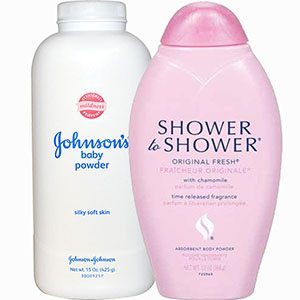
    In 2018, a Missouri appeals court upheld a jury verdict that Johnson & Johnson’s talcum-based baby powder caused ovarian cancer in twenty-two women. The Missouri Court of Appeals also reduced the total damages from $4.69 billion to about $2.1 billion that Johnson & Johnson was ordered to pay. This verdict was the biggest award of damages in a series of lawsuits over the safety of Johnson’s Baby Powder. The series of lawsuits also resulted from another talc-containing powder, Shower to Shower, that Johnson & Johnson used to sell. As of March, more than 19,000 plaintiffs had filed talcum-powder lawsuits against Johnson & Johnson in U.S. courts. The plaintiffs alleged that talc-containing powders caused ovarian cancer in women who used it for feminine hygiene for years. Others said that inhalation of the powder caused a rare cancer called mesothelioma, which affects the lining of the lungs. Their lawyers also have alleged in some cases that the talcum powder contained asbestos, a naturally occurring mineral linked to mesothelioma. In the Missouri Case, six of the twenty-two women died from ovarian cancer before the trial and five more after it ended. 
    On the other hand, Johnson & Johnson is continuing to state that their talc-based powder “is safe, doesn’t contain asbestos, and didn’t cause cancer in people who used it.” As a result of the talcum-powder verdicts and negative publicity over this issue, Johnson & Johnson’s reputation started to decline, and stock prices rose 0.1%. In 2019, Johnson & Johnson recalled about 33,000 bottles of its baby powder after the U.S. Food and Drug Administration said a laboratory test found a small amount of asbestos in one bottle. Johnson & Johnson said, “it issued the recall out of an abundance of caution and said subsequent testing of the same bottle and lot by different labs found no asbestos.” In May, they stated that they will stop selling talc-containing baby powder and continue to sell a cornstarch-based version of Johnson’s Baby Powder in the U.S. and Canada. 

Johnson & Johnson’s Baby Powder Showing Talc as an Ingredient

    Johnson & Johnson has been selling talcum-based baby powder since 1894. However, America’s litigation-friendly legal system subjected the company to an abundance of baby-powder lawsuits, making it too expensive to sell in the U.S. The first wave of lawsuits alleged that the product caused ovarian cancer – a claim the best medical science doesn’t support. A January study in the Journal of the American Medical Association followed more than 250,000 American women for 11 years and found no significant ovarian-cancer risk associated with talcum-powder use. The Centers for Disease Control and Prevention does not list talc as an ovarian-cancer risk. The Food and Drug Administration has consistently found insufficient evidence to mandate an ovarian-cancer warning label on talcum powder. 
An FDA determination that a product is safe doesn’t usually preclude litigation alleging otherwise. Between 2016 and 2018, five different juries in St. Louis returned verdicts totaling almost $5 billion. More-recent talcum-powder lawsuits have invoked a new theory of harm. Asbestos, once ubiquitous in-home insulation, has been definitively linked to the lung cancer mesothelioma – leading asbestos litigation to become the largest and longest-running mass tort in the U.S. Despite longstanding efforts by Johnson & Johnson and other manufacturers to eliminate asbestos entirely from consumer products, a small number of tests over the past five decades have detected some asbestos in talcum powder samples. As a result, asbestos lawyers have Johnson & Johnson as their latest deep-pocketed corporate defendant as other lawsuits bankrupted all the actual asbestos manufacturers long ago.
Asbestos
    An executive at Johnson & Johnson said the main ingredient in its best-selling baby powder could potentially be contaminated by asbestos, the dangerous mineral that can cause cancer. 
He recommended to senior staff in 1971 that the company “upgrade” its quality control of talc. Two years later, another executive said the company should no longer assume that its talc mines were asbestos-free. The powder, he said, sometimes contained materials that “might be classified as asbestos fiber.” Johnson & Johnson then demanded that the government block unfavorable findings from being made public. The company continuously defends the safety of its baby powder, saying that “it has never contained asbestos and that the claims are based on junk science.” Johnson & Johnson says that the lawyers in the cases have “cherry-picked” the memos, and that they instead conveniently show the company’s focus on safety. Several lab tests, some conducted in the past few years by plaintiffs’ lawyers, have found evidence of asbestos in talc. The link between asbestos and ovarian cancer was first reported in 1958, and in 2011, the International Agency for Research on Cancer said it was a cause. Johnson & Johnson’s efforts to mitigate the debate over its baby powder continue today. The company has sought to have documents used in court sealed, hired lawyers known for their work in crisis management and created a website to extol talc’s safety.

Talc: Magnesium Silicate

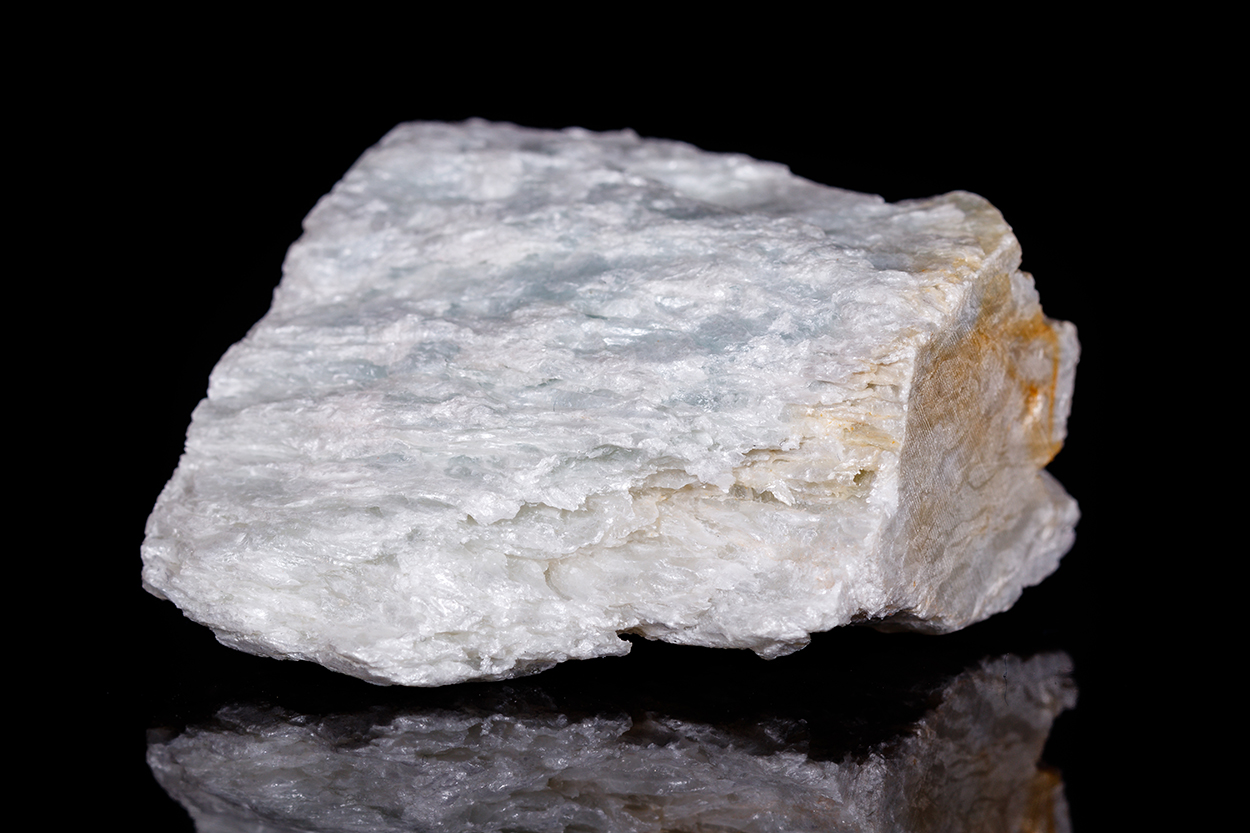
    Talcum powder is made from talc, a mineral made up mainly of the element’s magnesium, silicon, and oxygen. As a powder, it absorbs moisture well and helps cut down on friction, making it useful for keeping skin dry and helping to prevent rashes. In its natural form, some talc contains asbestos, a substance known to cause cancers in and around the lungs when inhaled. 
Researchers use two main types of studies to try to figure out if a substance or its exposure causes cancer: lab studies and studies in people. In most cases neither type of study provides enough evidence on its own, so researchers usually look at both lab-based and human studies when trying to figure out if something causes cancer. It has been suggested that talcum powder might cause cancer in the ovaries if the powder particles were to travel through the vagina, uterus, and fallopian tubes to the ovary. One of the problems with studying this issue is that ovarian cancer isn’t common. 
    Correspondingly, even the largest studies done so far might not have been big enough to detect a very small increase in risk, if it exists. No increased risk of lung cancer has been reported with the use of cosmetic talcum powder. One study suggested genital talcum powder use may slightly increase the risk of endometrial (uterine) cancer in women who are past menopause. But other studies have not found such a link, therefore further studies are needed to explore this topic. Several national and international agencies study substances in the environment to determine if they can cause cancer. The International Agency for Research on Cancer (IARC) classifies the perineal (genital) use of talc-based body powder as “possibly carcinogenic to humans” based on limited evidence from human studies. The U.S. National Toxicology Program (NTP) has not fully reviewed talc (with or without asbestos) as a possible carcinogen. In the end, there is very little evidence at this time that any other forms of cancer are linked with consumer use of talcum powder. Until more information is available, people concerned about using talcum powder may want to avoid or limit their use of consumer products that contain it. 
    A series of decisions made in multiple courts across the country have gone against Johnson & Johnson in the talcum powder litigation. Most recently, on August 5th, 2020, a New Jersey state appeals court reinstated lawsuits dismissed four years ago that claimed Johnson & Johnson’s talcum powder products caused ovarian cancer. The lawsuits were revived after the New Jersey court determined that the plaintiffs’ experts’ opinions should not have been dismissed. In reversing the lower court’s 2016 decision, the appellate court found that Judge Nelson improperly assessed the experts’ credibility and did not scrutinize the methodologies underlying their conclusions that talc exposure can lead to ovarian cancer. This reversal reinstated hundreds of ovarian cancer cases against Johnson & Johnson in the Atlantic County Superior Court in New Jersey. In the past few years, numerous juries concluded that Johnson & Johnson’s talcum powder products caused ovarian cancer and issued multi-million and even multi-billion-dollar verdicts. 
    In April 2020, a New Jersey jury charged Johnson & Johnson with a $750 million verdict in punitive damages alleging their Baby Powder caused mesothelioma in four individuals. In September 2019, a jury in New Jersey awarded over $37 million in damages to four individuals who claimed they developed mesothelioma after being exposed to asbestos-contaminated Johnson & Johnson products. The Missouri Court of Appeals issued a verdict in July of 2018 ordering Johnson & Johnson to pay $4.69 billion, which was ultimately reduced to $2.1 billion in June 2020. The verdict noted that Johnson & Johnson’s talcum powder caused cancer in 22 women, and that the corporation failed to properly warn consumers of the potential negative effects of using talc. In April 2018, a New Jersey jury awarded a verdict totaling $117 million to an individual who claimed using Johnson & Johnson’s Baby Powder and Shower to Shower products caused his mesothelioma.

Johnson & Johnson’s Baby Powder and Shower to Shower product


In August 2017, a plaintiff was awarded $417 million by a California jury after claiming her use of Johnson & Johnson products for decades caused her ovarian cancer. In May 2017, a jury in Missouri awarded an individual $110 million in both compensatory and punitive damages. In October 2016, a Missouri jury awarded an individual $70 million in damages after she developed ovarian cancer from using Johnson & Johnson’s talc powder. In one of the first ovarian cancer verdicts against Johnson & Johnson back in February 2016, a Missouri jury awarded a late plaintiff’s family $72 million after the plaintiff passed away from cancer she claimed she developed after using their talc powder. After decades of Johnson & Johnson falsely misleading consumers and the FDA about the impact of asbestos-contaminated talc on public health, thousands of affected consumers are seeking justice after developing cancer.

Stakeholders
    Johnson & Johnson holds their relationships with its stakeholders very highly. By being attentive and responsive to stakeholders, Johnson & Johnson can gain new insight that may advance business planning. This is achieved by listening to stakeholder feedback in areas they believe need improvement in, and by building trust with them through these interactive relationships. Johnson & Johnson engages with their stakeholders on a global, regional and local level to understand their expectations and how the company’s activities impact them. Some of their global, regional and local stakeholders include the Advanced Medical Technology Association, Consumer Healthcare Products Association, National Health Council (U.S.), and U.S. Chamber of Commerce. Johnson & Johnson also deploys a customer relationship management system to support consistency and visibility of engagement initiatives. The Food and Drug Administration (FDA) are also stakeholders in the talcum-powder recall. They are a part of the company’s ongoing testing and investigation to ensure their products are continuing to be safe for consumers. Individualism
    Individualism is a business ethics theory that values the business, the owner’s choices, and business profits. This theory was created by Nobel-Prize winning economists Milton Friedman. Friedman states that “it is the aim and the responsibility of businesses to maximize their profits” (Salazar 17). In other words, owners of a business have an ethical responsibility to design business actions that maximize profits for the business but do so within the law.
    An individualist would say that Johnson & Johnson did not maximize profits for the business within the law. They failed to inform the public and their stakeholders about the scientific findings of their baby powder, which resulted in the company losing a lot of money through lawsuits. The global recalls damaged the future of the product line. The negative publicity of the company also added a long-term damage on the brand. Therefore, it will be difficult for the owners of the company to recover financially. However, an individualist would not consider Johnson & Johnson’s actions as ethically wrong. The company replaced their talcum-based powder with cornstarch-based powder which will help them carry on with sales. The government on the other hand has the ethical responsibility to confirm a products safety. There are associations put in place that are supposed to enforce these safety standards before a product is placed on the market. Thus, an individualist cannot place this “blame” on Johnson & Johnson. Utilitarianism
    Utilitarianism is another business ethics theory which values happiness of all conscious beings with the absence of pain. This theory was created by Jeremy Bentham in the 1800’s but was popularized by John Stewart Mill. Mill states that “they measure the costs and benefits of various actions and principles not just for their impact on one individual or one company, but rather for all beings who are affected by the actions proposed or taken” (Salazar 19). With that being said, owners of a business have an ethical obligation to design business actions that aim to maximize the happiness for all conscious beings in the long run.
    A Utilitarian would say that Johnson & Johnson is unethical because of the consequences of their mistakes. They knew that talcum caused cancer and posed as a risk to the consumers, but they continued to sell the product anyways. Despite having this knowledge, they acquired many lawsuits against them and caused cancer in more than twenty-two women. Some of the women died from ovarian cancer after using Johnson & Johnson’s baby powder. Thus, going against the utilitarianism’s view that businesses should maximize happiness of all conscious beings with the absence of pain. At the time, Johnson & Johnson was only thinking about the happiness of the owners of the company. Correspondingly, their decision to replace the talcum-based powder was purely for their own capital gain. In the hope that the new Johnson & Johnson baby powder puts an end to the lawsuits and deaths, their initial actions were unethical and morally wrong. 
Kantianism
    Kantianism is the most popular business ethics theory that values rational decision-making, autonomy of individuals, honesty and freedom. This theory originated in the late 18th century by Immanuel Kant. Kant is concerned with “the moral permissibility of the action and the moral worth in the motivation of the action. In this case, an action is rational and permissible if it meets certain standards (Categorical Imperative) which reflect respect for the autonomy and rationality of all people. The most important aspect of the Categorical Imperative is the “formulation of humanity.” This states that “it is wrong to use people as a mere means to get what you want. It disregards their rationality and freedom and usually it involves an attempt to manipulate them” (Salazar 22). In the end, the owners of a business should always act in ways that respect individuals and their choices. They must do so without lying, cheating, manipulating, or harming individuals. 
    A Kantian would view Johnson & Johnson as unethical because they manipulated their consumers for many years. They failed to tell the public that their baby powder contained talc. What’s worse is that they kept the public misinformed by sealing all evidence that proved this was true. By selling their talcum-based powder without proper safety protocol, they were evidently implementing bad will. Johnson & Johnson had the wrong intentions which led them to treat consumers as a mere means in order to obtain a profit. Again, illustrating Johnson & Johnson as acting wrongly and disregarding consumers rationality. Granted that they removed talcum-based powder from the market, they only did so for the benefit of their stakeholders not for their consumers. They are hoping that consumers trust that the new powder is safe to use despite the hesitance to believe in the brand again. 
Virtue Theory
    Virtue theory is a business ethics theory that differs from the previous three theories. The virtue theory values character traits that promote wellness or flourishing of individuals within a society. This theory was developed by the Ancient Greek philosopher, Aristotle. Aristotle says that in order to know whether a person is fulfilling his purpose and potential, we need to know exactly what they are. Thus, owners of a business have the ethical responsibility to “act so as to embody a variety of virtuous or good character traits and so as to avoid vicious or bad character traits” (Salazar 23). 
    Under the virtue theory, Johnson & Johnson is considered unethical because they exhibited many bad character traits. First, the company was dishonest with their consumers when cases of ovarian cancer rose. Again, they kept information regarding testing of the baby powder in an attempt to increase profit. This follows the second bad character trait that Johnson & Johnson showed which was greed. The company hid these documents regarding testing during several of their trials in order to win the cases. Illustrating that all they care about is maximizing profits so that owners and stakeholders can benefit as well. Proving that they do not care about the safety and health of their consumers. Finally, Johnson & Johnson acted very selfishly when they released the cornstarch-based powder so that sales can continue and the investigation into talcum-based powder can stop. Overall, Johnson & Johnson is not a virtuous company and does not aid flourishing of individuals within society. 
Justified Ethics Evaluation
    In my opinion, Johnson & Johnson acted very unprofessionally and unethically. In order to avoid this situation, the company should have had their baby powder tested by the FDA right away. Johnson & Johnson also should have taken their talcum-based baby powder off the market as soon as their first consumer sued them. If they knew talcum could possibly cause ovarian cancer, then warning labels should have been added to the bottles as well. Instead, Johnson & Johnson ignored the safety protocol and only cared about making a profit. Knowing this, the FDA should have been more involved and customer safety should have been their top priority as they claimed it to be. 
    Once Johnson & Johnson started to develop negative publicity, they unethically continued to withhold information from the public. They continuously stated that their baby powder was safe to use even though the number of consumers claiming they were diagnosed with cancer increased. It ultimately made it tough for Johnson & Johnson to defend their company virtues and morality. By replacing their talcum-based powder, it only proved that they were trying to cover up their mistake of putting their consumers safety at risk. In the end, their unethical business actions costed lives and made them untrustworthy all because they focused more on their own self-interest. 
Company Action Plan
    Due to their mistakes, Johnson & Johnson’s talcum-based baby powder is too expensive to sell in the U.S. Not only did their actions cost them business partners, but also uncertainty for the future of the business. As I had previously stated, Johnson & Johnson should have first had the FDA approve the product before selling on the market. Next, they should have put warning labels on the baby powder bottles stating that talcum is an ingredient that may cause ovarian cancer. With that being said, Johnson & Johnson could have resolved the issue right away by selling cornstarch-based baby powder in the first place. In doing so, they could have avoided the negative publicity and the overall uncertainty of their products. 
    Johnson & Johnson’s current mission statement is “our credo stems from a belief that consumers, employees and the community are all equally important” (Johnson & Johnson). On the contrary, this mission statement is questionable due to their on-going controversy. Thus, a new mission statement is needed to ensure that they actually value the safety and future of their customers, employees and community. I propose that their new mission statement be “our credo stems from a belief that the safety and health of all consumers, employees and the community be our top priority built on honesty, compassion, and integrity.” This mission statement focuses on three points that lets the public know they are taking this issue seriously out of concern for their consumers and not just the profit they hope to gain back. In order to do so, Johnson & Johnson should market themselves as such. 

Values:
· Honesty - in a company is as valuable as honesty in a person. It is important to be able to have trust and respect in a company that you deal with. It creates a positive atmosphere for all.
· Compassion - we understand what others are going through, we empathize with them, and we show them that we love and care for them. We selflessly want to do things to help them.
· Integrity - We uphold the highest standards of integrity in all of our actions. It promotes a professional culture in which individuals can depend on one another and treat each other with respect. We have no tolerance for politics, hidden agendas or passive-aggressive behavior.
· Customer Safety - Every effort will be made to ensure the safety of our Customers and team members. If an unsafe condition is noticed it is each and every team member’s responsibility to see it is resolved. We strive to exceed the expectations of our customers by anticipating, understanding and responding appropriately to their needs.

    When a company states their mission and values, they need to not only state it but also prove that they will implement these changes. As one might say, actions speak louder than words. Therefore, Johnson & Johnson must put new systems in place to ensure their company will grow again. First, they should be in constant contact with the FDA ensuring that their products do not contain any ingredients that may cause another issue. Second, they need to hire someone who will monitor this communication with the FDA. Almost like a “checks and balances” type of system to oversee product safety. Lastly, they should implement a department that effectively collects data and suggestions from consumers or stakeholders. This is another way to ensure that everyone has a voice and place in the decisions of product safety. With these new policies, hiring of new employees will help the company flourish.
    All things considered, Johnson & Johnson should look into remarketing their products due to the ethical difficulty they faced. This can be done through creating a new logo or new bottles the products are sold in. Although this may cost a lot, my plan will promote business profits and productivity. By implementing a new mission statement, values, policies, and marketing, Johnson & Johnson can reinstate their brand and ensure good ethics. Again, proving that their actions speak louder than words.


Magen L.

References

Copland, James R. “Opinion | Johnson & Johnson Takes a Powder.” The Wall Street Journal, Dow Jones & Company, 22 May 2020, www.wsj.com/articles/johnson-johnson-takes-a-

John. “Johnson & Johnson Mission Statement 2020: Johnson & Johnson Mission & Vision Analysis.” Mission Statement Academy, 11 June 2020, mission-statement.com/johnson-johnson/. 

“Johnson & Johnson Position on Stakeholder Engagement.” 2020. PDF File.

https://www.jnj.com/about-jnj/policies-and-positions/our-position-on-stakeholder-engagement

“Johnson & Johnson Talcum Powder Litigation Continues to Grow.” Sullivan Papain Block McGrath Coffinas & Cannavo, P.C.www.triallaw1.com/johnson-johnson-talcum-powder-litigation-continues-to-grow/. 

Loftus, Peter. “Missouri Court Cuts Talc-Powder Verdict Against J&J to $2.1 Billion.” The Wall Street Journal, Dow Jones & Company, 23 June 2020, www.wsj.com/articles/issouri-court-cuts-talc-powder-verdict-against-j-j-11592935876. 

Rabin, Roni Caryn, and Tiffany Hsu. “Johnson & Johnson Feared Baby Powder’s Possible Asbestos Link for Years.” The New York Times, The New York Times, 15 Dec. 2018, www.nytimes.com/2018/12/14/business/baby-powder-asbestos-johnson-johnson.html?searchResultPosition=3. 

Salazar, Heather. The Business Ethics Case Manual. n.d. 

“Talcum Powder and Cancer.” American Cancer Societywww.cancer.org/cancer/cancer-causes/talcum-powder-and-cancer.html.