Showing posts with label stakeholders. Show all posts

Friday, December 2, 2022

Meta: Mega Layoffs at Meta (2022)

One of 11,000 laid off employees


Abstract


Meta is a company that was originally founded by Mark Zuckerberg in February 2004. Initially known as Facebook, it was a social media site where people could gather online in one place to connect with friends and family, meet new people, join neighborhood groups, and share whatever they felt like sharing. The social media world was still somewhat new in 2004 but over the next decade it grew immensely with Facebook leading the way and buying out any competitor that threatened their position. In 2012, Facebook filed an IPO (Initial Public Offering) and joined the stock market with their initial value being assessed at 104 billion dollars. Over the years Facebook bought Instagram, and Whatsapp among other buyouts further solidifying their place as one of the world's most valuable companies. In March 2020 when the Covid global pandemic hit, Facebook had 48,268 employees. With a pandemic forcing millions of people to be online more, Mark Zuckerberg saw that as an opportunity for growth and he went all in. In October, 2021 Facebook was receiving 97.5% of its revenue from advertising and in that same month Zuckerberg decided to rebrand. Meta was the new name and now the parent company of Facebook, Instagram, Whatsapp, etc. By September 2022, Meta had now employed 87,314 and surely a genius such as Zuckerberg prioritized his employees and put the health/happiness of his staff, and the privacy of his online user base ahead of any personal gain or success of his company. Or did he?


Ethics Case Controversy

Facebook was known as one of the Big 5 of American IT companies along with Alphabet, Amazon, Apple, and Microsoft. Zuckerberg was cruising along from the time he created the company in 2004 until the start of the pandemic. There were some controversies regarding Facebook and the 2016 presidential election that will be addressed later, but for the most part Facebook was thriving and Zuckerberg was loving every minute of it. When the pandemic hit and millions of people spent more time at home and online using Facebook, Netflix, TikTok, etc there was a huge influx of advertising money because the usage on these platforms skyrocketed. Mark Zuckerberg in his layoff letter to employees said "Many people predicted this would be a permanent acceleration that would continue even after the pandemic ended. I did too, so I made the decision to significantly increase our investments.” (LayoffLetter) He later goes on to admit that he was wrong and takes ownership, but one has to wonder if this potential huge layoff wasn’t a fall back he was planning on. The pandemic was terrible and millions died but I don’t think anyone thought that the pandemic was going to last forever. Even at the height of the pandemic there were tons of people still denying its seriousness and wanting it to end. How then, did Mark Zuckerberg and a team he likely pays very well get this prediction so wrong. Did they really assume that online usage would remain as high during the pandemic as when it was over? Or did the company know they had to hire and sell quickly to take advantage of the increase during the pandemic and never worried or cared that at some point in the future they’d have to lay off a large percentage of their staff. 


The pandemic alone can’t be fully to blame for Meta having to lay off 13,000 or 13% of its workforce. The rebranding to Meta at the same time Facebook was seeing record profits also should be called into question. In October, 2021 Zuckerberg came out saying he was rebranding and created Meta which stood for the metaverse. He saw this as the future of social media but why now, when the company was so successful did he make this change. Two months prior, an ex-product manager at Facebook Frances Haugen became a whistleblower against Facebook. She produced tons of evidence and testified before the SEC (securities exchange commission) and the US Congress, and on 60 Minutes with information showing how unethical and shady Facebook and Zuckerberg had been. “The documents paint a picture of a company that is often aware of the harms to which it contributes—but is either unwilling or unable to act against them.” (Time) She showed evidence of how Facebook knew they were spreading misinformation throughout the 2016 election, misinformation throughout a deadly pandemic, and the mental health effects of Instagram usage for teens, among others. She also said how Facebook was lying to shareholders about the value and direction of the company. She made the claim and had evidence to support it that Facebook put profit over safety and that they willingly ignored the dangers of their platform in order to make money. Facebook came out and denied her reports saying that they spend five billion every year keeping their platforms safe. Eight other whistleblowers came out after Haugen did against Facebook. Facebook stock fell after these reports but within two months Zuckerberg “rebranded” but was that just a way to change names and hide behind the guilt that Haugen had already laid out. 

Another huge controversy that further declined Meta’s profits in 2022 was the reports that Meta had provided personal data information to a group of hackers posing as Law Enforcement. In March 2022 it was reported that hackers compromised emails of police and sent “emergency data requests” to Meta for users' home addresses, phone numbers, IP addresses and other subscriber information. This is troublesome if you’re a user of the platform because you trust a company like Meta to protect your information. “Facebook has been scrutinized for its handling of user data for years following reports that Cambridge Analytics obtained data on tens of millions of the platform’s users.” (Bloomberg) This is another example like Haugen said above where Meta puts profit over privacy.


Stakeholders


The main stakeholders within Meta are its individual users, its shareholders, employees both current and terminated, and its advertisers. According to Bloomberg as of October 2022, there are currently 3.71 billion users across all of Meta’s platforms. That’s a lot of personal data information that people trust Meta to protect. Shareholders are people that own shares of a company and buy into the company hoping to make money. Vanguard, Fidelity etc are large shareholders of Meta and likely if you have a retirement account you are also a shareholder of Meta since it's been a huge successful company for so long. At the end of September before laying off 11,000 Meta employed 87,314. This number would include Mark Zuckerberg himself but not ex-employees like whistleblower Frances Haugen and countless others. It is estimated that Meta has over three million advertisers that pay for ads across Meta’s platforms. It’s easy to see that a company like Meta has lots of stakeholders that trust Zuckerberg to lead both a  successful and ethical company. 


Individualism

According to economist Milton Friedman “the only goal of a business is to profit, so the only obligation that the business person has is to maximize profit for the owner or the stockholders within the law or the rules of the game.” (Salazar_Slides) He fully believed in a free market and capitalistic society where companies can make as much money as they want even when they don’t value their employees, or value their customers' privacy. Individualism prioritizes the profit of the owner and stockholders ahead of what could be morally right like creating a safe work environment. During the Covid pandemic, Mark Zuckerberg took a chance that social media use would remain high and advertising dollars would keep coming in. In a span of 2.5 years from 3/20 until 9/22 he increased his staff working at Meta by 80%. Meta hired more people to maximize his profit and the profit of his company. According to Yahoo Finance, each share of Facebook stock on 3/4/2020 was worth $163.90 and by 9/6/2021 it was worth $375.88. That is an increase per share of almost 130%. Safe to say that Zuckerberg and the shareholders profited a lot from his decision to double down on the pandemic. Zuckerberg took a risk knowing full well that the jobs he promised people might not last, but he needed their commitment to Meta in order for the company to make this huge profit. He swung big and missed though since the advertising dollars stopped rolling in after the pandemic both due to reduced online usage, competition from other social media sites, and negative publicity from ex employees like Haugen. By 10/31/2022 each share was now only worth $98.22 and within weeks is when Meta laid off 11,000 workers. What Zuckerberg did doesn’t violate any laws and he prioritized his own profit and the profit of his shareholders ahead of the jobs his employees depended on. An Individualist like Friedman would be ok with Zuckerberg laying off any amount he needed at Meta as long as it kept profits rolling in. 


Share price of Meta 3/2020 through 12/2022

Utilitarianism


    Utilitarianism is a theory that allows for actions that maximize the most happiness in yourself and others. “Happiness or pleasure are the only things of intrinsic value” (Salazar_Slides) Utilitarianism believes that you should always tell the truth even if it doesn’t create happiness and that lying is morally impermissible. Trying to figure out if each Meta stakeholder's happiness was maximized in Zuckerberg’s decision to lay off 11,000 is a hard one to determine. It’s been shown that Meta has over 3 billion stakeholders but not each person was affected in the same way with the layoffs. Firstly you’d assume that the 11,000 that were laid off and their families were affected the worst in that they lost their job and source of income and who knows how long it could take them to get employment equal to what they had. In their declining profit and news of layoffs millions of shareholders saw the money they had invested in Meta drop as the share price dropped so they would be unhappy with the layoff decision.  Utilitarianism would likely be ok with sacrificing the happiness of the 11,000 that lost their jobs and the profit loss for the shareholders that invested because laying off those workers could be needed for the future success of Meta. Utilitarianism would see that there are 3.71 billion users across Meta platforms that use social media which makes them happy. Online users' short term happiness isn’t as profound as losing your job. Since there are significantly more people receiving happiness from Meta’s platforms than those that lost their jobs, a Utilitarianist would see the layoff decision as a good one since it allowed for the most people to be happy. 


Kantianism

Meta’s layoff passed the Utilitarianism theory but it definitely does not pass the Kantianism theory. According to Kants, there is only one right motivation to do something and that’s because it is simply the right thing to do. Obviously laying off 11,000 workers 6 weeks before Christmas is not the right thing to do, especially when you’re still a multi-billion dollar company. Kant defined morality using three Categorical Imperatives which are laws of rationality or logic. One of these imperatives is Humanity which means that we should always be fair and respectful and never treat people as a means to get something. Zuckerberg hired thousands of people likely knowing full well that social media usage wouldn’t remain as high as it was during the pandemic. He treated these people as a means to bring him more money knowing full well he would lay them off the minute they didn’t bring him value. Another problem that Kantians would find with Meta and Zuckerberg is that everything he did was motivated by self-interest. Hiring people, laying off people, selling personal data was all motivated by how it would impact his profit. Universal Law says that “you can act for that reason while at the same time willing that it be a universal law that everyone adopts that reason for acting.” (Salazar) Meta didn’t pass the universal law since their reason for acting was for profit and society would say the same for any other company that valued profits over people. 


Virtue Theory

CEO-Mark Zuckerberg


In looking at virtue theory Mark Zuckerberg would be the person to focus on as he is the CEO of Meta and all decisions are made and approved by him including the one to layoff 11,000 employees. There are four major virtues consisting of courage, temperance, justice, and honesty and does Zuckerberg appease these virtues in his daily role as CEO. Courage virtue consists of taking risks and having the courage to take a stand for the right ideas. Zuckerberg definitely took big risks as CEO of Meta in thinking that online usage would remain high, he thought it would continue so he hired tons of people, he spent money on new programs and invested further in the metaverse. Zuckerberg wouldn’t be as successful as he is without taking risks and he did stand up to the ideas he had that he thought would succeed so therefore he passes the Courage virtue. The temperance virtue is one that forces self control and It holds us accountable for our work and actions. Temperance slows things down and allows you to look at the bigger picture beyond what might be happening today. Zuckerberg wouldn’t pass the temperance virtue because he showed no real self control in jumping to hire thousands during the pandemic. If he had thought long term he would have seen that it was more likely online usage would drop as the pandemic went away. He could have predicted a future where those hired employees weren’t needed if he had shown some self-control instead of only seeing dollar signs early in the pandemic. Justice theory speaks for itself, were you a leader that was just and fair in your treatment of people. Did you work hard and were you honest and in this virtue Zuckerberg failed. As a CEO and leader if you make the wrong decisions and hire thousands of people only to lay them off a couple years later then that is not just. As the CEO Zuckerberg needs to take the blame for getting his prediction so wrong. Finally the fourth virtue is Honesty and was Zuckerberg honest in his treatment and hiring of employees and his treatment of customers and other companies he dealt with. Zuckerberg failed this virtue also since he hired people only for personal profit as I believe he knew this usage increase was going to be short term. He also wasn’t honest in what he did with customers' personal information in giving it to hackers.  


Justified Ethics Evaluation


In my opinion Mark Zuckerberg has failed in many ways ethically in protecting his employees right to work, his customers right to privacy, his platforms right to view honest and trustworthy material. Meta is a billion dollar company that should be held to a higher standard when it comes to being honest and fair and treating people with respect. I believe that Mark Zuckerberg knew that the pandemic wasn’t going to last forever and he hired thousands of people with the promise of good stable jobs. He used those people for 2.5 years for his own personal profit before laying off 11,000 of them. The fall of 2021 whistleblowers came out against Facebook and Zuckerberg with evidence as to the wrongdoings of the company. Just two months after these reports came out, Zuckerberg thought that by “rebranding” it would give him a fresh start. He wanted to ignore the problems the company had instead of facing them head on and dealing with them. After rebranding in the fall of 2021 to Meta the company continued to lose money. They saw a huge reduction in advertising money throughout 2022 due to the pandemic slowly ending. Meta also lost public faith when in March of 2022 it was found that they had given users personal data information to hackers. Meta lost money throughout 2022 until in November when Zuckerberg announced he was laying off 11,000 workers. While he did take blame for being wrong in predicting online usage would continue I think he was wrong in blaming competitors like Tik Tok or the fact that Apple was charging them more. Meta has a lot of internal problems and until Zuckerberg can take ownership of the many faults they have instead of blaming it on other things I believe we can expect more layoffs in their future. One of the biggest ethical problems I have with his decision to lay off is that “in 2020, Facebook, Inc. spent $19.7 million on lobbying, hiring 79 lobbyists. Facebook was the largest spender of lobbying money among the 5 Big Tech companies in 2020.” (Bloomberg) If they are spending that much on wasteful lobbying they could have figured out a way to not lay off 11,000 hard workers 6 weeks before Christmas.


Conclusion


In conclusion Zuckerberg is one of the richest and powerful business minds of mine and likely most generations. He surrounds himself with some of the smartest people to maintain a company that almost 4 billion users rely on. I can’t talk to the complexities of how hard it must be for Mark Zuckerberg. I can however talk to the basic decencies of human interactions and treating people. Never should a person's well-being be second to your personal profit. Never should false information or science denying platforms be openly shared so easily that can hurt real people. Never should personal information be sold because it can make someone a profit. Zuckerberg might think the metaverse is the future of social media, but before we get there he has a responsibility to be moral and just and honest and truthful to all of Meta’s stakeholders, today, tomorrow, and in the metaverse. 


Facebook-Meta Timeline
Major events from the creation of Facebook to their rebranding to META to their layoff of 11,000

2/2004 MARK ZUCKERBERG FOUNDED FACEBOOK

1/2012 FACEBOOK FILED IPO, COMPANY VALUED AT 104 BILLION

2/2012 FACEBOOK BOUGHT WHATSAPP FOR 19 BILLION

3/2012 FACEBOOK BOUGHT OCULUS VR FOR 2.3 BILLION

4/2012 FACEBOOK BOUGHT INSTAGRAM FOR 1 BILLION

3/2020 COVID PANDEMIC BEGINS - CURRENT EMPLOYEES 48,268

10/2021 FACEBOOK RECEIVES 97.5% REVENUE FROM ADVERTISING

10/2021 FACEBOOK NAME CHANGE TO META PLATFORMS, INC.

2/2022 META REPORTS BIG DECLINE IN PROFITS FROM Q4

2/2022 META LOSES 230 BILLION IN MARKET VALUE

3/2022 NEWS REPORTS META GAVE PERSONAL DATA TO HACKERS

6/2022 COO OF 14 YEARS ANNOUNCED SHE’S LEAVING META

7/2022 FIRST EVER REPORTED YEARLY REVENUE DECLINE BY 1%

9/2022 META EMPLOYS 87,314, UP 80% SINCE PANDEMIC BEGAN

11/2022 META LAYS OFF 11,000 OR 13% OF ITS WORKFORCE


Jake Harrison


Works Cited

Frenkel, Sheera, et al. “Meta Lays off More than 11,000 Employees.” The New York Times, The New York Times, 9 Nov. 2022, https://www.nytimes.com/2022/11/09/technology/meta-layoffs-facebook.html.

“Mark Zuckerberg's Message to Meta Employees.” Meta, 9 Nov. 2022, https://about.fb.com/news/2022/11/mark-zuckerberg-layoff-message-to-employees/. 

Perrigo, Billy. “Why Whistleblower Frances Haugen Decided to Take on Facebook.” Time, Time, 22 Nov. 2021, https://time.com/6121931/frances-haugen-facebook-whistleblower-profile/. 

Person, and Katie Paul. “Exclusive: Meta Slashes Hiring Plans, Girds for 'Fierce' Headwinds.” Reuters, Thomson Reuters, 1 July 2022, https://www.reuters.com/technology/exclusive-meta-girds-fierce-headwinds-slower-growth-second-half-memo-2022-06-30/. 

Turton, William. “Apple, Meta Gave User Data to Hackers with Forged Legal Requests (AAPL, FB).” Bloomberg.com, Bloomberg, 30 Mar. 2022, https://www.bloomberg.com/news/articles/2022-03-30/apple-meta-gave-user-data-to-hackers-who-forged-legal-requests. 

Wagner, Kurt. “Meta Freezes Hiring, Cuts Headcount, Slashes Budgets across Teams.” Bloomberg.com, Bloomberg, 29 Sept. 2022, https://www.bloomberg.com/news/articles/2022-09-29/meta-announces-hiring-freeze-warns-employees-of-restructuring?srnd=premium#xj4y7vzkg.


Thursday, May 5, 2022

Mercury in Amazon Face Products

Amazon: Dangerous Levels of Mercury Found in Skin Creams Sold on Amazon (April 2019)

Case Controversy

Often referred to as “quicksilver”, Mercury is a shiny, silvery, liquid metal that is placed on the periodic table as Hg. It is often used to make mirrors, fluorescent lights, thermometers, batteries, dental amalgams and some medicines. This metal provides us the ability to create such products. Unfortunately, after extensive research, mercury was determined to be highly toxic to people. This dangerous metal was not built to sustain in human bodies. Some people are exposed to low levels of mercury due to chronic exposure. This is when people are exposed to mercury vapors on a daily basis, often factory employees that use mercury for their manufacturing. But when the human body is exposed to high levels, mercury will start attacking the central and peripheral systems. An ambassador from the World Health Organization stated, “Symptoms include tremors, insomnia, memory loss, neuromuscular effects, headaches and cognitive and motor dysfunction. Mild, subclinical signs of central nervous system toxicity can be seen in workers exposed to an elemental mercury level in the air of 20 μg/m3 or more for several years” When mercury enters our bloodstream, it affects our entire body. Lungs, kidneys, digestive and nervous systems are all compromised. Studies have even shown that mercury exposure can cause neurological and behavioral disorders. 

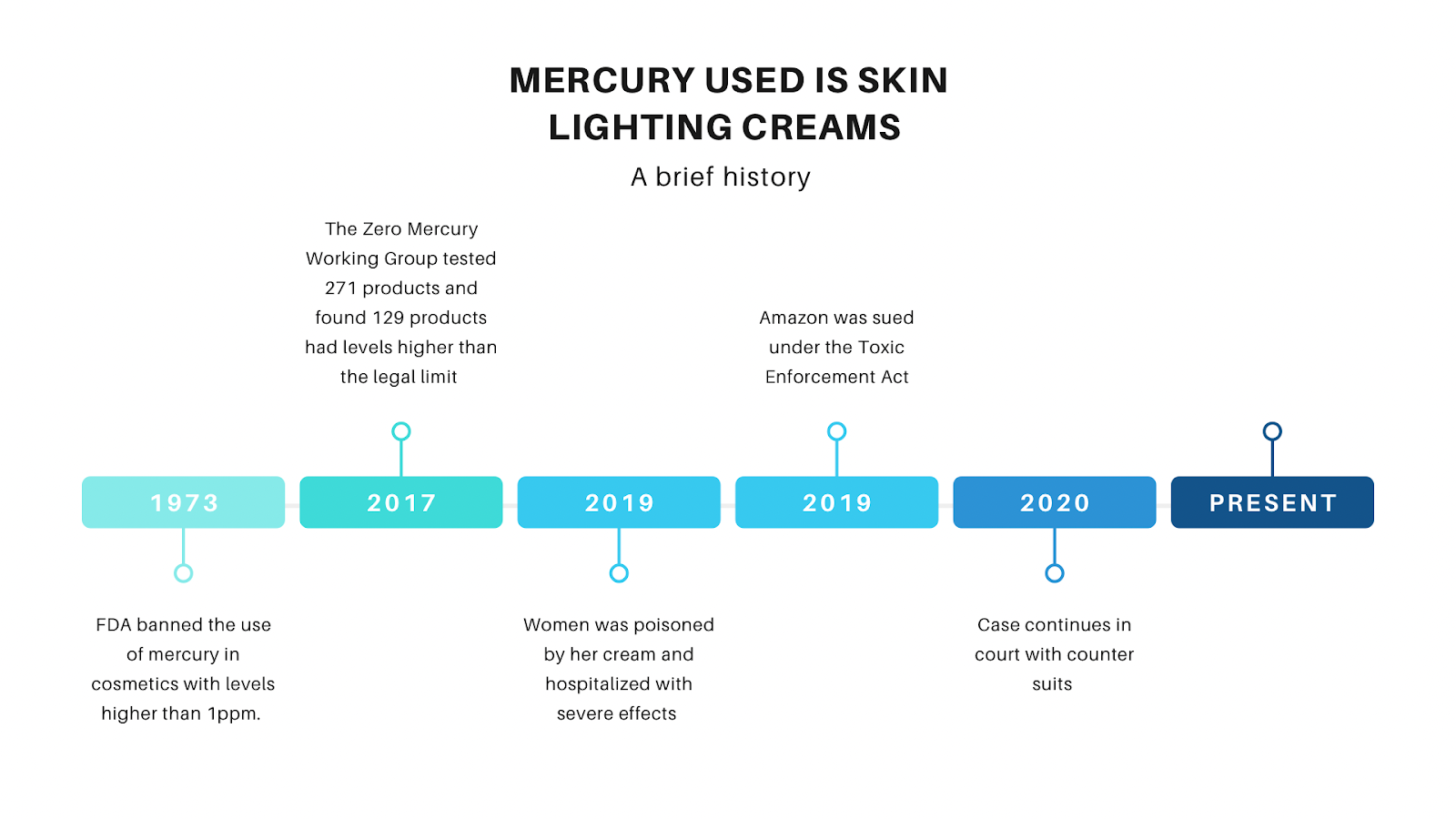
Although this metal is extremely dangerous to us, people continue to use mercury in new products such as cosmetics. Skin lightening creams contain doses of mercury that essentially helps hide blemishes but as a result can cause serious damages. These creams are used as anti aging creams that remove dark aging spots, wrinkles, freckles and blemishes. In 1973, the Food and Drug Administration banned the use of mercury in cosmetics that contain levels higher than 1 ppm (Parts Per Million). To help contain smuggling, the FDA also created an Import Alert. This was a program that legally allowed FDA agents to detain all skin lightening creams with mercury. This protocol was put in place due to the fact that forgien countries such as, Dominican Republic, Mexico, Lebanon, Pakistan, and Thailand have a history of selling creams with levels of mercury that exceeds 1 ppm. The Zero Mercury Working Group (ZMWG) is an organization that tested 271 products. These products came from over 15 countries and the results were shocking. More than half the products contain mercury levels exceeding the legal limit. Michael Bender, international coordinator with the Mercury Policy Project expressed his thoughts, “It’s really concerning that these online manufacturers continue to sell and flaunt and profit from illegal products that are doing significant damage to consumers''. As the ZMWG continued to test these products, they detected that some of the products had levels of 65,000 ppm. The legal limit is no higher than 1 ppm. “We’re not finding 1ppm, we're finding products that are hundreds or thousands or tens of thousands of times above 1ppm, '' Michael Bender said. “These levels are astronomical.” 

 In July of 2019, a 47 year old woman was poisoned by her skin lightening cream and fell into a coma. Her family stated that she used a cream imported from Mexico by the name of Pond’s Rejuveness. Twice a day, she applied the product to her face for seven long years. This woman started to feel the effects, complaining of arm weakness and odd pricking sensation. Two weeks later, she went back to the hospital with blurred vision and slurred speech. She was admitted into the University of California San Francisco Hospital. Her condition rapidly declined until the doctors declared her to be in a comatose. Their test results indicated high levels of mercury that was then later connected to her cream. Officials tested her cream quickly and found the culprit. Her skin lightening cream contained 12,000 ppm of mercury. This woman was quickly placed on twenty-four hour supervision and treatments of chelation to help flush out the metal from her system. “Central nervous system toxicity, as in this case, is the hallmark of organic mercury. It typically comes on after weeks to months of exposure. Once manifested, it quickly progresses and often worsens, despite removal of any further exposure. The patient was unable to speak or care for herself, relying on a feeding tube for nutrition”, Dr Paul Blanc of San Francisco Hospital stated. 

After the ZMGW tested thousands of products and determined them to be illegal, companies began to pull those products off their shelves. Companies such as Amazon, is a huge brand where people can sell their products on Amazon’s platform. Amazon claimed to have pulled those illegal products off their website and installed proactive measures to prevent suspicious products from being listed. But still, officials found certain products still on the inventory of Amazon. “The companies are evading responsibility, '' Bender said.

“They knowingly profit from the illegal trade of highly toxic products,” he stated. On April 17, 2019 Amazon was sued under the Toxic Enforcement Act. This lawsuit claims that Amazon had exposed customers to mercury with the knowledge of these products being filed as illegal. The lawsuit also claims that Amazon allowed these skin lightening creams to be sold on their websites without any of the required warnings. These consumers legally have the right to read the warning of mercury exposure before buying the product. Andrew Behar, CEO of As You Sow stated, “Amazon has effectively created a black market where products are being sold without full compliance with U.S. laws. By actively recruiting individuals and companies from all over the world to place products on the Amazon marketplace, without ensuring those products are safe and lawful, Amazon’s business model allows sellers to avoid critical health and safety compliance. It is not acceptable for Amazon to expose hundreds of millions of consumers to health and safety risks.” In response to such claims, Amazon responded back saying “Third-party vendors who use its site are responsible for the product’s safety, because Amazon and similar companies merely provide a platform”. To summarize, Amazon feels that they don't have the responsibility of the consumers safety. The case went to the California Court of Appeals and ruled that Amazon and all other companies must warn their consumers when they or a third party is selling mercury contaminated products. Unfortunately this ruling only applies to the state of California, but this is the first step into making a difference.  

Stakeholder

The stakeholders in this case are the consumers, cosmetics manufacturers, and public health agency staff. As for the consumers, they are the ones that are buying the laced products and are the ones that can stop the use of skin-lightening and blemish-removing creams that have mercury in them. A more enforced policy on this skin cream would help to protect them from getting seriously injured. Cosmetic manufacturers have found that if they self-regulate their products, it becomes very costly, and this way of going about this does not allow for fair competition from other manufacturers. The public health agency staff members that know there is an issue going on with people being exposed to unsafe amounts of mercury are not doing everything in their power to help stop this issue. Yes, they have put many regulations and policies in place to try and stop the sale of mercury-laced skin, but their resources are limited. They cannot see everything that is being sold because companies leave out ingredients from the ingredients list. It is very hard for health agencies to notice items with high mercury levels without doing extensive research, which is very expensive.

In the California case from 2019 there are a few different stakeholders. The most affected stakeholder would be the woman who ended up in the hospital and her son. Not only did she suffer from physical sickness due to using the product, but her son also suffered. Her son and even the woman herself most likely suffered from emotional trauma. She became so ill that she ended up in a semi-comatose state from using what should be a harmless product. Because there was no warning of the mercury in the product their lives would never be the same again. That woman suffered so that the curators of the product could earn a higher revenue. The creators of the product are also stakeholders in this. Even though they are hard to pinpoint, they are liable for what happened to the woman and should be held responsible. If they are ever caught, they could lose their business and potentially see further punishment. Lastly, the online retailers of such products are also stakeholders. As they are the ones acting as a platform to sell the product, it is part of their responsibility to ensure the safety of the product. While different retailers have their own opinions on how third-party products should be handled, it is more common than not that the retailers don’t feel they should be liable for a product that isn’t directly theirs if a problem were to occur. With the California case, Amazon was directly affected and forced to make changes to their policies.

The stakeholders in this case include Amazon and other similar companies, the customers, and the general public. Since these companies are responsible to ensure sellers in their community are selling safe and legal products, this will affect their further success and customer outcome. The lack of paying close attention and reviewing what these third-party sellers are carrying will cause sites such as Amazon to look bad. Amazon and the other companies who trust their third-party sellers to make their company look good, now face being sued or having a bad reputation for the illegal distribution sellers have done on their website. The customers are affected using these products by getting injured by the over amounts of mercury in what they are buying. The general public is affected because now that these skin creams are out in the world, customers who have bought these may have shared them with friends or family or even purchased them as a gift to someone not knowing what they were really giving to that person. 

Individualism

Individualism’s primary values are the “business, the owners’ choices and business profits.” (Salazar 17) The rule states that “business actions should maximize profits for the owners of business but do so within the law.” (Salazar 17) In the case of Amazon and other companies the third-party sellers along with other companies dismissed individualism by illegally selling and making products that carried above the maximum mercury allowed in something.

Amazon and other similar companies

The third-party sellers for Amazon or even eBay represent the big companies, helping to make them successful. Unfortunately, Amazon and similar companies are now being viewed as making money by selling illegal products that are unlawful. Here the third parties are looking to make money and not looking out for the people buying. In some cases, Amazon and these other companies are responsible just as much for not thoroughly inspecting who is selling on their website but only looking for the profit side of things.

Customers

Customers have the option to keep buying from these companies or look elsewhere. Knowing what has happened and what has been sold, may affect whether they continue to shop with these companies. For the people affected by the mercury, passing out or getting injured by the toxicity, they will be able to sue for the damage that was caused to themselves. It is within their rights and entitlement to get compensation for what was caused to them. They shouldn’t have to face problems when the seller should know what is safe and legal to sell.

General Public

The general public has the power to be self-reliant and look out for themselves. Instead of relying on the government and companies to change, they can take things into their own hands. They can simply not buy from these companies that have been known to sell such products or protest against the companies. 

Utilitarianism 

A utilitarian would not agree with Amazon's recent decisions. Amazon has ignored US regulations on products that contain mercury and continues to fight against their lawsuit. As a result, the Court of Appeals has agreed that Amazon has the responsibility to warn their customers prior to the purchase of skin lightening creams. A utilitarian values happiness through all their actions and opposes actions that cause unhappiness or harm. “Business actions should aim to maximize happiness in the long run for all conscious beings that are affected by the business action”, stated by Salazer, 17. In this case, happiness was not reached for most of the stakeholders stated below. 

Third Party Vendors: The specific vendor parties that manufactured skin lightening creams with high levels of mercury will be affected. Although some blame goes towards Amazon for allowing the selling and distribution, the third party vendors are the people who actually made these dangerous creams. After the lawsuit was issued, US officials began to find the specific vendor parties that made the creams, many of these businesses from forign countries were shut down. But unfortunately when one business is shut down, another 2 replaces it. 

Previous Amazon Customers: As for the previous Amazon customers, they were definitely affected by the actions of Amazon. Without any knowledge of the mercury warning, these customers bought their creams obliviously. After the suit, a handful of customers were compensated for their medical bills and emotional distress.

Future Shareholder & Customers: The reputation of Amazon all depends on whether new shareholders and customers will trust their company again. Although Amazon has made some mistakes in the past that a utilitarian would not agree with, Amazon seems to be trying to make up for their mistakes. And so if Amazon continues to go in this right direction, then more shareholders and customers will choose Amazon. The value of Amazon will rise, and as a result, giving Amazon a better value.   

Kantianism:

Kantianism is a very important theory when talking about mercury being in skin creams. The thinking of a Kantian can be summarized in the following: the motive can be more important than the consequences, even if the motive is wrong. You believe that the motivation that drives you to do something is more important than the consequences of whatever action you take. Kantianism was discovered by Immanuel Kant. Some of the basic principles of his thinking are: "don’t act inconsistently in your own actions or consider yourself exempt from rules. Allow and assist people in making rational decisions. Be motivated by good will, seeking to do what is right because it is right. " Another way that Kantianism is evaluated is by the actions as coming from the Good Woll or Not. The actions that come from Good Will are right (rational) and brightly motivated. Right you have done the correct thing and you have done what is morally permissible or morally required of you to do. There are three formulations of categorical imperative: those are the formula of Universal Law, of Humanity, and Autonomy. The one that is of the most importance is the Formula of Humanity. The formula goes “act in such a way that you treat humanity, whether in your own person or in the person of another, always at the same time as an end and never simply as a means” (Kant, MM 429). An example of this in the business world is withholding information from customers so that they will buy a product they would otherwise  be wary of purchasing. 

When it comes to Amazon and other online platforms that are selling these illegal products, they try to make it seem like they are in no way liable for people buying mercury-laced skin products off their site. Even though they are the ones in contract with the third-party vendors and they are responsible for regulating their items. They put regulations and rules in place to help their consumers, but their greed and care for making a profit outweighs the consequences of people being seriously injured by these creams. In most cases, with e-commerce sites selling products containing contaminated skin creams, it always comes back to money and being motivated by money. They put rules in place saying they prohibit the sale of mercury over 1 ppm, but they do not enforce them. They only enforce it when articles come out saying products from their platform are over the legal limit. That is when they will intervene. They all care about money and do not care about any consequences that may come.

Virtue Theory

Virtue theory, also known as virtue ethics, is based on what is known as the original ethical theory curated by Aristotle. The basic overview of Aristotle’s theory is that people who live their life to the fullest will have the happiest lives. There is a considerable difference between virtue ethics and Utilitarianism or Kantianism. In Utilitarianism and Kantianism there is only one focus, the morality of certain actions people do. In virtue theory, the focus is on the overall character of a person. It doesn’t question the acts that a person participates in, it questions what made them do such an act. From one culture to another there are many different lists of virtues, making the theory somewhat controversial. Virtue theory assumes that one universal list of virtues exists that every person in the world follows. This is not entirely true, leading many to oppose the idea of virtue ethics. In terms of business, there are also many different virtues that should be followed based on the theory. There is often the question “why be virtuous?” (Desjardins, 26). There should be virtue in business because it can increase the possibility that people, and organizations will reach their goals. In business, virtue emphasizes how crucial each employee is in contributing to the value of their company. It is important that corporate cultures can “reinforce virtues and discourage vice” (Desjardins, 28).

         Some of the virtues of business include temperance, honesty, and reliability. Considering the 2019 California case, one could argue that none of these virtues were really followed. But this example is also tricky because according to the skin cream company, Ponds, the addition of mercury was not their own doing. Regardless of who’s fault it is, there was a failure of protecting the customer. They did not keep her safe and she suffered greatly from that. It is reasonable that the woman would believe that the skin cream should be relatively safe for her to use. She was not expecting that she would suffer mercury poisoning upon using the product. She was expecting her skin to look better like the cream was advertised to do. There was also no reliability with this. After this came out, it became hard for some to rely on skin care brands that they may have been using and/or looking into. If some of these products were using mercury in legal amounts, how many other brands were doing the same, what brands could they really trust to work as they are supposed to without posing a health risk? Third parties were and still are profiting off of these products. They are profiting off of the possibility that a person could end up hospitalized or even dead. As long as their product sells and earns them money then they see no issue, a prime example of business without virtues.

Action Plan


Zero Mercury Working Group tested 217 skin lightening products from 15 different countries and found that nearly half of them to be contaminated with levels of about 1ppm of Mercury. Many of these products that were tested are sold by Amazon and other big name companies. Amazon can stop the sale of these products and will make sure that these products show all ingredients so people know what they are buying. The FDA does have regulations on mercury in face creams and Amazon will help with these regulations by funding it. High quality and trustable products are one Amazon's top priorities. Amazon's new mission statement should be to serve customers with the most trustable and high quality products through online and physical stores, focused on price and convenience. This compares to Amazon’s current mission statement which is: “To serve consumers through online and physical stores and focus on selection, price, and convenience." The new statement ensures the customer that Amazon is doing everything they can to sell products that will benefit and help the customer rather than make them ill with the mercury full face products. One of the core values when it comes to this company is to ensure that there is a mutual trust between the customers and the third party vendors. This stems from Amazon making sure their third party vendors are not doing anything illegal or selling a false product. It would be very important for Amazon to go the extra mile to list all ingredients in their products and make it very clear to the customers what exactly they are buying because most times someone has no idea their face product has any levels of mercury in it.  


T. Millerick, R. Kukharchuk, E. Lyons, and M. Cosme-Plein


References


Commissioner, Office of the. “Mercury Poisoning Linked to Skin Products.” U.S. Food and Drug Administration, FDA, https://www.fda.gov/consumers/consumer-updates/mercury-poisoning-linked-skin-products. 

“Department of Health Services.” Mercury in Skin Creams, https://dhs.saccounty.net/PUB/Pages/Mercury-in-Skin-Creams.aspx. 

Ejolt. “High Mercury Levels in Skin Whitening Cosmetics, Sri Lanka: Ejatlas.” Environmental Justice Atlas, https://ejatlas.org/conflict/high-mercury-level-in-cosmetics. 

EWG. “Dangerous Levels of Mercury Found in Skin Creams Sold on Amazon, EBay and Other Online Retailers.” Environmental Working Group, 13 Apr. 2022, https://www.ewg.org/news-insights/news-release/2022/03/dangerous-levels-mercury-found-skin-creams-sold-amazon-ebay-and.

Holger, Dieter. “Amazon, EBay Address Mercury-Laced Skin Creams.” The Wall Street Journal, Dow Jones & Company, 27 Nov. 2019, https://www.wsj.com/articles/amazon-ebay-address-mercury-laced-skin-creams-11574878756.

Zehn, Tarkor. “Amazon Pulls Skin-Lightening Creams from Site after Demands from Minnesota Activists.” MPR News, MPR News, 22 Nov. 2019, https://www.mprnews.org/story/2019/11/22/amazon-pulls-skinlightening-creams-from-site-after-demands-from-minnesota-activists.

Commissioner, Office of the. “Mercury Poisoning Linked to Skin Products.” U.S. Food and Drug Administration, FDA, 23 Nov. 2021, https://www.fda.gov/consumers/consumer-updates/mercury-poisoning-linked-skin-products.

Perkins, Tom. “Mercury Found in Skin Lightening and Anti-Ageing Creams Sold Online – Study.” The Guardian, Guardian News and Media, 21 Mar. 2022, https://www.theguardian.com/society/2022/mar/21/skin-lightening-anti-ageing-creams-mercury-contamination-study.

“California Woman in Semi-Comatose State Due to Mercury Poisoning from Mexican Skin Cream.” NBCNews.com, NBCUniversal News Group, 12 Sept. 2019, https://www.nbcnews.com/news/us-news/california-woman-semi-comatose-state-due-mercury-poisoning-mexican-skin-n1052961. 

“Mercury Found in Skin Lightening and Anti-Ageing Creams Sold Online – Study.” The Guardian, Guardian News and Media, 21 Mar. 2022, https://www.theguardian.com/society/2022/mar/21/skin-lightening-anti-ageing-creams-mercury-contamination-