Showing posts with label Ethical Analysis. Show all posts

Friday, December 2, 2022

FTX: Mishandling of Funds (2022)

FTX Logo (17)

Abstract:       

It’s a quiet morning in 1945, George Bailey opens Bailey Brother’s Bank and Loan for the day ahead. All is well until the unexpected happened. Swarms of customers come running into the bank demanding their money to be withdrawn from the bank. George is stunned, he doesn’t have enough money in the bank to pay out to everyone. What’s happened is a classic bank run, something everyone in the industry dreads. Although, these events are entirely fictional taking place in Christmas classic “It’s a Wonderful Life”, the threat of a bank run is very real. On November 6th, 2022, the unexpected happened and crypto exchange giant FTX’s coin “FTT” lost 80% of its value causing a six-billion-dollar bank run on the firm, crippling it in the process. This paper will delve into if FTX operated in an ethical manner, using four different principles: Individualism, Utilitarianism, Kantianism, and Virtue Theory.


Background of FTX:

            FTX’s journey from a small exchange within a separate finance company, Alameda Research to the fastest growing crypto exchange in the world to a smoking wreck is rocky one. Founded in 2019 by Sam Bankman-Fried, FTX began its slow climb as a subsidiary of Alameda Research, an investment firm. Sam, the founder, and CEO got to work, raising capital for his fledgling company through venture capitalists. By July of 2020 FTX was valued at eighteen billion dollars, fast forward two years, thirty-two billion dollars. One important early investor in the company was Binance CEO, Changpeng Zhao. He bought a twenty percent stake in the company. From its founding to August of 2022, FTX grew exponentially. In March of 2021, FTX bought the naming rights to the Miami Heat’s stadium. By 2022 it was the second biggest crypto currency exchange in the world, only surpasses by Changpeng Zhao’s company, Binance. Importantly, FTX bought back the share’s Zhao purchased using a crypto currency they created, FTT. FTT is used by FTX to fulfill customer’s exchanges of currency on their platform. As an exchange FTX’s business model is to serve as a middleman between one form of currency and another. Simply put, “A cryptocurrency exchange is simply where buyers and sellers can trade crypto. If you want to trade crypto, you need to do it via a crypto exchange” (10). This leads to the events that took place in November 2022.

The controversy:

            In the early hours of November 2nd, 2022, CoinDesk a popular website that covers the cryptocurrency market released an article on Alameda Research the company from which FTX was founded. Within the article it was revealed that Alameda Research held nearly fifteen billion dollars’ worth of assets. Of that fifteen billion about eight billion dollars was in FTX’s coin FTT. As another crypto currency CEO and expert Cory Klippsten puts it, “It’s fascinating to see that the majority of the net equity in the Alameda business is actually FTX’s own centrally controlled and printed-out-of-thin-air token)(2). What is important about this revelation is that according to FTX themselves, there is only five billion dollars’ worth of FTT coin in circulation, yet on Alameda’s books they had eight billion dollars’ worth of the coin. Zhao who was previously paid FTT for his twenty percent of FTX announced his was selling all FTT in his company’s possession not long after the article came out. The combination of the imbalances on the sheets and Zhao’s announcement caused the value of FTT to plummet, losing nearly eighty percent of its value in the following days of the article being released. On top of that, Sam Bankman- Fried’s FTX had more to worry about, a classic bank run. The New York times described the event as a, “ sudden cataclysm [that] prompted comparisons to the collapse of Lehman Brothers, the investment bank whose implosion helped set off the 2008 financial crisis.”(12). Much like the big banks going under in 2008 crisis, the crypto giant looked for a bailout. This bailout tentatively came from Changpeng Zhao and Binance. Zhao, Binance’s CEO went to twitter to say, “This afternoon, FTX asked for our help. There is a significant liquidity crunch. To protect users, we signed a non-binding LOI, intending to fully acquire http://FTX.com” (14). He also added that the company would be doing its due diligence into FTX before finalizing any deal. It was a good thing that Zhao did so, as what was uncovered was that FTX had been mishandling funds associated with customers. According to Fox Business an FTX lawyer was quoted to saying, “Bankman-Fried used the firm as his "personal fiefdom". (13). Unsurprisingly, the deal between FTX and Binance fell through, and on November 11th FTX, along with Alameda Research filed for bankruptcy. Bankman-Fried went to twitter to say,” I'm sorry. That's the biggest thing. I f**ked up and should have done better.” (3). Following this announcement Sam stepped down from CEO of FTX and

John J. Ray III who handled Enron’s bankruptcy in 2001 stepped up to helm the company. John after looking at the company financials stated, “Never in my career have I seen such a complete failure of corporate controls and such a complete absence of trustworthy financial information as occurred here” (Fox) As of the writing of this paper, FTX owes, “its creditors at least $3.1 billion, according to court documents filed by the bankrupt cryptocurrency exchange” (5).

Stakeholders:

Sam Bankman-Fried: CEO and founder of FTX. Controlled FTX during its downfall. Lost a large majority of his net worth with the collapse of his company.

Timeline of Events
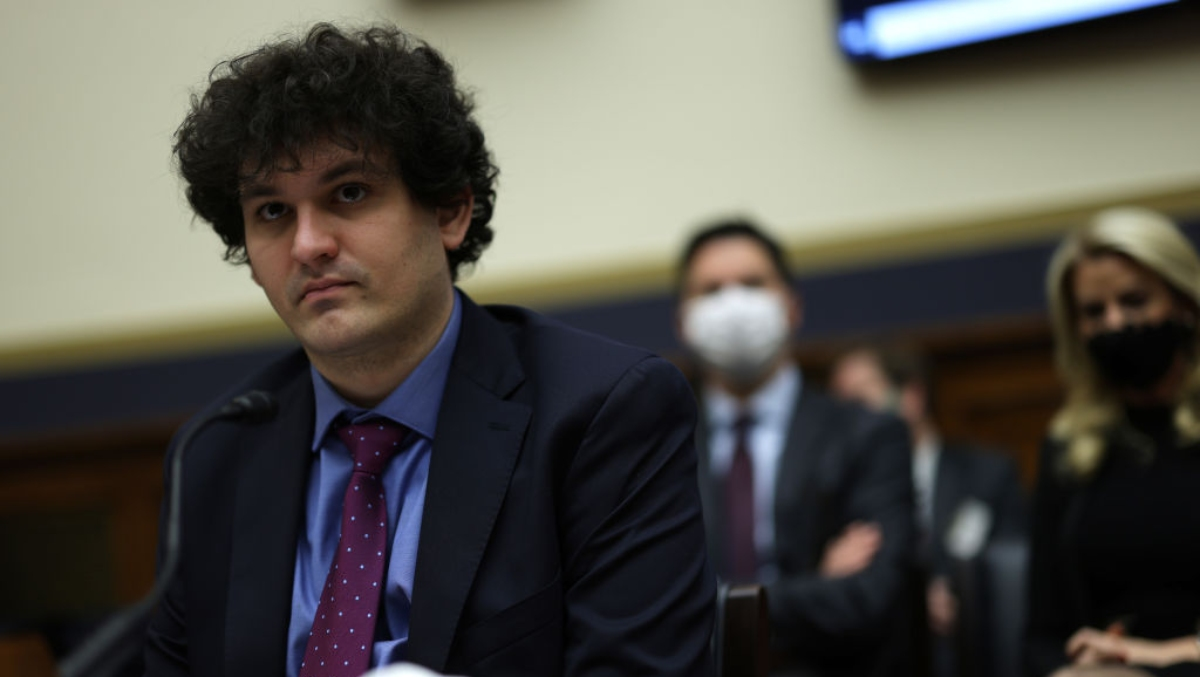
Sam Bankman Fried (15)


Changpeng Zhao: CEO of Binance. Early Investor in FTX, now is the rival company to FTX. Gains
near complete market control of crypto currency exchange markets with collapse of FTX.


Changpeng Zhao  (16)


Timeline Part II


Sequoia Capital and other investment firms: Invested funds in FTX, with the bankruptcy are likely to get pennies on the dollar of their investments.


Alameda Research: Sister Company to FTX. Very closely related, is also tied up in bankruptcy process


Individuals: Everyday users of the platform. Likely to have lost their funds they had with FTX if they did not withdraw in time. All users of the platform are due to be compensated if funds can be found.


Individualism:

            An individualistic perspective on how FTX operated would show that they failed. Individualism argues for the business and its owners to maximize its own profits and gains. With a net worth of over fifteen billion dollars before the collapse of FTX, Sam Bankman-Fried was one of wealthiest crypto investors in the world, not to mention straight up one of the wealthiest people in the world. After FTX went under due to the negligence of the company he, is currently valued at just over one billion dollars (11). The management of the firm was not in line with their own gain as it resulted in the company going belly up.

             FTX was poorly operated. The company routinely inflated FTT’s value, thereby raising its own value, as they operated the coin and had control of the flow of it. While this tactic worked in the short term, once the Coinbase article came out the value of FTT sank, bankrupting FTX. Essentially FTX shot themselves in the foot and was short sighted in their business strategy, the opposite of serving themselves. The market that FTX was in is essentially unregulated. Crypto currency is an extremely new concept, and governments have not caught up to the times. This left FTX with essentially unlimited avenues to succeed. Unfortunately, they built as Fox Business described them, “A house of Cards” (7). FTX couldn’t even save itself, let alone their customers failing to follow individualism.

Utilitarianism:

Under the guise of Utilitarianism, FTX’s actions are not acceptable. Utilitarianism demands that the majority is “happy” under all circumstances. The classic movie trope of the protagonist exclaiming “It’s for the greater good!” is a perfect example of Utilitarianism in action. In the case of FTX, they failed everyone. Due to their negligence over two billion dollars of assets are unaccounted for, and three billion is owed to customers and investors. Everyone the company effected was hurt by it in some way. No one wants to lose money on an investment, and through the companies’ misguided hand many people have. Others will get their money back, however, must go through the company’s bankruptcy process to do so. This not only is a headache for these investors but also could be costing them even more money due to legal fees and court procedures. Utilitarian thought is fundamentally upside down with the state the company is in. Employees are affected negatively without a job, investors and investment firms are hurt as they have not lost a portion of their portfolio. Not to mention, FTX has affected other investors and business with their recent collapse.

            FTX was the second largest crypto currency exchange in the world when they declared bankruptcy in November. This large of an exchange causes ripples in the crypto currency market. In financial terms, it will and did cause a downturn in the market in general. In fact, the crypto currency market has taken a hit in the last few weeks. Bitcoin the most popular crypto currency has dropped in price due to FTX’s bankruptcy. Time Investing reports, “Prior to FTX’s unraveling, bitcoin’s price was holding steady for most of October. Prices remained low at around $19,000 [per coin]” (8) Compare this with the price of Bitcoin as of December 1st, 2022, which is listed at just under seventeen thousand dollars per coin (10).

Bitcoin's Price Dec.2 2022 (1)


 That is an eleven percent drop in value in just under a month sense FTX has collapsed. Admittedly this is circumstantial evidence, however a similar event occurred when the investment bank goliath Lehman Brothers collapsed in the 2008 financial crisis. From the BBC, “The consequences for the world economy were extreme. Lehmans' fall contributed to a loss of confidence in other banks, a worldwide financial crisis and a deep recession in many countries” (4). FTX’s collapse has caused mistrust in the market. This as a result creates a downturn in the market. This downturn has affected an untold number of investors as small as individuals to as large as firms. The majority has been affected more in a negative way than the minority has. The rules of Utilitarianism have therefore been violated.

Kantianism:  

            Kantianism argues that the means of actions are more important that the result of an action. Not only this but the meaning behind the action is also equally important. Kant described the meaning behind the action as “Good Will”. For a business’s actions to be ethical permissible the actions the business takes must be first good, and second their intention must also be good, or at least neutral. In the case of FTX, the company’s bankruptcy isn’t the center of the controversy, being merely a consequence of the company’s actions. FTX’s management was poor. They took risks that were not necessary. Sam Bankman-Fried was even quoted to saying, “I wasn't spending any time or effort trying to manage risk on FTX” (6). Of course, this boils down to downright negligent management of a multibillion-dollar corporation. Without FTX releasing a statement as to why they took the actions they that inevitably bankrupted them, it can only be left to speculation. One theory would show that FTX violated Kantianism ethical procedure for pure greed of the company. FTX was shown to purposely inflate the market value of FTT by selling a small portion of the coin at a certain favorable price, then using that value to calculate their net worth (7). An analogy by Ben McMillan shows the flaw in this method, “imagine someone owns every house in a 100-home neighborhood and forces the sale of one home for $1 million, then uses that sale to show they have $100 million in "equity." But then, the owner is forced to sell all the remaining 99 homes, and the houses only sell for $100,000 each – meaning $90 million of their so-called equity disappears” (7). By inflating their net worth FTX could theoretically get more capital through loans, thereby giving the company more cash. Ethically through the guise of Kant, this isn’t permissible. It is misleading, FTX doesn’t have nearly the amount of equity as they claim, instead they misled customers and investors by having the inflated numbers on the books. This tactic is shady and impermissible by Kantian thought as the means that the company used to get larger is misleading, automatically violating Kant’s philosophy.

Virtue Theory:

            Virtue theory is an ethical theory that takes one’s character traits into account, to determine if one’s actions are ethical or not. Traits that help one flourish and grow as a person are good, or “virtues”. Whilst traits that hinder people’s growth and happiness are “vices”. Putting FTX under the microscope, they displayed both virtues and vices. Looking at Sam Bankman-Fried’s twitter shows the man at least at the public level is remorseful for what has occurred, and how it affected his customers; tweeting, “My goal—my one goal—is to do right by customers… after that investors. But first, customers” (3).

Tweet from Sam Bankman-Freid (3)

 While this is after the fact, he as the de facto head of the company does show willingness to fix what he self admittedly blundered. Being virtuous after the fact, however, does not make up for greed the company heads had before bankruptcy. As previously stated, FTX had no risk management, it routinely pumped FTT’s value increasing FTX’s on paper equity, and it also gave out messy loans to sister firm, Alameda Research. The New York Times claims that FTX could have loaned as much as 10 billion dollars to Alameda Research, much of that being customer funds (9). Of course, investment bankers loan out money all the time, it is their way of making money. However, the big difference here is that FTX’s ties to Alameda Research made it so FTX heads made money too when Alameda Research made money. FTX was greedy, it pushed risky investments and inflated their own revenues to the point where when hardship hit in the form of FTT tanking in price, the whole system collapsed around it. By falling to the vice, FTX doomed itself, and its unethical practices tarnished the company. Even before the collapse, other companies pulled out of loans with Alameda Research, which in extension is FTX. For instance, the New York Times reported, “Blockchain.com, a leading seller of Bitcoin and other cryptocurrencies, closed out a loan it had made to Alameda, concerned about “too many illiquid-related assets” (9). At the end of the day companies exist to make money, so it shows the risk that FTX and Alameda Research were taking for one to pull out. The risk taken was backed only by the greed of the firm’s leaders.

Justified Ethics Evaluation:

            FTX during its operation seemed too good to be true, and as the adage goes, if it seems too good to be true it is. Being the fastest growing exchange for crypto currency in the world is lucrative and enticing. Figures like Sam Bank
man-Fried took the world by the reins, capitalized on a budging market to make as much money as possible. The company clearly was a personal piggy bank for Sam and his cronies. The company was run with a loose cannon at the wheel, it is no wonder why it collapsed. Playing fast and loose with billions of customers dollars shows no regard to one’s customers. As a result, FTX is unable to pay back their customers and investors, loosing three billion dollars’ worth of assets. Sam’s actions as CEO were downright negligent. He ran FTX into the ground through his risky investments with Alameda and the self-inflation of FTX’s main asset, FTT. It doesn’t take a genius in economics to realize artificially pumping up the value of FTT would cause a market correction eventually. This tactic was used by Jorden too Belfort, better known as The Wolf of Wall Street with his investment firm, Stratton Oakmont. He pushed his customers to buy cheap stock on mass, inflating the price of it. It's out of pure greed to capitalize and make as much money as possible. Both firms ended in the same fate, bankrupt. If FTX were to go back and redo their past, they could easily be in business today if they didn’t do a measure of actions. One; FTX needed to cease their grey area relations with Alameda Research. This relationship in a non-crypto related market would’ve been under lots of scrutiny from investors and regulatory agencies. Second, FTX needed to practice ethical business practices, such as being honest about actual revenue, not inflating their net worth through shady means. The mix of negligence and FTX’s more dubious business practices marked their downfall. The company was mismanaged to the point that they had no idea of the amount of liquidity they had to pay debts owed. When FTX’s house of cards toppled, their customers paid the price.

Conclusion:

            FTX’s bankruptcy comes as no surprise in hindsight. Under the scrutiny of four different ethical theories, the company failed to show any sort of ethical actions. It didn’t serve itself by making poor decisions that ended the company, failing Individualism. The company did not serve the greater good either, instead plunging the market into distress and hurting the wallets of potentially millions of people. This breaks the rules of Utilitarianism. The company’s actions were not out of the good will either, they mislead customers and investors about the net worth of the company and thereby it’s security, breaking the rules of Kant. FTX was also not virtuous, operating out of pure greed, again pumping up its net worth and investing funds in risky bets. Truly, the fall of FTX is a shame, not because the company itself was anything particularly special, but the fall of FTX marks a new struggle in the crypto market and may delay its adoption into the mainstream. The concept of crypto is heavily intertwined in what experts are calling the “Internet 3.0” and this fall may falter a new renaissance in the development of the internet and humanity as whole.


References

1. (n.d.). CoinDesk. <a href='https://www.coindesk.com/price/bitcoin/'>https://www.coindesk.com/price/bitcoin/</a>   

2. Allison, I. (2022, November 2). Divisions in Sam Bankman-Fried‚Äôs Crypto Empire Blur on His Trading Titan Alameda‚Äôs Balance Sheet. CoinDesk. <a href='https://www.coindesk.com/business/2022/11/02/divisions-in-sam-bankman-frieds-crypto-empire-blur-on-his-trading-titan-alamedas-balance-sheet/https://www.coindesk.com/business/2022/11/02/divisions-in-sa'>https://www.coindesk.com/business/2022/11/02/divisions-in-sam-bankman-frieds-crypto-empire-blur-on-his-trading-titan-alamedas-balance-sheet/https://www.coindesk.com/business/2022/11/02/divisions-in-sa</a>   

3. Bankman-Freid, S. (n.d.). Twitter. <a href='https://twitter.com/SBF_FTX'>https://twitter.com/SBF_FTX</a>   

4. Blythe, N. (2010, September 15). How did Lehman's collapse affect the world of finance?. BBC. <a href='https://www.bbc.com/news/business-11310143'>https://www.bbc.com/news/business-11310143</a>   

5. Brooks, K. J. (2022, November 21). Bankrupt FTX Trading owes creditors more than $3 billion. CBS News. <a href='https://www.cbsnews.com/news/ftx-bankruptcy-3-billion-crypto-sam-bankman-fried/'>https://www.cbsnews.com/news/ftx-bankruptcy-3-billion-crypto-sam-bankman-fried/</a>   

6. Dean, G. (2022, December 1). Sam Bankman-Fried said that if he'd spent 'an hour a day' thinking about risk management FTX might not have collapsed. Yahoo Entertainment. <a href='https://www.yahoo.com/entertainment/sam-bankman-fried-said-hed-131733118.html?fr=sycsrp_catchall'>https://www.yahoo.com/entertainment/sam-bankman-fried-said-hed-131733118.html?fr=sycsrp_catchall</a>   

7. Dumas, B. (2022, November 23). FTX: How Sam Bankman-Fried built a house of cards. Fox Business. <a href='https://www.foxbusiness.com/markets/ftx-sam-bankman-frieds-house-cards-came-tumbling-down'>https://www.foxbusiness.com/markets/ftx-sam-bankman-frieds-house-cards-came-tumbling-down</a>   

8. Gailey, A., & Cabello, M. (2022, December 2). Bitcoin‚Äôs Price Remains Low as FTX Contagion Continues. How Investors Should React. Time. <a href='https://time.com/nextadvisor/investing/cryptocurrency/bitcoin-crash-continues/#:~:text=Despite%20the%20ups%20and%20downs%2C%20bitcoin%E2%80%99s%20price%20has,winding%20down%20pandemic%20measures%20to%'>https://time.com/nextadvisor/investing/cryptocurrency/bitcoin-crash-continues/#:~:text=Despite%20the%20ups%20and%20downs%2C%20bitcoin%E2%80%99s%20price%20has,winding%20down%20pandemic%20measures%20to%</a>   

9. Goldstein, M., Stevenson, A., Farrell, M., Yaffe-Bellany, D. (2022, November 18). How FTX‚Äôs Sister Firm Brought the Crypto Exchange Down. New York Times. <a href='https://www.nytimes.com/2022/11/18/business/ftx-alameda-ties.html?action=click&module=RelatedLinks&pgtype=Article'>https://www.nytimes.com/2022/11/18/business/ftx-alameda-ties.html?action=click&module=RelatedLinks&pgtype=Article</a>   

10. How Does a Crypto Exchange Work? (2022, September 23). Sofi Learn. <a href='https://www.sofi.com/learn/content/how-crypto-exchanges-work/'>https://www.sofi.com/learn/content/how-crypto-exchanges-work/</a>   

11. Morrow, A. (2022, November 10). Crypto‚Äôs white knight lost 94% of his wealth in a single day. CNN. <a href='https://www.cnn.com/2022/11/09/business/sam-bankman-fried-wealth-ftx-ctrp/index.html'>https://www.cnn.com/2022/11/09/business/sam-bankman-fried-wealth-ftx-ctrp/index.html</a>   

12. Yaffe-Belany, D., & Grithiff, E. (2022, November 8). Crypto World Is Rocked as World‚Äôs Largest Exchange Rescues Rival. New York Times. <a href='https://www.nytimes.com/2022/11/08/technology/binance-ftx-deal-crypto.html'>https://www.nytimes.com/2022/11/08/technology/binance-ftx-deal-crypto.html</a>   

13. O'Halloran, S. (2022, November 28). FTX bankruptcy unique, losses hard to determine: Ken Feinberg. Fox Business. <a href='https://www.foxbusiness.com/markets/ftx-bankruptcy-unique-losses-hard-to-determine-ken-feinberg'>https://www.foxbusiness.com/markets/ftx-bankruptcy-unique-losses-hard-to-determine-ken-feinberg</a>   

14. Zhao, C. (n.d.). Twitter . https://twitter.com/cz_binance

15. Sam Bankman-Fried Image (n.d.). https://miningtechnology.in/sam-bankman-fried-denies-fraud-in-ftx-collapse-rolling-stone/

16. Changpeng Zhao Image (n.d.). https://noticierobitcoin.net/noticia/changpeng-zhao-traders-binance-eludir-bloqueo-estados-unidos/

           

Venture Capital Firms: Rash Investing in FTX (2022)


(Larg investor of FTX)
ABSTRACT

            In the world of crypto currency and venture capitalist firms,’ ethics is not a term you might think of being especially important. Mr. Bankmen CEO of FTX swindled investors and mismanaged billions of customers money and eventually caused the failure of his company.  FTX and venture capitalist both fail when you grade them against the theory of individualism, they may have not broken laws, but they did not maximize profits. When FTX collapsed in on itself it also took with it many peoples life savings with it and with that their dreams and happiness there for FTX and venture capitalist fail to pass the ethical theory of Utilitarianism. Mr. Bankmen and the venture capitalist were motivated to make as much as possible and to them it did not matter so they were not motivated to do right because it is right, so they fail the theory of Kantianism. If businesspeople always used ethics to help them make their decisions events like the failing of FTX could be avoided.

ETHICS CASE CONTROVERSY

It all started when a Bahamas based cryptocurrency exchange company, FTX, was founded in May 2019 by Sam Bankmen. In the world of cryptocurrency Mr. Bankmen was seen as a savant that had complete understanding of the new and uncharted market of cryptocurrency. FTX’s goal was to try to make an easy and safe way for people to buy and hold and sell cryptocurrency. At their peak, they had over a million users. Sam Bankmen marketed his company aggressively through numerous different commercials. They ranged from comparing FTX to every major invention in history to having professional athletes endorse the company.

(FTX ad ran at the super bowl)

The ads put an emphasis on how safe and easy it was to use and now looking back at these statements it is extremely ironic. Mr. Bankmen’s aggressive marketing tactics also crossed over into his strategies when finding investors. His so-called pitch to potential investors was not really a pitch but a take it or leave it offer. Investors that heard Mr. Banksmen’s pitch stated that Mr. Bankmen believed that investors should only support and observe. This is where the FTX’s story becomes strange. Investors, after hearing Mr. Bankmen’s pitch, did not completely avoid this company like the plague but even more surprisingly invested with extremely little research into the company. The large venture capital’s firms that were investing should have the experience and knowledge not to just trust a person’s word but to conduct in depth research. It seems that they were blinded by the opportunity to be an early investor in a new market the New York Times
said, “Investing in FTX gave them a piece of the hottest start-up in an emerging sector that promised to be as big as smartphone apps or the internet itself.” (Griffith, Erin, and David Yaffe-Bellany) New York Times, 11 Nov. 2022). Venture Capital firms completely went away from their due diligence and hard-core review procedures that they got involved in when it came to FTX. They fell in love with this “unique” investment, and it ended up having a detrimental impact on their balance sheets. If investors took the time to investigate FTX’s company’s practices, they all would have turned away from the potential investment. Mr. Bankmen also was the CEO of Alameda Research which is a trading firm that came out November 2, 2022. This trading firm held five billion dollars’ worth of FTT coins, these are FTX’s own coins, and this discovery served as the spark to the powder keg that was FTX. On November sixth the world’s largest crypto currency exchange, Binance, said they were going to liquidate all the holdings of the coin FTT due to their concerns about risk management. This news sent shock waves throughout the crypto currency world causing mass liquidation of the coin. The problem with that is FTX did not actually have the money to give back and found itself in a crisis where they needed to find six billion dollars to give back to customers. During this the price of a FTT coin plummeted eighty percent in just two days. FTX started to look for ways out of the situation they found themselves in, so it had turned to one of its competitors. Binance announced on November eighth that they had made a deal to acquire FTX. They also released that it was still non-binding and did not release the purchase price. After this announcement FTX was going to be bailed out from the predicament that they had gotten themselves into. Only a day later, on November ninth, Binance announced that they would be pulling out of the deal due to their concerns on how the company was run and most importantly how the customer’s finances were being handled,  John J. Ray III a CEO who specializes in bankruptcy had this to say "Never in my career have I seen such a complete failure of corporate controls and such a complete absence of trustworthy financial information as occurred here," Ray said in a filing on Nov. 17(O'Halloran, Suzanne O'Halloran Fox Business, 28 Nov). This action thrust FTX back into its original position but with the add on of people questioning how their money was managed. November tenth the Bahamas securities regulator froze the remaining FTXs assets and California Department of Financial Protection, and Innovation started an investigation. Mr. Bankmen also took to twitter to inform the world that FTX did not have the capital to fulfill all the customers’ requests. He blamed the over leveraging of the company on “poor internal labeling.” (REIFF, NATHAN Investopedia 18 Nov. 2022) He also said that Alameda would slow down their trading. On November eleventh Mr. Bankmen would step down from his position as CEO and John J. Ray III would take his place as well as the company filing for Chapter 11 bankruptcy protection. When this was filed one hundred and thirty other companies were engaged in the proceedings. Soon after the filings took place, FTX stated that they were victims of “unauthorized transactions.” Third party business analysis believes that in a hack four hundred and seventy-seven million dollars was stolen. After this was discovered, the Securities Commission of the Bahamas, decided on November 18
th that FTX had to move all crypto assets to the regulator’s wallet to help protect everyone. Currently FTX is involved in civil lawsuits and one class-action lawsuit. The failure of FTX will most certainly leave a permanent stain on the crypto currency market and investors that invested in it without the research to see all the warning signs. Some economists have compared the FTX debacle to the collapse of Enron in October 2021.

(Timeline)

STAKEHOLDERS

(FTX's crypto currency) 
                   All those who engaged in FTX, were left with a bad taste in their mouths and less money in their pockets. The stakeholders that were hurt the most in the fall of FTX was the average person who was trying to invest in their future and ended up losing their hard-earned money, like Terri Smith an architect in Seattle who may have lost everything from this situation. Investors are left with depleted accounts and a limited hope of getting anything back once the bankruptcy proceedings happen. FTX did not only burn regular investors, but they did so to many venture capital firm such as Temasek and Sequoia, which stand to lose large amounts of capital.

INDIVIDUALISM

(Past CEO of FTX)
When you look at the case of FTX and the Venture Capital firms that were involved through the scope of individualism, it is hard to fully explore with the information that is currently available. At the time of this writing there are no criminal charges brought against any FTX employees. This lines up with one of the main points of individualism of attempting to maximize profits while staying within the laws. In this instance, FTX was attempting to create the most profit it could and just ended up failing. As far as we know, no laws were violated therefore FTX played by the rules of individualism and just unfortunately went under. When looking at the venture capitalist firms and how they interact with the ideas of individualism it can be looked at in two separate ways. On one hand an argument can, be made that the firms were trying to stay ahead of technology and become an early investor of a brand-new market and did not know how to research an investment like this. In this way the firm was trying to make the most profit and no laws were broken, therefore they followed the ethics of individualism. On the other hand, it could be said that one of the major jobs of an investment firm is to know every aspect of where their money is invested. They were not looking to make the most profit but were just gambling on the perceived golden boy of the crypto world. As of now, FTX only halfway follows the ideas of individualism by failing to maximize profits and the investment firms that invested without investigating the company that they invested in, did not follow the ideas of individualism due to their oversight not only not maximizing profit but actually minimizing it. The massive investments by the Venture Capital market inadvertently represented to the average investor that this was a “solid” investment based on the regular principles usually adhered to by them.

UTILITARIANISM

Looking at FTX and all its doings, it is quite clear that this business was not run under the ethical guidelines of utilitarianism. Utilitarianism is the middle ground between egoism, where you are only looking out for your own happiness and altruism, where you only look out for others happiness. When a company is operated under the guidelines of utilitarianism, the company is not only looking out for themselves but also for everyone involved. FTX showed, with their less than desirable management of themselves and their customers’ investments that they were only looking out for themselves. When Mr. Bankmen did not allow anyone else to help make decisions on his company’s board, he embodied an egoism ethical standpoint and was only looking out for his own interests. The way Mr. Bankmen conducted himself outside of his business also shows that he was only looking out for his own happiness when he used his image as a crypto golden boy to convince investment firms to blindly toss money at his company without proper research. Mr. Bankmen does not fit into utilitarianism clearly and he was known to only be looking out for his own happiness not the happiness of his users or investors. His willingness to lie and swindle people to complete his own agenda of making the most profit for himself proves this. His ethics fit an egotist model due to the fact he was only concerned in what happened to him and not how any of his own actions affected anyone else. Venture capital firms that heavily invested should have been able to see that the CEO of the company they had invested in only cared about his own net worth and happiness and did not care how he increased it.

KANTIANISM

                        Kantianism is an interesting way to approach a business ethical dilemma. Kantianism is based around acting rationally, helping, and allowing people to make their own decisions, respecting people’s decisions and everyone’s individual needs. Finally, to be motivated to do the right thing because it is right. Mr. Bankmen and FTX, under the light of acting rationally did not act in a rational manner, when Mr. Bankmen refused to allow outside help of people that have more experience that could have helped him avoid running his business into bankruptcy. During the operation of FTX people were allowed to make their own decisions if they wanted to invest or if they did not, but Mr. Bankmen did not help them by withholding invaluable information on how FTX was being run and how FTX sister company Alameda held five billion dollars’ worth of FTX own coin. This information would have most certainly changed how investors would have made their decisions, therefore FTX did not allow investors to make their own decisions but coerced them into a decision by withholding essential information about themselves. The only point where a case could be made in FTXs favor, is that they respected people’s decisions and needs. Investing always has an inherent risk involved in it so when a person invests their money in any investment, they also must accept all the risks involved in it as well. In this way, FTX respected everyone’s decisions of taking a risk in this situation. It just did not pan out in a favorable fashion. If you look at the motivations of FTX it is crystal, clear that they were not motivated by the right thing but were motivated to just make the most profit for themselves no matter the amount of people that would be burned by their business plan. They were not motivated to help their investor’s or to improve the new emerging market space, which is crypto, therefore they were not motivated to do the right thing because it is right. Mr. Bankmen did not use Kantianism ethical guidelines to help run his company.

VIRTUE THEORY

                       Some people would describe FTX as generally distrustful and dishonest. Learning and moral leadership are not terms that are used to describe FTX. It is quite the opposite. If you want to look at FTX as a trustworthy company, you must do your proper research on who runs the company and that is Mr. Bankmen. This individual was also the CEO of another investment company. This company also held five billion dollars of the crypto coin FTT. FTT is FTXs own crypto currency made for their exchange in most circumstances this would not be a problem but both companies shared a CEO. This was seen as an extremely shady way to do business and was done to boost the perceived numbers of their own coin. When looking to see if this is an honest company, you must look at how they managed users and how they secured investments for themselves. FTX was well known for partnering with many super star athletes such as Shaquille O'Neal, Trevor Lawrence, David Ortiz, and Tom Brady and even running a Super Bowl ad. The ads that FTX released to the public openly stated how easy and safe their platform is. The ads were not honest to their customers about all the risks involved in investing but made it sound like there was no risk and that anyone could do it with no research on what they were doing. Hearing investors stories that heard Mr. Banksmen’s pitch to invest in his company all share the same few traits. The pitch was often described as not a pitch but a take it or leave it offer to the investment firms and Mr. Bankmen felt strongly against having outside help when making decisions about the company. FTX was extremely dishonest and used the inexperience of the investment firms in the crypto currency market to pull the wool over their eyes and take them for a ride. They had no say in it. Mr. Bankmen was notorious for refusing to allow investors a spot at the table to voice the ideas and concerns. He would not learn from people that had more experience, which could have made the company better, but he remained stuck in his ways and would not accept the help offered. The moral leadership of Mr. Bankmen is not present at any of his companies that he ran. He did not care about anything but how to increase his personal net worth.

JUSTIFICATIED ETHICS EVALUATION

            When you are running an investment firm whether that is in regular stock and securities or forging a path into a new and unclaimed market of crypto currency, the goal should be the same and it is to provide a trustful experience. FTX and Mr. Bankmen failed to provide anything that is even remotely related to the word trust. From the start Mr. Bankmen used extremely aggressive and questionable business tactics. Mr. Bankmen was a predator to all his customers with his promise of a safe exchange platform, but he was unable to provide this. He was unable provide this due to his perceived expertise and not allowing investors to have a say on the decisions with the company and provide insight from there past experiences. The incident that kicked off oversight and poor management was that Mr. Bankmen caused the failure of the company. It was even stated in a tweet that “poor internal labeling” was the cause to all the leveraging and liquidity problems that tore apart the company. If Mr. Bankmen allowed his investors, that have had countless years of experience to help him, I believe that he would have a trustful strong company that is opening a new market and giving everyone the ability to invest with it. If you were to look at it from Mr. Bankmen’s perspective, it might seem a little different. He could have viewed this situation as no one has experience running a company in a crypto currency company and his aggressive business practices could just be him fully believing that he is trying spread the new world changing innovation. In the end Mr. Bankmen and FTX did not follow any ethical guidelines and were only looking out for themselves. It did not matter who they destroyed in the rise to the top. 

CONCLUSION

The way business was conducted for everyone involved in FTX was an unfortunate display of what happens when business is done in complete disregard of any ethical thought. Mr. Bankmen’s desperate crawl to the top not only destroyed his dream of a safe and easy crypto currency exchange but also installed a new distrust for the whole market of crypto currency. It also made venture capitalist firms extremely weary of supporting any of these companies in the future. This will stunt the growth of this new market and limit new innovations in this field. In the end, the way FTX treated their customers and investor’s put a negative view on their whole industry and it all could have been avoided if any ethical thought were used.


REFERENCES 

Griffith, Erin, and David Yaffe-Bellany. "Investors Who Put $2 Billion Into FTX Face Scrutiny, Too." The Collapse of FTX, The New York Times, 11 Nov. 2022, www.nytimes.com/2022/11/11/technology/ftx-investors-venture-capital.html.

REIFF, NATHAN. "The Collapse of FTX: What Went Wrong with the Crypto Exchange?" , edited by VIKKI VELASQUEZ, Investopedia, 18 Nov. 2022, www.investopedia.com/what-went-wrong-with-ftx-6828447#:~:text=Cryptocurrency%20exchange%20FTX%20collapsed%20in%20early%20November%202022,portions%20of%20the%20company%20but%20quickly%20backed%.


Taranto, Steven, and Isabel Gonzalez. "FTX collapse: Tom Brady, Stephen Curry, Shohei Ohtani among sports figures named in class-action lawsuit." , CBSSPORTS, 16 Nov. 2022, www.cbssports.com/nfl/news/ftx-collapse-tom-brady-stephen-curry-shohei-ohtani-among-sports-figures-named-in-class-action-lawsuit/#:~:text=Those%20three%20are%20part%20of%20a%20group%20of,who%2.

Peterson-Withorn, Chase. "Exclusive: These FTX Investors Stand To Lose The Most From The Crypto Exchange’s Implosion." The fall of FTX, Forbes, 10 Nov. 2022, www.forbes.com/sites/chasewithorn/2022/11/10/exclusive-these-investors-stand-to-lose-the-most-from-ftxs-implosion/?sh=1c04ca326700.

ROBERTS, JEFF J. "SBF in criminal jeopardy: How and when he could face justice." , Fortune Crypto, fortune.com/crypto/2022/11/18/sbf-in-criminal-jeopardy-how-and-when-he-could-face-justice/.


O'Halloran, Suzanne O'Halloran. "FTX bankruptcy unique, losses hard to determine: Ken Feinberg." , Fox Business, 28 Nov. 2022, www.foxbusiness.com/markets/ftx-bankruptcy-unique-losses-hard-to-determine-ken-feinberg.


Saturday, May 7, 2022

CNN: Chris Cuomo seeks $125 million after being fired from CNN (March 2022)


Case Controversy

By: Ben F, Peter J, Devin W, Ryan S

The current issue is that Chris Cuomo was caught assisting his brother Andrew Cuomo with dealing with sexual assault allegations. This is an issue because Chris is a head journalist at a massive news organization and his brother Andrew is the governor of New York. There’s conflict in their jobs from an ethical standpoint and there is a conflict of interest with the fact that they’re brothers together. It was later that someone stepped forward alleging that Chris had sexually assaulted her as well.


CNN is a publicly-traded company founded in 1980, being the first-ever 24-hour news channel. Since then they have built off of that unique feature, and become a well-known source for important events in America and across the world. CNN has always been very involved with politics, going all the way back to the 1988 Presidential debate between George Bush and Michael Dukakis when reporter Bernard Shaw from CNN was a moderator. In 1997, CNN reporter Peter Bergen was the first-ever American journalist to interview Osama Bin Laden, and in this famous interview, he declared war on the United States. Another famous moment that they captured was nine-eleven when they were the first national news channel to break the news. They have been a major source for decades, consistently staying involved with major events. It is because of their reputation that CNN was so quick to fire Chris. He decided to defend his brother despite the high number of allegations against him, and CNN felt it was too much risk to keep Chris on their team. Chris’s actions of aiding and strategizing with his brother’s political aides were certainly outside of the journalist precedents, and CNN was uncomfortable with what would result.


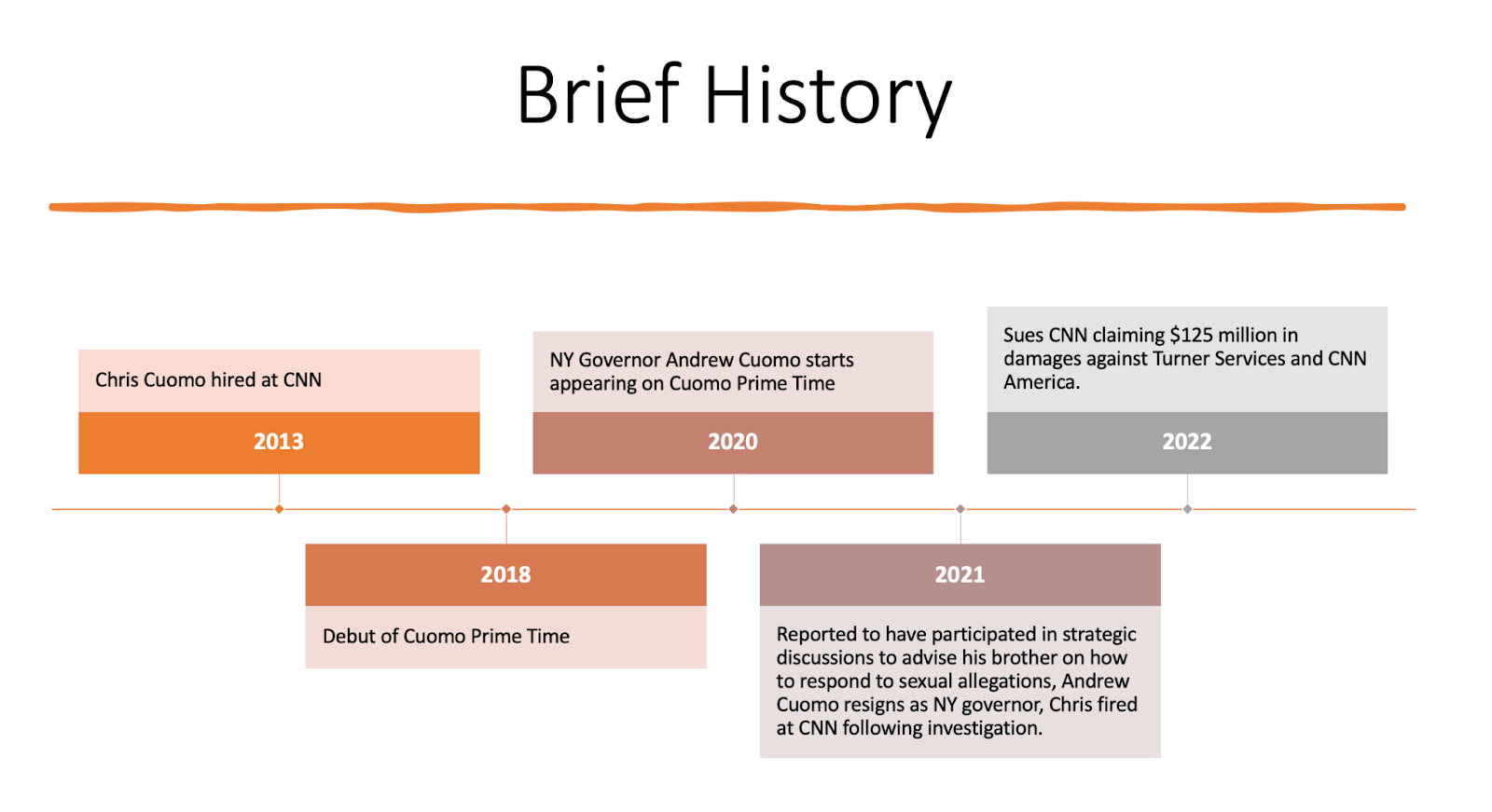
Timeline


The stakeholders, in this case, would be CNN viewers, Cuomo Family (Chris and Andrew), stockholders, the general public, and Jeff Zucker (CNN Management). 


CNN viewer:  Would be a stakeholder because they are directly affected by the decisions CNN decides to make. Recurring audiences can favor a particular journalist and say in this case the viewer loved Chris Cuomo, then they're going to have to find another option. But for every other CNN viewer who didn’t typically watch Chris Cuomo's show will benefit in a positive way because he won't ever be on CNN again. 


Andrew Cuomo & Chris Cuomo: This will ultimately negatively impact Andrew because it exposes the mistakes he's made in regards to sexual harassment while he was the governor of New York at the time. For his brother Chris if he were to win the lawsuit in fiscal terms he will be positively impacted but if he loses this would negatively impact him because he wouldn't be awarded the $125 million. The scandal as a whole shines a bad light on the Cuomo family because of the actions his brother took.


Stockholders: Since CNN is a public company there would have to be affected in one way or another. In the NPR article, it states that Andrew Cuomo being interviewed by his brother Chris during the lockdowns boosted ratings but also states in the article that Zucker and Gollust (CNN management) had Gov. Cuomo moves his Covid-19 briefings to the afternoon to help the network boost its weaker ratings during those hours.  (Shivaram) It’s plausible that during this scenario of Chris and Andrew on live television during the Covid-19 briefings that CNN’s stock rose because of the attraction the public has to this family. But after the public found out about this case and how this was all a calculated decision on behalf of CNN to boost ratings stockholders had to have lost belief and trust in the company. When management is partaking in shady actions like these ones, it's rare that stockholders would become bullish or optimistic about the country’s future and invest capital into it.  

Jeff Zucker (Left) & Chris Cuomo (Right)

General Public: as a whole benefit from this case because they will never have to watch Chris Cuomo again on CNN or be governed by his brother Andrew in New York. People like this have no business being on national television let alone being governor of a state. People oftentimes watch the news to be “filled in” on the latest top stories, not listen to someone cover for his brother who is the governor at the time and has serious allegations against him. I think society as benefits because the person who has sexual allegations against him isn't in power in New York anymore and also viewers of CNN can trust the company more and the direction that it's headed.


CNN Management & Company (Jeff Zucker): They as a whole benefit positively from this case. The company and Zucker don't have to deal with bad headlines about the Cuomo brothers that negatively affect their brand and reputation. 

This makes their life easier, relieving a big headache from their life. It must be extremely difficult working with someone and being productive when all these negative headlines or coming out about them. It makes the work-life atmosphere as a whole less stressful and more enjoyable for CNN employees. Another interesting point is that CNN  being on the national news makes this even a bigger deal because of the competition and how there aren't many other national news companies. Viewers could easily become alarmed with all the negative noise about CNN and view CNN as not a credible news source and watch another big-time national news station like Fox News. 


Individualism: 

Individualism is an ethical theory that is primarily interested in the individual's personal moral concerns rather than the society as a whole. There are a couple different perceptions of how individualism works. According to Adam Smith, we should only worry about our own self-interest and the rest will fall in place. Friedman believed that the only obligation by a business is to maximize profit, therefore they must act in the best interest of the stockholders. Tibor Machan’s ideology is very similar, however, he believed that in order to maximize profit you must sometimes indirectly raise your profit. CNN firing Chris would definitely follow Machan’s theory on individualism. While they could keep raising their profits, they aimed to avoid any possible turmoil from the situation and maximize their profit by terminating him and replacing his show. Not only could the company get a bad look for supporting Andrew in his defense against the allegations, but Chris would also be unable to report unbiasedly on the situation with his brother. This was certainly playing their position safely, but by doing so CNN was able to maintain high profits.

The decision by Chris to stay completely out of the situation in order to support his brother was more true to Adam Smith’s theory. He was mainly concerned with what was best for himself and his family. Defending his brother against the public was certainly the best way he could aid him during the allegations against him, which was certainly his main interest. His first comment to the media was “I’m not an adviser, I’m a brother. I never attacked nor encouraged anyone to attack any woman who came forward. I never made calls to the press about my brother’s situation”(New York Times). Chris wants to make it clear to the public that his main intention is to aid his brother without influencing the media’s coverage of the event. Chris was successful because his brother Andrew was found innocent, so his moral concern for his family was achieved. Chris’s focus on his individual morals allowed him to protect his family without breaking any laws, however, this cost him his job and reputation.


Utilitarianism

A utilitarian would believe that CNN made the right decision by firing Chris Cuomo because this “maximizes the overall good” or producing “the greatest good for the greatest number” Salzar (36).  A Utilitarian also believes in what is best for the majority which would be firing Chris, and the president for breaking company policy and contract, as well as benefiting the public and doing what’s correct, and they broke policy. Overall the firing of Chris Cuomo maximizes happiness for the majority of stakeholders in this scenario, the only negatively affected stakeholder is Chris Cuomo and his brother. The stakeholders that happiness was maximized would be:

Andrew Cuomo (Left) Chris Cuomo (Right)

CNN: CNN will in the end be positively impacted after following its own company policies by firing Chris and the Ex-President Zucker and maximizing happiness for all CNN fans and CNN. Getting rid of a bad look on your company benefits the company and its supporters and stockholders, the company's reputation is the most important thing. If Chris gets his 125 million dollars it will negatively impact CNN but only temporarily, so in the end, the better of the company is more important.

Kantism:

Someone who follows Immanuel Kant’s code of ethics would say that CNN made the correct ethical decision in terminating Chris Cuomo’s contract. Under Kantianism, people and entities should need their autonomy, and individual needs and differences respected. Chris Cuomo was easily one of CNN’s biggest news anchors, if not their largest, so their firing Cuomo can seriously hurt their ratings if a significant number of people only tune in to watch Chris Cuomo’s broadcast. But by keeping him hired just so they can retain the viewers and therefore continue to make money off of him CNN would go against Kant's "Duty or the moral law". Firing Cuomo was the right thing to do after he demonstrated multiple actions of his own self-interest and not those of the company and people.

    CNN respected Cuomo's rationality when he first helped out his brother by letting him off with a warning. But after Cuomo had gone behind CNN's back to help his brother again after explicitly being told not to and sexual assault allegations came out against him it was clear that CNN had to fire Cuomo for the goodwill of the company.


Virtue Theory:

“Cuomo Prime Time” Studio

A virtue ethics believer believes that virtues depend on two things. Firstly, they depend on the way things function. Second, they depend on the circumstances. Our professor gives us an example of this in the Business Ethics and virtue lecture video. She compares this to the conditions a computer is in; the computer could be good or bad. For example, a gamer might hate her computer because it doesn't have the capability to be able to view the quick pace of games or interact with gaming software, but someone who isn’t into gaming may love this product. People who have certain circumstances will give us certain virtues. The virtues that we then discuss are broken down into virtues of character and intellectual virtue. There are 4 cardinal virtues: Courage, Tempairness, Justice/Fairness, and Honesty. Then there is one intellectual virtue called Prudence. Prudence is the ability to make good decisions considering your future. Virtue theory also embraces the doctrine of meaning. This meaning of virtue lies in between the two extremes. The vice of cowardness and the vice of rashness. One who believes in virtue ethics could look at this in multiple ways. (Business ethics and virtue)


Courage:  One way to look at this case is from the lens that Chris Cuomo is courageous. Despite going against his company's wishes, Chris defended his brother and allegedly helped his brother strategize to fight the sexual harassment allegations. Courage can be defined as risk-taking and willingness to stand for the right ideas and actions. A virtue ethics believer would view Chris as courageous by risking his reputation and job employment to stand up for what he believes to be the right ideas and actions. But they would also view Chris as not standing for the right ideas or actions. In one lens some might look at defending your brother as the “right idea and action” but others might view it negatively because he's helping his brother who has serious felony accusations against him.


Honesty: Honesty by definition is in agreements, hiring, and treatment of employees, customers, and other companies.  A virtue ethics believer would view that Chris might have to learn to be virtuous. You don't just pop out of the womb as a good person.  Chris in some eyes would be viewed as dishonest or lying after he was fired for “ being unaware of the full extent of the former anchor's efforts to aid his brother.” Companies aren’t quick to accuse their employees of egregious actions like this one, so in some eyes, Chris is just lying and covering in hopes to salvage his brother's reputation and the family name. In other eyes, fans of Chris Cuomo or supporters might view him as being honest and just standing up for his brother for what he believes to be right. We would have to let the lawsuit unfold and more details to come before we can make the judgment if Chris has been honest or not. (Mullin)


Temperance: Temperance from the lecture video can be described as “reasonable expectations and desires.” In this case, it's hard to judge how reasonable Chris seeking $125 million is. According to yahoo.com after being fired from CNN Chris Cuomo has a net worth of $12 million after earning $6 million annually for his role as the host of “Cuomo Prime Time.” I think most people who believe in virtue ethics would think Chris is seeking reasonable expectations and desires because he did make millions of dollars a year and is said to be valued at over ten million dollars so $125 million for a person that might never make $6 million a year or host his own show again this seems like a reasonable number for someone of his stature. (Yahoo)


Justice: According to the lecture video, Justice can be defined as hard work, quality products, good ideas, and fair practices. One who believes in virtue ethics would believe Chris embodies this cardinal virtue. Chris earned his law degree in 1995 then switched roles and decided to become a television journalist. Within the next few years, Chris became the youngest correspondent ever on the show 20/20 before joining CNN in 2013. Hard work is hard to categorize because it's subjective and it is your opinion of what you deem to qualify as “hard work.” In my mind, someone who finishes law school alone is a hard worker because of the rigorous workload and many years of schooling. In my mind, Chris embodies the cardinal virtue of justice, and most virtue ethics believers would agree. (Business ethics and virtue)


Action Plan

    The current issue is that Chris Cuomo was caught assisting his brother Andrew Cuomo with dealing with sexual assault allegations. This is an issue because Chris is a head journalist at a massive news organization and his brother Andrew is the governor of New York. There’s conflict in their jobs on an ethical standpoint and there is a conflict of interest with the fact that they’re brothers together. It was later that someone stepped forward alleging that Chris had sexually assaulted her as well. A warning should be issued to Cuomo about him helping his brother, because of his position in the company and he has been a good employee since hiring, his value is too high to fire over one offense. Once he was found to continue to help and over the sexual assault allegations he should be put on temporary leave while an investigation is underway then based on the results of the investigation either lift his leave or fire him.​​ These decisions are the most ethical that will allow CNN to be viewed as a more reputable news source. This will show viewers that CNN is taking this seriously and they believe in the rule of law. This will enhance viewership for the company which will increase profits. For CNN, this would set an example for other people in the company on the code of conduct and show the commitment to rules, laws, and facts. 


The appropriate ethical steps of Action to be ethical that CNN needs to take is

1) A single warning to Chris Cuomo, he has been with the company for a long time and works very hard at his job. This one issue shouldn't warrant immediate termination as a warning will suffice in getting the message across to him that what he did was not okay.

2) after finding out he had potentially helped again a leave of absence should be issued while an investigation goes underway of what exactly happened. A decision will be made based on what is found during the investigation

3) since sexual assault allegations have come out against Cuomo and he is already on a leave of absence for previous wrongdoings, termination should be the final course of action


CNN’s mission statement 

Their current mission statement is, “to inform, engage and empower the world.” It focuses on the viewing audience and the content that CNN provides to them, but it fails to address the quality of the content and the people providing it to you. The new mission statement I propose for CNN is “To deliver the news as ethically and truthfully as possible with only the best in the industry delivering to you” (Harryman 1).

CNN Core Values (Harryman 1)

Ethical

Important (“News Worthy”)

Truthful

Unbiased

How to prevent this problem from occurring again

There shouldn’t be any policy changes since Cuomo had broken a policy that was already in place, but new training should be done for these rare situations. Reiteration that as a journalist you can’t engage with politicians to help their campaigns even if they are family as it goes directly against the journalistic code of ethics.

Types of hiring, firing, and promoting procedures will help the company to flourish after the controversy.  Firing Cuomo will help the company flourish since this would sever the company from the controversy and show that CNN takes these situations seriously. It will also set a precedent in the future that CNN will take action even against people that are at the top of the company if it is in the best interest of the people and the company.

Explain what kinds of marketing or remarketing need to be done for the company, especially in the case of bad publicity due to the ethical difficulty it faced. 

I think an announcement that CNN has parted ways with Cuomo would be good enough, it’s best for these kinds of situations to address them early and professionally and to make a good statement that shouldn’t need to be reiterated..

How your plan will promote business profits and productivity, and how it conforms to the mission and core values and ensures good ethics 


With our plan, we will be enticing more viewers to believe CNN is headed in a positive direction by displaying trustful, important, and unbiased information. This will lead to more profitability and productivity for the company as more and more people start to take notice.  Our new mission statement hopes to deliver news as ethically and truthfully as possible with only the best in the industry delivering to you.


References 

A&E Television Networks. (2009, November 24). CNN launches. History.com. Retrieved April 14, 2022, from https://www.history.com/this-day-in-history/cnn-launches 

5. business ethics and virtue.mp4. (n.d.). Retrieved April 14, 2022, from https://echo360.org/media/4f088fa0-42d5-4e5c-a185-137f519b46bf/public 

Chris Cuomo wants $125 million for 'unlawful' CNN firing. POLITICO. (n.d.). Retrieved April 14, 2022, from https://www.politico.com/news/2022/03/16/chris-cuomo-125-million-unlawful-cnn-firing-00017944

Mullin, B. (2022, March 16). Chris Cuomo demands at least $125 million in arbitration with CNN. The Wall Street Journal. Retrieved April 14, 2022, from https://www.wsj.com/articles/chris-cuomo-demands-at-least-125-million-in-arbitration-with-cnn-11647466673

Shivaram, D. (2022, March 17). Chris Cuomo seeks $125 million after being fired from CNN. NPR. Retrieved April 14, 2022, from https://www.npr.org/2022/03/17/1087167551/chris-cuomo-cnn-125-million 

Yahoo! (n.d.). How much is Chris Cuomo worth after being fired by CNN? Yahoo! Retrieved April 14, 2022, from https://www.yahoo.com/video/much-chris-cuomo-worth-being-135537929.html

Dawsey, Josh, and Sarah Ellison. “Chris Cuomo Took Part in Strategy Calls Advising His Brother, the New York Governor, on How to Respond to Sexual Harassment Allegations.” The Washington Post, WP Company, 21 May 2021, https://www.washingtonpost.com/politics/chris-cuomo-andrew-cuomo/2021/05/20/99579382- b7f9-11eb-bb84-6b92dedcd8ed_story.html. 

Folkenflik, David, and Joe Hernandez. “Chris Cuomo, Newly Fired from CNN, Faces an Allegation of Sexual Misconduct.” NPR, NPR, 5 Dec. 2021, https://www.npr.org/ 2021/12/05/1061639233/chris-cuomo-newly-fired-from-cnn-faces-an-allegation-ofsexual-misconduct. 

Planas, Antonio. “Chris Cuomo Calls His Suspension from CNN 'Embarrassing'.” NBCNews.com, NBCUniversal News Group, 1 Dec. 2021, https://www.nbcnews.com/ news/us-news/chris-cuomo-calls-suspension-cnn-embarrassing-rcna7327. 

Schwartz, Brian. “CNN Host Chris Cuomo Used His Media Sources to Find out Info on Brother Andrew's Accusers, Records Show.” CNBC, CNBC, 30 Nov. 2021, https:// www.cnbc.com/2021/11/29/cnn-host-chris-cuomo-used-sources-to-find-info-on-andrewcuomo-accusers-records.html. 

Shivaram, Deepa. “Chris Cuomo Seeks $125 Million after Being Fired from CNN.” NPR, NPR, 17 Mar. 2022, https://www.npr.org/2022/03/17/1087167551/chris-cuomo-cnn-125- million. 

SkyNewsAustralia, director. CNN's Chris Cuomo Finally Addresses His Brother's Sexual Assault Allegations. YouTube, YouTube, 1 Mar. 2021, http://www.youtube.com/watch? v=MaH8qb-0G0E&ab_channel=SkyNewsAustralia. Accessed 15 Apr. 2022.