Showing posts with label politics. Show all posts

Sunday, December 11, 2022

TikTok: Revealing Fake Information to Viewers- Politics (2020-2022)


ABSTRACT

         TikTok, a video-sharing app, has been publicly exposed for having videos that could potentially skew people’s opinions in the political election. TikTok has updated their system to catch search terms relating to the election and has taken steps to partner with others in the industry and experts to help limit the spread of these posts. TikTok created new verification and partnered with fact checkers to make sure the content in these posts is accurate. Four ethical theories are discussed when evaluating this case. An individualistic view would agree with the actions of TikTok as they were operating within the law and increasing their profits in doing so. A Utilitarian view would agree with the fact that TikTok is taking measures to limit the spread of misinformation, but also disagree with the fact that the people are becoming unhappy with the posts on this platform. A Kantian view would agree with TikTok because they took actions to do what was right, which was finding a way to stop the spread of misinformation on the app and abided by the Formula of Humanity. Virtue Theory would disagree as TikTok had a lack of trust, good intention, and honesty in their platform. I believe that TikTok completed all the actions they needed to make sure this platform wasn’t a place for users to view false information about the election.


ETHICS CASE CONTROVERSY

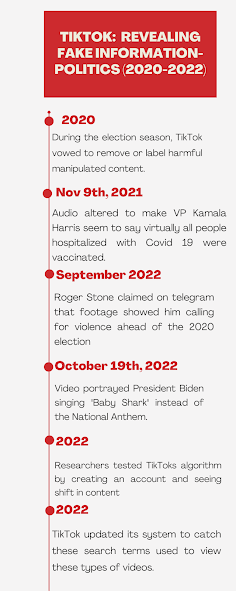
         TikTok has become a place where users are posting information that could have an effect on the election. TikTok has a positive outlook when discussing the issue and the company states, “At TikTok, we take our responsibility to protect the integrity of our platform- particularly around elections- with the utmost seriousness” (Han). With this, it is assumed by readers and viewers that they are taking this very seriously and are working diligently to find a solution to stop the spread of misinformation. According to an article by Rebekah Dunne, she describes that 1,057 U.S. residents were asked about their feelings towards social media and search platforms, specifically TikTok. With this research, “Even though TikTok boosted 100 million users towards the end of last year, it is the least trusted, with only 28% of respondents seeing the social platform as trustworthy” (Dunne). This shows that less than half of the respondents said they trusted this platform for the quality of their videos and if the videos were factual. 28% of respondents who trust TikTok is worrisome because that means that there is a good amount of people who watch these videos, and their opinions might be changed based on what they see. This in the end, could influence the election since these viewers are watching videos regarding political figures. In the wall street journal article, Worries Grow That TikTok Is New Home for Manipulated Video and Photos, Tiffany Hsu writes about the misinformation that these videos on TikTok are showing. This case started in 2020 during the election season when TikTok and other social media platforms vowed to remove or label harmful manipulated content. In November of 2021 there was a video posted of Kamala Harris, the Vice President, altered to make it seem like she was stating that all people hospitalized with Covid-19 were vaccinated. In the original film she was stating that these people that were sick were unvaccinated, but users of TikTok made her seem like she was telling the public that these people were vaccinated. This could potentially ruin her reputation on social media and affect the results in the election. Another example video discussed in the article was in September of 2022. This video that was posted shows political consultant Roger Stone claiming on Telegram that footage showed him calling for violence ahead of the 2020 election. Later, CNN aired that this was fraudulent deep fake videos. This could have a major impact on people’s opinions towards Stone. Stone is being portrayed in this video as wanting violence and the timing of this video being posted is very close to the election. Another example video was from October of 2022 regarding Ms. Biden. There were several TikTok videos that, “manipulated video of Ms. Biden promoting White House cancer initiatives at the Philadelphia Eagles’ home field” (Hsu). These videos were viewed tens of thousands of times. In these videos, the sound of the crowd was replaced with loud booing and heckling. Seeing this video spreads a dislike for Ms. Biden across the country. In October of 2022 two videos were posted that also could have had an effect on the election. The first video being President Biden portrayed to be singing “Baby Shark” instead of the National Anthem. The next video was a video where the White

President Biden singing baby shark


House press secretary Karine Jean-Pierre was edited to imply she was ignoring a question from a Fox News reporter. With these examples and many more that are out there on social media there is a need for this to be stopped. This is affecting and changing people’s opinions on political measures. Personally, I know when I see a video my first instinct is to not think it is fake. However, seeing videos that involve politics for sure makes me question what I am watching. People started to question these videos and it became such a big deal that researchers wanted to learn more about this app. This research team was from a corporate accountability advocacy group called SumOfUs. This group wanted to test TikTok’s algorithm, so they created an account on this app. They started by searching for the 20 most widely watched videos that showed doubt in the election system. The article stated that, “Within an hour, the algorithm had switched from serving neutral content to pushing more election disinformation, polarizing content, far right extremism, QAnon conspiracy theories and false Covid-19 narratives, the researchers found” (Hsu). TikTok’s response to this was to remove the content and inform the public that they updated their system to catch the search terms used to find these specific videos. These videos violated TikTok’s guidelines, it was just a matter of how to figure out a way to stop this from happening. In closing of the article, it was stated that TikTok had removed all the videos that were reported by The New York Times that went against its policies that “mislead users by distorting the truth of events and cause significant harm to the subject of the video, other persons or society” (Hsu). TikTok took the measures they needed to in dealing with these videos. TikTok stated on their page that they were updating their policies for political accounts. One way to limit these posts was to verify accounts when they are created. Verification is now mandatory for accounts that belong to “governments, politicians, and political parties through midterm elections” (Chandlee). These accounts that belong to politicians and political parties will also have their access to advertising denied which will help TikTok more consistently enforce their policy. A statement from TikTok that caught my eye when thinking of how hard working this company is included, “By prohibiting campaign fundraising and limiting access to our monetization features and verifying accounts, we’re aiming to strike a balance between enabling people to discuss the issues that are relevant to their lives while also protecting the creating, entertaining platform that our community wants” (Chandlee). I believe that TikTok is being very smart in the way they are approaching this issue. They are making sure that their platform can be a place for viewers to learn about politics, something that impacts their lives greatly, but at the same time protecting their company from being a place where misinformation occurs. Another step TikTok did in response to these videos was partnering with experts and fact-checkers to check how accurate the videos being posted are. They also worked in limiting the feed that contained unsubstantial content (Morse). They stated that with these experts it was important that they helped “improve our overall approach to platform integrity, from policies to enforcement strategies to product experiences…” (Morse). These fact checkers assess the accuracy of content in more than 30 languages. TikTok explains that for precaution while this content is being checked it is ineligible for recommendation into For You feeds. This means that it will not show up on viewers' home pages when they are using the app. Throughout political elections TikTok enforces its policies through not allowing, “Paid political advertising, and our Community Guidelines prohibit content including election misinformation, harassment- including that directed towards election workers- hateful behavior, and violent extremism” (Han). This statement from TikTok shows the diligence from their company during the political election.

STAKEHOLDERS

         The Stakeholders involved with TikTok are TikTok’s 1 billion users across 154 countries, Oracle, Walmart, the U.S. government, the company TikTok Global, TikTok and its technology, and ByteDance (Ruby).

The owner of TikTok, ByteDance

ByteDance is a Chinese internet company that owns TikTok. Oracle acquires 12.5% of the company while Walmart has a 7.5% stake in TikTok (Kovach). ByteDance has the majority of stake in the company with an overwhelming 80%. ByteDance made around $58 billion in revenue in 2022. The app was originally launched in 2016 by ByteDance, so ByteDance owns a large part of the company with other companies having little stake in comparison. ByteDance shareholders include American, Chinese, and international investors. About 53% of TikTok’s global shares are owned by American investors and the two companies Oracle and Walmart. Also, the 8,424 employees are stakeholders of the company as they show interest in working (Zippia). Along with employees, any investors that buy stock in TikTok also show great interest in the company. Throughout my paper, some of the political figures who are stakeholders in this case were President Biden, Kamala Harris, Roger Stone, Ms. Biden, and Karine Jean-Pierre. As a result of this case, the public of America are stakeholders because they are greatly affected by the election and its results.

INDIVIDUALISM

Individualism, according to Milton Friedman is the idea that the only goal of the business organization is to profit. This means that for an employee of that organization the only obligation they have to the company is to maximize profit for the stockholders and owners and doing this still obeying the law. On the other hand, Tibor Machan had a different view on individualism. His belief towards this was the same as Friedman’s first part but he also included that with keeping in mind that the goal is to profit, employees and workers might have other goals that they are responsible for socially. They can choose to use company resources for social responsibilities if it helps with the overall goal. This is a more free way of individualism and gives the employees, owners, and company a little more freedom with the way they run their organization. Through this company struggle, TikTok abided by the law in their efforts to solve the problem of this spread. Dealing with these videos is shown to not have a negative effect on their profit. From 2020 to 2022 TikTok’s revenue increased from $1.9 billion to $11.64 billion (Ying). Even though they had to spend more of their time focusing on this issue, they were still able to find a way to maximize their profit. If TikTok had not spent their time and efforts on evaluating this issue, they would have not maximized their profits as users wanted to see a change for the better of the app. TikTok cooperated with government and political figures in working to find a way to ensure a safe factual platform for their users.  

UTILITARIANISM

Utilitarianism is the idea of maximizing happiness in yourself and others. The main goal is to “bring out happiness and pleasure in all beings capable of feeling it” (Salazar). One way a Utilitarian shows their values is making sure that their actions benefit everyone around them. For example, in a workplace this would include making sure one’s actions benefited all the other workers and the company. Employees at TikTok were most affected during this case. They were being pressured to make sure the content being posted was not fake and affecting the election. Their main goal is to make sure that people are viewing videos that are not edited to make people seem like something they aren’t. Throughout the time that these TikTok’s were being created, employees were making sure that TikTok’s automatic system was catching and deleting them as fast as they could to benefit the company and keep them up in running. In return with the company staying up and running because these posts were getting deleted it benefited other employees and the company because everyone got to keep their jobs. Not only were the employees benefiting by keeping their jobs by making sure these videos are being deleted so the company can succeed, but viewers also appreciate when they scroll through their feed and there are no videos relating to political figures being made out to be something that they are not. When viewers see a post that might not be true, and they know it is not true they could easily become very upset and possibly delete the app because of their frustrations. But, in this case with deleting these posts, viewers will be happy because they most likely won’t see posts they don’t want to see. TikTok is an app that creates happiness for viewers as they view videos that make them laugh and smile. This app is addictive for users as many get stuck scrolling for hours and don’t even realize the time that has passed. A Utilitarian would disagree with the way TikTok can manipulate viewers to believe false information because in the end it is not maximizing one’s happiness. Also, TikTok can get in the way of one’s personal health as they are comparing themselves to these people in these various videos.

KANTIANISM

         Kantianism is a theory developed by Immanuel Kant that has four basic principles. These include acting rationally, helping others to make rational decisions, respect others, and be motivated to do what is right because it is right. Under Kantianism, The Formula of Humanity states that “Act in such a way that you treat humanity, whether in your own person or in the person of another, always at the same time as an end and never simply a means” (Kerstein). This formula explains that you should never treat a person merely as something that is valuable to get something else. TikTok continues to put their efforts in steps to eliminate this misinformation without disregarding The Formula of Humanity towards their users and employees. TikTok is motivated to do what is right in this situation and that is to do everything they can do to prevent these videos from spreading. With this ethical theory, Kantians would agree with the actions and steps that TikTok took to make sure these videos that were election focused were being caught before viewers got to see them and make opinions that are not from facts. This is shown when researchers created a TikTok account to test its algorithm. After creating this account, the researchers searched for the 20 most widely watched videos that showed doubt in the election system. In the New York Times article, Hsu stated that, “Within an hour, the algorithm had switched from serving neutral content to pushing more election disinformation, polarizing content, far right extremism…” (Hsu). Kantians would agree with TikTok’s response to this because they stated that they would remove the content that violated its guidelines and would update its system to catch the search terms used to find the videos. TikTok is doing what is right and is motivated to find the best way to catch these videos that users are posting. They are also respecting these viewers because they don’t want their opinions to be made from watching a video that has fake information. TikTok is not using their viewers for their own personal gain, instead they are trying to find a way to solve this problem. This is a very smart action that TikTok performed because not only does this affect the users in the moment by seeing these videos, but if these videos shape their votes in the election, it could very easily affect the results since this browser is such a worldwide prominent social media app. The company is hard to evaluate since they continue to improve their app to catch misinformation, yet there are still posts out there currently that portray misinformation. Because of their efforts, a Kantian would agree with their actions. TikTok has good intentions, and this is something that is very important when considering the Kantian view. TikTok didn’t create their app wanting people to post misinformation and viewers can notice the efforts they are putting in to stop this.

Americans trust/mistrust in TikTok


VIRTUE THEORY

         Virtue theory, developed by Aristotle, describes that rationality is the characteristic that makes one person different from another. Aristotle believes that to live a good life and function strongly throughout one's life people must practice rationality. There are four cardinal virtues to virtue theory that are very important to look at when looking into TikTok as a company. These four include: Courage, temperance, justice/fairness, and honesty. The one intellectual virtue that Aristotle describes in this theory is prudence. Prudence is the ability to look forward at your future self and make good decisions in your current experiences to make sure you become the person you want to be. Aristotle believes that happiness comes from living a flourishing life. This means that you have lived your life to its fullest and have taken in and appreciated everything. The main goal of this theory bases the idea of good upon a specific thing’s characteristics and its purpose. When diving into the TikTok case and the way the employees dealt with it through the Virtue Theory, these employees showed great courage when trying to solve this issue. These employees worked long days and were willing to work hard and do anything they needed to make sure these viewers weren’t watching fake news relating to the election. The business as well showed great courage when dealing with this issue. They worked hard to come up with solutions and battled through the adversity they faced as there were many complaints about the posts on the app. Management at TikTok didn’t do a great job with the treatment of their employees, meaning that the second virtue, fairness, was not met by the company. These employees stated in multiple articles that they were working long hours in toxic environments. Some may say that employees were not being fair in the way they chose the videos to remove, but from the insider it is known that experts are the ones that are the deciding factor. The next virtue, temperance, was not met by the company and employees as employees’ expectations were way too high for their position. In an article it is stated that, “Exhausting hours and sleep deprivation are coming amongst staff, while some employees said they averaged 85 hours of meetings per week” (Yahoo Finance). This is not a reasonable expectation for these workers and with this stress and exhaustion it doesn’t do the company any good. The company also had high expectations from the public to get rid of these videos. The last virtue is justice. Justice is described as hard work and good ideas. These employees and TikTok management are working hard to make sure these videos are being deleted from viewers' pages and they have come up with ways to prevent this from happening. For example, updating their system to catch search terms relating to misinformation in the election. Overall, the company shows justice by coming up with solid ideas to stop this spread.

JUSTIFIED ETHICS EVALUATION

In my opinion, TikTok’s approach to this issue was the best they could do. Even though there is no solution to stopping people from editing posts and posting them for the world to see, I think there are few solutions for TikTok to implement. Although, TikTok was unethical in the way they cared for their employees. With the long hours and overworking of their employees, it became known to the public that one should not apply to work for TikTok because of these conditions.  I think the most unethical part about this case was the fact that in 2020 before the election TikTok agreed to remove or label the harmful manipulated content and clearly this didn’t happen as much as people wanted. Videos were still being posted and seen by the public. The content in videos that are posted on TikTok can be very unethical as described in some of the examples of videos relating to the election. TikTok is a very addictive app, and many people get stuck scrolling for hours. When people get caught up in these videos, they start to form opinions on whatever it is that they are watching. Because social media is a platform with a lot of freedom to post whatever you want, many other companies are struggling with this issue as well. I think that because they are working to update their search terms and catch these videos as quickly as they can, they are taking steps to limit the negative effects of these videos.

CONCLUSION

         In all, TikTok has created a good baseline for protecting viewers from seeing information that is false. They are trying their best to quickly update their systems to catch all these search terms without getting rid of the app completely. The main issue is that TikTok vowed to remove all content starting in 2020 that would impact the election. As described in my essay it is proven wrong as many accounts of videos were created to depict political figures as something they aren’t. Now, being 2022, there are still several videos being created that viewers are watching that are related to the election and people involved in the election. Throughout my paper, I analyzed TikTok’s response to this issue and used the theories of individualism, Utilitarianism, Kantianism, and Virtue Theory to evaluate the company.


REFERENCES

Chandlee. “Updating Our Policies for Political Accounts.” Newsroom, TikTok, 16 Aug. 2019, https://newsroom.tiktok.com/en-us/updating-our-policies-for-political-accounts.

Dunne, Rebekah. “Americans Trust Google More than Facebook, Tiktok.” Search Engine Journal, 10 Mar. 2021, https://www.searchenginejournal.com/americans-trust-google-more-than-facebook-or-tiktok/397774/.

Han. “Our Commitment to Election Integrity.” Newsroom, TikTok, 16 Aug. 2019, https://newsroom.tiktok.com/en-us/our-commitment-to-election-integrity.

Hsu, Tiffany. “Worries Grow That TikTok Is New Home for Manipulated Video and Photos.” The New York Times, The New York Times, 4 Nov. 2022, https://www.nytimes.com/2022/11/04/technology/tiktok-deepfakes-disinformation.html.

Kerstein, Samuel. “Treating Persons as Means.” Stanford Encyclopedia of Philosophy, Stanford University, 13 Apr. 2019, https://plato.stanford.edu/entries/persons-means/#:~:text=One%20formulation%2C%20often%20called%20the,1785%3A%20429%2C%20italics%20removed).

Lin, Ying. “Tiktok Ad Revenue (2019–2024).” Oberlo, Oberlo, https://www.oberlo.com/statistics/tiktok-ad-revenue.

Morse, Andrew. “Tiktok Removed Nearly 350,000 Videos Related to Election Misinformation.” CNET, CNET, 25 Feb. 2021, https://www.cnet.com/news/politics/tiktok-removed-nearly-350000-videos-related-to-election-misinformation/.

Ruby, Daniel, and About The Author Daniel Ruby Content writer with 10+ years of experience. I write across a range of subjects. “35+ Tiktok User Statistics: How Many TikTok Users Are There in 2022?” Demandsage, 16 Nov. 2022, https://www.demandsage.com/tiktok-user-statistics/.

Salazar, Heather. The Business Ethics Case Manual .

Stevekovach. “Tiktok Deal Puts U.S. Owners in Charge, but Chinese Parent Company Still Has Some Say.” CNBC, CNBC, 22 Sept. 2020, https://www.cnbc.com/2020/09/21/tiktok-deal-splits-control-between-us-and-chinese-owners.html.

“TikTok Staff Speak out about Toxic Work Culture and Emphasis on 'Relentless Productivity'.” Yahoo! Finance, Yahoo!, https://finance.yahoo.com/news/tiktok-staff-speak-toxic-culture-104417817.html?guccounter=1&guce_referrer=aHR0cHM6Ly93d3cuZ29vZ2xlLmNvbS8&guce_referrer_sig=AQAAAI8RY0VGJn6eKALw3U-2ysIcCSEfpKGfkFN_Ln-233TzYawgFDyqccq7fCuu0ZUtVUfgJ_BPb_K5Dw__GhL3CuFOp1wS61cJqbDyyY_0fF5ZLmRu8wfgSNjJxMq4ipsdgy77Lqdq8ggrcPmKsssZmEPZxnvhlx9sfaLlV8JZXZy3.

             “Working at TikTok.” Employee Reviews and Culture, 18 Nov. 2022, https://www.zippia.com/tiktok-careers-1472578/.

Friday, December 2, 2022

TikTok and the Dangerous Spread of Misinformation(2020-2022)


Abstract

            TikTok is one of the most popular social media sites on the planet, amassing 1 billion monthly users, (backlinko.com). Unprecedented in its reach and influence, the app has a massive responsibility that no other social media company has had to realize. It’s imperative that the information being shown is the truth, and not manipulated to alter viewers opinions, especially when it comes to topics like politics. This, however, has been the center of massive controversy around the app, with political figures being shown in deepfakes to manipulate their messages, to false information being spread like wildfire. The company responded stating that they would take action to limit this, but despite this the misinformation continues to run rampant. 

            Different ethical theories would take different stances on the misinformation spread on TikTok. For individualists, they would only care that if the company is operating within the law, their main goal should be to optimize profits and wealth of the owners. With this being such a new issue, TikTok operates within the laws, and its reach is spread further with the attention it gains, thus increasing profits, so individualists would not see an issue. Utilitarian’s value the importance of increasing the happiness of people. A utilitarian would take issue with the spread of misinformation, as this can lead to division among most people. Kantians would take the stance that TikTok takes action to prevent the spread of false information and eliminate this issue from the app. Lastly, Virtue Theory would take large issue with TikTok’s lack of trust, good intention, and honesty, considering the never before seen spread of misinformation the app is responsible for. 


Ethics Case Controversy

            TikTok was released in China in September of 2016, and since then has exploded into the most largely used social media app in the world. It was released worldwide in 2018, but launched for most areas around the globe in 2017. By 2020, the app had over 2 billion users, (bbc.com). 

            One of the biggest accusations against TikTok continues to be against the data the app collects from its users. Being that it is originally a Chinese app that was mainly operated by a Chinese company, (up until a deal put U.S. owners in charge which we’ll talk more about later), many politicians were worried what information was being shared. The main concern was that the app could be used by the communist Chinese party to spy on Americans as well as other countries. India banned TikTok in April of 2019, (bbc.com), however this was later overturned. The U.S. opened a national security review of the app after both Democratic and Republican lawmakers claimed that the app was a threat. Some of the data TikTok collects seems unnecessary and an invasion of privacy. Things like location, phone model, keystroke rhythms when users type, and even what users copy and paste on their phones, both in and out of the app, (bbc.com). Donald Trump, when President, worked to ban TikTok from the Appstore, however clearly this did not happen. TikTok worked with the governments of the world to try to be as transparent as possible. They allowed for experts to examine their alarmingly effective algorithm, as well as clearly stating what data they collect and what they do with that data. Nothing has been found to be an issue, and many other apps such as Reddit, Facebook, and Instagram also collect similar data. 

            This past midterm election, TikTok was the center of a lot of attention, as the app is the foremost platform for people to spread misinformation, attempting to affect political outcomes. This, however, is not a new topic of conversation when it comes to TikTok. Three years ago, TikTok had to create a set of rules regarding posts surrounding election periods, prohibiting campaign advertising, (washingtonpost.com). This does not remove the threat that the app has, especially when it comes to politics. Lindsay Gorman, former senior advisor to the Biden administration, said, “If Russia had owned Facebook during 2016, the amount of influence that Russia could have exerted on American voters might have made that effort much, much more successful. That’s the vulnerability that we’re talking about with TikTok,” (Gorman). 

President Biden and Vice President Harris
            A California law in 2019 made it illegal to share deepfake videos of politicians within 60 days of an election, (nytimes.com). TikTok itself stated that it removed videos “that misled users by distorting the truth of events and cause significant harm to the subject of the video, other persons or society.” This past month, during midterm elections, there were many deepfake and manipulative videos posted about political figures such as President Biden, his Vice President Kamala Harris, former President Trump, Nancy Pelosi, and many others. It is impossible for TikTok to narrow down each individual fake video and delete it from the app, and the company has taken a stance to attempt to prevent the spread of misinformation as much as possible. As recently as September 28, 2022, TikTok released an official statement, “An update on our work to counter misinformation.” This includes using fact checkers to analyze posts, improved detection of audio which is known to be misleading, and increased investments into machine learning models, (TikTok.com).

            Although TikTok has never been banned from the Appstore, or removed in any other countries around the world, it still poses a threat, although it has been improving its stance. TikTok is now under control of the U.S. after a deal in September of 2020. Americans now hold 4 of 5 seats on TikTok’s global board, with Bytedance CEO at the 5th seat, (cnbc.com). President Trump was responsible for this deal, which gave American companies Oracle and Walmart full control over the app. Despite the continued spread of misinformation, many users are more comfortable with the security of TikTok.


Individualism

            An Individualist would not see any issue with how TikTok operates its business. Milton Friedman, a Nobel prize winning economist, argued that businesses should not be socially responsible and should only focus on maximizing profits for the owners, and anything else such as spending money on resources, employees, and other things is taking away from the owners, (Salazar 17). The only issue an Individualist would have is that TikTok does invest in ways to solve the issues presented in this case, however the app itself is still a hotspot for misinformation and attention grabbing videos, which ultimately maximize profits. 

On top of this, I believe the app would have been removed and there would be no profits had it not cooperated with the government and political officials, and shown an effort to decrease the spread of false information. It could be argued that these steps taken were necessary to continue to increase profits. This ties into the argument made by libertarian philosopher, Tibor Machan. He claims that Friedman’s ideas are “overly restrictive” and “sometimes limits long-term profits by failing to acknowledge that other goals of a business besides profiting may actually help to boost profits,” (Salazar 18). Along with this, as mentioned previously, TikTok does not really need to be concerned with stakeholder groups, which is another common theme in individualist theories. 

All things considered, an individualist, depending on their specific stance, would likely not see any issue with how TikTok operates and handles its issues such as misinformation and data collection. 


Utilitarianism


Dr. Nia Williams - Bangor University
Utilitarianists believe the most important role a business plays is to improve the happiness of all the customers it affects. There are two ways to interpret this when it comes to TikTok, the short term, and long term. Short term, TikTok does this perfectly. In fact, there is probably no other app on the planet that creates happiness in the way TikTok does. Its short, sub 30 second videos of cute dogs, funny people, and personal interests are an artificial spike of dopamine that keeps users hooked for hours. It’s been accused of being highly addictive for this reason, as stated by Dr. Nia Williams of Bangor University, (bbc.com). This leads us into the long-term effects. Students often say that they must delete TikTok during exams in order to properly focus, (bbc.com). Along with this, getting into the situations described in this case, the misinformation spread on TikTok can cause a lot of argument and hatred between people. I personally have seen arguments started over a TikTok, and I’m sure I’m not alone. Anyone familiar with the app can look at a comment section of a controversial or political TikTok and see what I’m talking about. “Under a utilitarian framework, all beings who are capable of experiencing happiness should be considered when weighing the costs and benefits of actions,” (Salazar 20). Despite the short-term boosts in dopamine, a utilitarian would not be happy with TikTok ethically. These short term, addictive periods of happiness are comparable to drugs or alcohol. They can be detrimental to a person’s wellbeing, draining hours of their time and creating a negative loop. Long-term it can damage grades, relationships, and possibly most importantly, a person’s integrity and ability to think on their own. Overall, profits are most important, and TikTok uses its algorithm and addictive nature to draw in more consumers. 


Kantianism

            It’s challenging to determine whether TikTok’s controversy is justified under Kantian ethics. “Kantianism does not make decisions based on consequences, but rather on what Kant calls the “Good Will,” (Salazar 21). The “good will” of the company is hard to determine, since they continue to take steps to eliminate misinformation, however misinformation still is all over the app. From my perspective, as long as TikTok continues to take actions that show their disproval of the misinformation plaguing the platform, a Kantian theorist would see no issue with TikTok. Whether their intentions are pure, or just to keep their customers and stakeholders happy, from the outside it is unfair to make assumptions. If their actions show good intentions, it must be assumed their actual intentions align with their actions. 

TikTok's new CEO Kevin Mayer

            In a different perspective, a Kantian also believes that respecting someone’s freedom and rationality is key, (Salazar 22). It could easily be argued that the data TikTok collects does not respect an individual’s freedom and rationality, however upon downloading the app the user is asked to read and agree to all of the apps terms. You are given the choice to allow TikTok to collect this information by using the app, and it is just as easy to delete the app if you don’t want your information collected. It is fully disclosed what information is collected, how it is used, and how the algorithm is used. In my eyes this is not an invasion of privacy or freedom if you are agreeing to these terms and knowingly using the app despite all this. Most people don’t read the terms of service and privacy policy, but this is not the company’s responsibility, and they do their part to inform the customer. 

            This is a tricky one, but TikTok does its part to be transparent with all its customers and stakeholders. It is unfair to assume malicious intent as long as the company cooperates with stakeholders and the law to prove that they are not attempting to invade privacy or encourage the spread of misinformation. The people on the app are the ones posting misinformation, and TikTok is not intended for this purpose according to the company, as proven by the steps they have taken since the issue arose to eliminate it. 


Virtue Theory

            Similar to Kantianism, a virtue theorist would want to analyze the intent of the company. However, with a virtue theorist, is much more interested in the character of the company or individuals in charge and how their actions show this. “Is the person getting better in life, flourishing, and fulfilling his or her purpose in life, or not?” (Salazar 22). To interpret this into the perspective of a company, is TikTok striving to make the app better and fulfill the app’s purpose in the world? TikTok started to simply entertain people with its short videos. It gave people an opportunity to showcase their talents and creativity, and potentially make money. Many people who have gained a large following on the app have profited greatly off it, whether directly through their TikToks or through sponsorships garnered from their fame. Although the apps users take advantage of the platform and the freedom it offers, the app has taken the stance that it does not approve of posts that spread misinformation and hatred. With this in mind, it is easy to assume, like mentioned previously, that the company has good intentions and is striving to improve its place in the world. 

            Some of the values that are important when considering virtue theory are honesty, justice, and leadership. These are all values TikTok has displayed throughout the years, working to overcome the controversy it has created. They have been fully transparent with all of its stakeholders, held individuals responsible who have threatened the apps integrity, and paved the way for many people to create a better world. 


References

Alvarado, Jesus. “Deepfake Videos on TikTok Can Be Fun. They Can Also Be Malicious.” Marketplace, 1 Nov. 2022, https://www.marketplace.org/shows/marketplace-tech/deepfake-videos-on-tiktok-can-be-fun-they-can-also-be-malicious/. 

Hsu, Tiffany. “Worries Grow That TikTok Is New Home for Manipulated Video and Photos.” The New York Times, The New York Times, 4 Nov. 2022, https://www.nytimes.com/2022/11/04/technology/tiktok-deepfakes-disinformation.html. 

Kovach, Steve. “Tiktok Deal Puts U.S. Owners in Charge, but Chinese Parent Company Still Has Some Say.” CNBC, CNBC, 22 Sept. 2020, https://www.cnbc.com/2020/09/21/tiktok-deal-splits-control-between-us-and-chinese-owners.html. 

Salazar, Heather. The Business Ethics Case Manual. n.d. 

Tidy , Joe, and Sophia Smith Galer. “Tiktok: The Story of a Social Media Giant.” BBC News, BBC, 5 Aug. 2020, https://www.bbc.com/news/technology-53640724. 

“Tiktok User Statistics (2022).” Backlinko, Backlinko, 5 Jan. 2022, https://backlinko.com/tiktok-users#monthly-active-tiktok-users. 

TikTok. “An Update on Our Work to Counter Misinformation.” Newsroom, TikTok, 16 Aug. 2019, https://newsroom.tiktok.com/en-us/an-update-on-our-work-to-counter-misinformation. 

Tucker, Emma. “TikTok's Search Engine Repeatedly Delivers Misinformation to Its Majority-Young User Base, Report Says | CNN Business.” CNN, Cable News Network, 18 Sept. 2022, https://www.cnn.com/2022/09/18/business/tiktok-search-engine-misinformation. 

Zakrzewski, Cat, et al. “As Midterms Loom, Tiktok Faces Its next Political Test.” The Washington Post, WP Company, 2 Nov. 2022, https://www.washingtonpost.com/technology/2022/10/31/tiktok-faces-2022-midterm-elections/. 

Tuesday, April 4, 2017

The Boy Scouts of America: LGBT* Discrimination (2015)

by Madeleine Specht

Ethics Controversy
BSA members protesting LGBT* inclusion
Since the 1970s, the BSA has reserved the right to “not grant membership to individuals who are open or avowed homosexuals” (Boy). Being a private organization, this policy was protected under the First Amendment for decades, and a number of parents and members were forcibly expelled or denied membership because of it (Blomquist). June of 2000 marked the legal beginning of the BSA’s battle against inclusivity, when James Dale, a gay troop leader, sued for discrimination. The case was brought before the Supreme Court, but was struck down in a 5-4 decision (Blomquist). “My case might be over, but this issue is not,” said Dale, who was consequently forced to leave the organization (Blomquist). He turned out to be quite right, as the discriminatory practices gained more and more media traction over the next few years.
The ethics of these policies were challenged by the media as well as in court, but the BSA’s status as a private organization shielded it from legal retribution. However, many companies began implementing anti-discrimination policies regarding sexuality, and the BSA lost major corporate sponsors. Their membership numbers also declined over the years, and eventually, the backlash lead the executive staff to make changes. However, their progress was hindered by the BSA’s long-standing ties to various Christian churches who sponsored many of their charters. Anxious to improve their public standing, but wary of offending their religious affiliates, in 2013 the BSA issued a “partial repeal.” The ban was reduced to just LGBT* adults, and a “Don’t-Ask-Don’t-Tell” policy was implemented for Scouts under age 18 (Scouting). However, this was seen as an offensive compromise, not a step forward, so the backlash continued until the ban was officially repealed in 2015. Technically, the BSA violated no judicial laws, but under different moral philosophies, they arguably broke many ethical codes.


Stakeholders
The stakeholders in this case includes all BSA youth members (Cub Scouts, Boy Scouts, Eagle Scouts) who range from ages 6-18. Parents and adults are also stakeholders, for there are a variety of adult positions in the BSA staff for both men and women over the age of 21. In total, there are approximately 2.4 million youth participants and almost one million adults (Annual). The executive staff, aka the National Council, are also stakeholders, as they are in charge of the entire organization. These members include the President: Randall L. Stephenson, the National Commissioner: Charles W. Dahlquist, the Chief Scout Executive: Michael Surbaugh, etc (National). Perhaps most importantly, the LGBT* community provides around 11 million potential stakeholders, as 3.5% of Americans identify as LGB*, and .03% identify as transgender (Greve). Sponsors are also stakeholders, as they have financial assets invested in the organization. Some prominent sponsors include the Intel Foundation, Verizon, Wells Fargo, and Bank of America (Birkey). The BSA’s religious affiliates such as the Christian Church (and all subdivisions) are stakeholders as they have a specific faith-based stake in the anti-LGBT* policy.


Individualism
UPS ad protesting BSA's anti-LGBT* policy
Individualism is a prominent ethical theory featuring egocentric ideals, including the right to make individual choices, pursue personal interests, and not inhibit these actions for others. Economic individualism was championed by thinkers including Milton Friedman and Tibor Machan. While both men’s ideologies stemmed from a common vein of self-interest and independence, they differ somewhat with goal flexibility. Friedman postulated that the “only goal of business is to profit” and therefore the sole obligation of workers should be to maximize profit for the company’s owner or stockholders (cite Business Ethics and Economics and Individualism). By contrast, Machan suggested that while profit should be the direct goal, there may be indirect goals that need to be prioritized at times. From either perspective, the most important factor is how the stockholders (i.e. corporate sponsors and paying members) financially benefited or suffered because of the ban.
At first, the BSA enjoyed the patronage of many large businesses such as Intel, Emerson, and Verizon. However, once more companies began enacting anti-discrimination policies of their own, some began to pull their funding. In the ensuing years, the BSA lost over twenty major donors including UPS, Merck, IBM, and J.P. Morgan (Noble). A spokesperson from Intel stated that they could no longer support the BSA while they maintained their “long-held policy” of barring LGBT* members, because that contradicted Intel’s anti-discrimination policy (Ferraro). This backlash cost the BSA funding and crippled their public image. It then follows that Friedman and Machan would deem the LGBT* ban unethical, because it caused the BSA to suffer financially.
The BSA faced intense pressure from its religious affiliates, who sponsor more than 70% of Scout charters, to maintain the ban (Leopold). When it was finally removed in 2015, many feared that there would be a “mass exodus” from the BSA’s religious affiliates. However, it was noted that the “vast majority of religious groups stayed with the organization despite the policy shift” and that “less than 2% of [the Church’s] 116,000 units were abandoned by their sponsors” (Israel). In addition, while some churches left, “every single unit that lost a charter partner, within an hour, had a new charter partner” (Israel). Furthermore, after the ban was removed, membership rates increased and for the first time in years (Israel).
From this information, the economic ethics of individualism can be applied. When sponsors began cutting funding, Friedman would likely agree that the policy was unethical because it was no longer maximizing profits for the company. Machan would likely suggest that the secondary goal of anti-discrimination may need to be prioritized in order to restore financial success. Neither philosopher would likely have objected to the BSA’s right to enact the ban in the first place, because it was within the BSA’s rights as a private organization. Their morals are solely focused on profit, so because of the BSA’s financial suffering, they would have rendered the ban unethical, and its reversal an ethical response.  


Utilitarianism
The primary value of utilitarianism is the “happiness of conscious beings” (Salazar 17). This philosophy postulates an economic or mathematical approach to maximizing happiness, meaning that it favors whatever brings the majority of people the most happiness.
It is difficult to properly gauge exactly how many people were made happy vs. unhappy by the LGBT* ban and its subsequent removal. For instance, it cannot be assumed that all members of associated religious sects objected to LGBT* inclusion. Also, many LGBT* groups were dissatisfied because they still felt the language of the new policy gave “implied permission” to continue discrimination (Summers). However, in general terms, it can be said that by 2015, the ban’s reversal made more Americans happy than unhappy, by simple fact of majority vote. Within each stakeholder group, a clear majority favored the reversal. A year before the repeal, 61% of staff favored reversing the ban (Israel), and the actual vote to repeal was unanimous vote of the BSA executive board (Geider). A year after the repeal, Scout membership was “on the verge of stabilizing after a prolonged decline” showing that the BSA was attracting more Scouts than ever (McCombs). Additionally, the vast majority of religious affiliates remained with the BSA, with “less than 2%” (Israel) defecting. Lastly, sponsors who had cut funding because of the ban began to return after it was lifted, making it more financially prosperous. In summation, the various stakeholders, including the LGBT* community, the BSA staff, the Scouts, and the sponsors who supported reversing the ban outweighed those who did not. Therefore, the majority of people “made happy” by the ban’s reversal outnumbered those who did not, meaning under Utilitarianism, repealing the ban was an ethical move.


Kantianism
Boy Scout uniform demonstrating LGBT* equality
Kant’s philosophy rests on four basic maxims: act rationally, allow and help others to make rational decisions, respect others, and be motivated by Good Will. This theory is primarily focused on how an action is executed, and the motivations behind it. Under Kantianism, the LGBT* ban would likely qualify as an ethical violation.
Firstly, Kant’s maxims stipulate that an act is rational and right if “it demonstrates respect for the autonomy and rationality of all people affected” (Salazar 21). To classify the BSA’s action as rightful, Kant would compare it against the Formula of Humanity, a formulation of the Categorical Imperative which governs rational thought. This formula demands that people be treated as ends not as means, meaning that people should not be treated as resources. Disrespecting people’s individual freedoms violates that principle. Kantianism also states that individual freedom and autonomy must be respected. The freedom of the LGBT* community was not respected by the BSA, who implemented discriminatory policies to prevent them from joining. The historic prejudice against the LGBT* community was exploited in order to appease the religious organizations affiliated with the BSA. Over 70% of the Scout charters are backed by religious organizations, many of whom threatened to pull their money and sponsorship if the ban was lifted (Leopold). By keeping the ban in place, the BSA was able to get what they wanted, i.e. the benefits of sponsorship. However, they did so at the expense of  current and prospective LGBT* members, which disrespected their autonomy and infringed upon their freedom. By definition, Kantianism cannot condone any form of discrimination because infringing on personal freedom violates its ethical dictums.
Furthermore, another stipulation of Kantian rationality is to act consistently in all values and behaviors. By keeping a group of people from joining their organization, they are not adhering to a policy they would wish inflicted upon themselves. Also, their discriminatory actions were repeatedly inconsistent with their justifications, for although religious beliefs were a dominant driver in their policies, the BSA also cited numerous and largely baseless reasons for barring the LGBT* community. For instance, parents feared that exposure to gay parents/children would “turn” other children gay, although sexuality is genetic rather than contagious (Tayag). Another common justification was that the presence of gay parents “would open the door for sexual predators” (Blue), even though the BSA had been trying to cover up countless allegations of sexual abuse since 1965, long before the LGBT* ban was contested (Kearney). This also does not explain why lesbians, who are not likely to molest young boys, were similarly ousted. For instance, Jennifer Tyrrell, a lesbian den leader, was told that because she was gay she “did not meet the high standards of membership” and was removed from her position (McDonald).
Another pillar of Kantianism is to allow others to make rational decisions. When the ban was overturned for both staff and Scouts in 2015, all BSA charters were allowed to elect their own leaders, including LGBT* members (Summers). In this way, the BSA members could make rational, autonomous decisions when electing their new members. Before they could not because some members were unfairly disqualified from consideration. In addition, it gives both the religious and secular charters agency over their own affairs.
The final axiom of Kantianism is that all actions must be motivated by Good Will in order to be morally credible. Under Kantianism, Good Will is only possible through making a decision simply because it it the right thing to do. The decision to overturn the LGBT* ban had a variety of factors decided by numerous people because the motivation was diffused throughout an entire organization. Thousands of different people were involved, all of whom had their own reasons for wanting the ban repealed or kept. Therefore the motivation had a spectrum of morality: some people were mainly focused on losing financial corporate sponsors, some were worried about fixing the BSA’s suffering public image, some were genuinely motivated by promoting social equality. These are not necessarily bad motives, but they are not all just for the sake of moral duty. Because not all of the reasons were selfless, the decision to repeal the LGBT* ban can be classified as morally neutral (Salazar 22).  


Virtue Theory
First openly gay Eagle Scout, Lucien Tessier (right) and brother
Originated by Aristotle, Virtue Theory is a philosophy centered around the characteristics that make up a person. This theory focuses on four main characteristics, or virtues: courage, honesty, temperance, and justice (Salazar 23). Aristotle postulates that these characteristics would people to flourish, while negative traits, or vices, would not (Salazar 23). Under Virtue Theory, an action was only deemed ethical if the people committing the action possessed these four traits.
According to Aristotle, being courageous meant being willing to to take risks in the pursuit of greater goods, similar to Kantian Good Will. Under this doctrine, repealing the LGBT* ban was a courageous action because the BSA jeopardized a century-old relationship with its religious affiliates in order to pursue social equality. Continuing to uphold the ban would have been judged an act of cowardice, because it demonstrates fear of changing social climes and succumbing to peer pressure of its religious affiliates.
Aristotle also preaches that honesty is an important character trait, because it ensures that people are not manipulated or deceived. By overturning the ban, the BSA also removed its previous “Don’t-Ask-Don’t Tell” type policy established in 2013 (Summers). Under this policy, gay Scouts under age 18 were allowed membership, but once they reached adulthood were “no longer welcome” in the organization (Summers). LGBT* Scouts were therefore forced to conceal their sexuality in order to even participate in the organization. This fate befell Scouts such as Lucien Tessier, who was forced to keep his sexuality “under the radar” in order to become an Eagle Scout (James). Those who did not hide, such as Lucien’s younger brother Pascal, were asked to leave the organization after they turned 18 (James). Ryan Andreson, who spent years working to earn the required badges was told that he would not be considered for Eagle Scout candidacy because of his sexuality (James). The ban forced many LGBT* Scouts to conceal their sexuality, and a policy that encourages deception is not an ethical policy. Therefore, under Virtue Theory the LGBT* ban would be condemned. Lifting the ban allowed all Scouts to be open about who they were without fear of repercussion--which would engender an inherently more honest environment for everyone.
Virtue Theory also requires temperance, which includes only “reasonable expectations and desires” (5. Business Ethics and Virtue). Aristotle would likely argue that the terms of the ban were unreasonable for Scouts and staff to follow because it required them to lie. A policy that is inherently coercive and deceptive is not ethical under Virtue Theory.
Lastly, Virtue Theory requires justice, which involves hard work and fair practices. Under the BSA codes, Scouts are required to be dedicated and productive, so they are certainly hard-working. However, not all Scouts were being treated fairly under the codes. Because of the ban, Scouts like Ryan Andreson completed the same requirements, but were denied the same rewards just because of his sexuality (James). Therefore, the ban cannot be classified as just.
No matter the given justification, these policies are inherently discriminatory. Under the ban, LGBT* Scouts were unable to reach their full potential and flourish. They could not rise through the Scout ranks, become troop leaders, or be honest about who they were. Furthermore, the ban inhibited the BSA itself from flourishing because it cost them financial backers and discouraged members from joining. Therefore, Virtue Theory would condemn the policy as unethical. By being brave and casting off old prejudices, the BSA removed unrealistic and unjust expectations from its codes. This allowed its members to be more honest, productive, and equal under its laws. Therefore, the repeal would be hailed as an ethical move under Virtue Theory.


Justified Ethics Evaluation
Joe Maldonado, first openly transgender Scout
In my opinion, the implementation of the LGBT* ban was an inherently cruel and overtly homophobic policy that should never have been enacted. The BSA chose to propagate bigotry and kowtow to its religious sponsors instead of protecting its members. The cocktail of pseudoscience, misinformation, fear, religion, and conservatism prevented countless LGBT* Scouts from feeling accepted and safe in their organization. The reasons given for ostracizing an entire group of people ranged from flimsy to hypocritical. Only when the scandal was repeatedly publicized and corporate sponsors began to withdraw funding did the BSA begin to compromise. The partial-repeal of 2013 was little better: Don’t-Ask-Don’t-Tell for Scouts but zero tolerance for adults. This was not a victory, it was an insult. It implied to LGBT* Scouts that they were only welcome if they hid their identities and would be expelled once they reached adulthood.
To me, the BSA’s motivations seemed more political than moral. However, my opinion is that changing the policies was the most important thing to do regardless of motive, so I view the repeals as ethical steps in the right direction. The BSA has a foundation of conservatism that will not yield overnight, but every drop of ethical change will eventually help it to erode.


References
"After New Policy, Boy Scouts Still Losing Money, Sponsors." American Independent Institute. American Independent Institute, n.d. Web. 04 Apr. 2017.
"Annual Membership Summary." Boy Scouts of America Annual Membership Summary. Boy Scouts of America, 2000. Web. 04 Apr. 2017.
Birkey, Andy. "Corporations Giving Big Money to Boy Scouts Despite Antigay Policy." The Advocate. The Advocate, 18 Sept. 2012. Web. 04 Apr. 2017.
Blue, Miranda. "Religious Right Groups Warn Gay Boy Scout Leaders Will Sexually Molest And Recruit Boys Into Homosexuality." Right Wing Watch. Right Wing Watch, 22 May 2015. Web. 04 Apr. 2017.
"BOY SCOUTS OF AMERICA V. DALE." Legal Information Institute. Cornell University Law School, 28 June 2000. Web. 04 Apr. 2017.
"Chartered Organizations and Boy Scouts of America." Chartered Organizations and Boy Scouts of America 10.1 (1963): 1-2. Boy Scouts of America. Boy Scouts of America, Mar. 2014. Web. 4 Apr. 2017.
Crary, David. "As Eagle Scouts Return Medals, Gay Ban Still Firm." Minnesota Public Radio News. MPR News, 06 Aug. 2012. Web. 04 Apr. 2017.
Ferraro, Rich. "Intel Will Not Fund Boy Scouts of America until Ban on Gay Scouts and Scout Leaders Ends." GLAAD. GLAAD, 21 Sept. 2012. Web. 04 Apr. 2017.
Gast, Phil. "Boy Scouts to Allow Gay Youths to Join." CNN. Cable News Network, 24 May 2013. Web. 04 Apr. 2017.
Geidner, Chris. "Boy Scouts Executive Committee Unanimously Votes To End Gay Leadership Ban." BuzzFeed. BuzzFeed, 13 July 2013. Web. 04 Apr. 2017.
Greve, Joan. "LGBT America: By the Numbers." PBS. Public Broadcasting Service, 13 July 2016. Web. 04 Apr. 2017.
Israel, Josh. "No 'Mass Exodus' From Boy Scouts As New Gay Scout Rule Goes Into Effect." ThinkProgress. ThinkProgress, 01 Jan. 2014. Web. 04 Apr. 2017.
James, Susan Donaldson. "First Openly Gay Eagle Scout Under New Policy, But Brother Excluded From Scouting." ABC News. ABC News Network, 11 Feb. 1014. Web. 04 Apr. 2017.
Kearney, Laila. "Boy Scout Files May Be Used In Sex Abuse Trial, Judge Rules." The Huffington Post. TheHuffingtonPost.com, 10 Jan. 2015. Web. 04 Apr. 2017.
Koloff, Abbott. "8-year-old Transgender Boy Barred from Cub Scouts." North Jersey. North Jersey, 27 Dec. 2016. Web. 04 Apr. 2017.
Leopold, Todd. "Boy Scouts Change Policy on Gay Leaders." CNN. Cable News Network, 28 July 2015. Web. 04 Apr. 2017.
McCombs, Brady. "Boy Scouts Faring Well a Year after Easing Ban on Gay Adults." The Big Story. Associated Press, 23 July 2016. Web. 04 Apr. 2017.
McDonald, Natalie. "Lesbian Den Mother Ousted." Philadelphia Magazine. Philadelphia Magazine, 18 Apr. 2012. Web. 04 Apr. 2017.
"Mission Statement and Vision Statement." Mission Statement and Vision Statement. Boy Scouts of America, 2017. Web. 04 Apr. 2017.
"National Leadership." Scouting Newsroom. Boy Scouts of America, 2017. Web. 04 Apr. 2017.
Noble, Breana. "16 Companies That Ended Sponsorship of Boy Scouts Over Gay Ban." Newsmax. Newsmax, 21 Oct. 2015. Web. 04 Apr. 2017.
Salazar, Heather. The Business Ethics Case Manual: The Authoritative Step-by-Step Guide to Understanding and Improving the Ethics of Any Business. Print.
Salazar, Heather. “Business Ethics and Economics and Individualism.” Business Ethics Lecture Series. Western New England University. Springfield, MA. Jan 2017. Lecture.
"Scouting in Protestant Churches." Scouting in Protestant Churches (2006): n. pag. Boy Scouts of America. Boy Scouts of America, 2016. Web. 4 Apr. 2017.
Summers, Claude. "How The Boy Scouts Tricked America Into Thinking They No Longer Discriminate Against Gays." The New Civil Rights Movement. The New Civil Rights Movement LLC, 2 Oct. 2016. Web. 04 Apr. 2017.
Tayag, Yasmin. "Despite What You May Have Read, There's No 'gay Gene'." Genetic Literacy Project. Genetic Literacy Project, 12 Oct. 2015. Web. 04 Apr. 2017.