Showing posts with label election. Show all posts

Sunday, December 11, 2022

TikTok: Revealing Fake Information to Viewers- Politics (2020-2022)


ABSTRACT

         TikTok, a video-sharing app, has been publicly exposed for having videos that could potentially skew people’s opinions in the political election. TikTok has updated their system to catch search terms relating to the election and has taken steps to partner with others in the industry and experts to help limit the spread of these posts. TikTok created new verification and partnered with fact checkers to make sure the content in these posts is accurate. Four ethical theories are discussed when evaluating this case. An individualistic view would agree with the actions of TikTok as they were operating within the law and increasing their profits in doing so. A Utilitarian view would agree with the fact that TikTok is taking measures to limit the spread of misinformation, but also disagree with the fact that the people are becoming unhappy with the posts on this platform. A Kantian view would agree with TikTok because they took actions to do what was right, which was finding a way to stop the spread of misinformation on the app and abided by the Formula of Humanity. Virtue Theory would disagree as TikTok had a lack of trust, good intention, and honesty in their platform. I believe that TikTok completed all the actions they needed to make sure this platform wasn’t a place for users to view false information about the election.


ETHICS CASE CONTROVERSY

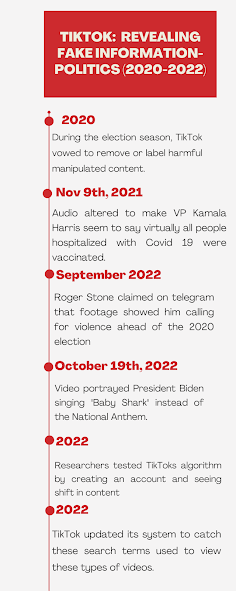
         TikTok has become a place where users are posting information that could have an effect on the election. TikTok has a positive outlook when discussing the issue and the company states, “At TikTok, we take our responsibility to protect the integrity of our platform- particularly around elections- with the utmost seriousness” (Han). With this, it is assumed by readers and viewers that they are taking this very seriously and are working diligently to find a solution to stop the spread of misinformation. According to an article by Rebekah Dunne, she describes that 1,057 U.S. residents were asked about their feelings towards social media and search platforms, specifically TikTok. With this research, “Even though TikTok boosted 100 million users towards the end of last year, it is the least trusted, with only 28% of respondents seeing the social platform as trustworthy” (Dunne). This shows that less than half of the respondents said they trusted this platform for the quality of their videos and if the videos were factual. 28% of respondents who trust TikTok is worrisome because that means that there is a good amount of people who watch these videos, and their opinions might be changed based on what they see. This in the end, could influence the election since these viewers are watching videos regarding political figures. In the wall street journal article, Worries Grow That TikTok Is New Home for Manipulated Video and Photos, Tiffany Hsu writes about the misinformation that these videos on TikTok are showing. This case started in 2020 during the election season when TikTok and other social media platforms vowed to remove or label harmful manipulated content. In November of 2021 there was a video posted of Kamala Harris, the Vice President, altered to make it seem like she was stating that all people hospitalized with Covid-19 were vaccinated. In the original film she was stating that these people that were sick were unvaccinated, but users of TikTok made her seem like she was telling the public that these people were vaccinated. This could potentially ruin her reputation on social media and affect the results in the election. Another example video discussed in the article was in September of 2022. This video that was posted shows political consultant Roger Stone claiming on Telegram that footage showed him calling for violence ahead of the 2020 election. Later, CNN aired that this was fraudulent deep fake videos. This could have a major impact on people’s opinions towards Stone. Stone is being portrayed in this video as wanting violence and the timing of this video being posted is very close to the election. Another example video was from October of 2022 regarding Ms. Biden. There were several TikTok videos that, “manipulated video of Ms. Biden promoting White House cancer initiatives at the Philadelphia Eagles’ home field” (Hsu). These videos were viewed tens of thousands of times. In these videos, the sound of the crowd was replaced with loud booing and heckling. Seeing this video spreads a dislike for Ms. Biden across the country. In October of 2022 two videos were posted that also could have had an effect on the election. The first video being President Biden portrayed to be singing “Baby Shark” instead of the National Anthem. The next video was a video where the White

President Biden singing baby shark


House press secretary Karine Jean-Pierre was edited to imply she was ignoring a question from a Fox News reporter. With these examples and many more that are out there on social media there is a need for this to be stopped. This is affecting and changing people’s opinions on political measures. Personally, I know when I see a video my first instinct is to not think it is fake. However, seeing videos that involve politics for sure makes me question what I am watching. People started to question these videos and it became such a big deal that researchers wanted to learn more about this app. This research team was from a corporate accountability advocacy group called SumOfUs. This group wanted to test TikTok’s algorithm, so they created an account on this app. They started by searching for the 20 most widely watched videos that showed doubt in the election system. The article stated that, “Within an hour, the algorithm had switched from serving neutral content to pushing more election disinformation, polarizing content, far right extremism, QAnon conspiracy theories and false Covid-19 narratives, the researchers found” (Hsu). TikTok’s response to this was to remove the content and inform the public that they updated their system to catch the search terms used to find these specific videos. These videos violated TikTok’s guidelines, it was just a matter of how to figure out a way to stop this from happening. In closing of the article, it was stated that TikTok had removed all the videos that were reported by The New York Times that went against its policies that “mislead users by distorting the truth of events and cause significant harm to the subject of the video, other persons or society” (Hsu). TikTok took the measures they needed to in dealing with these videos. TikTok stated on their page that they were updating their policies for political accounts. One way to limit these posts was to verify accounts when they are created. Verification is now mandatory for accounts that belong to “governments, politicians, and political parties through midterm elections” (Chandlee). These accounts that belong to politicians and political parties will also have their access to advertising denied which will help TikTok more consistently enforce their policy. A statement from TikTok that caught my eye when thinking of how hard working this company is included, “By prohibiting campaign fundraising and limiting access to our monetization features and verifying accounts, we’re aiming to strike a balance between enabling people to discuss the issues that are relevant to their lives while also protecting the creating, entertaining platform that our community wants” (Chandlee). I believe that TikTok is being very smart in the way they are approaching this issue. They are making sure that their platform can be a place for viewers to learn about politics, something that impacts their lives greatly, but at the same time protecting their company from being a place where misinformation occurs. Another step TikTok did in response to these videos was partnering with experts and fact-checkers to check how accurate the videos being posted are. They also worked in limiting the feed that contained unsubstantial content (Morse). They stated that with these experts it was important that they helped “improve our overall approach to platform integrity, from policies to enforcement strategies to product experiences…” (Morse). These fact checkers assess the accuracy of content in more than 30 languages. TikTok explains that for precaution while this content is being checked it is ineligible for recommendation into For You feeds. This means that it will not show up on viewers' home pages when they are using the app. Throughout political elections TikTok enforces its policies through not allowing, “Paid political advertising, and our Community Guidelines prohibit content including election misinformation, harassment- including that directed towards election workers- hateful behavior, and violent extremism” (Han). This statement from TikTok shows the diligence from their company during the political election.

STAKEHOLDERS

         The Stakeholders involved with TikTok are TikTok’s 1 billion users across 154 countries, Oracle, Walmart, the U.S. government, the company TikTok Global, TikTok and its technology, and ByteDance (Ruby).

The owner of TikTok, ByteDance

ByteDance is a Chinese internet company that owns TikTok. Oracle acquires 12.5% of the company while Walmart has a 7.5% stake in TikTok (Kovach). ByteDance has the majority of stake in the company with an overwhelming 80%. ByteDance made around $58 billion in revenue in 2022. The app was originally launched in 2016 by ByteDance, so ByteDance owns a large part of the company with other companies having little stake in comparison. ByteDance shareholders include American, Chinese, and international investors. About 53% of TikTok’s global shares are owned by American investors and the two companies Oracle and Walmart. Also, the 8,424 employees are stakeholders of the company as they show interest in working (Zippia). Along with employees, any investors that buy stock in TikTok also show great interest in the company. Throughout my paper, some of the political figures who are stakeholders in this case were President Biden, Kamala Harris, Roger Stone, Ms. Biden, and Karine Jean-Pierre. As a result of this case, the public of America are stakeholders because they are greatly affected by the election and its results.

INDIVIDUALISM

Individualism, according to Milton Friedman is the idea that the only goal of the business organization is to profit. This means that for an employee of that organization the only obligation they have to the company is to maximize profit for the stockholders and owners and doing this still obeying the law. On the other hand, Tibor Machan had a different view on individualism. His belief towards this was the same as Friedman’s first part but he also included that with keeping in mind that the goal is to profit, employees and workers might have other goals that they are responsible for socially. They can choose to use company resources for social responsibilities if it helps with the overall goal. This is a more free way of individualism and gives the employees, owners, and company a little more freedom with the way they run their organization. Through this company struggle, TikTok abided by the law in their efforts to solve the problem of this spread. Dealing with these videos is shown to not have a negative effect on their profit. From 2020 to 2022 TikTok’s revenue increased from $1.9 billion to $11.64 billion (Ying). Even though they had to spend more of their time focusing on this issue, they were still able to find a way to maximize their profit. If TikTok had not spent their time and efforts on evaluating this issue, they would have not maximized their profits as users wanted to see a change for the better of the app. TikTok cooperated with government and political figures in working to find a way to ensure a safe factual platform for their users.  

UTILITARIANISM

Utilitarianism is the idea of maximizing happiness in yourself and others. The main goal is to “bring out happiness and pleasure in all beings capable of feeling it” (Salazar). One way a Utilitarian shows their values is making sure that their actions benefit everyone around them. For example, in a workplace this would include making sure one’s actions benefited all the other workers and the company. Employees at TikTok were most affected during this case. They were being pressured to make sure the content being posted was not fake and affecting the election. Their main goal is to make sure that people are viewing videos that are not edited to make people seem like something they aren’t. Throughout the time that these TikTok’s were being created, employees were making sure that TikTok’s automatic system was catching and deleting them as fast as they could to benefit the company and keep them up in running. In return with the company staying up and running because these posts were getting deleted it benefited other employees and the company because everyone got to keep their jobs. Not only were the employees benefiting by keeping their jobs by making sure these videos are being deleted so the company can succeed, but viewers also appreciate when they scroll through their feed and there are no videos relating to political figures being made out to be something that they are not. When viewers see a post that might not be true, and they know it is not true they could easily become very upset and possibly delete the app because of their frustrations. But, in this case with deleting these posts, viewers will be happy because they most likely won’t see posts they don’t want to see. TikTok is an app that creates happiness for viewers as they view videos that make them laugh and smile. This app is addictive for users as many get stuck scrolling for hours and don’t even realize the time that has passed. A Utilitarian would disagree with the way TikTok can manipulate viewers to believe false information because in the end it is not maximizing one’s happiness. Also, TikTok can get in the way of one’s personal health as they are comparing themselves to these people in these various videos.

KANTIANISM

         Kantianism is a theory developed by Immanuel Kant that has four basic principles. These include acting rationally, helping others to make rational decisions, respect others, and be motivated to do what is right because it is right. Under Kantianism, The Formula of Humanity states that “Act in such a way that you treat humanity, whether in your own person or in the person of another, always at the same time as an end and never simply a means” (Kerstein). This formula explains that you should never treat a person merely as something that is valuable to get something else. TikTok continues to put their efforts in steps to eliminate this misinformation without disregarding The Formula of Humanity towards their users and employees. TikTok is motivated to do what is right in this situation and that is to do everything they can do to prevent these videos from spreading. With this ethical theory, Kantians would agree with the actions and steps that TikTok took to make sure these videos that were election focused were being caught before viewers got to see them and make opinions that are not from facts. This is shown when researchers created a TikTok account to test its algorithm. After creating this account, the researchers searched for the 20 most widely watched videos that showed doubt in the election system. In the New York Times article, Hsu stated that, “Within an hour, the algorithm had switched from serving neutral content to pushing more election disinformation, polarizing content, far right extremism…” (Hsu). Kantians would agree with TikTok’s response to this because they stated that they would remove the content that violated its guidelines and would update its system to catch the search terms used to find the videos. TikTok is doing what is right and is motivated to find the best way to catch these videos that users are posting. They are also respecting these viewers because they don’t want their opinions to be made from watching a video that has fake information. TikTok is not using their viewers for their own personal gain, instead they are trying to find a way to solve this problem. This is a very smart action that TikTok performed because not only does this affect the users in the moment by seeing these videos, but if these videos shape their votes in the election, it could very easily affect the results since this browser is such a worldwide prominent social media app. The company is hard to evaluate since they continue to improve their app to catch misinformation, yet there are still posts out there currently that portray misinformation. Because of their efforts, a Kantian would agree with their actions. TikTok has good intentions, and this is something that is very important when considering the Kantian view. TikTok didn’t create their app wanting people to post misinformation and viewers can notice the efforts they are putting in to stop this.

Americans trust/mistrust in TikTok


VIRTUE THEORY

         Virtue theory, developed by Aristotle, describes that rationality is the characteristic that makes one person different from another. Aristotle believes that to live a good life and function strongly throughout one's life people must practice rationality. There are four cardinal virtues to virtue theory that are very important to look at when looking into TikTok as a company. These four include: Courage, temperance, justice/fairness, and honesty. The one intellectual virtue that Aristotle describes in this theory is prudence. Prudence is the ability to look forward at your future self and make good decisions in your current experiences to make sure you become the person you want to be. Aristotle believes that happiness comes from living a flourishing life. This means that you have lived your life to its fullest and have taken in and appreciated everything. The main goal of this theory bases the idea of good upon a specific thing’s characteristics and its purpose. When diving into the TikTok case and the way the employees dealt with it through the Virtue Theory, these employees showed great courage when trying to solve this issue. These employees worked long days and were willing to work hard and do anything they needed to make sure these viewers weren’t watching fake news relating to the election. The business as well showed great courage when dealing with this issue. They worked hard to come up with solutions and battled through the adversity they faced as there were many complaints about the posts on the app. Management at TikTok didn’t do a great job with the treatment of their employees, meaning that the second virtue, fairness, was not met by the company. These employees stated in multiple articles that they were working long hours in toxic environments. Some may say that employees were not being fair in the way they chose the videos to remove, but from the insider it is known that experts are the ones that are the deciding factor. The next virtue, temperance, was not met by the company and employees as employees’ expectations were way too high for their position. In an article it is stated that, “Exhausting hours and sleep deprivation are coming amongst staff, while some employees said they averaged 85 hours of meetings per week” (Yahoo Finance). This is not a reasonable expectation for these workers and with this stress and exhaustion it doesn’t do the company any good. The company also had high expectations from the public to get rid of these videos. The last virtue is justice. Justice is described as hard work and good ideas. These employees and TikTok management are working hard to make sure these videos are being deleted from viewers' pages and they have come up with ways to prevent this from happening. For example, updating their system to catch search terms relating to misinformation in the election. Overall, the company shows justice by coming up with solid ideas to stop this spread.

JUSTIFIED ETHICS EVALUATION

In my opinion, TikTok’s approach to this issue was the best they could do. Even though there is no solution to stopping people from editing posts and posting them for the world to see, I think there are few solutions for TikTok to implement. Although, TikTok was unethical in the way they cared for their employees. With the long hours and overworking of their employees, it became known to the public that one should not apply to work for TikTok because of these conditions.  I think the most unethical part about this case was the fact that in 2020 before the election TikTok agreed to remove or label the harmful manipulated content and clearly this didn’t happen as much as people wanted. Videos were still being posted and seen by the public. The content in videos that are posted on TikTok can be very unethical as described in some of the examples of videos relating to the election. TikTok is a very addictive app, and many people get stuck scrolling for hours. When people get caught up in these videos, they start to form opinions on whatever it is that they are watching. Because social media is a platform with a lot of freedom to post whatever you want, many other companies are struggling with this issue as well. I think that because they are working to update their search terms and catch these videos as quickly as they can, they are taking steps to limit the negative effects of these videos.

CONCLUSION

         In all, TikTok has created a good baseline for protecting viewers from seeing information that is false. They are trying their best to quickly update their systems to catch all these search terms without getting rid of the app completely. The main issue is that TikTok vowed to remove all content starting in 2020 that would impact the election. As described in my essay it is proven wrong as many accounts of videos were created to depict political figures as something they aren’t. Now, being 2022, there are still several videos being created that viewers are watching that are related to the election and people involved in the election. Throughout my paper, I analyzed TikTok’s response to this issue and used the theories of individualism, Utilitarianism, Kantianism, and Virtue Theory to evaluate the company.


REFERENCES

Chandlee. “Updating Our Policies for Political Accounts.” Newsroom, TikTok, 16 Aug. 2019, https://newsroom.tiktok.com/en-us/updating-our-policies-for-political-accounts.

Dunne, Rebekah. “Americans Trust Google More than Facebook, Tiktok.” Search Engine Journal, 10 Mar. 2021, https://www.searchenginejournal.com/americans-trust-google-more-than-facebook-or-tiktok/397774/.

Han. “Our Commitment to Election Integrity.” Newsroom, TikTok, 16 Aug. 2019, https://newsroom.tiktok.com/en-us/our-commitment-to-election-integrity.

Hsu, Tiffany. “Worries Grow That TikTok Is New Home for Manipulated Video and Photos.” The New York Times, The New York Times, 4 Nov. 2022, https://www.nytimes.com/2022/11/04/technology/tiktok-deepfakes-disinformation.html.

Kerstein, Samuel. “Treating Persons as Means.” Stanford Encyclopedia of Philosophy, Stanford University, 13 Apr. 2019, https://plato.stanford.edu/entries/persons-means/#:~:text=One%20formulation%2C%20often%20called%20the,1785%3A%20429%2C%20italics%20removed).

Lin, Ying. “Tiktok Ad Revenue (2019–2024).” Oberlo, Oberlo, https://www.oberlo.com/statistics/tiktok-ad-revenue.

Morse, Andrew. “Tiktok Removed Nearly 350,000 Videos Related to Election Misinformation.” CNET, CNET, 25 Feb. 2021, https://www.cnet.com/news/politics/tiktok-removed-nearly-350000-videos-related-to-election-misinformation/.

Ruby, Daniel, and About The Author Daniel Ruby Content writer with 10+ years of experience. I write across a range of subjects. “35+ Tiktok User Statistics: How Many TikTok Users Are There in 2022?” Demandsage, 16 Nov. 2022, https://www.demandsage.com/tiktok-user-statistics/.

Salazar, Heather. The Business Ethics Case Manual .

Stevekovach. “Tiktok Deal Puts U.S. Owners in Charge, but Chinese Parent Company Still Has Some Say.” CNBC, CNBC, 22 Sept. 2020, https://www.cnbc.com/2020/09/21/tiktok-deal-splits-control-between-us-and-chinese-owners.html.

“TikTok Staff Speak out about Toxic Work Culture and Emphasis on 'Relentless Productivity'.” Yahoo! Finance, Yahoo!, https://finance.yahoo.com/news/tiktok-staff-speak-toxic-culture-104417817.html?guccounter=1&guce_referrer=aHR0cHM6Ly93d3cuZ29vZ2xlLmNvbS8&guce_referrer_sig=AQAAAI8RY0VGJn6eKALw3U-2ysIcCSEfpKGfkFN_Ln-233TzYawgFDyqccq7fCuu0ZUtVUfgJ_BPb_K5Dw__GhL3CuFOp1wS61cJqbDyyY_0fF5ZLmRu8wfgSNjJxMq4ipsdgy77Lqdq8ggrcPmKsssZmEPZxnvhlx9sfaLlV8JZXZy3.

             “Working at TikTok.” Employee Reviews and Culture, 18 Nov. 2022, https://www.zippia.com/tiktok-careers-1472578/.

Thursday, December 3, 2020

Google: Department of Justice files a Long-Anticipated Antitrust Lawsuit (2020-Current)


        Google is one of the largest companies in the world, and has a major influence not only on the internet itself, but all its users. On Tuesday October 20th, 2020, the United States Department of Justice along with eleven state Attorney Generals filed a civil antitrust lawsuit against Google. Google is under heavy scrutiny, and the future of the tech giant is dependent upon the results of this lawsuit. The main objectives of this paper are to allude to whether or not Google is in fact in violation of antitrust laws, and whether or not their business practices and potential monopolization of the market lies within ethical boundaries, or violates them. There are four main ethical theories that will evaluate Google, those four theories include Individualism, Utilitarianism, Kantianism, and Virtue Theory. Each theory consists of different rules and criteria, but with all four justifications considered, Google’s recent practices can be evaluated fairly and without bias.

What is Google?

         “Our mission is to organize the world’s information and make it universally accessible and useful” (1). This is the mission statement for Google, an American multinational technology company, that has dominated the internet over the past decade. Google specializes in internet services and products, most importantly, online advertising technologies, a global search engine, cloud computing, software, and hardware. Google is the most visited website worldwide. It is considered one of the big five technology companies in the United States: Google, Apple, Amazon, Facebook, and Microsoft. (2) Undoubtedly, Google has embedded itself into the daily lives of billions of people all across the world. Google was first conceived as a graduate project at Stanford, however, since its initial public offering in 2004, it has amassed into one of the most recognizable firms worldwide. In order to truly understand the worldwide impact of Google, the following information must be acknowledged. In an article compiling statistics on Google, the author states the following, “Google handles more than 40,000 queries per second. That translates to over 3.5 billion searches every day. Additionally, as of December 2019, Google holds 92.71% of the search engine market share“(3). Not only does Google have a huge consumer base, but it also serves as a marketplace. The article states, “[Producers] can get up to 30% more customers

by only moving up one spot in Google’s search results, and users are four times more likely to click on a Google ad than on one by any of its competitors” (3). Google’s influence upon its consumers has exponentially grown over the years through new advertising strategies. Overall, Google has grown into a household name and entity in billions of lives, and will continue to provide its vast services and products to people worldwide. However, despite Google’s overwhelming success, it has faced its share of obstacles. On October 20th, 2020, a civil antitrust lawsuit was filed against Google by the Department of Justice. 


[The graphic to the left shows the statistics of various search engine usage rates across multiple platforms. It is important to acknowledge that Google is represented by the blue, red, and a few of the smaller sections in the graph. The largest competitors of Google are also shown in this graphic.] 


Antitrust Laws

         To put it in simple terms, antitrust laws are laws which regulate firms, and prevent the monopolization of markets in order to preserve the competitive integrity of the market. The Federal Trade Commission provides an overview of the various antitrust laws. The FTC states,

“Congress passed the first antitrust law, the Sherman Act, in 1890 as a "comprehensive charter of economic liberty aimed at preserving free and unfettered competition as the rule of trade." In 1914, Congress passed two additional antitrust laws: The Federal Trade Commission Act, which created the FTC, and the Clayton Act” (6)

Despite being passed by Congress over a hundred years ago, these three main antitrust laws, with some minor changes, are still serving today. The Sherman Act, according to the FTC, “outlaws every contract, combination, or conspiracy in restraint of trade, and any monopolization, attempted monopolization, or conspiracy or combination to monopolize” (6). The Sherman Act has been cited in many antitrust lawsuits in the past, and is often the deciding factor of whether a company is deemed as a monopoly. The Federal Trade Commission Act prohibits, “‘unfair methods of competition’ and ‘unfair or deceptive acts or practices’ “(6). Lastly, the Clayton Act prohibits forms or mergers in which the same people are able to make decisions for competing firms. All three of these antitrust laws form the basis for any antitrust lawsuit filed against a firm. In order to win an antitrust lawsuit, the Department of Justice must be able to provide enough evidence to prove that the firm is in violation of one or more of these laws. With regards to Google, the Department of Justice has enforced the Sherman Act similar to what they have done in the past. In order to understand the consequences of a violation of antitrust laws, historical cases must be analyzed.

History of Antitrust Lawsuits

         Google is not the first major firm to face an antitrust lawsuit; some notorious antitrust lawsuits include the ones filed against AT&T in 1974 and Microsoft in 1998. The Department of Justice has made it clear that this current lawsuit filed against Google has the same severity of those previous lawsuits. In order to fully understand the complexity of the lawsuit filed against Google, there must be some historical context to provide a basis for this current lawsuit. In 1974, the Department of Justice filed a civil antitrust lawsuit against AT&T. The following excerpt has been taken directly from the public release by the Department of Justice in 1974,

“According to the complaint, the alleged violation of Section 2 of the Sherman Act had the following effects: Defendants have achieved and maintained a monopoly in telecommunications service and telecommunications equipment in the United States; Actual and potential competition in telecommunications service and telecommunications equipment has been restrained and eliminated; and Purchasers of telecommunications service and telecommunications equipment have been denied the benefits of a free and competitive market” (4).

Under the antitrust laws, AT&T was deemed a monopoly, and was forced to split up following the lawsuit in order to sustain a free and competitive market. AT&T coincidentally possessed some similar statistics to Google in regards to market ownership in an industry. The document states, “AT&T has total assets of more than $67 billion, and its operating company subsidiaries supply more than 80 percent of the nation's telephones” (4). The Department of Justice has been closely watching Google for years, and has finally filed this lawsuit with the same concern that was voiced in 1974. Fast forward 24 years, and the Department of Justice filed its second major antitrust lawsuit against Microsoft.  On May 18th, 1998, the Department of Justice made the antitrust suit available to the public, under the claim that Microsoft was unlawfully monopolizing computer software markets. Within the document, Joel I. Klein, Assistant Attorney General in charge of the Department's Antitrust Division, said the following regarding the case, "This action will protect innovation by ensuring that anyone who develops a software program will have a fair opportunity to compete in the marketplace” and additionally, “Inventors and investors cannot and will not develop and market innovative software programs if they know that Microsoft can use its Windows monopoly to block the distribution of their programs and to force consumers to buy Microsoft's competing products” (5). Similar to AT&T, Microsoft was acting as a monopoly in the software industry. This successful lawsuit protected the competitive market, and ensured the consumers that no large firm was above the law. The current antitrust lawsuit, filed by the Department of Justice, aims to do the same; preserve the free and competitive market that allows consumers and producers to make fair and conscious decisions.

Overview of Google’s Antitrust Lawsuit

         October 20th, 2020 marked the beginning of another major antitrust lawsuit against the internet giant, Google. Similar to AT&T and Microsoft, Google has control over most of their market. The Department of Justice is labeling Google as a monopoly, whereas Google is stating that they are a free to use search engine who is driven by the consumer. In a statement from Attorney General William Barr,

“Over the course of the last 16 months, the Antitrust Division collected convincing evidence that Google no longer competes only on the merits but instead uses its monopoly power – and billions in monopoly profits – to lock up key pathways to search on mobile phones, browsers, and next generation devices, depriving rivals of distribution and scale” (7).

Attorney General Barr along with numerous other Attorney Generals from all different parts of the country as well as the Department of Justice, are stating that Google is wielding monopoly power and is successfully manipulating the consumers. Attorney General Barr would then go on to state, “This lack of competition harms users, advertisers, and small businesses in the form of fewer choices, reduced quality (including on metrics like privacy), higher advertising prices, and less innovation” (7). Google is continuing to grow and prosper off of these practices, and without regulation, consumers and smaller firms and producers will be hurt. In closing, Attorney General Barr writes, “If we let Google continue its anticompetitive ways, we will lose the next wave of innovators and Americans may never get to benefit from the “next Google.”  The time has come to restore competition to this vital industry” (7). The Department of Justice is enforcing the Sherman Act, as explained previously as the prohibition of any restriction in trade or monopolization of a market. However, the information provided by Attorney General William Barr is not sufficient in exploiting Google’s unethical practices. The lawsuit released by the Department of Justice provides a more in-depth explanation as to how Google is in violation of antitrust laws. The complaint alleges that Google acquired monopoly powers in search and search advertising through the following:

“Entering into exclusivity agreements that forbid preinstallation of any competing search service. Entering into tying and other arrangements that force preinstallation of its search applications in prime locations on mobile devices and make them un-deletable, regardless of consumer preference. Entering into long-term agreements with Apple that require Google to be the default – and de facto exclusive – general search engine on Apple’s popular Safari browser and other Apple search tools. Generally using monopoly profits to buy preferential treatment for its search engine on devices, web browsers, and other search access points, creating a continuous and self-reinforcing cycle of monopolization” (8).

The complaint against Google is substantial, and the giant corporation is facing quite the challenge with the odds stacked against them. In response to the allegations brought up against them, Google wittily responded, “The bigger point is that people don't use Google because they have to, they use it because they choose to. We remain absolutely focused on delivering the free services that help Americans every day” (9). There is quite a lot that lies within the verdict of this lawsuit, and this will unequivocally impact the markets, its producers, and consumers worldwide. Considering the vast amount of information, the claims by the Department of Justice seem to wield enough power to impose antitrust restrictions on Google. However, this is an ongoing lawsuit, and the eventual verdict will not be a simple answer. The following ethical evaluation will be based on the claims that the Department of Justice has put forward.


Stakeholders

         The people affected by this antitrust lawsuit extends much further than Google itself. Obviously, the shareholders, employees, and executives of Google will be substantially impacted by this lawsuit. However, as the worldwide leading search engine, Google reaches billions of people all over the planet. The stakeholders consist of all of the billions of individuals worldwide that use Google’s search engine and products every day. The verdict in this antitrust lawsuit will impact the advertising on google for all of the producers and firms worldwide that pay Google to run their advertisements. Consumers and smaller producers may even benefit from this lawsuit if Google’s advertising practices are changed, giving smaller businesses an opportunity to grow. Certainly, in the case of a monopoly, competitors are unable to compete in the market. This lawsuit brings life into all of the competitors in the industry, and gives them a fair opportunity to provide their services. The reality is that billions of people are affected by Google and their practices, whether good or bad, this antitrust lawsuit will have an impact on all of our lives.

The Application of Individualism

         Individualism is one of four ethical theories that will be used to evaluate Google and their current antitrust lawsuit. Individualism’s primary values are the business, the owner’s choices, and most importantly the business’ profits. According to Dr. Salazar’s Case Manual, the general rule of individualism is that, “business actions should maximize profits for the owners of a business, but do so within the law” (10). Individualism is the contrary to many ethical beliefs, but nonetheless it is a form of ethical evaluation. In the antitrust lawsuit filed against Google, which is an ongoing investigation and lawsuit, it is difficult to completely assess whether or not Google is acting ethically or unethically. Google would state that they are in fact maximizing profits through the generation of ad revenue and the sales of their products. However, according to the Department of Justice, Google is in violation of antitrust laws, and is a monopoly in the market. As stated previously, they have justified their position by stating that Google is in violation of the Sherman Act. They have done so by achieving monopoly powers in the market, and essentially entering agreements with companies like Apple to diminish any presence of competition in the market. By doing this, Google would certainly benefit and profit a lot more off of their services through advertisements. However, this practice is illegal and an abuse of power by the firm. If the Department of Justice can prove that Google has been conducting these practices and is a monopoly, then Google would be acting unethically according to individualism. Again, individualism states that a business’ main objective is to maximize profits within the law, but in this case, Google would be maximizing their profits by breaking antitrust laws. Therefore, from an individualism standpoint, if the accusations filed against Google are true, then Google’s business practices would be unethical.

The Application of Utilitarianism

         Utilitarianism, another main ethical theory that will be used to assess Google, focuses on the overall happiness of all human beings. According to the Case Manual, Dr. Salazar states that the primary values of Utilitarianism include, “Happiness of all conscious beings, often interpreted hedonistically as pleasure and the absence of pain, but also sometimes interpreted as the satisfaction of desires” (10). For Google, Utilitarianism states that its actions must promote happiness for all conscious beings, and not only for the business and their consumers. Dr. Salazar states that the ethical rule of Utilitarianism is to, “maximize the happiness in the long run for all conscious beings that are affected by the business action” (10). Utilitarianism is completely different from Individualism; essentially with individualism, it is ethical to conduct a business practice that hurts a majority of individuals as long as the practice maximizes profit and is conducted within the boundaries of the law. With regards to Utilitarianism, maximizing profit is not a main focus, and you can break the law as long as it promotes happiness for the majority of conscious beings. For this reason, it is a lot simpler to evaluate Google and the current antitrust lawsuit under Utilitarianism than Individualism. The verdict in the antitrust lawsuit against Google will not justify Google’s ethical standing. Google is one of the largest and widely recognized firms in the world. As stated earlier, Google is home to billions of consumers, and much of their consumers have Google’s services at their disposal at all times. Google’s search engine is extremely useful and helpful, and makes everyone’s day easier. It is without a doubt that the average person is more than grateful for Google’s substantial information databases and search queries. Billions of lives around the globe are made easier with Google, and it is without a doubt that those individuals are very happy with Google and what it provides to them. However, although the majority is content with the firm’s free-to-use services, there are a few groups of people who are unhappy with Google and are seeking justice. Those groups include the justice system who had filed the lawsuit against Google, and the competitors of Google who do not have a fair chance to compete with its products and services. Utilitarianism focuses on the overall happiness of conscious beings, but not every single conscious being can always be content. For this reason, the majority rules. In the case of Google, despite the antitrust lawsuit and potential violation of antitrust laws, their products and services make billions of people all around the world happy. From a Utilitarian standpoint, Google’s practices would be considered ethical, because although it might be a violation of antitrust laws, it makes more people happy than not.

The Application of Kantianism

         Kantianism is one of the more complex ethical theories, and the evaluation of Google using Kantian ethics can be influenced through the outcome of the lawsuit as well as the legitimacy of the allegations against Google. According to the Case Manual written by Dr. Salazar, the primary decision-making values of Kantianism ethics include, “Rational decision making, autonomy of individuals, honesty, and freedom” (10). Kantian ethics vouches for decisions to be made based on the “Good Will”, essentially, this means that decisions should be made with the right intentions. Kantianism states that you should not be a hypocrite, to be consistent and rational, allow and help people to make rational decisions, respect individuals, their own rationale, and their differences, and finally do what is right because it is the right thing to do. Dr. Salazar states that the Kantian ethical rule is the following, “Always act in ways that respect and honor individuals and their choices. Don’t lie, cheat, manipulate or harm others to get your way. Rather, use informed and rational consent from all parties” (10). Essentially, with regards to the Kantian ethical theory, a party must allow others to make decisions for themselves, and you must not lie or manipulate them in any way that will affect their ability to make rational decisions. A law of Kantian ethics that applies to the Google antitrust lawsuit is the Formula of Humanity. This ethical law states that you must not use an individual as a mere means to achieve what you want, but rather use them as an end. With regards to Google’s case, it appears that through the accusations of broken antitrust laws, Google has used its “free” platform to create a monopoly. Google has always credited its success to its fairness and accessibility to consumers, but their free platform has been manipulating billions of people for years. Although it is a free platform, Google runs thousands of ads to each user, and has implemented some new advertising strategies to maximize their success. In an article exposing the invasive tactics of Google, the author writes,

“That’s how monopolies extract their price. Google is playing fast and loose with the whole idea of search engines, making sure the simplest and easiest-to-access results are either paid ads or information that keeps you on Google. Either way, Google wins — and, more often than we realize, we lose” (11).

This article is very informative about advertising practices along with the specified results that allow Google to continue to build on its power on the market and the consumer. Although Google search queries are very useful and helpful more than not, the indirect effects of these advertisements and internet traffic are a direct manipulation of the consumer. Everything that Google does is conducted with the main objective of keeping you on their sites, and keeping their products a favorite amongst consumers. Although Google claims that their platform has the purpose of helping the consumer, in reality, the consumers are pawns in the grand scheme. The whole reason that Google has gotten to the point where an antitrust lawsuit was filed against them, is due to their manipulation of the consumer in order to gain more power. Additionally, through their search queries, Google is manipulating the individual’s rational and ability to make rational decisions by themselves. In the article exposing Google of unethical practices, the author writes, “A few weeks ago Elliot Anderson, a former state lawmaker who helped get Question One on the ballot, noticed that Googling “question one Nevada” generated a box at the top of the results that began: “Vote ‘no’ on Question 1” (11).

Not only is the firm using the consumer to further its dominance over its market, but it is also impeding on the individual’s rationale by attempting to influence them through their beliefs as a firm. With all the information considered, from a Kantian standpoint, Google is clearly acting unethically and their business practices violate the Formula of Humanity. Google is using the consumer to further its strangle on the market, and is utilizing their market power to influence the rational of their consumers. Undoubtedly, Google is in violation of Kantianism and the evidence to support how Google has acted unethically is similar to the evidence cited by the Department of Justice.


[The image above shows the search results for Question One on a Nevada ballot, which was discussed in the prior paragraph.]


The Application of Virtue Theory

         Virtue Theory ethics assesses whether a person, or in this case a firm, is virtuous or not. According to the Case Manual, the ethical rule of Virtue Theory is to, “Act so as to embody a variety of virtuous or good character traits so as to avoid vicious or bad character traits” (10). Overall, the objective is to accumulate good character traits by embodying the values of these various traits, and to avoid any harmful or malicious traits. When Virtue Theory is applied to an individual or firm, the following virtues are assessed: Prudence, Temperance, Courage, and Justice. These four character-traits are commonly referred to as the “Four Cardinal Values”. In regards to the four cardinal virtues, prudence and justice can be applied to the antitrust lawsuit. Prudence refers to making wise decisions pertaining to your future self, and certainly Google has not made great decisions considering the fact that they are facing an antitrust lawsuit, and are being accused of manipulating consumers and destroying competitors. Rather than utilizing justice to describe what Google has not done, it is important to acknowledge that the Department of Justice is seeking justice for the competitors of Google by attempting to dismantle their alleged monopoly. The advertising practices and corporate goals can be seen as greedy and selfish; Google is generating an absurd amount of money, but as a firm they are adamant about eliminating all forms of competition. As explained in the Kantian evaluation of Google, they are very dishonest with their consumers and are effectively manipulating them to further their control on the market. Overall, from a virtue theory ethical standpoint, Google has accumulated many negative virtues through the events that have led up to an antitrust lawsuit against them. The practices and business model of Google, assessed through virtues, are unethical.

Justified Ethical Evaluation

         Given that this case study involves an ongoing lawsuit, which has yet to be heard in court, it is unfair to give a verdict with complete certainty. We have all heard the common theory “Innocent until proven guilty”, but with all the information considered, we can speculate about the outcome of this lawsuit and the potential violation of ethics and morality by Google. In my opinion, after reviewing information from the Department of Justice and further validating some of their claims through outside credible sources, I do believe that Google is in violation of the antitrust laws, especially the Sherman Act which was previously discussed in this study. I believe that Google has engaged in unethical advertising practices in order to manipulate their consumers and the market, the information and studies speak for themselves. We all understand the power that the firm wields, but the methods in which they obtained this power was in violation of both antitrust laws and ethical theories. Google has successfully killed off competition through engaging in deals with other powerful companies like Apple to make their products unavoidable. These deals made by Google to establish themselves as a monopoly power, have violated the law and morals. Although some ethical evaluation does not deem Google’s practices as unethical, I believe the majority of ethical analyses will overwhelmingly deem their practices as unethical. To further develop my belief that Google has acted unethically and violated antitrust laws, I will reiterate a few key points. First off, I believe that any violation of antitrust laws is a violation of the individual consumer’s rights; it does not allow any competitor to experience success, thus destroying any choice that a consumer should be allowed to make. Second, I believe that Google is solely motivated by profits and has little regard for the consumer or any smaller firm that is trying to compete; their practices have proven to be malicious to competition. Google has manipulated the consumer by showing them what they want to see, and further enforcing selective advertisement. They have been able to control the rationality and decision making of billions of otherwise free minds. Google should be unbiased and impartial, and should enforce the belief that each individual should be open minded. However, the manipulation of the individual through prioritizing certain search queries and selective advertisement, has genuinely hurt the average user. Last, I believe the accumulation of search queries to produce a digital profile, and in turn using that to generate familiar and favorite results is an invasion of privacy. Google has been able to justify this by claiming it is helpful and more efficient, but in reality, it is just a means of control. I believe that this lawsuit will be very difficult for Google to put to rest, and I think that the evidence provided by the Department of Justice will help to reach a guilty verdict. I believe that Google needs to change their practices and allow competitors to be active in the industry that way one firm will be unable to manipulate the consumer; Google should be held accountable for their unethical practices.

Action Plan

         Google certainly has a lot of work ahead of them to demonstrate that they are and can continue to abide by antitrust laws, regain the trust of the consumer, and regain respect that has been lost to a lot of smaller competing firms and producers. Although Google is under heavy scrutiny with this impending antitrust lawsuit, as one of the most recognized companies in the world, it is without a doubt that Google can regain their respect. In order to resolve this issue, Google must first of all settle this lawsuit. Google must either clear their name and beat the lawsuit, or pay the consequences of the lawsuit and admit their wrongdoings. Once the lawsuit is settled, Google is still far from being up to ethical standards. Google must resolve the issues cited in the lawsuit by implementing new advertising methods that's main objective is being unbiased to the consumer, while still retaining its profitability. Google’s new practices may not be as profitable due to their previous practices being unethical and potentially illegal, but they must initiate change. If they do not change their methods, they may profit more, but they will still be acting unethically towards the consumer and to the market. Once Google implements new business practices which its goals are clearly stated, ethical, and importantly within legal boundaries, Google must be honest with the consumer and competitor. Google needs to encourage competition and allow the consumer to have a fair choice. Google’s current mission statement reads, “Our mission is to organize the world’s information and make it universally accessible and useful”. Google needs to prioritize freedom of will and the power to make individual decisions. They must continue their current mission statement, but attach a crucial part onto it. Google’s new mission statement should emphasize fairness, equal opportunity, freedom of will and choice, privacy and security, and respect for the opposition. Google’s new mission statement should be the following: Our mission is to provide the world’s information and make it accessible for everyone, but to do so impartially and respect the choices and views of all individuals. With Google’s new standards, the system must provide all information equally and make all information easily accessible. Google should not have any favorites, but act as a beneficiary to all individuals despite any preferences. Google should allow for competition, and win its consumers over through honesty and transparency rather than engaging in cutthroat business methods. All employees and management should be in support of being impartial, and welcoming to competition. Google will have to engage in a large-scale marketing campaign to push this new mission statement and regain confidence from its consumers. Although Google’s new practices might not be as profitable as before, their past practices lead them to an antitrust lawsuit which hurt consumer confidence. With their new business methods, Google will certainly avoid any future lawsuits of this kind, and will not have to allocate resources and time towards defending their brand. Google, after the lawsuit despite the outcome, will remain the most popular name in their industry. For this reason, if they become more transparent with their consumer and regain their trust, this can retain their large consumer base. Justice, honesty, and fairness will propel Google from this lawsuit back into profitability, but do so ethically and within the boundaries set by antitrust laws. To conclude, Google still has a long journey ahead of them to get back to where they want to be, but new methodology and values will ensure the legality and ethics of future endeavors.


References 

1) Google. “About Google, Our Culture & Company News”. (n.d.). Retrieved November 23, 2020, from https://about.google/.

2) “Google”. (2020, November 21). Retrieved November 23, 2020, from https://en.wikipedia.org/wiki/Google

3) S, Aleksander. (2020, September 11). “70+ Intriguing Google Statistics and Facts, Updated in 2020”. Retrieved November 23, 2020, from https://techjury.net/blog/google-statistics/

4) Department of Justice. (1974, November 20). “DOJ Antitrust Lawsuit filed against AT&T”. Retrieved November 23, 2020, from https://www.justice.gov/archive/atr/public/press_releases/1974/338834.pdf

5) Department of Justice. (1998, May 18). “JUSTICE DEPARTMENT FILES ANTITRUST SUIT AGAINST MICROSOFT FOR UNLAWFULLY MONOPOLIZING COMPUTER SOFTWARE MARKETS”. Retrieved November 23, 2020, from https://www.justice.gov/archive/atr/public/press_releases/1998/1764.htm

6) Federal Trade Commission. “The Antitrust Laws”. (2017, December 15). Retrieved November 23, 2020, from https://www.ftc.gov/tips-advice/competition-guidance/guide-antitrust-laws/antitrust-laws

7) Department of Justice. “Statement of the Attorney General on the Announcement of Civil Antitrust Lawsuit Filed Against Google”. (2020, October 20). Retrieved November 23, 2020, from https://www.justice.gov/opa/pr/statement-attorney-general-announcement-civil-antitrust-lawsuit-filed-against-google

8) Department of Justice. “Justice Department Sues Monopolist Google For Violating Antitrust Laws”. (2020, October 21). Retrieved November 23, 2020, from https://www.justice.gov/opa/pr/justice-department-sues-monopolist-google-violating-antitrust-laws

9) Fung, B. (2020, October 22). “Google's defense against antitrust lawsuit? You”. Retrieved November 23, 2020, from https://www.cnn.com/2020/10/22/tech/doj-google-antitrust-analysis/index.html

10) Salazar, Heather. The Business Ethics Case Manual. n.d.

11) Fowler, G. (2020, October 27). “Perspective | How does Google's monopoly hurt you? Try these searches”. Retrieved November 23, 2020, from https://www.washingtonpost.com/technology/2020/10/19/google-search-results-monopoly/