Showing posts with label Lawsuit. Show all posts

Friday, December 2, 2022

Elon Musk and the Twitter Midterm Elections (November 8, 2022)


Abstract

    The richest man in the world, Elon Musk, bought Twitter and immediately started to change it drastically right around election time without taking into consideration the ethical views with his decisions. It became hard for Twitter to be able to handle any information being posted about the election since so many employees had to leave in such a short span of time with no one able to fill their shoes right away. Some people have gone as far as changing their profile to look like Elon Musk’s to voice their opinions about the election. Which has caused some issues with Twitter wanting to change some of their rules to counteract impersonators. With there have been many complaints about what Musk is trying to do so far with changing the free social media app into a subscription service. Having the new verification process being added to Twitter seems like it’s more of a way for Musk to get his money back while using the idea of preventing impersonators as a cover up. With the ideas of Individualism, Utilitarianism, Kantianism, and Virtue Theory we can see what type of platform Musk is trying to turn Twitter into. Even if he was unaware of the ethical issues, he had to deal with to get what he wanted down with Twitter and its employees.


Ethics Case Controversy

    On October 28, 2022, Elon Musk officially had ownership of Twitter after putting an offer up back in April. He originally wanted to fire roughly half his staff before the bonuses that would come out on November 1st, but after talking with HR he changed it to November 3rd. Part of the reason why HR recommended that he do that was so that the people who would be fired couldn’t sue or anything due to not being able to receive their bonus that was promised to them. And since Musk had been dealing with the lawsuit that Twitter had against him for trying to back out of the original agreement, he probably wouldn’t want to deal with any more lawsuits that are back-to-back. This was only the start to what he was about to do with changing how Twitter is being operated. Not everyone realizes that sometimes what gets posted can have consequences that the social media employees must deal with. On November 7th it was reported that Elon Musk posted a very controversial photo of a Nazi soldier and commented it with how the “homing pigeons the soldier carried, comparing them to the ‘bird’ that is Twitter” (Chabria). Even though the comment that he made was not directly related to the solider in the picture it still causes issues due to the hate that is still in the image because of the presence of the Nazi soldier. There were so many other options for pictures that Musk could have just as easily posted but he chose that one for a reason even if he won’t come out and say it directly. It was around this time too that many advertisement companies have stopped posting ads on Twitter due to the amount of hateful speech that is being said and how some of it is being directed towards these companies such as, General Motors, Volkswagen Group and General Mills. There is a civil rights group calling for advertisers to boycott Twitter because “’it is immoral, dangerous, and highly destructive to our democracy for any advertiser to fund a platform that fuels hate speech, election denialism, and conspiracy theories’” (Oremus). No advertising company wants to back up another company that is not following the same idea of respect or morals because it can also make them look bad. That’s part of the reason why so many influential people try to refrain from saying their opinions on topics unless they felt it was absolutely important to. Musk believes that Twitter “should adhere to principles of free speech, doing little beyond what the law explicitly requires to police itself” (Oremus). It sounds almost like Musk will allow people to say whatever they want until they either trying to impersonate him or go against what he believes to be right opinion. Elon Musk even went as far as banning accounts that were impersonating him even though he is a big activist for freedom of speech. The people who impersonated him had the opposite political view that he had for this midterm election and that caused there to be tension between Musk and anyone who had impersonated him. In the Twitter rules one can “impersonate” another individual as long as they “distinguish themselves in BOTH their account name and bio” (Kolodny). It’s a way to make sure the actual account holder is reliable for what they say rather than get the person or group that they are trying to impersonate in trouble.
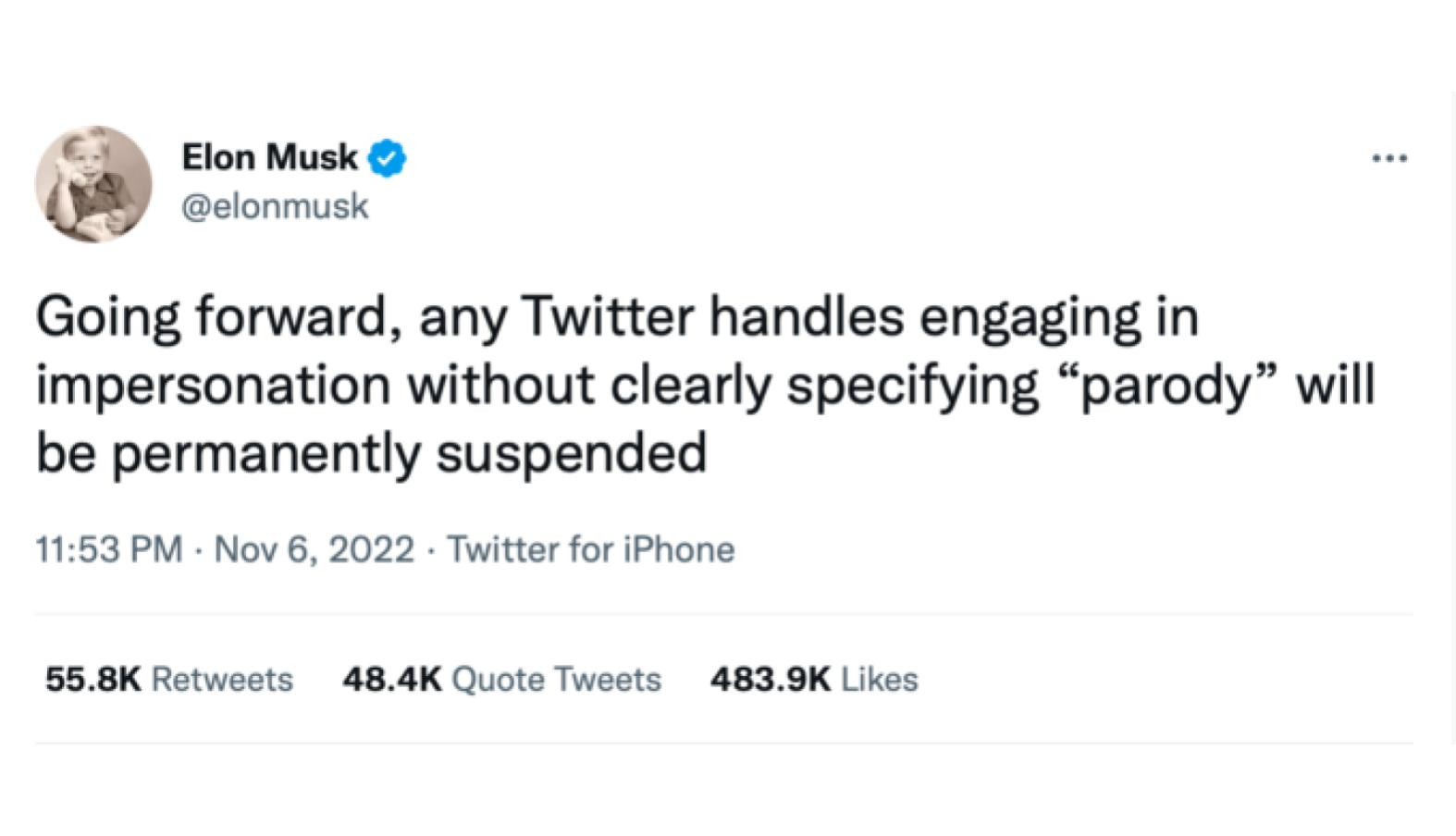
    On the same day that Elon Musk posted the controversial image he also tweeted to his 115 million followers to vote Republican. This happened after Musk was tweeting about staying politically neutral. There has been more and more misinformation about the elections as time goes by but since Twitter lost 7,500 employees, there isn’t enough people working to be able to keep up with the amount of misinformation that is being posted. Some people noticed a big slowdown in how quick and efficient Twitter used to be when needing to take fake news and other misinformation down. There are a lot of people trying to claim that the WI-FI networks at any location that polling is happening can cause the voting machines to be hacked. There have also been problems surrounding absentee ballots since so many people are starting to believe that mail in ballots is leading there to be a lot more voting fraud since there isn’t anyone making sure each person only drops off one ballot. When there are so many people on a social media platform as big as Twitter it can cause any information whether it is true or not to spread like wildfire. To help counteract some of the misinformation around election time, Elon Musk decided to launch a new Twitter verification process. It was originally supposed to launch before the election but due to the amount of people who got fired it made it hard for it to be launched on time. So, on November 9th the new verification process was launched which now requires people to pay an $8 a month subscription to have that blue check mark next to their name so that the chance of getting impersonated goes down. Some have speculated that the new verification process is a way to help Elon Musk make back the $44 billion that he spent on buying Twitter. Others think it was a way to stop so many comedies from trying to impersonate him and tell people to “vote Democrat” when he is trying to tell people to vote the opposite. (Conger).

    Once Elon musk had complete control over Twitter there was a huge increase in hateful speech that was happening. Most of it happening by accounts that are inauthentic. These trolling accounts are causing a lot of problems for the people and employees of Twitter. Since the hateful information isn’t being taken done fast enough it is leading more and more people to repost and add to the other hateful speech. In just a 12 hour window there was a over a 500% increase in the N word, Jew increased fivefold, and misogynistic and transphobic speech increased. It is believed that since “Musk is now the primary owner of the platform, he may follow through with loosening standards of harmful content and dissolving the so-called censorship he has criticized in the past” (Ray). It just goes to show how Elon Musk is trying to change Twitter and how fast it is changing under his ownership. Although some people believe that censoring content doesn’t do anything, statically speaking it has definitely made an impact when Trump got banned because the idea of election misinformation dropped by roughly 73% once he was removed. The type of people on social media really does have a huge impact in what gets posted and how big of an effect it has on the platform. (Ray).

Stakeholders
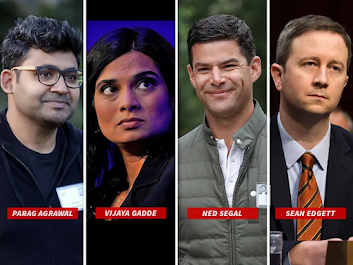
    All the people who have and use Twitter have been affected drastically since Elon Musk became the owner. He’s made it hard for people to know if the information they have been reading about the election is true or false. With roughly 7,500 of the staff gone from various positions such chief executive, policy executive, and many more that were completely fired. Some of executives that were fired are, Parag Agrawal, Ned Segal, and Vijaya Gadde. While also cutting “half of its public policy team: and “more than one team that touched election integrity” (Hatmaker). After Kathy Griffin and Rich Sommer were banned on Twitter there were several people who had complained and tried to get them unbanned. Elon Musk Said he would unban them if they chose to go through with the new verification process. It seems like Twitter is going to become like a streaming service and a way for Elon Musk to make back the money he lost buying Twitter.

Individualism

    Companies want employees that will help them achieve their goal in the long term, which means having to get rid of the ones that are holding back the company. With Elon Musk trying to make Twitter better, he needs to have employees that are going to help him achieve his goal. Since Musk wants to make Twitter a better social media platform so that more people would want to use it. Even though Musk is a big advocate for free speech, which means Musk is going to push the boundaries that have been set by society. With the smaller staff size at Twitter anything that isn’t morally allowed to be posted is taking longer to get down, which ends up helping Musk with the idea of free speech. Another one of Musk’s goals would be to maximize profit since that is what businesses would do so that they remain in business. With less employees and the subscription service to verify accounts, it will help increase the over all profit of Twitter.

                                                   Utilitarianism

   When Elon Musk bought Twitter, he bought it with the intention of making it better. By doing that he intends on finding ways to make more people on the platform happy. Even though Musk is trying to maximize his own happiness he also must consider the happiness of the users so that he can keep them on Twitter. By trying to get ads to be removed and banning people for impersonating other users it can make the platform more enjoyable for everyone. However, with how long it is taking Twitter to take down certain posts that are problematic, it is not helping with the user’s happiness of the platform. It’s the posts that are targeting specific people that are the more problematic ones and posts that have been made by impersonators.

Kantianism

    The users of Twitter should be treated with respect because they are the ones that are going to make it profitable for Elon Musk in the long run. They can’t be treated as just a way to get profit because it goes against the idea of having a good will. Musk would need to be able to find ways to make Twitter better that would benefit the users so that in return they would be able to give him what he wants. Since it is the motivation behind the action that matters more than the outcome itself. Even when Musk tried pulling out of the deal to get Twitter it made it a little clear that he was using Twitter to benefit himself more than making the platform better for everyone who uses it.

Virtue Theory

    It takes courage to be able to own a social media platform because not only does one have to worry about making it interesting enough for people to stay on it but also having to deal with what others are posting. On top of that but also having the self-control to handle any situation without overreacting or causing more problems that might end up causing people to leave the platform. Elon Musk would have needed to be taught how to deal with situations so that it appears like he has control over Twitter. He also would need to be fair with how he treats the people who are impersonating someone or posting things that are against the rules that Twitter has. Since if he treats people differently for doing the same thing then it is going to cause more problems for him down the line because no one would want to be treated differently. Without having the knowledge from either past experiences or from coworkers on how to run a platform like Twitter, it would not have been good for Musk since he would have lacked the wisdom and judgement that would be needed for Twitter. It requires a lot of experience and patience to learn from others on how things should be dealt with in a social media platform compared to other companies since there aren’t as many people watching and seeing what others are saying about it.

Justification Ethics Evaluation

    The way Musk is trying to handle everything that is going on with Twitter is not being handled well. It has been causing more problems when it comes to election information because there aren’t enough people to be able to keep up with everything everyone is posting. With the slowdown in the control of misinformation it has caused several tweets to get reposted thousands of times before anything has been done about it. The whole idea of Twitter becoming a paid verification social media app is just a way for Musk to be able to pay off the loans he had to pull out to buy Twitter because Twitter wouldn’t lower the cost after the original agreement. It feels wrong having someone run a social media app that’s as big as Twitter when there have been several times when Musk himself had to remove something he posted. By being the owner, it doesn’t give Musk the right to say and post whatever he wants and the amount of time it is taking for someone in his company to tell him to take down inappropriate posts is a problem. Musk doesn’t have the morals to be able to handle owning the app especially around the times that elections are held because so many people try to impersonate him. It just creates a lot of controversy about what the owner of any platform can and can’t be able to do and Musk seems like he wants to keep trying to push the envelope since he is so into freedom of speech.

                                                    Conclusion

    Even though Elon Musk has shown that he knows how to run a company and try to make it better he himself doesn’t know how to act on such a platform. By examining what he has done with the platform so far it shows how he hasn’t investigated the ethical views of his ideas. He seems to be very focused on making sure he can say what he wants and to try and find a way to make back the money he lost when he originally bought Twitter. Musk is all for freedom of speech but at the same time it seems almost as if he doesn’t like other people having a different opinion then him or even trying to be a comedian. He did at some point after getting Twitter say that comedy is now legal on Twitter but when some comedians tried to have fun with him it ended with their accounts getting banned or locked. Part of the issue seems to be that Elon is having a harder time trying to run a social media platform since it is drastically different from his other company Tesla and so many people on Twitter will voice their opinions on things that he says.


References

Chabria, Anita. “Column: Elon Musk is Breaking His New Toy. Will it Cost us Our Democracy?” Los Angeles Times. Nov. 8, 2022. https://www.latimes.com/california/story/2022-11- 08/column-icarus-has-crashed-the-weekend-we-all-expected-from-twitter
Conger, Kate. Hirsch, Lauren. “Elon Musk Twitter Take Over”. New York Times. October 27, 2022. https://www.nytimes.com/2022/10/27/technology/elon-musk-twitter-deal-complete.html
Dang, Sheila. Roumeliotis, Greg. “Musk Begins His Twitter Ownership With Firings, Declares the ‘Bird is Freed’”. Reuters. October 28, 2022. https://www.reuters.com/markets/deals/elon-musk-completes-44-bln-acquisition-twitter- 2022-10-28/
Hatmaker, Taylor. “Elon Musk’s Twitter Faces US Midterm Elections, His First High-Stakes Test”. TechCrunch. November 7, 2022. https://techcrunch.com/2022/11/07/elon-musk-twitter-us-midterm-elections/?guccounter=1
Kolodny, Lora. “Elon Musk Bans Impersonation Without Parody Label on Twitter Raising Questions  About Free Speech Commitment”. CNBC. November 7, 2022. https://www.cnbc.com/2022/11/07/elon-musk-unlabeled-twitter-parody-accounts-risk- permanent-suspension.html
Oremus, Will. Hassan, Jennifer. Siddiqui, Faiz. “Musk Recommends Voting GOP, Bans Twitter Accounts for ‘impersonation’”. The Washington Post. November 7, 2022.       https://www.washingtonpost.com/technology/2022/11/07/elon-musk-twitter/
Ray, Rashawn. Anyanwu, Joy. “Why is Elon Musk’s Twitter Takeover Increasing Hate Speech”. Brookings. November 23, 2022. https://www.brookings.edu/blog/how-we- rise/2022/11/23/why-is-elon-musks-twitter-takeover-increasing-hate-speech/

Friday, December 10, 2021

DoorDash: Lawsuit from the City of Chicago due to divisive tipping policy (May 2019)


DoorDash: Lawsuit from the City of Chicago due to divisive tipping policy (May 2019)


Case Controversy

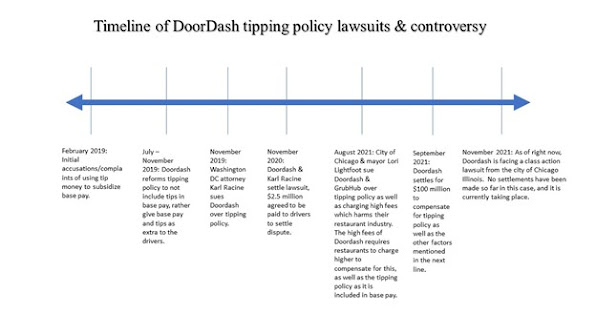
    As of September 2021, DoorDash is the largest food delivery service in the United States, delivering 57% of the United States’ food delivery orders in September.  However, prior to July of 2019 DoorDash had been using a deceptive tactic in terms of their tipping policy to pay less out of pocket to their drivers.  This policy was not only taking away tip money from drivers but was also making it so that DoorDash had to pay less base salary per delivery and would profit even more off of each order.  Since November of 2019, they have changed this policy to allow tips to be on top of the base salary, rather than a direct part of it. 

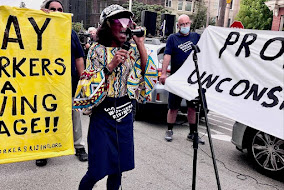
DoorDash Drivers knock on CEO's door to protest wages
            In February of 2019, DoorDash began to receive the initial complaints over the tipping policy on a mass scale.  This led to an investigation into the policy, as well as a boycott by employees and tech workers.  The investigation also included other food delivery services such as Amazon Flex and Instacart, who were both accused of this same tipping deception, and Instacart would be the first to change its policy on February 6th of 2019.  However, in February of 2019, Amazon Flex and DoorDash had still not changed their policy to follow suit with Instacart and stood by their decision to not do so.  This is due in part to a private market, as DoorDash is allowed to handle its own policies unless there is governmental intervention.  This allows DoorDash to stick with its initial tipping policy rather than changing it immediately. 

            This would lead to DoorDash changing its tipping policy over the course of July to November of 2019.  Rather than subsidizing tips into base payment, they would follow the traditional method of tips being on top of base salary.  The new tipping policy ensured that “Dashers wouldn't earn less as a result of customers not tipping, DoorDash increased the amount it chipped in per delivery. The company now pays $2 to $10 per delivery out of its own pocket to cover the minimum payment.”  (Fortune.com) After this change, there were multiple lawsuits regarding the previous tipping policy, and paying the drivers for tipping money that was subsidized up to that point.

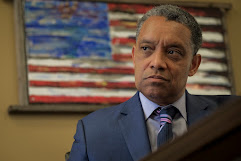
Attorney General Karl Racine
            The first lawsuit would come in November 2019 from the city of Washington D.C. and Attorney General Karl Racine.  This lawsuit would be filed under the charge that DoorDash misled consumers in Washington D.C. about how tips were being paid to the drivers.  This lawsuit would be settled a year later in November of 2020, in favor of Karl Racine and the city of Washington D.C.  The settlement would be $1.5 million to DoorDashers in a relief format, then $750,000 to Washington D.C. and $250,000 to local charities.  This totals up to $2.5 million, as well as Karl Racine requiring DoorDash to change their tipping policy to make sure all workers got their base pay amount even with tips.  While this tipping policy was already being implemented as of the prior year, the lawsuit began the same month they changed the policy so this was to ensure the policy would be used fully.   

Chicago Mayor Lori Lightfoot
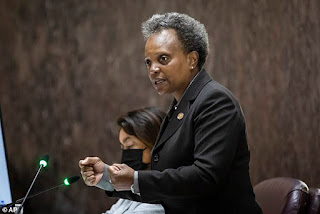
            Then the City of Chicago, Illinois, and mayor Lori Lightfoot would sue DoorDash in August of 2021.  This lawsuit was filed under the pretenses that DoorDash, among other food delivery services, was, “using unfair and deceptive tactics to take advantage of restaurants and consumers who were struggling to stay afloat.” (Lori Lightfoot) This lawsuit is based on multiple issues, one of which being DoorDash charging higher prices for items compared to the restaurant with the new tipping and payment policies.  They were also accused of delivering food without the prior authorization of the restaurants, which is believed to cause customer unhappiness with the restaurant rather than DoorDash even though it may not be their fault.  As of November 2021, this lawsuit is still being investigated and is on trial until a conclusion comes to fruition. 

Stakeholders

    The stakeholders involved with the DoorDash case would be the DoorDash as a Company, Employees of DoorDash, Previous Consumers of DoorDash, Future Customers with DoorDash, Future Shareholders, and the General Public.  The delayed actions of DoorDash to change their policy will affect how their employees and the general public view them in the future.  Prior to the change of policy, it was reported that 80% of DoorDash workers prefer the old pre-2019 model over the pre-2017 model, the pre-2017 model being nearly identical to the new one.  A statement from DoorDash also says that “Since we implemented our pay model in 2017, Dasher satisfaction has increased while average delivery times have fallen.” (DoorDash Spokesperson)  These two factors will heavily affect how stakeholders view this situation, as the change back to the earliest policy goes against what the majority of employees want.  The future customers of DoorDash are affected by this as they now have to read through the new policies, and likely will have higher prices to even out the amount of money lost by DoorDash without tip subsidization.  In terms of future shareholders, they have to consider these policies as well, and since DoorDash was very delayed in changing these policies until they were forced to, how will they handle events such as these in the future.  The general public is affected as DoorDash currently holds 57% of the online food delivery service orders, and this impacts a large number of people around the United States.  How these stakeholders are affected and the ties to Utilitarianism with this are explained in the next section.

Individualism

            Individualism as it pertains to DoorDash, Friedman’s individualism where “the only goal of business is to profit, so the only obligation that the business person has is to maximize profit for the owner or the stockholder within the law of the land.” Applying this to DoorDash we can see how the company was using the extra tips to cover the losses they are taking on the mandated tip rate. This is unethical, the employee is entitled to at least know they are losing out on the tip and make a choice if they would want to continue to work for DoorDash instead of thinking they are getting fair treatment. The customer is also entitled to know that if a tip is required then where directly is the money going. To mislead someone so drastically by advertising you are tipping the driver when it's really you’re covering the losses the company has placed on themselves clearly falls into the impermissible category. Regarding Machan’s Individualism “the only direct goal of business is to profit, and the primary obligation of the business person is to maximize profit within the law but: the direct goal of profiting may need to be met by indirect goals and not aimed at profiting, business people may have other goals and those goals may at times be prioritized over the goals of profit-maximizing.”

            The impacts the DoorDash lawsuits by the business should worry about the profits yes, but also worry about employees and customers, it may come as a loss but are you a company of enough morals to look at these potential losses and say it’s better for us to lose the tip money or lose the customers and employees. To an extent, DoorDash should be concerned with the profit and the return they are receiving. The company had every opportunity to come clean and say they made a mistake and grew too big to continue this guarantee. Instead, they decided to try and cover it secretly. They gambled and lost. Was it more important to cover a deal they offered to employees or the respect and moral integrity of the company? With these impermissible acts, they are facing a more drastic loss, the customer.

Utilitarianism

    A utilitarian would view this situation as the least ethically beneficial, including how DoorDash handled it and the situation itself.  The primary goal of utilitarianism is happiness for the majority of all parties involved.  To specifically quote the ethical rule of utilitarianism, “Business actions should aim to maximize the happiness in the long run for all conscious beings that are affected by the business action.” (Salazar 19) Salazar (19) also notes that “The basic method is to analyze the costs and benefits of a particular course of action.”  In the case of DoorDash, the happiness of all groups was not maximized, but rather the opposite, which includes the following groups:

DoorDash Company: DoorDash in ultimately every sense lost in this scenario, due to the many different factors involved in this situation.  They had to give up over $100 million in lawsuits during this course of time, had to change their policy on tipping subsidization which makes them less money, and lost future customers and employees due to their lack of change until they were required to do so.  The slow initiative of DoorDash to pay their workers more, which is still ongoing as of November 2021, will harm them in the long term financially and in terms of future employment opportunities.

Employees of DoorDash: While the tipping policy was reversed so that now tips are not included in base pay, this will likely negatively impact the employees long term.  The settlement by DoorDash to give money back to the employees only gave roughly $130 to each member, which is much more than the tipping amount that was subsidized (DoorDash Class Settlement)  This also negatively impacts DoorDash employees in the future, as the prior 2017-2019 policy was preferred by 80% of employees, so this does not maximize their happiness.

Customers of DoorDash: The previous customers of DoorDash will not have maximized happiness with this situation, as their tips were not given to the drivers in the normal sense.  The customers would be tipping to show appreciation to the driver for them bringing their food, not to subsidize their base pay and pay off their salary.  Then in terms of future customers, they would have to deal with potential price heightening from DoorDash, which has already been reported by the Chicago lawsuit, to cover for the tipping money they are not subsidizing. 

Future Shareholders: Future shareholders would have trouble trusting the company first off, due to their delayed fixing of company policies regarding tipping.  This also applies to the currently pending lawsuit against DoorDash for their policies, and the potential loss of employees and customers gradually over time.  The future of the company, especially with the new policy that the majority

Kantianism

            Kantianism is based on making and respecting ethical, rational decisions. Ethics is a sense of what is right and remaining loyal to those who work from you and purchase from you. This also means that the person themselves is not above the law or being ethical. Kantianism is in a sense “practice what you preach” what you would preach is making smart and ethical choices based on facts and reasons while helping others to do the same.

            Kantianism was not followed when comparing it to the DoorDash tipping policy. The first thing that shows that it does not follow the theory is the ethics part of the theory. Keeping a tip that was promised to someone when you are a billion-dollar company I would argue is extremely unethical. As already stated, these delivery drivers usually do not make a lot of money delivering orders to the customers, so those tips are highly important to them and their livelihood. Another reason why Kantianism would find this impermissible is that DoorDash is not letting its customers make a rational choice when it comes to tipping. Kantianism is big on helping others make rational choices with all the right information available to them. If DoorDash is giving their customer, the right to tip their delivery driver on the app the customer is under the impression that the driver is the one receiving the tip they are giving. This was obviously not correct and was misguiding the customer to tip DoorDash themselves and not the person handling their order. This is not letting the customer make a rational choice since they do not have accurate information on where the tip would be going. Overall, The DoorDash tipping controversy will be deemed unethical by Kantianism.

Virtue Theory

            A Virtue Theorist would look at the way DoorDash handled this situation as ethical. In the views of Virtue Theory, for a business to be ethical they must focus more on the process of getting the goal rather than strictly caring about achieving the goal. With the old tipping model, DoorDash would be considered very unethical according to those 4 virtues.

            With the Courage Virtue, it is important to find the middle ground between rashness and cowardice. DoorDash took a risk by not giving out the maximum amount of money to their workers. DoorDash was seeking to maximize their profits which a company should be striving to do so but by taking money out of their worker's pockets is not a good middle ground to settle in. The new tipping policy gave DoorDash room to grow in the Courage Virtue by finding a good middle ground of a larger tip will not decrease the base pay paid by DoorDash.

            When it comes to the Honesty Virtue it is key to be transparent with the public about the treatment of employees, customers, business partners in all aspects of the business. By unknowingly using tips to pay some of the base pay, this allows DoorDash to pay out less money to workers in return making them more money. The only issue is DoorDash wasn’t telling people that’s how it worked, they were working in silence. This is the biggest change DoorDash had when it came to the new policy. The settlement forcing DoorDash to be completely transparent with their workers and consumers allows them to put them back on the ethical side of the Honesty Virtue.

            The Temperance Virtue is to have reasonable desires and expectations. I think in this case DoorDash has reasonable desires when it comes to them seeking to maximize the money made for the company but their expectations of taking tips away from drivers would never fit into any business model. The Temperance Virtue is the only virtue DoorDash really didn’t change after the settlement because their desires and expectations had nothing wrong with them.

            The Justice virtue is hard work, quality products, good ideas, and fair practices. The employees of DoorDash were very hard workers and produces quality products but the practices done on the end of the company were unfair. Taking tips away from people is the same as taking money out of their pocket. Knowingly doing this to your employees is wrong. After the settlement, DoorDash had improved the Justice Virtue to become much more ethical than before. The new tipping policy shows good new practices compared to their old bad ones.

Action Plan

            The current issue displayed by DoorDash, in this case, is that they are being extremely unethical towards their employees and customers in a multitude of ways.  Firstly, the subsidization of tips to pay for their employees base wages, without notifying them that this is what they were doing.  This also impacts their customers, as the tips they are giving are intended to go to the driver directly for exemplary service, not just to pay their base salary.  To truly acknowledge this issue, DoorDash needs to be able to admit that they were using deceptive payment methods to their drivers, which they still have not done.  The choice to take accountability for what they did will show that DoorDash is aware of what they did and will give them the image they hope to have in that they have responsibility for their actions.  Next, they would need to pay reparations to those employees affected by this, and they should receive the sum amount of tips taken and used towards their base pay.  This would be the most surefire way to show the company has evolved and would prove that they care about the employees over profit. 

            The next step would be a rebrand of the company, firstly starting with their mission statement.  Their mission statement currently says, “We're working to empower local communities and in turn, creating new ways for people to earn, work, and thrive. We believe in delivering goods by connecting people and possibility.”  (DoorDash).  There are a few ways this mission statement can be improved after the case, one of which is adding a section regarding deceptive tactics.  A new example of such would be, “We’re working to empower local communities and in turn, creating new ways for people to earn, work, and thrive.  We believe in delivering goods by connecting people and possibility, while also using fair and honest values to do so.”  This new mission statement is not a far cry from the initial, however, it shows they are focusing on the addition of fair and honest methods to help their company thrive. 

            The new core values for them to follow are commitment, honesty, fairness, respect, and accountability.  To improve upon the company, DoorDash will have to be committed to finding a way to improve the company standards and help their employees thrive, not just the company.  They will need to be honest, and make sure employees clearly understand how they are being paid, and customers understand where their tip money goes.  They will need to change their policy on this payment method to further benefit the employees for their hard work, and make sure tips are directly being used for their initial intent.  Fairness to employees is a huge issue and can be addressed the same way, as the employees are not being treated fairly compared to other delivery services due to this case.  Respect and accountability finally, which come from DoorDash admitting to their deceptive tactics and building a new future to improve the lives of all people involved.  If they can go above and beyond by not just improving the company, but also the employees’ and customers’ experiences, then they can truly move forward from this case.

            To prevent this from happening again, they should focus on fully implementing the new tipping utilization so that it is never used for base wages again.  They should focus on creating new rules within the company to prevent any more deceptive tactics from forming, and whichever employees can stick to this and come up with a way of doing so can receive promotion.  Training would also be beneficial as it would allow employees of DoorDash itself to understand how to be open and clear with the drivers and customers while still being helpful. 

            All of this will help promote profit and productivity, as it is enticing customers to tip so DoorDash will still be paying the base amount but there will likely be more orders.  With this, more drivers will apply to the company and take more orders, making the company profit, and increasing their outreach.  This conforms to the mission statement and core values as it is honest and being respectful of those who work for the company, and is fair to all employees across their network, which also ensures good ethics. 

Authors: Jeremy Trottier, Brian Wiener, Owen Stanton, Ryan Suprin, Grace Trembley


References
-Dickey, Megan Rose. “DoorDash Tipping Practices Prompts Lawsuit from DC Attorney General.” TechCrunch, TechCrunch, 19 Nov. 2019, https://techcrunch.com/2019/11/19/doordash-tipping-practices-prompts-lawsuit-from-dc-attorney-general/

-EntreCourier, Author. “Doordash Taxes Made Easy: A Complete Guide for Dashers.” EntreCourier, 4 Oct. 2021, https://entrecourier.com/delivery/delivery-contractor-taxes/how-taxes-work/doordash-taxes/

-Rapier, Graham. “DoorDash Uses a Shady Tactic That Stiffs Workers out of Some Tips and Customers Are Furious.” Business Insider, Business Insider, 22 July 2019, https://www.businessinsider.com/doordash-delivery-tipping-practices-under-fire-cash-2019-7

-Tran, Sheila. “The Ethical Delivery Dilemma.” SF Weekly, 9 Apr. 2021, https://www.sfweekly.com/dining/ethical-delivery-app-dilemma-food/

-Canales, Katie. “DoorDash Is Paying $2.5 Million to Settle a Lawsuit That Accused the Food Delivery Company of Stealing Drivers' Tips.” Business Insider. Business Insider, November 25, 2020. https://www.businessinsider.com/doordash-25-million-settlement-lawsuit-tipping-model-2020

-Ghaffary, Shirin. “Pressure Is Mounting on Food Delivery App Doordash to Change Its Controversial Tipping Policy.” Vox. Vox, March 8, 2019. https://www.vox.com/2019/3/8/18253378/doordash-tipping-food-delivery-gig-economy-worker-rights

-Kelso, Alicia. “DoorDash Settles Lawsuit over Old Tipping Model for $2.5M.” Restaurant Dive, November 25, 2020. https://www.restaurantdive.com/news/doordash-settles-lawsuit-over-old-tipping-model-for-25m/589702/

-Kerr, Dara. “DoorDash Settles Lawsuit for $2.5m over 'Deceptive' Tipping Practices.” CNET. CNET, November 25, 2020. https://www.cnet.com/tech/mobile/doordash-settles-lawsuit-for-2-5m-over-deceptive-tipping-practices/


Thursday, December 17, 2020

Uber and Lyft: Employee Reclassification

Uber and Lyft: Employee Reclassification

By Benjamin Kolb

Abstract

In the past year of 2020, Uber and Lyft services have provided easy access and affordable driver services to people across the United States. Their drivers have played a key role in executing these services to the general public. Recently however, both companies have come under fire by the state of California for the misclassification of their drivers as independent contractors. The state of California sued both companies, claiming that these drivers are employees, not independent contractors and they should be given employee benefits. Uber and Lyft fought the courts, and the final decision turned into a ballot question for the public to vote on. 

By looking at business ethics theories including Individualism, Utilitarianism, Kantianism, and Virtue theory, Uber and Lyft can be found morally right or wrong in their actions. An individualist would find these actions of Uber and Lyft as justified, because they are within the law. A Utilitarian would also find these actions as morally okay, because they are maximizing the overall happiness of all involved. Kantians would however not find these actions as permissible because using the formula of humanity, they are treating their drivers as mere means for profit. A virtue theorist would also find these actions as showing poor characteristics, because Uber and Lyfts’ leadership qualities are poor. This article will discuss the situation and the court case, along with the ethical theories surrounding the case and will finish with an action plan for Uber and Lyft to use when similar situations arise in the future.


Summary of Case

Uber and Lyft have been two of the largest and most forward-thinking companies following the turn for the 2010 decade. They offer a more available and simple transportation service that relies on independent contractors, or drivers, to sign up and work like a taxi service on behalf of Uber/Lyft. Uber (established in 2009) and Lyft (established in 2012) hire many different civilian drivers and pay them for driving people to where they need to go based on their mobile phone technology or app. Drivers for Uber and Lyft must go through several background checks and be 21 or older with a valid driver's license to qualify. However, after going through this process and being accepted by Uber or Lyft, drivers are not considered employees of the company but rather independent contractors. The difference simply put, although being paid by Uber and/or Lyft, they do not receive basic benefits such as health benefits, overtime pay, unemployment insurance, and other supplements that most employees would be entitled to. Nonetheless, the state of California recently noticed this unfair treatment towards the drivers and sued Uber and Lyft for their inequitable treatment of their workers. In addition, the general public recognized this as well and was immediately enraged. Many people believed that a company with such large prosperity should not be able to withhold basic fundamental employee benefits and thus began to criticize these companies. But was this a one-sided story about a big company wronging their workers or was this a misunderstood industry? 


The People vs Uber Technologies was filed on April 26th, 2020. The main issue behind the suit was the misclassification of employees within the company and in violation of the California Assembly Bill 5. The purpose of Assembly bill 5 is to define the difference between an independent contractor and an employee. If categorized as an employee, the employees have employee rights and are entitled to benefits. The bill highlights the ABC test which says that workers are employees unless the hiring entity satisfies all three of the following conditions: 1) The worker is free from the control and direction of the hiring entity in connection with the performance of the work, both under the contract for the performance of the work and in fact; 2) The worker performs work that is outside the usual course of the hiring entity’s business; 3) The worker is customarily engaged in an independently established trade, occupation, or business of the same nature as that involved in the work performed. The court in this case ultimately justified the use of the Assembly bill 5 as applied to drivers, and thus determined that Uber and Lyft violated misclassifying their workers. This decision was ultimately upheld by the Appeals Court on August 22, 2020. The Court granted the state a preliminary injunction that would require Uber and Lyft to reclassify their drivers as employees beginning August 21, 2020. Consequently, Uber and Lyft responded to this ruling and spent 20 million dollars to make up a California ballot question: Proposition 22. Proposition 22 was designed so that the public could have the power to decide whether or not Uber and Lyft drivers should become employees. Uber's argument through this entire lawsuit and public scrutiny was that “Our drivers don’t want to be employees”.


It is easy to see why the state of California and its citizens were upset with Uber and Lyft and other companies that operate in the same capacity but to fully understand what happened in this decision, both sides need to be understood. During the November 2020 election, proposition 22 was released for the public to vote on, the results were 58.6% yes. The people of California voted in favor of Uber and Lyft, allowing them to continue calling their drivers, independent contractors. This was a major win for the gig economy, meaning all companies similar to Uber and Lyft services. The reason why the people voted for this solution was because of what Uber and Lyft were claiming the whole time, “Our drivers don’t want to be employees''. Uber and Lyft arguments according to reporter Alex Schulman was “...uber views itself as a tech company and so there only employees are those involved with the Tech of these apps”. While this wasn’t good enough to please the courts, the actual drivers for these companies also had an argument. As Uber drivers spoke about this issue, one said in an interview what many were expressing. He said that “This effort to make me an employee is trying to fix a problem that I don't have...I live a life separate from my work. And I set the hours for myself when I want to work and when I don’t want to work. If one of my grandkids has a Little League game that they want me to go to, I can just go ‘yeah, I’ll show up.’”. Many people that now work for Uber and Lyft quit full-time jobs to become drivers because of the flexible hours. This sort of response represented a majority of gig workers but not all. A Uber and Lyft driver named Gage said in an interview that “After every single ride when I get out and sanitize the car, I'm not getting paid for that,” said Gage. “If I get a flat tire on the road, I’m not getting paid for that. If I’m returning a lost item, a lost wallet or cellphone, to a passenger, I’m not getting paid for that time.”. This problem started because drivers were upset about not receiving benefits but a far majority of drivers seemed to like the flexibility and the way Uber and Lyft operated. 


This court case was so important because Uber/Lyft is challenging the constitutionality of the law, known as Assembly bill 5. This will be seen as a landmark case because it is the first case of its kind and a big win for the gig economy. Companies in the future that use gig workers as independent contractors will now have a defense from the government when being pushed on the issue of classification of employees. Although the public did vote for proposition 22 to pass, the state of California was very split in this decision. Many people call this a loss for democracy and a win for the big companies who were able to put lots of money into campaigning this idea. Proposition 22 did however give drivers more benefits but not nearly as many as they could have. Drivers will now get vouchers to access subsidized health insurance and guaranteed hourly earnings. The companies will also implement new safety measures including more frequent background checks of drivers. Although this case was long and seen from many different angles, the ending result is that Uber and Lyft will be allowed to do the same business they have been doing and for the most part, drivers are happy with that. 

Stakeholders

The main stakeholders or decision-makers in the case and all that are affected include; Uber and Lyft, the state government of California, the people of California, the gig economy(all other similar companies), and most importantly the drivers or independent contractors. For Uber/Lyft to maintain their successful companies, they will have to gain the popularity of the people, and the drivers to remain in business. These are their main customers and workers and will need to please them to continue making profits and operating. Uber/Lyft must also win out against the state government because if they lose this case in California, many other states will follow California’s lead, and soon Uber and Lyft will be out of business. The gig economy will also be concerned since this will be a landmark case in the classification of independent contractors. This case could likely result in a change in the economy if companies like Uber and Lyft are unable to win over the people and their potential legal issues. 

Individualism

Friedman’s Individualism is one of the ethical theories that will be applied to this case. Friedman’s Individualism is one of the most basic ethical arguments that revolve around maximizing profits within the law. The theory states that the only goal in business is to profit, so the only obligation that the businessman has is to maximize profit for the owner or the stockholders, within the law. According to this theory and looking from the standpoint of Uber or Lyft, their actions are complicated but in the end, morally correct. Although this theory is relatively simple, the case of Uber and Lyft make it complicated legally speaking. The case started as an unethical practice because they were tried and convicted of breaking the law, by not following assembly bill 5. They later went into the appeals courts which only confirmed the initial court rulings. If the case ended here, then based on this fact they did indeed break the law, and although this was not a criminal court, they still do not follow Friedman’s Individualism. But, because this was a civil court problem, they have some options to be exempt, which they pursued. The two companies challenged this ruling and made their argument into a ballot question, known as proposition 22. During the recent 2020 elections, the people of California favored Uber and Lyft, overturning the state's rulings on assembly bill 5. This means that although they were found guilty, the public voted and allowed them to continue their current employee classification system. Revisiting individualism ethics, if they are maximizing profits within the law, then the business is doing well. If proposition 22 did not pass, Uber and Lyft may have left the state to maximize stockholder value, which would have meant that they could still follow individualism but not in the state of California. In the end, based on the fact Uber and Lyft are not exempt from following assembly bill 5, they follow individualism ethics and therefore their actions are morally acceptable. 

Utilitarianism

Utilitarian theory is another one of the main ethical theories that can be related to this case. Utilitarian ethics theory revolves around the idea that happiness and pleasure are the only valuable intrinsic things. A more specific definition of Utilitarian ethics is described by J.R. DesJardins, “Utilitarianism tells us that we can determine the ethical significance of any action by looking at the consequences of that act. Utilitarianism is typically identified with the policy of ‘maximizing the overall good’... Acts that accomplish this aim are good; those that do not are bad.”. Uber and Lyft may have approached this argument so that they will benefit but the result of this issue also led to maximum happiness. Uber and Lyft may not have wanted to give their drivers benefits that came with their new reclassification of employees, but due to the public voting, neither did the drivers. Many drivers spoke out saying that they want benefits, overtime pay, and job security, but a great many more, claimed that the reclassification would hurt them. The general public also weighed in, some saying that they want to stand against big-name companies and others claiming that if the drivers don’t want it, ‘Why should we?’ Drivers claimed that they liked the way things were and especially the flexible lifestyle of an independent contractor. The state of California would be happiest with reclassifying the drivers as employees. The public and the independent contractors or drivers are currently mixed between standing up to big corporations and getting the best lifestyle for the drivers. In the end, the people voted for Uber and Lyft, in the form of proposition 22 on the ballot sheet. Proposition 22 did offer the maximum happiness for this situation however because proposition 22 offered a compromise for the drivers that were not happy. Proposition 22 offered some healthcare based on the number of hours you work and offered to pay the difference of minimum wage if the driver does not achieve this engaged time, meaning in actual driving hours. Along with other things, this offers a good mix for the drivers that wanted things to stay the same and the ones that didn't. Drivers and the people who wanted things to stay the same now have this, with some bonus benefits, and drivers that wanted to be employees now have some of the benefits that they wanted which makes them happier than before. The public was the ones that voted for this solution, meaning that if they were not happy with it they would have shown this on the ballot sheet. Overall this solution makes the majority happy, and with the risk of losing Uber and Lyft in California, this solution is best. If Uber and Lyft left, then people would have been very upset and troubled because people are reliant on their transportation. If anything could have been different, Uber and Lyft could have offered employee status to those special workers who do clock in a lot of hours because these employees are most valuable to the company. This would have been seen very favorably because they would be offering something that the public has been protesting about and they wouldn’t lose any current independent contractors or money.

Kantianism

Developed by Immanual Kant, Kantianism is another business ethics theory that will determine whether or not the actions of Uber/Lyft are permissible. Kantian business ethics are different from Utilitarian and Individualism because while those two look at what is ethical from a judge of happiness or legal perspective, Kantians use the categorical imperative. Part of the categorical imperative is the law of humanity, which states that humans are required never to treat others merely as a means to an end, but always as ends in themselves. Kantian ethics specifically differs from Utilitarian ethics by looking at maxims, or the reason for doing something while Utilitarian ethics looks at what result will make people the happiest. For Kant, it doesn’t matter if you use another person for achieving a goal but one cannot use another for the mere purpose of achieving a goal then dismissing them. In terms of Uber and Lyft, a Kantian would look at whether they are using the drivers or anyone in the situation as a mere means, and if they are, then this act is not morally correct. The main suspect to see if Uber and Lyft were mistreating or using as a mere means would be the drivers for both companies since the whole case revolves around their employment status. Uber and Lyft need these workers to be independent contractors to make a profit, and they rely on not giving these drivers benefits to make a profit. Uber and Lyft both threatened to leave the state of California if they had to give these drivers benefits because their business couldn’t afford to pay these workers. Whether or not the drivers wanted to be employees or not, Uber and Lyft by not giving their workers benefits or protection on the job, and by needing the workers to continue to not have these benefits shows that they are indeed using them as a mere means. The end goal is to make a profit and by not showing support or giving benefits or protection, Uber and Lyft are using their drivers for the only purpose of using their cheap labor to make gains. Yes, proposition 22 does include benefits for workers and even some overtime pay, but these benefits are for only a select few drivers that drive for a certain time and the benefits they do give are minimum. From the viewpoint of Kant, what Uber and Lyft are doing is not morally correct and can only be corrected by treating their drivers as people and not just numbers and figures. A way that Uber or Lyft could achieve this is by giving their drivers benefits, or by announcing a driving reward program, or by even taking on full-time employees if drivers want that choice. This would prove that Uber and Lyft aren’t just looking at their drivers as a way of making profits, but looking at them as a useful tool that needs to be treated as important. Kantian ethics do not align with what Uber and Lyft are doing and would agree with the state in making these drivers and employees. 

Virtue Theory

Another business theory that will be applied is Virtue theory, which was first founded by Ancient Greek philosopher, Aristotle. Virtue theory varies from some of the other ethical theories that were already discussed because virtue theory focuses on characteristics a company shows, rather than the outcome of the situation. In The Case Manual by Heather Salazar, virtue theory is described as, “Act to embody a variety of virtuous or good character traits and to avoid vicious or bad character traits.”. The opposite of a virtuous trait is a vice, meaning that for every good trait there is an equal bad trait that people/organizations can have. Uber and Lyft have shown many bad characteristics in their actions that a virtue theorist would find unethical. One of the main vices that Uber and Lyft showed was greed. Their entire motivation for not categorizing their drivers as employees were that they wouldn’t be able to afford them and therefore would not make a large enough profit. Both companies went as far as to threaten to leave the state. Uber and Lyft showed little compassion when making proposition 22 and showed even more greed and selfishness when coming up with the plan. For the people who wanted to become employees for the benefits and protection, Uber/Lyft gave these people very little compromise and few benefits that are next to impossible to qualify for. The one virtue that Uber and Lyft have displayed was justice. Although they were stubborn throughout the whole process, they did in the end let the drivers and the people decide what was the right thing to do. They let their workers and customers decide and it ended up working out for them. However, although they did show some virtues, the leadership and decision making qualities overall showed greed and selfishness. Their compromise in proposition 22 for the drivers was very little and left many drivers abandoned with no protection or benefits. Uber and Lyft showed very few virtuous traits and their qualities represent unvirtuous leaders. 

Justified Ethics Evaluation

In my opinion of the case, Uber and Lyft acted aggressive and selfish, but nothing impermissible. From the beginning, Uber and Lyft advertised this job as a ‘side hustle’ and not a full-time job with the same description as an employee. This case would not have been so controversial if Uber and Lyft didn’t have the support of their drivers. If the people that the government is trying to protect(the drivers) do not want these benefits and employee classification, then why should the government be fighting for them? The independent contractors working for Uber and Lyft indeed deserve job protection, and some benefits. However as long as the drivers know what they are getting into before they begin, then I don't see the problem with Uber and Lyft withholding these benefits for the overall profit of their company, especially if the drivers don’t want these things.

When the media and the public found out about this case, immediate outrage took place. People were upset that Uber and Lyft were fighting back so hard against the government and because the government was claiming they are doing things in the best interest of the drivers, people sided with the state. This was not the case however, drivers should be able to choose how they wanted to be treated and for the most part, they were pleased with their working situation. From my interactions with Uber and Lyft drivers, they seem very happy and sometimes even gloat about their working situation. Uber and Lyft showed many aggressive and bad qualities in this case, but I do think that they were justified in fighting back so hard. Their company couldn’t afford to operate in the environment the government wanted and was most likely confused. This issue had never come to their attention by their workers, so they saw no problem and in reality, I don’t think I see one either.

Action Plan

The current issue for Uber/Lyft is some of the drivers feel they are being cheated out of benefits and certain protections that they feel they deserve. Uber and Lyft drivers feel as though they should be considered employees and they want to be employees. This problem is challenging however because not all of their drivers feel the same way or want the same thing. Uber and Lyft are also unable to pay for all of their drivers to become employees. Based on the situation that Uber/Lyft are in, there are action steps that they can take to get them out of or resolve their conflict of interest. 

Step one of the action would include the following proposition 22 for at least six months. Their proposition 22 was the agreed-upon arrangement between Uber, Lyft, the public, and the drivers and should be followed for a certain period before going into step two. Step two would involve resolving this action plan to make their benefits, for full-time drivers, more attainable, and more rewarding. Uber’s and Lyft’s agreement in proposition 22 was to offer benefits for qualifying drivers, but these qualifications are met by a very small number of drivers. Surely Uber and Lyft would be able to offer committed drivers, who want the employee status, and employee benefits. The number of drivers who want this is reportedly small for Uber and Lyft, so if the number is small they should be able to offer this without losing too much money. The public would love to see this because it is two large companies, going out of their way to see that they are taking care of their employees. Thus, Uber and Lyft could see a rise in stock value and therefore maximizing their stockholder value. Step three would be more situational and would depend on what other drivers and other states want. Step three includes not giving these options to other states until they reach resistance from their drivers of that state. Although their stock may rise for this plan, their profits may suffer a small loss. This wouldn’t be a large loss and with more innovations from the Uber and Lyft teams, they will be able to recover. However, releasing this plan to ever state all at once may be too much money and complications for the two companies to handle at one time. So, step three would be the gradual integration of steps one and two, into the other states when requested upon by drivers. This would forgo the many legal fees they would have to repeat from the past case, which was high, and immediately look like a caring company in the eyes of the public. Making a good impression on the people who ultimately buy the companies stock, is always a wise thing to do, especially with the increase of companies going into the same business. 

Uber’s current mission statement focuses on bringing transportation to everyone, everywhere; Lyft’s mission statement is similar but adds to the improvement of customer’s lives. None of their statements focus on the drivers and this should be addressed. The new mission statement I propose for both companies would be; “Provide safe transportation for everyone, everywhere, looking after everyone in the car.”. This mission statement improves the original by adding attention to everyone in the car, not just passengers. Core values that will come from this statement will be safety, accessibility, affordability, and accommodation. Safety must always be mentioned because Uber and Lyft must guarantee their customers will be safe when riding with them. Accessibility because from the start, these two companies have revolved around how anyone from anywhere can order a driving service. Affordability is similar to accessibility because they want anyone to be able to afford their service to make the most profits. Accommodation is new and needs to be mentioned because they want all their customers and drivers to feel as though they are being heard and can be listened to if they have any problems. Uber and Lyft would reshape their core values and focus on making sure everyone in the car feels safe and happy. 

Everything following the action plan steps and the new mission statement and core values will fall into place. New drivers will be brought into the company knowing that they could receive employee benefits for acting as though a full-time employee would. Uber and Lyft will need to focus on having conversations with employees after the fact as well. To ensure that they do not need to spend money on a lengthy lawsuit and to make sure that they are not exploiting their workers. They could also hire a third-party company to come in to perform an ethical review and employee evaluation to find out what they are doing well or what they could expect to happen if they continue one of their practices. It is important that Uber and Lyft follow good ethical practices, not just for the face of the company, but to ensure they will continue to make profits. Expensive lawsuits and ballot questions are not how any company wants to continue business and if they want to avoid this in the future then following these steps will help to prevent this.


References

California, S. (2020). ABC Test. Retrieved November 29, 2020, from https://www.labor.ca.gov/employmentstatus/abctest/

Feiner, L. (2020, August 10). Judge grants preliminary injunction requiring Uber and Lyft to stop classifying drivers as contractors. Retrieved November 29, 2020, from https://www.cnbc.com/2020/08/10/judge-grants-preliminary-injunction-requiring-uber-and-lyft-to-stop-classifying-drivers-as-contractors.html

Legislative Branch, C. (2019, September 19). Bill Text. Retrieved November 29, 2020, from https://leginfo.legislature.ca.gov/faces/billTextClient.xhtml?bill_id=201920200AB5

The People vs Uber Technologies, 1 Https://law.justia.com/cases/california/court-of-appeal/2020/a160701.html (California Appeals Court September 22, 2020) (Justia US Law, Dist. file).

Salazar, H. (2020). The Business Ethics Case Manual. Springfield, MA: Western New England University.

American Politics, B. (2020). California Proposition 22, App-Based Drivers as Contractors and Labor Policies Initiative (2020). Retrieved November 09, 2020, from https://ballotpedia.org/California_Proposition_22,_App-Based_Drivers_as_Contractors_and_Labor_Policies_Initiative_(2020)

Bond, S. (2020, October 23). Uber And Lyft Must Make Drivers Employees, California Court Rules. Retrieved November 09, 2020, from https://www.npr.org/2020/10/22/926916925/uber-and-lyft-must-make-drivers-employees-california-appeals-court-rules

CBS News. (2020, October 23). California appeals court says Uber, Lyft drivers are employees, not contractors. Retrieved November 09, 2020, from https://www.cbsnews.com/news/uber-lyft-drivers-employees-california-appeals-court/

O'Brien, S. (2020, October 23). Uber and Lyft must reclassify drivers as employees, appeals court finds. Retrieved November 09, 2020, from https://www.cnn.com/2020/10/23/tech/uber-lyft-california-appeal/index.html

Roher, C. (2020, October 19). Drivers on Both Sides of Prop 22: What They Want Voters to Know. Retrieved November 09, 2020, from https://www.nbclosangeles.com/investigations/randy-responds/drivers-on-both-sides-of-prop-22-what-they-want-voters-to-know/2446288/

DesJardins, J. R. (2020). Modern Ethical Theory: Utilitarian Ethics. In 1067447215 812769305 J. R. DesJardins (Author), An introduction to business ethics (p. 29). New York, NY, NY: McGraw-Hill Education.