Showing posts with label Elon Musk. Show all posts

Tuesday, December 20, 2022

Elon Musk's Twitter Takeover and Tweets

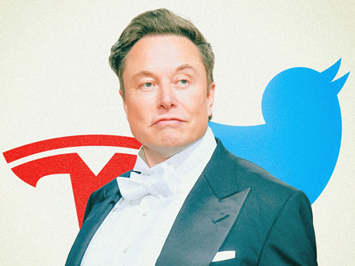
Image of Elon Musk posted in front of the Twitter logo and the
 logo of his best-known company Tesla (Ohnsman, Nov.23, 2022).

 Abstract

Elon Musk has rapidly grown in popularity and wealth in recent years by investing and leading in technology, all while being an active presence on social media platforms by expressing his personal views on cultural topics of debate and politics. More recently, Musk was moved by many followers to purchase the social media platform “Twitter”. The deal was finalized on October 27th, 2022 requiring Musk to sell over $4 Billion in his Tesla stock to afford the $44 Billion price tag on Twitter (Isidore, 2022). Since then, Musk has made many changes to the company including massive layoffs of full-time employees and moving the company into the private sector with his other businesses. More recently, in the time leading up to and since the November 8th midterms, Musk began posting his political views and opinions on his newly acquired social media platform to sway voters in the direction he was planning on voting in the midterms. Elon Musk’s actions as CEO of Twitter have become topics of much ethical debate which I will be addressing in regard to how his actions as CEO have affected stockholders, employees, and Twitter users as well as a breakdown of the ethics of this case through lenses of individualism, utilitarianism, Kantianism, and virtue theory.

Ethics Case Controversy

The main controversy, in this case, is held between the following two sides. Musk’s responsibility as CEO of Twitter, a massive mainstream media platform, is to “project apolitical stances” (Satariano, Nov. 8, 2022). This is typical within a corporate culture in that high-ranking members of a company do not typically share their political ideas. CEOs and other high-ranking officers serve in a role where they are a representation of their companies and must act on behalf of that organization, which includes remaining neutral on political matters that could cause a divide among employees or shareholders. By making a political statement on his platform, Musk made some users turn away from the network because they saw that the CEO was expressing ideas that went against their own. In retaliation to his post, many employees of Twitter took to posting their own political opinions on the platform. This only led to more controversy within the company as many of the employees who Musk laid off after coming in were the same employees who took to the platform to speak out against him (Taylor, Nov. 4, 2022). The other side to arguments surrounding Musk’s actions is that he has the right as a user on the platform to be able to say anything he wants as long as his posts remain within Twitter’s user guidelines (Twitter User Agreement, as accessed on November 27, 2022). The idea that a CEO should project apolitical stances has always been the case for any business in the public sector. While Twitter has historically been a publicly traded company, its new positioning in the private sector makes it so that the CEO, Musk, has fewer responsibilities in terms of behaving in a way that benefits shareholders. Another benefit to Musk with taking the company private is that he no longer has to respond to a board of directors. A board of directors would normally hold a CEO to certain standards and to the idea that a CEO should remain “apolitical”. Since Musk does not have the looming threat of being replaced as CEO, he is able to act on the platform in whatever way he pleases so long as he still abides by Twitter’s community guidelines. Overall, Musk has been known to create ethical dilemmas through the management of his companies in the past due to his words and actions as CEO. Now that he is the CEO of the social media platform on which he is making questionable statements, though, the question of whether or not his actions are ethical must be revisited.

Stakeholders

The first place to look to see how Musk’s actions have affected Twitter as a company is at the stakeholders. Upon purchasing Twitter, Musk made sure that he paid shareholders a fair market price for the stock. At the time the deal was made, he offered a per-share price that provided a 38% premium to the company’s shareholders (Willing, 2022). This proved to be massively beneficial to anyone holding shares of the company’s stock since before that the company had fallen massively in stock price and many investors were worried that they might lose their investments. These same investors were not only offered a price for their shares 38% above their current standings, but the news caused the price to shoot up over 30% soon after Musk’s announcement, indirectly allowing the worried investors an opportunity to sell in case the deal were to fall through. Since they are not the only investors that have business involvements with the company though, they are not the only people affected. Some big names affected by Twitter’s active user rates include Donald Trump, Apple, and Vanguard. Former President Donald Trump had previously been banned from the site but Musk reactivated his account on November 19, 2022, allowing him access to the 51.8% of polled Twitter users who wanted to see him back on the platform that he had previously used during his presidency to communicate with his large Twitter audience (Wong, 2022). Apple is another major company that Wong explained was affected by Musk’s Twitter takeover. Apple has always been the number one advertiser on Twitter, benefiting Twitter’s stakeholders and the company as a whole with massive Ad revenues. When Musk took over Twitter and began posting his personal opinions on the platform, Apple temporarily halted its advertising on the platform. They have since resumed their Ad campaigns on Twitter which benefits both parties by generating sales for Apple and keeping advertisers around on Twitter since many of the company’s other advertisers held concerns about keeping their advertisements on the platform. Vanguard is a fund management giant that was proven to be the largest shareholder of Twitter’s stock as of March 31, 2022, with 10.29% of the company’s shares (Willing, 2022). They were affected the most, based on pure share volume, by Musk buying out shares in his acquisition of the company.

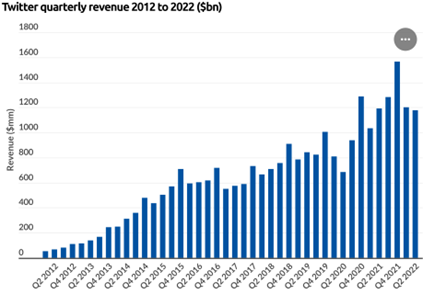
Twitter revenue displayed over time leading into 
Musk’s takeover. (Iqbal, as accessed December 6, 2022).
Individualism

Individualism is an economic theory developed by Milton Friedman that states that “there is one and only one social responsibility of business-to use its resources and engage in activities designed to increase its profits so long as they… engage in open and free competition, without deception or fraud” (Friedman, 1962). In other words, the main purpose of a business is to make a profit, therefore that should be any company’s most important responsibility and top priority (Desjardins, 2019). With Musk already being the wealthiest person in the world with many thanks to his very successfully run businesses, he made clear early on in the acquisition that he planned on running Twitter under these ideas of individualism. Since he took the company private, wherefrom he operates a number of his other businesses, he no longer has to worry about any interference from a board of directors or shareholders of the company. This freedom allows him to operate under whichever practices he sees fit as long as he remains within the legal confines that all businesses must operate under. The first major action Musk took toward maximizing Twitter’s profits was to lay off a massive amount of full-time employees as reported by Yu on November 5, 2022. Musk claimed that this was an essential step to making Twitter run more efficiently because the company had been losing $4 million at the time of his entry. This is where the ethical problem in this case regarding individualism arose. While Musk did in fact offer 3 months of severance to everyone that received the email that they were being laid off, “which is 50% more than legally required” (Musk, @elonmusk, 2022), he did so with only 1 week’s notice causing an uproar among those fired (Yu, 2022). The timeline of the layoffs became the main concern in question in this case. Although his actions were justified ethically by the idea of individualism, seeing as he was acting in the best interest of the company’s profitability, he did so in a manner that violated the legal limits within which he is bound to operate. Musk went about the layoffs in a manner that he thought to be Text Box: Screenshot of Musk’s Tweet in response to criticism surrounding massive layoffs.excusable because he was offering the laid-off employees greater severance packages than what was legally required of him. This is still illegal though, raising the question of how ethical his actions were because mass layoffs on this scale need to be performed with more notice than he provided the employees regardless of how much severance was being offered (Taylor, 2022).
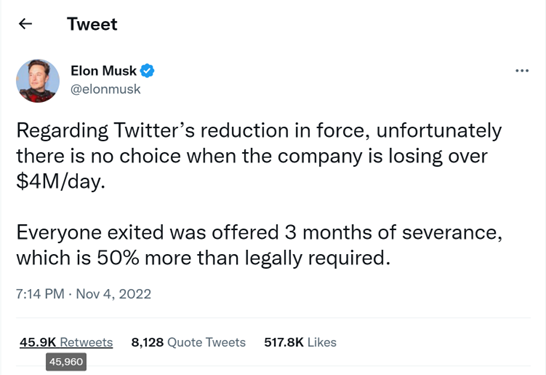
Screenshot of Musk’s Tweet in response
to 
criticism surrounding massive layoffs.
Utilitarianism

Utilitarianism is another ethical practice that many businesses adopt and do their best to stand by. The practice requires a business to address the consequences of its actions and measure how ethical they are based on the amount of “good” that action does (Desjardins, 2019). A company under utilitarianism should focus on maximizing the good that it does and attempt to reach as many people as possible with its good actions. In the case of Musk within Twitter, his action of laying off over half of the company’s full-time staff can be seen as unethical based on the idea of utilitarianism. Normally, a company could try and make the argument that it is doing good for its shareholders by maximizing profits and acting under ideas of individualism. Because Musk brought Twitter private as soon as he took over the company, the actions he takes to generate profits for the company have no way of benefiting any public shareholders. The thousands of employees who were left jobless after the massive layoffs, therefore, outweigh any good these actions might have done for the company. Outside of the financials associated with the company, it is important to assess the overall good of Musk’s tweets since becoming CEO. The full effect of these actions has yet to be weighed by any quantifiable metrics, however, they have still begun showing through the reactions of many Twitter users. It is also difficult to determine whether his actions have done more good than bad seeing as his politically based posts have caused a divide among the platform’s users (Satariano, 2022). This divide is made up of people who sided with the opinions Musk posted starting on May 18, 2022, which was later recalled for the November 8, 2022 midterms after he became CEO, and those who disagreed with his political opinions. Among those who sided with Musk’s tweets was former president Donald Trump, who was a representative of the Republican party that Musk had openly sided with in his message on the platform (Wong, 2022). Trump’s account, under Twitter’s previous management, had been banned due to disagreements with Twitter’s “User Agreement Policy” (2022). In response, the side of Twitter that disagreed with Musk’s posts was quick to halt their activity on the platform out of concern for how their own political views would be met by the new management. Although it is impossible to make a choice between which side Musk would have been able to do more good with by supporting, it is still a clearly unethical action for him to take based on utilitarianism because the most “good” would have been done to the most people if he had taken an apolitical stance in the midterm elections as CEO.

Kantianism

Immanuel Kant was a German philosopher who believed that people “should act only according to those maxims that could be universally accepted and acted on” (Desjardins, 2019). More simply put, when translated to business ethics, Kant’s ideas tell us that a business should operate in a manner that respects everyone. An important distinction within this idea is that while a business must respect the independent knowledge that customers and other involved parties have in their decision-making processes, the business also holds a responsibility to uphold the expectations that these parties have while doing business with them. An example of this would be the difference between an online drug retailer posting warnings for a new, possibly harmful drug on their website and respecting the customer’s ability to decide for themself whether they should purchase it and keeping the product off of their shelves altogether out of respect for the customer’s well-being (Salazar, pages 1-13). The question that Kantianism raises, in this case, is whether Elon Musk as CEO of Twitter should have acted more respectfully towards the ideas of all users on his platform. One way to accomplish this would be by abstaining from voicing his political opinion on how people should vote. Kantianism would argue that since Musk’s political views are not “universally accepted and acted on” (Desjardins, 2019. Page 39.), his responsibility as CEO of the company would be to not post his views because the company would be acting controversially. The other argument supporting his actions would be similar to the example of a drug retailer trusting customers to make purchasing decisions independently with the information presented to them by the company. His actions could have been ethically justifiable because users of the platform possess enough individuality and confidence to not need to listen to his opinions on the platform if they disagree with him.

Virtue Theory

Unlike the previously mentioned ethical theories, virtue theory focuses on the characteristics of a person to determine the ethics of that person’s “virtues” (Desjardins, 2019. page 26) instead of looking at actions taken by the company. Many use a person’s virtues to determine whether a person holds strong leadership characteristics that will allow them to behave ethically in a business setting. In order to determine if Musk is capable of leading Twitter in an ethical manner, his character must be broken down into the biggest virtues that make him a good leader and see if they outweigh the characteristics that make him a bad one. Many of Elon Musk’s followers believe him to be a virtuous character due to the actions he takes with his companies, specifically SpaceX and Tesla. With these companies, he makes many attempts at bettering technologies that are key to everyday life for many people. This is a feat that encompasses meaningfulness, which would help better the case that he is a virtuous CEO due to the good he is trying to do for a vast number of people. Another virtue that can be found in the case of Musk posting his political views on Twitter is his honesty. An honest person can be seen as virtuous, and Musk’s transparency with his followers when it comes to his tweets is ethically good since they do not have to worry about being deceived when it comes to his individual actions or the actions of his companies. Contrary to Musk’s actions which can be viewed as good and virtuous, those who have shied away from the platform may find him undisciplined and egoistic. These character traits are considered to be common in unethical behaviors as shown by Desjardins, 2019, page 26. The continual posting of his personal ideas and political standings after taking over the mantle of CEO demonstrates his undisciplined nature. His egoistic behavior can also be seen in these Tweets where he has commonly boasted about his personal achievements and even went so far as to poke fun at other users on the platform (Cassidy, 2022).

Justified Ethics Evaluation

After evaluating the case I feel that Musk’s actions while frustrating many Twitter users, were not unethical. He walks a very thin line as a man who holds so much wealth and influence in the world between acting ethically and irresponsibly. By buying Twitter with the intention of running the company better than its previous owners and promising to loosen restrictions on what users on the platform would be allowed to share, he was serving Twitter users by providing most of them with what they had been asking for from the platform. In this case, where he posted his own political opinions, I think he is demonstrating to the users that under his management people on Twitter will be able to speak their minds freely. Although this is unusual behavior coming from a CEO, not just that of a social media company, I would not go so far as to say that his actions were unethical. In the article “Elon Musk Puts His Own Politics on Display on Election Day”, author Satariano focuses on pointing out what Musk did wrong by voicing his opinions on election day. I think it is still extremely important, though, to acknowledge that Musk is speaking independently from the company in his Tweets. All he has done is exercise the freedom of speech that Twitter is supposed to provide users, therefore not acting unethically even if it was in the poor taste of some of the platform’s users and followers.

Conclusion

Although Elon Musk has become the topic of much heated ethical debate since becoming CEO of Twitter, his actions have become much clearer after evaluating them through lenses of individualism, utilitarianism, Kantianism, and virtue theory. While attempting to better the company financially, its users, and stakeholders, Musk made some personal choices that ended up negatively affecting the actions he was taking as CEO. So, although his actions as CEO have not been made unethically, his actions as a Twitter user on the platform have become arguably unethical due to the consequences they have had on everyone involved with the social media site.


Satariano, Adam, et al. “Elon Musk Puts His Own Politics on Display on Election Day.” The New York Times, The New York Times, 8 Nov. 2022, https://www.nytimes.com/2022/11/08/technology/elon-musk-twitter-elections.html.

Cassidy, J. (2022, October 28). Beware Elon Musk's Takeover of Twitter. The New Yorker. Retrieved from https://www.newyorker.com/news/our-columnists/beware-elon-musks-takeover-of-twitter

Isidore, Chris. “Elon Musk Sold Nearly $4 Billion Worth of Tesla Stock since Twitter Deal Closed | CNN Business.” CNN, Cable News Network, 9 Nov. 2022, https://www.cnn.com/2022/11/08/business/elon-musk-tesla-stock-sale-twitter-purchase/index.html.

Willing, Nicole and Medleva, Valerie. Twitter stock forecast: Is Twitter a good stock to buy? Twitter Stock Forecast | Is Twitter a Good Stock to Buy? (October 28, 2022). Retrieved November 19, 2022, from https://capital.com/twitter-stock-forecast-will-twtr-go-up

Twitter User Agreement. Twitter, Inc. As accessed on November 27, 2022.

Desjardins, Joseph (2019). Introduction to business ethics. MCGRAW-HILL EDUCATION.

Yu, B. (2022, November 5). Update: Musk claims Twitter losing $4M per day as widespread layoffs begin. CBS News. https://www.cbsnews.com/sanfrancisco/news/elon-musk-claims-twitter-losing-4-million-per-day-widespread-layoffs/

Salazar, Heather. Kantian Business Ethics. 1-13.

Wong, Queenie. “Twitter-Musk News Timeline: Musk Lets Trump Back onto Twitter.” CNET, 19 Nov. 2022, www.cnet.com/news/social-media/twitter-musk-news-timeline-musk-summons-engineers-as-worries-of-twitter-crash-grow/.

Musk, Elon. @elonmusk. “Regarding Twitter’s reduction in force…”. Twitter, November 4, 2022, 7:14 PM, https://twitter.com/elonmusk/status/1588671155766194176?ref_src=twsrc%5Etfw%7Ctwcamp%5Etweetembed%7Ctwterm%5E1588671155766194176%7Ctwgr%5E7f2d21c1cbd40e674c1a177b25fb31a5e5806836%7Ctwcon%5Es1_&ref_url=https%3A%2F%2F. As accessed on November 19, 2022.

Taylor, J. (2022, November 4). Twitter sued by former staff as Elon Musk begins mass sackings. The Guardian. Retrieved December 4, 2022, from https://www.theguardian.com/technology/2022/nov/04/twitter-sued-by-former-staff-as-elon-musk-begins-mass-sackings

Friedman, Milton. Capitalism and Freedom (Chicago: University of Chicago Press, 1962), p.133.

Ohnsman, A. (2022, November 24). How elon musk's Twitter takeover is ruining his own myth - and Tesla's stock. Forbes. Retrieved December 6, 2022, from https://www.forbes.com/sites/alanohnsman/2022/11/23/elon-musk-tesla-stock-twitter/?sh=4393b7b96f81

IQBAL, MANSOOR. “Twitter Revenue and Usage Statistics (2018).” Business of Apps, 27 Feb. 2019, www.businessofapps.com/data/twitter-statistics/.

Friday, December 2, 2022

FTX: A Fall From Grace (November 2022)

                                                                            Abstract

    FTX, a cryptocurrency marketplace, was using its own created crypto tokens to fund its sister company Alameda Research, an investment firm. This was discovered on a leaked balance sheet causing the token price to plummet, billions of dollars were lost for customers and shareholders, and mass outrage ensued. According to Utilitarianism, FTX acted unethically as they did not maximize happiness for everyone involved. Individualists would say FTX acted ethically as they attempted to maximize profits for the business owners. Kantianism would show that FTX acted ethically as they did not explicitly attempt to deceive anyone. Virtue Theory shows that FTX was neither ethical nor unethical as they were virtuous in some areas but also unvirtuous in others. I think FTX was unintentionally unethical and that the SEC and DOJ need to regulate the cryptocurrency industry better to prevent something like this in the future. 

                                                  FTX Logo (Image from PRNewswire.com)


                                                                Ethics Case Controversy

    Ftx is an online digital currency marketplace where people can buy, sell, and trade cryptocurrencies like Ethereum, bitcoin, and sol. Ftx was created in 2019 and quickly became popular due to publicity stunts and strategic acquisitions. Some of these marketing stunts included winning the naming rights to the arena of the Miami Heat, commercials featuring big celebrities such as Tom Brady and Larry David, and sweepstakes with Shaq.


    The founder, Sam Bankman-Fried, also known as SBF, was thought to be a revolutionary, celebrated, and supported by the crypto community, as it looked like he would be making crypto a mainstream industry and not the niche community it had been since its infancy.


    Everything started to crumble for FTX on November 2nd, when Coindesk, a news site focusing on digital currency, posted a balance sheet from the investment firm that Bankman-Fried owned. The report showed,  “That balance sheet is full of FTX – specifically, the FTT token issued by the exchange that grants holders a discount on trading fees on its marketplace.” (Coindesk, 2022) This is worrisome because the performance of the investment firm is directly tied to the performance of a made-up coin created by the founder’s other company.


    Four days later, on November 6th rival trading platform Binance announced it would be selling all of its FTT tokens as a result of the findings in the Coindesk article. The price of the FTT token crashed, and customers rushed to withdraw their funds from the FTX platform to avoid losing their money. On November 8th, FTX paused customers withdrawing money. Bankman-Fried said in an interview that he would have to raise 8 million dollars in the upcoming weeks to rectify the situation with account holders. That same day, Changpeng Zhao, founder, and CEO of rival platform Binance, announced that Binance would buy out FTX, essentially bailing out Bankman-Fried and the company. Zhao and Binance quickly backtracked on this announcement later that day. Zhao cited evidence of FTX mismanaging user funds and not correctly reporting its finances as the reason for the deal's breakdown. An article by NBC stated, “blockchain analysts tracked the flow of $400 million of assets out of FTX accounts' ' and “Bankman-Fried appeared to confirm reports that funds had moved between FTX and Alameda.”(NBC, 2022). Since FTX and Alameda’s balance sheets were never reported or audited by anyone, there is an easy way to tell why the funds were moved around like they were or where they ended up. Three days later, on November 11th, Bankman-Fried Stepped down from his CEO position at FTX, and Alameda Research, his investment firm, filed for Chapter 11 bankruptcy. 


    As the Securities Exchange Commission and Department of Justice work through their investigations, one of the strangest revelations has been how the executives of FTX and Alameda interacted with one another, especially the relationship between Bankman-Fried and CEO of Alameda Research Caroline Ellison. The New York Post wrote the following, 

“Ellison and Bankman-Fried were part of “cabal of roommates'' based in a “luxury penthouse” in the Bahamas that were behind the machinations at FTX and Alameda,’ “Relationships between the group of 10 insiders were not strictly business – members of the inner circle “are, or used to be, paired up in romantic relationships with each other,” (New York Post, 2022). 

These two sister companies were run by a group of college friends living together in the Bahamas, interdating one another. If that does not scream collusion, then I do not know what does. 


Timeline


Stakeholders 

    The stakeholders, in this case, include the founder and CEO of FTX and founder of Alameda Research, Sam Bankman-Fried, CEO of Alameda Research and alleged ex-girlfriend of SBF Caroline Ellison, founder and CEO of Binance Changpeng Zhao, FTX and Alameda Research as companies, current, and future customers/shareholders, and the general public.

    Bankman-Fried has completely fallen from grace; it is unsure whether he will be arrested for his part in this scandal, as no charges have been filed yet, but it is safe to say that he will never return to the position of status and power that he once had. Even if he gets off ultimately Scott-free, it still came out that he had murky and incorrect financial reporting and was moving around shareholders’ funds without explanation, so it would be difficult for any consumers to trust him in future endeavors.

    Most FTX/Alameda executives living with Bankman-Fried in the Bahamas have done their best to stay out of the public eye. However, the same cannot be said for former Alameda Research CEO and alleged ex-girlfriend to SBF, Caroline Ellison. Only a few days after the initial Coindesk article, users on social media had already sniffed out the two's previous love affair. They had begun to make memes attacking both CEOs. If SBF has not been charged with a crime yet, then it is unlikely that she would be found guilty of anything, as she is slightly more removed from it than he is. However, her name and face have already made their way into public discourse. She will forever be associated with Sam Bankman-Fried, and the public will be hesitant to trust her in future endeavors.

    FTX and Alameda Research filed for chapter 11 bankruptcy. Even if they were to recover financially, the reputations of the companies and those associated with them would be so tarnished that they would never recover in the public eye.

    Founder and CEO of Binance Changpeng Zhao is using this situation to his advantage. One of his biggest competitors has gone under. He is taking the opportunity to distance himself from the shady get-rich-quick con artists that inhabit the crypto industry by acting as a voice of reason and stability.

    Current and future customers/shareholders are the most negatively impacted. Current customers/shareholders scramble to recover whatever funds they can and minimize losses. Future customers/shareholders for FTX might not exist, as it is currently unclear what the company's fate will be. However, future customers/shareholders of crypto, in general, are negatively impacted because this scandal can set back the crypto industry 5-10 years from actual public adoption.

    The general public is more or less unaffected as they are not losing any money, but they may decide to distrust and be weary of crypto as a result and lose out on using it as the helpful tool it can be. 


Sam Bankman-Fried (Image from CityAM.com)

Individualism

From an individualist perspective, Sam Bankman-Fried did not do anything ethically wrong. He ran FTX and Alameda as he saw fit, moving funds between the two based on his discretion. FTX was making savvy deals and acquisitions, they had big-name celebrity endorsements, a super bowl commercial, and they owned the naming rights to the arena of the Miami Heat. Business was booming, and FTX was an absolute powerhouse in the crypto industry. Just days before this whole scandal FTX was valued at $32 billion. (CNBC, 2022) Seeing as SBF and FTX have not yet been charged with any crimes yet they definitely fit the individualist criteria that “Business actions should maximize profits for the owners of a business, but do so within the law.” (Salazar, 17) Randall Eliason, a former prosecutor and current professor at George Washington University, says, “Mismanaging your company and losing a bunch of other people’s money is not criminal. It happens all the time. For a criminal case, there has to be deception,” (Fortune, 2022). There has not been concrete evidence showing proof of deception or any crimes committed, so as far as an individualist is concerned, SBF is ethically correct in his actions. He looks like a total moron, failure, and terrible business manager, but he is not yet a criminal.

Utilitarianism

A utilitarian would consider FTX’s actions as least ethically beneficial as possible and were minimizing “happiness in the long run for all conscious beings that are affected by the business action.” (Salazar, 17) Sam Bankman-Fried put his happiness and desire to operate how he wanted ahead of the financial well-being of all of his customers and shareholders. He may have achieved personal happiness in the short term through his selfish actions, but he will be very unhappy in the long term as his business and power are stripped away. Caroline Ellison acted selfishly for the happiness of herself, Sam, and their roommates above all others. She, too, will become unhappy as her status and power are stripped away. Changpeng Zhao did his due diligence to confirm he would secure profit in the long run before offering to bail FTX out, but I cannot write him off as purely focused on personal gain. This move would have helped the customers and shareholders and maximized happiness for most people involved. He set himself apart from others in the crypto industry and, as a result, walked away positively impacted. Current customers and shareholders are unhappy as some lost money and were deceived, but hopefully, they can recover as much as possible. Future customers and shareholders of the crypto industry are unhappy because this is a big negative for crypto. However, they did not lose money like the current customers and shareholders. The general public’s happiness is relatively unaffected; they did not lose money, which will lead to better regulation in the crypto industry. However, they are still mad at FTX and everyone involved, regardless of whether they were customers. 


Kantianism

Kantianism is a philosophy developed by Immanuel Kant, an 18th-century philosopher from Prussia. Kantianism is focused on “the moral permissibility of the action, as well as the moral worth in the motivation of the action.”(Salazar, 21) A categorical imperative test evaluates whether an action is permissible and morally acceptable. The most understandable version of the Categorical Imperative is “the formulation of humanity,” which says actions are impermissible and morally unacceptable if people are used solely as a means to an end. A Kantian would be on the fence about how Bankman-Fried acted. They would say he acted ethically correctly because there is no evidence so far that he would “lie, cheat, manipulate or harm others to get your way.” (Salazar, 17) However, on the other hand, he did not “use informed and rational consent from all parties.”(Salazar, 17) because he was moving funds as he saw fit without running it by customers and shareholders first. A Kantian may have an issue knowing that the executives of FTX and Alameda Research were all living together and supposedly sleeping with one another. Relationships like that are a big no-no in the business world, and they shouldn’t have engaged in them in the first place, but at the very least, they should have been upfront and open about it. There wasn’t any malicious intent as far as we know in the withholding of that information so it seems ethical as far as Kantianism is concerned. The Kantian would ultimately say that Bankman-Fried acted ethically correctly as there is no evidence that he maliciously intended to deceive anyone or use people as a means to an end; he was just a bad manager who made some very costly and careless decisions as he attempted to increase the value of his company for himself and shareholders.

Virtue Theory

The Greek philosopher Aristotle was the first to develop the virtue theory philosophy. Virtue theory is a tool used to judge “a person’s character and assesses whether a person is virtuous or not. Is the person getting better in life, flourishing, and fulfilling his or her purpose in life, or not?” (Salazar, 23). Look at the person in question and see if their actions align with particular positive ‘virtues’ or harmful ‘vices.’ You can then get a good idea of a person’s character. The four main ‘cardinal’ virtues are courage, temperance, justice/fairness, and honesty. Courage is about standing up for the right things; Sam Bankman-Fried was taking a risk when founding FTX, but he believed bringing crypto to the general public was a good thing to do. He would be considered virtuous in that regard, although not correctly reporting his company’s finances and keeping up-to-date records was cowardly as he was not fully committed to his actions. Temperance is about moderation in action and being realistic; Bankman-fried would not be considered virtuous. Instead of being happy and grounded with his company’s success, he kept trying to achieve more; while this would score him points on an individualist scale, it shows him as lacking virtue here. He did not have to take it upon himself to make those unannounced fund transfers between companies to avoid holdups from shareholder questions. Justice is about suitable products and good practices; FTX was an active crypto marketplace that provided the public with all the tools they would need to buy, sell, and trade various cryptocurrencies. FTX was virtuous in this sense; they provided people with quality products and maintained them properly. Honesty is about being truthful with the general public, your customers, employees, and other businesses. Sam Bankman-Fried was neither honest nor dishonest; as far as the evidence goes, he never purposely misled or deceived anyone, but he was also not completely forthcoming with all of the moves he was making behind the scenes. For this, SBF and FTX would not be looked at as virtuous. The virtue theory would place FTX in a gray area regarding being ethical or unethical. For courage and justice, they were virtuous, but for justice and honesty, they were unvirtuous. 

Justified Ethics Evaluation

After studying this case for weeks, I am frustrated to admit that I still don’t know who I should be mad at the most for this scandal. After analyzing the case through each ethical theory, FTX acted both ethically and unethically. I personally don’t believe Sam Bankman-Fried was intentionally unethical; I think he was just arrogant and way over his head. I still think he and the other FTX and Alameda Research executives should somehow be held accountable and punished. I cannot entirely agree with jail time; I do not think any of them would survive in jail, and if the Securities Exchange Commission and Department of Justice have not charged them with any crimes yet, then I cannot say they deserve the slammer. They should be fined millions of dollars and banned from finance in all capacities. Although this will not make up for all the money still unaccounted for, it will ensure they are made an example of and are not let off easily. I am very unhappy with our Securities Exchange Commission and cannot understand how regulations were not already in place to prevent something of this magnitude from happening. I desperately hope we all learn from this scandal and pass the proper laws to ensure that financial crises like these stop happening or, at the very least, can be reversed and resolved quickly. 


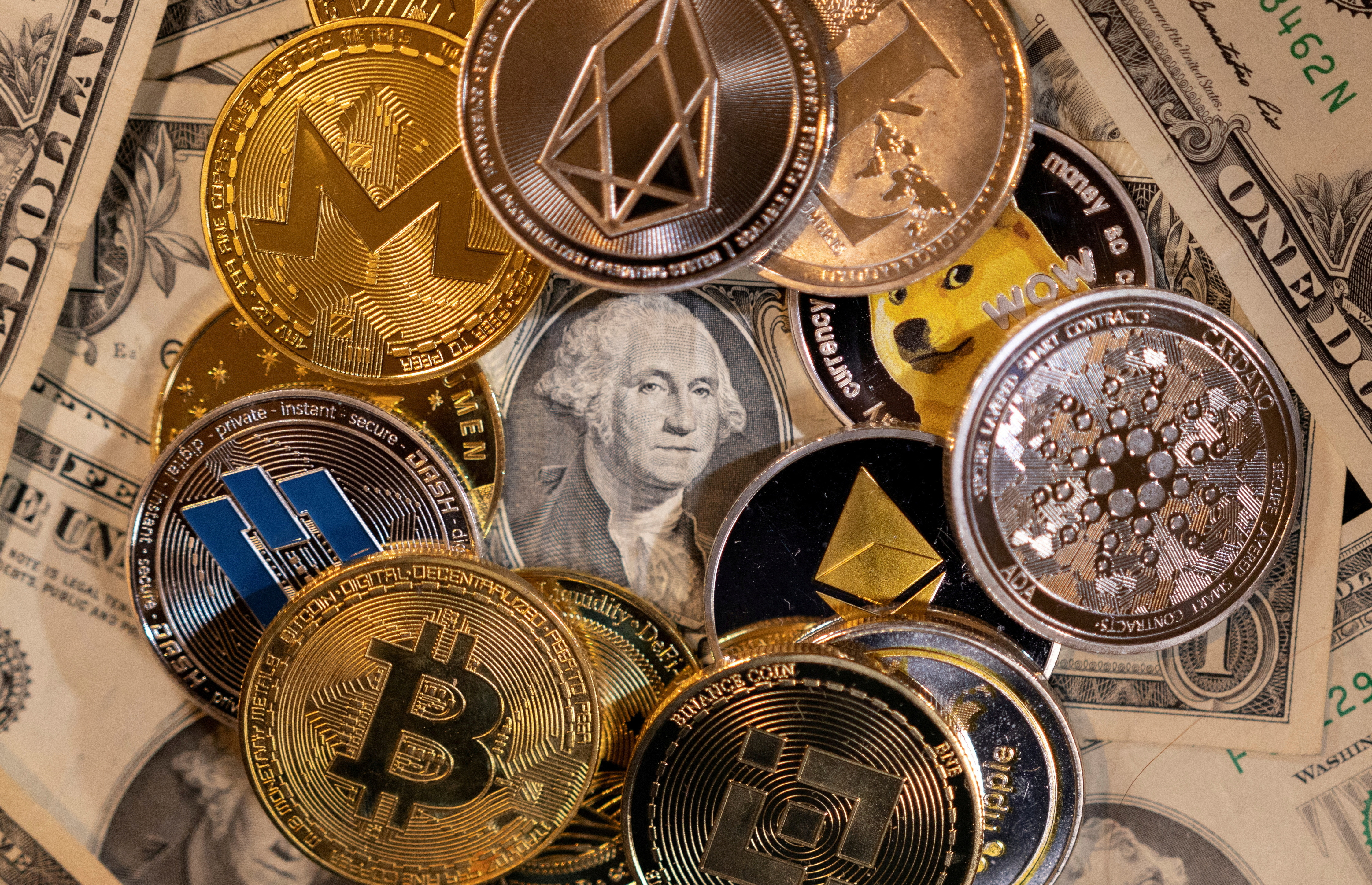
Graphic displaying physical examples of crypto tokens

(Image from ArcPublishing.com)

Conclusion

Between the Wells Fargo cross-selling controversy, the 2008 housing crisis, Bernie Madoff’s Ponzi Scheme, and now the FTX scandal, the general public is at its wit's end with controversy in the financial industry. FTX needs to sort out what happened and return the funds to each of its customers. They should completely disband the company and brand, as nobody will again trust that name. The government, specifically the SEC, should review everything that went wrong after its investigation is wrapped up and start drafting new legislation in conjunction with the DOJ to prevent something like this from happening in the future. Crypto is rapidly evolving daily, and if it is not adequately regulated soon, this exact problem could happen multiple times over the next few years. We must get the proper laws in place as soon as possible.


ReferencesAllison, Ian. “Divisions in Sam Bankman-Fried's Crypto Empire Blur on His Trading Titan Alameda's Balance Sheet.”

CoinDesk Latest Headlines RSS, CoinDesk, 9 Nov. 2022, https://www.coindesk.com/business/2022/11/02/divisions-in-sam-bankman-frieds-crypto-empire-blur-

on-his-trading-titan-alamedas-balance-sheet/. “Sam Bankman-Fried and the FTX Collapse, Explained.” NBCNews.com, NBCUniversal News Group, https://www.nbcnews.com/tech/crypto/sam-bankman-fried-crypto-ftx-collapse-explained-

rcna57582. Barrabi, Thomas, and Lydia Moynihan. “Meet Caroline Ellison, Sam Bankman-Fried's Top Exec - and Rumored Ex-Girlfriend.”

New York Post, New York Post, 14 Nov. 2022, https://nypost.com/2022/11/14/meet-caroline-ellison-sam-bankman-frieds-rumored-ex-girlfriend/. Roberts, Jeff John. “Could SBF Go to Prison? Here's What the Justice Department Would Have to Prove.” Fortune, Fortune, 18 Nov. 2022, https://fortune.com/crypto/2022/11/13/could-sam-bankman-fried-go-to-prison-for-the-ftx-disaster/. Salazar, Heather. The Business Ethics Case Manual: The Authoritative Step-by-Step Guide to Understanding and Improving the

Ethics of Any Business. Print.Huang, Kalley. “Why Did FTX Collapse? Here's What to Know.” The New York Times, The New York Times, 10 Nov. 2022, https://www.nytimes.com/2022/11/10/technology/ftx-binance-crypto-explained.html. FTX. https://www.google.com/url?sa=i&url=https%3A%2F%2Fwww.prnewswire.com%2Fnews-releases%2Fftx-resumes-ordinary-

course-payments-of-employees-and-certain-foreign-contractors-301688260.html&psig=AOvVaw3LNs8zHf7Nsez_lUD_5sbv&ust=

1670129806944000&source=images&cd=vfe&ved=0CA8QjRxqFwoTCNjnusHU3PsCFQAAAAAdAAAAABAD. SBF. https://www.google.com/url?sa=i&url=https%3A%2F%2Fwww.cityam.com%2Fsam-bankman-fried-i-clearly-failed-and-im-

sorry%2F&psig=AOvVaw25txLu18g8ZbpKp9U9A5dp&ust=1670129931641000&source=images&cd=vfe&ved=0CA8Qj

RxqFwoTCOi81f3U3PsCFQAAAAAdAAAAABAL. Crypto. https://cloudfront-us-east-2.images.arcpublishing.com/reuters/C4SMQFCB4JICHAM4PBKXROWFKQ.jpg. 

Twitter: Elon Musk’s Acquisition Harms Employees and User Base (2022)

ABSTRACT

Twitter CEO Elon Musk
            Elon Musk’s 44 billion dollar acquisition of social media company Twitter has had the public talking. The new billionaire CEO has laid off over half of his workforce, as well as both, directly and indirectly, allowed the spread of misinformation in just the first month since purchasing the company. An Individualist would argue for the case to be unethical as Musk is not maximizing the profit of the company within the law. Under utilitarianism, his actions would be considered unethical due to the harm of his actions outweighing the little happiness they provide. Kantianism would classify Musk’s actions as unethical due to their failure to lack rationality. A Virtue Theorist would consider Musk an unethical person from the lack of virtues shown in his behavior. I, and hopefully you once you finish reading this, believe that the actions of Elon Musk toward Twitter employees and users are heavily unethical.

ETHICS CASE CONTROVERSY

Twitter Under Musk Timeline

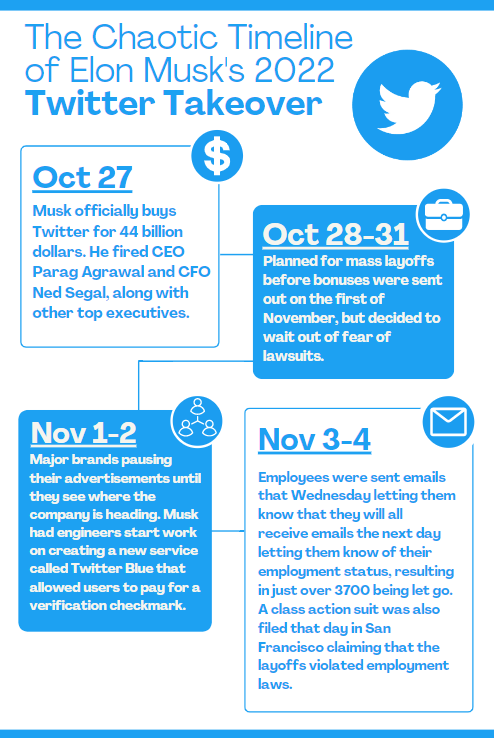
            Twitter is a social media application that allows users to post thoughts, images, and videos as “tweets”. Billionaire and multi-business owner Elon Musk was in talks to buy the company back in April 2022. However, it was not until October 27 of the same year that he officially bought Twitter for 44 billion US dollars. Musk’s vision for the app was to remove the censorship and bring back his version of free speech. Upon acquisition of the company, his first action as the new owner was to fire the top executives, including former CEO Parag Agrawal and CFO Ned Segal, just a glimpse of what was to come over the next month (Conger et al.). Purchasing Twitter at such an enormous amount, one that required taking on 13 billion in debt, had made the new CEO’s mission clear: reduce costs (Griffin).

The next day, Musk told the remaining executives to prepare for widespread layoffs before employee bonuses were sent out on November 1. However, he decided to push till after the issuances out of risks of potential lawsuits. On November 3, employees received an email letting them know that they will receive another email the next day with their employment status. However, some employees were locked out of their accounts before the day had ended. A class action lawsuit was filed against the company in San Francisco for violating California’s Worker Adjustment and Retraining Notification Act which says that employers must give at least a 60-day notice before mass layoffs. By the next day, almost half of the company’s 7500 global employees were gone. After receiving major backlash from the public, Musk said that all laid-off employees were getting 3 months’ severance, which is 50% more than the required amount (Palmer). Major companies including General Motors and Volkswagen Group pause their advertisements until they see what direction the company is heading (Vranica et al). Musk later tweeted that Twitter is losing 4 million dollars a day. Meanwhile, the remaining employees were tasked with creating a paid subscription that allowed their users to become verified. Musk imposed strict deadlines, with some employees going as far as to sleep at the office to reach them (Conger et al.). By November 9, the subscription Twitter Blue was rolled out to iOS users for 8 dollars a month. Problems arose quickly, with widespread impersonations afflicting the app and having major real-life consequences. One account impersonating insulin manufacturer Eli and Lilly Company tweeted out that insulin was now free of charge. After a couple of hours, the tweet was removed, but the damage was already done. Eli and Lilly’s stock price plummeted, with an estimated loss of 15 billion dollars to their market cap (Barr). With mass impersonations and misinformation spreading, Twitter Blue was removed from the app only two days after its launch.

Timeline continued
The following week saw another wave of layoffs. Contract workers in engineering, marketing, and customer service were the first to be let go this week. Musk issued an ultimatum to the remaining employees, having them choose between either working long, intense hours or accepting the severance package (Kolodny et al.). He also removed the ability to work from home, which would prove to be a mistake. Two more class actions were filed; the first lawsuit claims that removing the ability to work from home goes against the Americans with Disabilities Act (ADA), while the other one claims employment laws were violated in the layoffs for contract workers (Wiessner). By the next week, Twitter was estimated to have lost another 1000-1200 employees (Mac et al.). Musk announces that an improved version of Twitter Blue will come back once the impersonations stop. The newer version of the subscription will have different color verification depending on whether the account belongs to a brand, government official, or an individual (including celebrities and people with Twitter Blue), making it easier to identify a possible impersonator. As a part of Musk’s goal to make Twitter a more free, less restrictive space, previously suspended accounts are being brought back. The COVID-19 misinformation policy, which labeled certain tweets that talked about the virus as misleading, was also removed, with experts saying it could have serious consequences (Ivanova).

STAKEHOLDERS

Any party that is affected by the decisions of Elon Musk would be considered a stakeholder. This would include all Twitter employees, their user base, and shareholders invested in Musk’s other publicly traded companies, including Tesla. From the first day Musk took ownership of the company, top executives were fired. Massive layoffs caused over half of the company’s global employees, an estimated 4,800, to be let go. Twitter Blue allowed anybody with 8 dollars to impersonate a person or company, spreading misinformation to anyone who sees that account not knowing they are the official account. The COVID-19 policy getting removed only further increases the spread of misinformation. The consequences are unfathomable when you realize Twitter usage is at an all-time high of 254 million active users a day (Best). Musk’s other multi-billion dollar company Tesla has seen a major hit to its stock price, with it reaching a 52-week low this past week (Raymond).

INDIVIDUALISM

Twitter Headquarters in San Francisco
Under individualism, the goal of the company is to maximize its profits for the owners of the business in a legal way. From the beginning, all of Elon Musk’s decisions have been to maximize profits. He has laid off over half of Twitter’s workforce, as well as created the subscription service Twitter Blue to bring in more revenue. However, not all of the actions to maximize profit have been within the law. In California, where Twitter’s headquarters reside, it is illegal to execute mass layoffs of employees without at least a 60-day warning under the California WARN Act. Musk also remove the remote work policy, in hopes that going into the office would increase the productivity of workers. This also violates laws set by the ADA, which allows remote work as an acceptable accommodation as long as it put no significant hassle on the employer (Wiessner). He also stopped the purchase of Twitter Blue two days after its launch, something that could have increased profits if left available to purchase for longer. The bad press that comes along with these actions has stopped many major companies from using Twitter for advertising, ultimately making the actions lose more money.

To an Individualist, these actions taken by Musk would be considered ethically wrong. Individualism stresses that, “it is the aim and the responsibility of businesses to maximize their profits” (Salazar 17). Increasing profit in one area just to lose profit in another would not go work for an Individualist, especially if those actions were illegal. If Musk were to have given a warning to its employees within the legal limit, as well as kept the remote working policy, he would still be able to cut costs while staying within the law which is ethical under Individualism.

UTILITARIANISM

Utilitarianism stresses the importance of happiness. A Utilitarian considers an action ethical as long as it creates more overall good than bad. In other words, for an action to be ethical under utilitarianism, it would have to, “maximize happiness in all affected parties in the long-term” (Salazar 20). In the case of Elon Musk and his actions as CEO, Utilitarians would consider his actions unethical.

The efforts Musk has implemented over his first month as the owner goes against everything Utilitarians value. Laying off over half of his workforce leaves an estimated 4,700 unhappy people without jobs and one person happier as they have fewer costs. Twitter Blue may supply some happiness to individuals impersonating brands or celebrities, but for every account impersonating, there is a person or company whose reputation is possibly being damaged. Then there are all the people absorbing the misinformation by the impersonators who are now worse off than they were before. Forcing all employees, including ones with disabilities, to come back to the office only makes Musk happy, while the employees, some who physically cannot get to the office, are stuck with having to a severance package over their job. The strict deadlines and intense working hours create a harsh environment for the workers whose job was much easier just over a month ago. These actions all only benefit one person, Elon Musk, while leaving thousands of employees and millions of Twitter users less happy than before Musk came into power, something a Utilitarian would heavily disagree with.

KANTIANISM

An ethical action under Kantianism is rational and has the right motivations. To determine whether or not an action is rational or not, a series of tests known as the Categorical Imperative are used to find out if the action is permissible or impermissible. We can apply these tests to the actions Elon Musk has employed over his first month as CEO of Twitter to figure out if his actions, under Kantianism, are ethical.

Manager Esther Crawford Sleeping at the Office

The first of the Categorical Imperative tests is the Formula of Universal Law, which tests if it would be possible if everybody in the world to follow through with the same action. If we were to consider the mass layoffs Musk gave his employees, it would fail the test. If every company in the world was to lay off half of its employees without giving proper notice, billions of people would be left without jobs and unable to provide for their families. Not to mention the countless lawsuits brought up because of it. Another way to test for rationality would be through the Formula of Humanity, which asserts that, “it is wrong to use people as a mere means to get what you want” (Salazar 22). Considering all the major actions Musk put his employees and users through, they would fail the test. Creating a subscription service to increase revenues is using the user base simply as a means to get more money. The layoffs also fail this test, as Musk is laying off employees as a means to reduce overall costs. The final test in the Categorical Imperative is the Formula of Autonomy, stating that we must abide by the actions we place on others. When applying this to the strict deadlines and harsh working conditions Musk puts on his employees, we have to ask whether or not Elon himself would like to have to sleep at the office to meet those deadlines or have to work long hours at high intensity. If any of the tests yielded a permissible action, it would not have the correct motivation. The actions Musk implemented in the first month as the owner were to help himself, not the employees or the user base, leading any Kantian to believe that his actions were, in fact, unethical.

VIRTUE THEORY

Virtue theory emphasizes acting with virtuous traits and in doing so will lead you to live an overall better and flourishing life. A virtue is a positive characteristic allowing things to run better. This ethical theory is different from the other three as they, “analyze individual actions whereas virtue theory analyzes a person’s character” (Salazar 23). The four cardinal virtues one can possess are courage, temperance, justice/fairness, and honesty, along with one intellectual virtue known as prudence. Looking at Elon Musk during his new reign over Twitter, a virtue theorist would find him to be unethical.

We can see Musk not acting on good virtue the day he bought Twitter. One could say that Musk buying the company was courageous but looking at what he had to do to make up for it, such as taking on 13 billion in loans, Musk would have been considered to act rashly and impulsive, which are both vices. Vices are the opposite of virtues and lead a person’s life in the opposite direction of what virtue theorists would accept. Musk would also not possess the justice/fairness virtue. It is not fair to the employees who have been working at Twitter for a long time to all of sudden be laid off by someone who just took over. Even if you did nothing wrong, you could have been laid off and stuck with having to find a new place to work. Musk also does not show the intellectual virtue of prudence, or the ability to make rational decisions considering the future. It is unlikely that he would have bought Twitter for such a high amount knowing the major effects of it, including having to lay off over half the workforce, companies pausing their advertisements, and a major toll on his other company’s stock Tesla, just to name a few. Musk acting with more vices than virtues not only will lead to a worse, dull life but is also considered unethical under virtue theory.

JUSTIFIED ETHICS EVALUATION

Popular Tweet Denying Facts about COVID-19
            From my perspective, I believe Elon Musk is in the wrong. He should have known that 44 billion dollars were too much for the company, and now he is taking it out on the employees. Musk should have given a 60-day warning before the mass layoffs to not only be following the law but also to be a decent person and help the employees out; giving them more time to look for a job. Imposing strict deadlines to the point where workers had to sleep at the office crosses the line. Taking away the remote work possibility not only affects employees with disabilities who struggle to come to the office but also hurts the workers who signed up as remote workers and have never been to the office. I thought Twitter Blue was okay in concept, but the execution was a disaster. It was clear from the announcement of the service that it would be heavily abused from the get-go. His reforms around freedom of speech can cause more harm than good, especially with the removal of the COVID-19 misinformation policy and the addition of previously suspended accounts. I think freedom of speech is a good thing, except when it is used to hurt people or a demographic, such as hate speech or misinformation. I believe the three lawsuits filed against Twitter are in good faith and have a higher chance of winning over Musk. When reviewing the facts of the case, it is clear that the actions exhibited by Elon Musk were highly unethical.

CONCLUSION

Elon Musk has made many questionable decisions since he acquired Twitter back in October. He laid off over half his staff without a proper warning. Misinformation was able to spread through his new policies as well as through his new service Twitter Blue. According to each of the ethical theories, including Individualism, Utilitarianism, Kantianism, and Virtue Theory, Elon Musk and his actions are unethical. I, along with probably most of you reading this, believe that Musk is clearly in the wrong, and only time will tell how the law agrees with us too.

REFERENCES

Barr, Kyle. “How Much Did Twitter's Verification Chaos Cost Insulin Maker Eli Lilly and Twitter Itself?” Gizmodo, Gizmodo, 14 Nov. 2022, https://gizmodo.com/twitter-eli-lilly-elon-musk-insulin-1849779323.

Best, Paul. “Elon Musk Says Twitter Sign-Ups at All-Time High, Predicts One Billion Monthly Active Users One Year from Now.” Yahoo! News, Yahoo!, 27 Nov. 2022, https://news.yahoo.com/elon-musk-says-twitter-sign-230445301.html?guccounter=1&guce_referrer=aHR0cHM6Ly93d3cuYmluZy5jb20v&guce_referrer_sig=AQAAAG9iS5aYvEzHbhJP4Xhp-KHZ52-YhgbMRFTeyMshEL99TJcixwFYML7snCVIscfTNPxmA38Wgq97Nh8NGBEk9Ud3P17v572tmZhuKamKkcq7ckGpYSNJUBkLIBqMqWPRTVz16vE1RnkS_OoayOn_0TcNZYURk4S2md3UkudGolXaqWPRTVz16vE1RnkS_OoayOn_0TcNZYURk4S2md3UkudGolXa.

Conger, Kate, et al. “Two Weeks of Chaos: Inside Elon Musk's Takeover of Twitter.” The New York Times, The New York Times, 11 Nov. 2022, https://www.nytimes.com/2022/11/11/technology/elon-musk-twitter-takeover.html.

Griffin, Allie. “Elon Musk to Lay off Half of Twitter's Staff, Enforce Return-to-Office Policy: Report.” New York Post, New York Post, 3 Nov. 2022, https://nypost.com/2022/11/02/elon-musk-to-lay-off-half-of-twitters-staff-enforce-return-to-office-policy/.

Ivanova, Irina. “Twitter Stops Enforcing Its Covid Misinformation Policy.” CBS News, CBS Interactive, 30 Nov. 2022, https://www.cbsnews.com/news/twitter-covid-misinformation-policy-ends/.

Kolodny, Lora, and Jason Abbruzzese. “New Wave of Resignations Hits Twitter after Musk Ultimatum.” CNBC, CNBC, 19 Nov. 2022, https://www.cnbc.com/2022/11/17/new-wave-of-resignations-hits-twitter-after-musk-ultimatum.html.

Mac, Ryan, et al. “Elon Musk's Twitter Teeters on the Edge after Another 1,200 Leave.” The New York Times, The New York Times, 18 Nov. 2022, https://www.nytimes.com/2022/11/18/technology/elon-musk-twitter-workers-quit.html.

Palmer, Annie. “Twitter Sued by Employees after Mass Layoffs Begin.” CNBC, CNBC, 4 Nov. 2022, https://www.cnbc.com/2022/11/04/twitter-sued-by-employees-after-mass-layoffs-begin.html.

Raymond, Art. “As Elon Musk Fiddles with Twitter, Tesla Stock Tanking and on Track for Worst Year Ever.” MSN, Desert News, 22 Nov. 2022, https://www.msn.com/en-us/autos/news/as-elon-musk-fiddles-with-twitter-tesla-stock-tanking-and-on-track-for-worst-year-ever/ar-AA14qXAp.

Salazar, Heather. The Business Ethics Case Manual: The Authoritative Step-by-Step Guide to Understanding and Improving the Ethics of Any Business. Print.

Vranica, Suzanne, and Patience Haggin. “Twitter's Advertising Exodus Accelerates, despite Outreach from Elon Musk.” The Wall Street Journal, Dow Jones & Company, 14 Nov. 2022, https://www.wsj.com/articles/twitters-advertising-exodus-accelerates-despite-outreach-from-elon-musk-11668262920?mod=Searchresults_pos1&page=1.

Wiessner, Daniel. “Disabled Employee Sues Twitter over Musk's Ban on Remote Work.” Reuters, Thomson Reuters, 17 Nov. 2022, https://www.reuters.com/business/disabled-employee-sues-twitter-over-musks-ban-remote-work-2022-11-17/.