Showing posts with label ethics of twitter. Show all posts

Friday, December 2, 2022

Twitter: Elon Musk’s Acquisition Harms Employees and User Base (2022)

ABSTRACT

Twitter CEO Elon Musk
            Elon Musk’s 44 billion dollar acquisition of social media company Twitter has had the public talking. The new billionaire CEO has laid off over half of his workforce, as well as both, directly and indirectly, allowed the spread of misinformation in just the first month since purchasing the company. An Individualist would argue for the case to be unethical as Musk is not maximizing the profit of the company within the law. Under utilitarianism, his actions would be considered unethical due to the harm of his actions outweighing the little happiness they provide. Kantianism would classify Musk’s actions as unethical due to their failure to lack rationality. A Virtue Theorist would consider Musk an unethical person from the lack of virtues shown in his behavior. I, and hopefully you once you finish reading this, believe that the actions of Elon Musk toward Twitter employees and users are heavily unethical.

ETHICS CASE CONTROVERSY

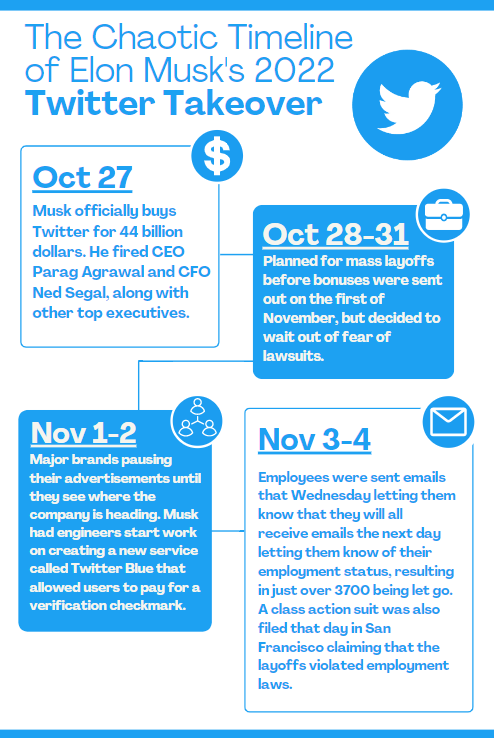
Twitter Under Musk Timeline

            Twitter is a social media application that allows users to post thoughts, images, and videos as “tweets”. Billionaire and multi-business owner Elon Musk was in talks to buy the company back in April 2022. However, it was not until October 27 of the same year that he officially bought Twitter for 44 billion US dollars. Musk’s vision for the app was to remove the censorship and bring back his version of free speech. Upon acquisition of the company, his first action as the new owner was to fire the top executives, including former CEO Parag Agrawal and CFO Ned Segal, just a glimpse of what was to come over the next month (Conger et al.). Purchasing Twitter at such an enormous amount, one that required taking on 13 billion in debt, had made the new CEO’s mission clear: reduce costs (Griffin).

The next day, Musk told the remaining executives to prepare for widespread layoffs before employee bonuses were sent out on November 1. However, he decided to push till after the issuances out of risks of potential lawsuits. On November 3, employees received an email letting them know that they will receive another email the next day with their employment status. However, some employees were locked out of their accounts before the day had ended. A class action lawsuit was filed against the company in San Francisco for violating California’s Worker Adjustment and Retraining Notification Act which says that employers must give at least a 60-day notice before mass layoffs. By the next day, almost half of the company’s 7500 global employees were gone. After receiving major backlash from the public, Musk said that all laid-off employees were getting 3 months’ severance, which is 50% more than the required amount (Palmer). Major companies including General Motors and Volkswagen Group pause their advertisements until they see what direction the company is heading (Vranica et al). Musk later tweeted that Twitter is losing 4 million dollars a day. Meanwhile, the remaining employees were tasked with creating a paid subscription that allowed their users to become verified. Musk imposed strict deadlines, with some employees going as far as to sleep at the office to reach them (Conger et al.). By November 9, the subscription Twitter Blue was rolled out to iOS users for 8 dollars a month. Problems arose quickly, with widespread impersonations afflicting the app and having major real-life consequences. One account impersonating insulin manufacturer Eli and Lilly Company tweeted out that insulin was now free of charge. After a couple of hours, the tweet was removed, but the damage was already done. Eli and Lilly’s stock price plummeted, with an estimated loss of 15 billion dollars to their market cap (Barr). With mass impersonations and misinformation spreading, Twitter Blue was removed from the app only two days after its launch.

Timeline continued
The following week saw another wave of layoffs. Contract workers in engineering, marketing, and customer service were the first to be let go this week. Musk issued an ultimatum to the remaining employees, having them choose between either working long, intense hours or accepting the severance package (Kolodny et al.). He also removed the ability to work from home, which would prove to be a mistake. Two more class actions were filed; the first lawsuit claims that removing the ability to work from home goes against the Americans with Disabilities Act (ADA), while the other one claims employment laws were violated in the layoffs for contract workers (Wiessner). By the next week, Twitter was estimated to have lost another 1000-1200 employees (Mac et al.). Musk announces that an improved version of Twitter Blue will come back once the impersonations stop. The newer version of the subscription will have different color verification depending on whether the account belongs to a brand, government official, or an individual (including celebrities and people with Twitter Blue), making it easier to identify a possible impersonator. As a part of Musk’s goal to make Twitter a more free, less restrictive space, previously suspended accounts are being brought back. The COVID-19 misinformation policy, which labeled certain tweets that talked about the virus as misleading, was also removed, with experts saying it could have serious consequences (Ivanova).

STAKEHOLDERS

Any party that is affected by the decisions of Elon Musk would be considered a stakeholder. This would include all Twitter employees, their user base, and shareholders invested in Musk’s other publicly traded companies, including Tesla. From the first day Musk took ownership of the company, top executives were fired. Massive layoffs caused over half of the company’s global employees, an estimated 4,800, to be let go. Twitter Blue allowed anybody with 8 dollars to impersonate a person or company, spreading misinformation to anyone who sees that account not knowing they are the official account. The COVID-19 policy getting removed only further increases the spread of misinformation. The consequences are unfathomable when you realize Twitter usage is at an all-time high of 254 million active users a day (Best). Musk’s other multi-billion dollar company Tesla has seen a major hit to its stock price, with it reaching a 52-week low this past week (Raymond).

INDIVIDUALISM

Twitter Headquarters in San Francisco
Under individualism, the goal of the company is to maximize its profits for the owners of the business in a legal way. From the beginning, all of Elon Musk’s decisions have been to maximize profits. He has laid off over half of Twitter’s workforce, as well as created the subscription service Twitter Blue to bring in more revenue. However, not all of the actions to maximize profit have been within the law. In California, where Twitter’s headquarters reside, it is illegal to execute mass layoffs of employees without at least a 60-day warning under the California WARN Act. Musk also remove the remote work policy, in hopes that going into the office would increase the productivity of workers. This also violates laws set by the ADA, which allows remote work as an acceptable accommodation as long as it put no significant hassle on the employer (Wiessner). He also stopped the purchase of Twitter Blue two days after its launch, something that could have increased profits if left available to purchase for longer. The bad press that comes along with these actions has stopped many major companies from using Twitter for advertising, ultimately making the actions lose more money.

To an Individualist, these actions taken by Musk would be considered ethically wrong. Individualism stresses that, “it is the aim and the responsibility of businesses to maximize their profits” (Salazar 17). Increasing profit in one area just to lose profit in another would not go work for an Individualist, especially if those actions were illegal. If Musk were to have given a warning to its employees within the legal limit, as well as kept the remote working policy, he would still be able to cut costs while staying within the law which is ethical under Individualism.

UTILITARIANISM

Utilitarianism stresses the importance of happiness. A Utilitarian considers an action ethical as long as it creates more overall good than bad. In other words, for an action to be ethical under utilitarianism, it would have to, “maximize happiness in all affected parties in the long-term” (Salazar 20). In the case of Elon Musk and his actions as CEO, Utilitarians would consider his actions unethical.

The efforts Musk has implemented over his first month as the owner goes against everything Utilitarians value. Laying off over half of his workforce leaves an estimated 4,700 unhappy people without jobs and one person happier as they have fewer costs. Twitter Blue may supply some happiness to individuals impersonating brands or celebrities, but for every account impersonating, there is a person or company whose reputation is possibly being damaged. Then there are all the people absorbing the misinformation by the impersonators who are now worse off than they were before. Forcing all employees, including ones with disabilities, to come back to the office only makes Musk happy, while the employees, some who physically cannot get to the office, are stuck with having to a severance package over their job. The strict deadlines and intense working hours create a harsh environment for the workers whose job was much easier just over a month ago. These actions all only benefit one person, Elon Musk, while leaving thousands of employees and millions of Twitter users less happy than before Musk came into power, something a Utilitarian would heavily disagree with.

KANTIANISM

An ethical action under Kantianism is rational and has the right motivations. To determine whether or not an action is rational or not, a series of tests known as the Categorical Imperative are used to find out if the action is permissible or impermissible. We can apply these tests to the actions Elon Musk has employed over his first month as CEO of Twitter to figure out if his actions, under Kantianism, are ethical.

Manager Esther Crawford Sleeping at the Office

The first of the Categorical Imperative tests is the Formula of Universal Law, which tests if it would be possible if everybody in the world to follow through with the same action. If we were to consider the mass layoffs Musk gave his employees, it would fail the test. If every company in the world was to lay off half of its employees without giving proper notice, billions of people would be left without jobs and unable to provide for their families. Not to mention the countless lawsuits brought up because of it. Another way to test for rationality would be through the Formula of Humanity, which asserts that, “it is wrong to use people as a mere means to get what you want” (Salazar 22). Considering all the major actions Musk put his employees and users through, they would fail the test. Creating a subscription service to increase revenues is using the user base simply as a means to get more money. The layoffs also fail this test, as Musk is laying off employees as a means to reduce overall costs. The final test in the Categorical Imperative is the Formula of Autonomy, stating that we must abide by the actions we place on others. When applying this to the strict deadlines and harsh working conditions Musk puts on his employees, we have to ask whether or not Elon himself would like to have to sleep at the office to meet those deadlines or have to work long hours at high intensity. If any of the tests yielded a permissible action, it would not have the correct motivation. The actions Musk implemented in the first month as the owner were to help himself, not the employees or the user base, leading any Kantian to believe that his actions were, in fact, unethical.

VIRTUE THEORY

Virtue theory emphasizes acting with virtuous traits and in doing so will lead you to live an overall better and flourishing life. A virtue is a positive characteristic allowing things to run better. This ethical theory is different from the other three as they, “analyze individual actions whereas virtue theory analyzes a person’s character” (Salazar 23). The four cardinal virtues one can possess are courage, temperance, justice/fairness, and honesty, along with one intellectual virtue known as prudence. Looking at Elon Musk during his new reign over Twitter, a virtue theorist would find him to be unethical.

We can see Musk not acting on good virtue the day he bought Twitter. One could say that Musk buying the company was courageous but looking at what he had to do to make up for it, such as taking on 13 billion in loans, Musk would have been considered to act rashly and impulsive, which are both vices. Vices are the opposite of virtues and lead a person’s life in the opposite direction of what virtue theorists would accept. Musk would also not possess the justice/fairness virtue. It is not fair to the employees who have been working at Twitter for a long time to all of sudden be laid off by someone who just took over. Even if you did nothing wrong, you could have been laid off and stuck with having to find a new place to work. Musk also does not show the intellectual virtue of prudence, or the ability to make rational decisions considering the future. It is unlikely that he would have bought Twitter for such a high amount knowing the major effects of it, including having to lay off over half the workforce, companies pausing their advertisements, and a major toll on his other company’s stock Tesla, just to name a few. Musk acting with more vices than virtues not only will lead to a worse, dull life but is also considered unethical under virtue theory.

JUSTIFIED ETHICS EVALUATION

Popular Tweet Denying Facts about COVID-19
            From my perspective, I believe Elon Musk is in the wrong. He should have known that 44 billion dollars were too much for the company, and now he is taking it out on the employees. Musk should have given a 60-day warning before the mass layoffs to not only be following the law but also to be a decent person and help the employees out; giving them more time to look for a job. Imposing strict deadlines to the point where workers had to sleep at the office crosses the line. Taking away the remote work possibility not only affects employees with disabilities who struggle to come to the office but also hurts the workers who signed up as remote workers and have never been to the office. I thought Twitter Blue was okay in concept, but the execution was a disaster. It was clear from the announcement of the service that it would be heavily abused from the get-go. His reforms around freedom of speech can cause more harm than good, especially with the removal of the COVID-19 misinformation policy and the addition of previously suspended accounts. I think freedom of speech is a good thing, except when it is used to hurt people or a demographic, such as hate speech or misinformation. I believe the three lawsuits filed against Twitter are in good faith and have a higher chance of winning over Musk. When reviewing the facts of the case, it is clear that the actions exhibited by Elon Musk were highly unethical.

CONCLUSION

Elon Musk has made many questionable decisions since he acquired Twitter back in October. He laid off over half his staff without a proper warning. Misinformation was able to spread through his new policies as well as through his new service Twitter Blue. According to each of the ethical theories, including Individualism, Utilitarianism, Kantianism, and Virtue Theory, Elon Musk and his actions are unethical. I, along with probably most of you reading this, believe that Musk is clearly in the wrong, and only time will tell how the law agrees with us too.

REFERENCES

Barr, Kyle. “How Much Did Twitter's Verification Chaos Cost Insulin Maker Eli Lilly and Twitter Itself?” Gizmodo, Gizmodo, 14 Nov. 2022, https://gizmodo.com/twitter-eli-lilly-elon-musk-insulin-1849779323.

Best, Paul. “Elon Musk Says Twitter Sign-Ups at All-Time High, Predicts One Billion Monthly Active Users One Year from Now.” Yahoo! News, Yahoo!, 27 Nov. 2022, https://news.yahoo.com/elon-musk-says-twitter-sign-230445301.html?guccounter=1&guce_referrer=aHR0cHM6Ly93d3cuYmluZy5jb20v&guce_referrer_sig=AQAAAG9iS5aYvEzHbhJP4Xhp-KHZ52-YhgbMRFTeyMshEL99TJcixwFYML7snCVIscfTNPxmA38Wgq97Nh8NGBEk9Ud3P17v572tmZhuKamKkcq7ckGpYSNJUBkLIBqMqWPRTVz16vE1RnkS_OoayOn_0TcNZYURk4S2md3UkudGolXaqWPRTVz16vE1RnkS_OoayOn_0TcNZYURk4S2md3UkudGolXa.

Conger, Kate, et al. “Two Weeks of Chaos: Inside Elon Musk's Takeover of Twitter.” The New York Times, The New York Times, 11 Nov. 2022, https://www.nytimes.com/2022/11/11/technology/elon-musk-twitter-takeover.html.

Griffin, Allie. “Elon Musk to Lay off Half of Twitter's Staff, Enforce Return-to-Office Policy: Report.” New York Post, New York Post, 3 Nov. 2022, https://nypost.com/2022/11/02/elon-musk-to-lay-off-half-of-twitters-staff-enforce-return-to-office-policy/.

Ivanova, Irina. “Twitter Stops Enforcing Its Covid Misinformation Policy.” CBS News, CBS Interactive, 30 Nov. 2022, https://www.cbsnews.com/news/twitter-covid-misinformation-policy-ends/.

Kolodny, Lora, and Jason Abbruzzese. “New Wave of Resignations Hits Twitter after Musk Ultimatum.” CNBC, CNBC, 19 Nov. 2022, https://www.cnbc.com/2022/11/17/new-wave-of-resignations-hits-twitter-after-musk-ultimatum.html.

Mac, Ryan, et al. “Elon Musk's Twitter Teeters on the Edge after Another 1,200 Leave.” The New York Times, The New York Times, 18 Nov. 2022, https://www.nytimes.com/2022/11/18/technology/elon-musk-twitter-workers-quit.html.

Palmer, Annie. “Twitter Sued by Employees after Mass Layoffs Begin.” CNBC, CNBC, 4 Nov. 2022, https://www.cnbc.com/2022/11/04/twitter-sued-by-employees-after-mass-layoffs-begin.html.

Raymond, Art. “As Elon Musk Fiddles with Twitter, Tesla Stock Tanking and on Track for Worst Year Ever.” MSN, Desert News, 22 Nov. 2022, https://www.msn.com/en-us/autos/news/as-elon-musk-fiddles-with-twitter-tesla-stock-tanking-and-on-track-for-worst-year-ever/ar-AA14qXAp.

Salazar, Heather. The Business Ethics Case Manual: The Authoritative Step-by-Step Guide to Understanding and Improving the Ethics of Any Business. Print.

Vranica, Suzanne, and Patience Haggin. “Twitter's Advertising Exodus Accelerates, despite Outreach from Elon Musk.” The Wall Street Journal, Dow Jones & Company, 14 Nov. 2022, https://www.wsj.com/articles/twitters-advertising-exodus-accelerates-despite-outreach-from-elon-musk-11668262920?mod=Searchresults_pos1&page=1.

Wiessner, Daniel. “Disabled Employee Sues Twitter over Musk's Ban on Remote Work.” Reuters, Thomson Reuters, 17 Nov. 2022, https://www.reuters.com/business/disabled-employee-sues-twitter-over-musks-ban-remote-work-2022-11-17/.


Elon Musk and the Twitter Midterm Elections (November 8, 2022)


Abstract

    The richest man in the world, Elon Musk, bought Twitter and immediately started to change it drastically right around election time without taking into consideration the ethical views with his decisions. It became hard for Twitter to be able to handle any information being posted about the election since so many employees had to leave in such a short span of time with no one able to fill their shoes right away. Some people have gone as far as changing their profile to look like Elon Musk’s to voice their opinions about the election. Which has caused some issues with Twitter wanting to change some of their rules to counteract impersonators. With there have been many complaints about what Musk is trying to do so far with changing the free social media app into a subscription service. Having the new verification process being added to Twitter seems like it’s more of a way for Musk to get his money back while using the idea of preventing impersonators as a cover up. With the ideas of Individualism, Utilitarianism, Kantianism, and Virtue Theory we can see what type of platform Musk is trying to turn Twitter into. Even if he was unaware of the ethical issues, he had to deal with to get what he wanted down with Twitter and its employees.


Ethics Case Controversy

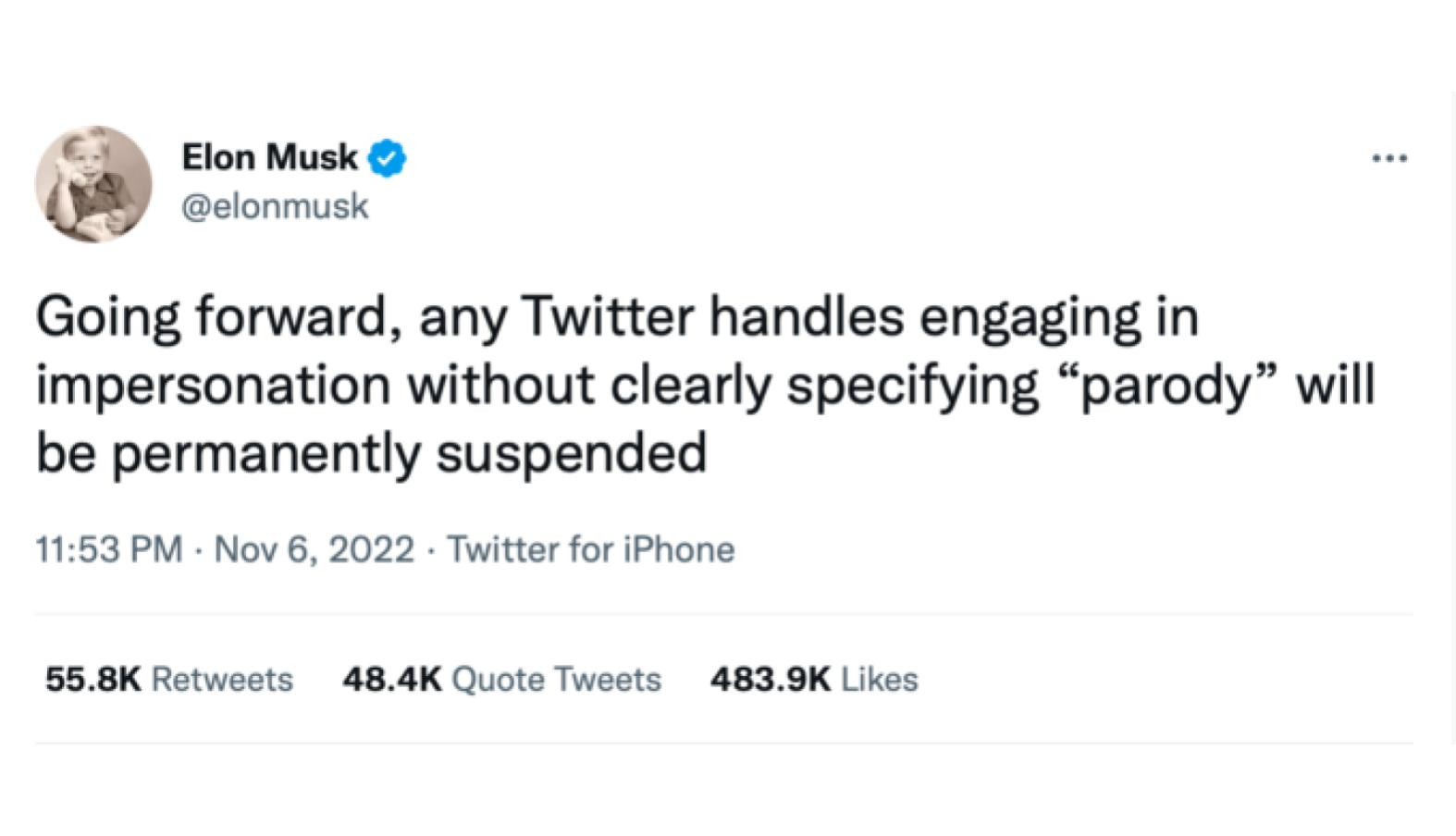
    On October 28, 2022, Elon Musk officially had ownership of Twitter after putting an offer up back in April. He originally wanted to fire roughly half his staff before the bonuses that would come out on November 1st, but after talking with HR he changed it to November 3rd. Part of the reason why HR recommended that he do that was so that the people who would be fired couldn’t sue or anything due to not being able to receive their bonus that was promised to them. And since Musk had been dealing with the lawsuit that Twitter had against him for trying to back out of the original agreement, he probably wouldn’t want to deal with any more lawsuits that are back-to-back. This was only the start to what he was about to do with changing how Twitter is being operated. Not everyone realizes that sometimes what gets posted can have consequences that the social media employees must deal with. On November 7th it was reported that Elon Musk posted a very controversial photo of a Nazi soldier and commented it with how the “homing pigeons the soldier carried, comparing them to the ‘bird’ that is Twitter” (Chabria). Even though the comment that he made was not directly related to the solider in the picture it still causes issues due to the hate that is still in the image because of the presence of the Nazi soldier. There were so many other options for pictures that Musk could have just as easily posted but he chose that one for a reason even if he won’t come out and say it directly. It was around this time too that many advertisement companies have stopped posting ads on Twitter due to the amount of hateful speech that is being said and how some of it is being directed towards these companies such as, General Motors, Volkswagen Group and General Mills. There is a civil rights group calling for advertisers to boycott Twitter because “’it is immoral, dangerous, and highly destructive to our democracy for any advertiser to fund a platform that fuels hate speech, election denialism, and conspiracy theories’” (Oremus). No advertising company wants to back up another company that is not following the same idea of respect or morals because it can also make them look bad. That’s part of the reason why so many influential people try to refrain from saying their opinions on topics unless they felt it was absolutely important to. Musk believes that Twitter “should adhere to principles of free speech, doing little beyond what the law explicitly requires to police itself” (Oremus). It sounds almost like Musk will allow people to say whatever they want until they either trying to impersonate him or go against what he believes to be right opinion. Elon Musk even went as far as banning accounts that were impersonating him even though he is a big activist for freedom of speech. The people who impersonated him had the opposite political view that he had for this midterm election and that caused there to be tension between Musk and anyone who had impersonated him. In the Twitter rules one can “impersonate” another individual as long as they “distinguish themselves in BOTH their account name and bio” (Kolodny). It’s a way to make sure the actual account holder is reliable for what they say rather than get the person or group that they are trying to impersonate in trouble.

    On the same day that Elon Musk posted the controversial image he also tweeted to his 115 million followers to vote Republican. This happened after Musk was tweeting about staying politically neutral. There has been more and more misinformation about the elections as time goes by but since Twitter lost 7,500 employees, there isn’t enough people working to be able to keep up with the amount of misinformation that is being posted. Some people noticed a big slowdown in how quick and efficient Twitter used to be when needing to take fake news and other misinformation down. There are a lot of people trying to claim that the WI-FI networks at any location that polling is happening can cause the voting machines to be hacked. There have also been problems surrounding absentee ballots since so many people are starting to believe that mail in ballots is leading there to be a lot more voting fraud since there isn’t anyone making sure each person only drops off one ballot. When there are so many people on a social media platform as big as Twitter it can cause any information whether it is true or not to spread like wildfire. To help counteract some of the misinformation around election time, Elon Musk decided to launch a new Twitter verification process. It was originally supposed to launch before the election but due to the amount of people who got fired it made it hard for it to be launched on time. So, on November 9th the new verification process was launched which now requires people to pay an $8 a month subscription to have that blue check mark next to their name so that the chance of getting impersonated goes down. Some have speculated that the new verification process is a way to help Elon Musk make back the $44 billion that he spent on buying Twitter. Others think it was a way to stop so many comedies from trying to impersonate him and tell people to “vote Democrat” when he is trying to tell people to vote the opposite. (Conger).

    Once Elon musk had complete control over Twitter there was a huge increase in hateful speech that was happening. Most of it happening by accounts that are inauthentic. These trolling accounts are causing a lot of problems for the people and employees of Twitter. Since the hateful information isn’t being taken done fast enough it is leading more and more people to repost and add to the other hateful speech. In just a 12 hour window there was a over a 500% increase in the N word, Jew increased fivefold, and misogynistic and transphobic speech increased. It is believed that since “Musk is now the primary owner of the platform, he may follow through with loosening standards of harmful content and dissolving the so-called censorship he has criticized in the past” (Ray). It just goes to show how Elon Musk is trying to change Twitter and how fast it is changing under his ownership. Although some people believe that censoring content doesn’t do anything, statically speaking it has definitely made an impact when Trump got banned because the idea of election misinformation dropped by roughly 73% once he was removed. The type of people on social media really does have a huge impact in what gets posted and how big of an effect it has on the platform. (Ray).

Stakeholders

    All the people who have and use Twitter have been affected drastically since Elon Musk became the owner. He’s made it hard for people to know if the information they have been reading about the election is true or false. With roughly 7,500 of the staff gone from various positions such chief executive, policy executive, and many more that were completely fired. Some of executives that were fired are, Parag Agrawal, Ned Segal, and Vijaya Gadde. While also cutting “half of its public policy team: and “more than one team that touched election integrity” (Hatmaker). After Kathy Griffin and Rich Sommer were banned on Twitter there were several people who had complained and tried to get them unbanned. Elon Musk Said he would unban them if they chose to go through with the new verification process. It seems like Twitter is going to become like a streaming service and a way for Elon Musk to make back the money he lost buying Twitter.

Individualism

    Companies want employees that will help them achieve their goal in the long term, which means having to get rid of the ones that are holding back the company. With Elon Musk trying to make Twitter better, he needs to have employees that are going to help him achieve his goal. Since Musk wants to make Twitter a better social media platform so that more people would want to use it. Even though Musk is a big advocate for free speech, which means Musk is going to push the boundaries that have been set by society. With the smaller staff size at Twitter anything that isn’t morally allowed to be posted is taking longer to get down, which ends up helping Musk with the idea of free speech. Another one of Musk’s goals would be to maximize profit since that is what businesses would do so that they remain in business. With less employees and the subscription service to verify accounts, it will help increase the over all profit of Twitter.

                                                   Utilitarianism

   When Elon Musk bought Twitter, he bought it with the intention of making it better. By doing that he intends on finding ways to make more people on the platform happy. Even though Musk is trying to maximize his own happiness he also must consider the happiness of the users so that he can keep them on Twitter. By trying to get ads to be removed and banning people for impersonating other users it can make the platform more enjoyable for everyone. However, with how long it is taking Twitter to take down certain posts that are problematic, it is not helping with the user’s happiness of the platform. It’s the posts that are targeting specific people that are the more problematic ones and posts that have been made by impersonators.

Kantianism

    The users of Twitter should be treated with respect because they are the ones that are going to make it profitable for Elon Musk in the long run. They can’t be treated as just a way to get profit because it goes against the idea of having a good will. Musk would need to be able to find ways to make Twitter better that would benefit the users so that in return they would be able to give him what he wants. Since it is the motivation behind the action that matters more than the outcome itself. Even when Musk tried pulling out of the deal to get Twitter it made it a little clear that he was using Twitter to benefit himself more than making the platform better for everyone who uses it.

Virtue Theory

    It takes courage to be able to own a social media platform because not only does one have to worry about making it interesting enough for people to stay on it but also having to deal with what others are posting. On top of that but also having the self-control to handle any situation without overreacting or causing more problems that might end up causing people to leave the platform. Elon Musk would have needed to be taught how to deal with situations so that it appears like he has control over Twitter. He also would need to be fair with how he treats the people who are impersonating someone or posting things that are against the rules that Twitter has. Since if he treats people differently for doing the same thing then it is going to cause more problems for him down the line because no one would want to be treated differently. Without having the knowledge from either past experiences or from coworkers on how to run a platform like Twitter, it would not have been good for Musk since he would have lacked the wisdom and judgement that would be needed for Twitter. It requires a lot of experience and patience to learn from others on how things should be dealt with in a social media platform compared to other companies since there aren’t as many people watching and seeing what others are saying about it.

Justification Ethics Evaluation

    The way Musk is trying to handle everything that is going on with Twitter is not being handled well. It has been causing more problems when it comes to election information because there aren’t enough people to be able to keep up with everything everyone is posting. With the slowdown in the control of misinformation it has caused several tweets to get reposted thousands of times before anything has been done about it. The whole idea of Twitter becoming a paid verification social media app is just a way for Musk to be able to pay off the loans he had to pull out to buy Twitter because Twitter wouldn’t lower the cost after the original agreement. It feels wrong having someone run a social media app that’s as big as Twitter when there have been several times when Musk himself had to remove something he posted. By being the owner, it doesn’t give Musk the right to say and post whatever he wants and the amount of time it is taking for someone in his company to tell him to take down inappropriate posts is a problem. Musk doesn’t have the morals to be able to handle owning the app especially around the times that elections are held because so many people try to impersonate him. It just creates a lot of controversy about what the owner of any platform can and can’t be able to do and Musk seems like he wants to keep trying to push the envelope since he is so into freedom of speech.

                                                    Conclusion

    Even though Elon Musk has shown that he knows how to run a company and try to make it better he himself doesn’t know how to act on such a platform. By examining what he has done with the platform so far it shows how he hasn’t investigated the ethical views of his ideas. He seems to be very focused on making sure he can say what he wants and to try and find a way to make back the money he lost when he originally bought Twitter. Musk is all for freedom of speech but at the same time it seems almost as if he doesn’t like other people having a different opinion then him or even trying to be a comedian. He did at some point after getting Twitter say that comedy is now legal on Twitter but when some comedians tried to have fun with him it ended with their accounts getting banned or locked. Part of the issue seems to be that Elon is having a harder time trying to run a social media platform since it is drastically different from his other company Tesla and so many people on Twitter will voice their opinions on things that he says.


References

Chabria, Anita. “Column: Elon Musk is Breaking His New Toy. Will it Cost us Our Democracy?” Los Angeles Times. Nov. 8, 2022. https://www.latimes.com/california/story/2022-11- 08/column-icarus-has-crashed-the-weekend-we-all-expected-from-twitter
Conger, Kate. Hirsch, Lauren. “Elon Musk Twitter Take Over”. New York Times. October 27, 2022. https://www.nytimes.com/2022/10/27/technology/elon-musk-twitter-deal-complete.html
Dang, Sheila. Roumeliotis, Greg. “Musk Begins His Twitter Ownership With Firings, Declares the ‘Bird is Freed’”. Reuters. October 28, 2022. https://www.reuters.com/markets/deals/elon-musk-completes-44-bln-acquisition-twitter- 2022-10-28/
Hatmaker, Taylor. “Elon Musk’s Twitter Faces US Midterm Elections, His First High-Stakes Test”. TechCrunch. November 7, 2022. https://techcrunch.com/2022/11/07/elon-musk-twitter-us-midterm-elections/?guccounter=1
Kolodny, Lora. “Elon Musk Bans Impersonation Without Parody Label on Twitter Raising Questions  About Free Speech Commitment”. CNBC. November 7, 2022. https://www.cnbc.com/2022/11/07/elon-musk-unlabeled-twitter-parody-accounts-risk- permanent-suspension.html
Oremus, Will. Hassan, Jennifer. Siddiqui, Faiz. “Musk Recommends Voting GOP, Bans Twitter Accounts for ‘impersonation’”. The Washington Post. November 7, 2022.       https://www.washingtonpost.com/technology/2022/11/07/elon-musk-twitter/
Ray, Rashawn. Anyanwu, Joy. “Why is Elon Musk’s Twitter Takeover Increasing Hate Speech”. Brookings. November 23, 2022. https://www.brookings.edu/blog/how-we- rise/2022/11/23/why-is-elon-musks-twitter-takeover-increasing-hate-speech/


Twitter: Elon Musk Layoffs (2022)


Abstract

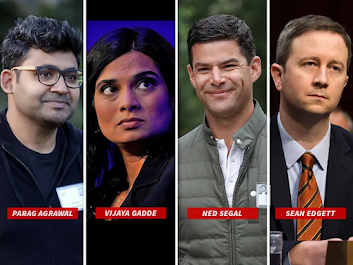
Between January and April, Elon Musk began to collect large amounts of shares of the social media company known as Twitter. On the 27th of October, the deal was finalized. Musk immediately became Twitter's new owner, promptly firing Agrawal, chief financial officer (CFO) Ned Segal, Gadde, and general counsel Sean Edgett. Because of the exorbitant expense of the Twitter Exchange, Mr. Musk began to cut costs within the company, on October 20th The Washington Post reported that Musk intended to terminate 75 percent of Twitter's staff to which Mr. Musk told Twitter employees, while layoffs were still likely to happen, he did not intend to do so at the scale the Post had previously reported. Fast-forward to November 4th Musk and Twitter began laying off a substantial portion of the company's workforce and Twitter temporarily closed its offices, with The New York Times estimating that roughly half of the employees had been let go. Because of this mass layoff without warning five Twitter employees based in San Francisco and Cambridge, Massachusetts filed a lawsuit against the company, alleging that mass layoffs would violate federal and California WARN Acts.

This paper will be an analysis of the potential ethical violations that Mr. Musk has committed, according to the theories of Individualism, Utilitarianism, Kantianism, and Virtue Theory to determine whether Mr. Musk and the company was acting ethically or unethically.


Company takeover overview

Between January and April, Elon Musk began to collect large amounts of shares of the social media company known as Twitter. On April 2nd Mr. Musk becomes the largest shareholder and is invited into the spheres of influence within Twitter. On the 14th Mr. Musk makes a bid to buy out the company to which the board of directors unanimously agrees on the 25th for a price of $44 billion. Between May and June however, Elon Musk begins to back out of the said deal for a multitude of reasons. The first of which was revealed to the public was the report that five percent of all Twitter users were either bots or spam accounts. To ensure that the deal would be as smooth as possible, the board agrees to a 3rd party investigation, to dismiss the claims that were given by Mr. Musk.

In July, at the time, security officer Peiter Zatko had accused several Twitter executives, including CEO Agrawal and certain board members, of making false or misleading statements about the privacy of its users. Because of this Mr. Musk then announced his intention to terminate the proposed acquisition, claiming in a regulatory filing that Twitter was in "material breach" of several parts of the agreement. In response, Twitter formally launched its lawsuit against Musk at the Delaware Court of Chancery and hired the law firm Wachtell, Lipton, Rosen & Katz to represent its case on July 12th. When the Board and Mr. Musk went to court on the 19th judge Kathaleen McCormick ruled that the trial would take place in early October and last for five days. In the coming weeks, many chaotic events took place, that caused the value of Twitter to fall drastically, on the 22nd Twitter cited the "chaos" caused by the proposal as the primary factor for its decline in revenue. At the end of the month, Musk's lawyers complained that Twitter had hindered them from commencing the discovery process and requested an October 17 start date, which they were given.

On August 10th Musk sold 7.92 million Tesla shares worth a total of $6.9 billion as a backup should he lose the lawsuit and be forced to buy the company. To strengthen his case Elon Musk would begin to gather evidence that suggests Twitter had manipulated the deal in bad faith. On the 29th Musk filed a "termination letter" with the SEC, citing Zatko's claims as evidence Twitter breached their contract, which was accepted into the case.


On the 13th of September Zatko testified before the Senate Judiciary Committee, while Twitter shareholders voted in favor of the acquisition. While at the same time Musk privately offered to purchase Twitter at the reduced prices of $31 billion and $39.6 billion, both of which the company rejected. On October 3rd as the time for the court hearing drew nearer Mr. Musk’s legal team informed Twitter that Musk had changed his mind and decided to move forward with his proposed acquisition at the originally agreed-upon price of $54.20 per share, on the condition that Twitter drops its lawsuit. They accepted and McCormick agreed to a request by Musk to postpone the trial to October 28 so Musk could finalize his debt financing for the acquisition. On the 27th of October, the deal was finalized. Musk immediately became Twitter's new owner, promptly firing Agrawal, chief financial officer (CFO) Ned Segal, Gadde, and general counsel Sean Edgett


Case Controversy


Because of the exorbitant expense of the Twitter Exchange, Mr. Musk began to cut costs within the company, on October 20th The Washington Post reported that Musk intended to terminate 75 percent of Twitter's staff to which Mr. Musk told Twitter employees, while layoffs were still likely to happen, he did not intend to do so at the scale the Post had previously reported. Fast-forward to November 4th Musk and Twitter began laying off a substantial portion of the company's workforce and Twitter temporarily closed its offices, with The New York Times estimating that roughly half of the employees had been let go. Because of this mass layoff without warning five Twitter employees based in San Francisco and Cambridge, Massachusetts filed a lawsuit against the company, alleging that mass layoffs would violate federal and California WARN Acts. which have yet to be addressed in a court of law. Due to the layoffs being so numerous Twitter asked some employees who had been laid off to return to the company, either because they had been fired by mistake or because they were belatedly deemed important to the health of the business. On the 16th Musk stated that he planned to appoint a new CEO to oversee Twitter eventually. Musk and his advisers met with several employees to dissuade them from leaving the company while Twitter offices were once again closed until the following Monday.
On November 18th a large number of core functions had been rendered nonviable due to resignations. These included the "payroll team, financial reporting team, and taxes team for the US, [who] completely resigned". Elon Musk calls for 'anyone' left at Twitter who can write software to meet him, or fly in, to help him 'better understand' Twitter's tech


Stakeholders

The stakeholders, in this case, are the employees at Twitter and their families. Due to the massive changes being made in their workplace they have had no assurance that they will be employed by the end of the week each day. The workforce of Twitter is directly being treated unethically. Being left without a job with no prior notice, their livelihood being put at risk as well as their families being left without a major source of income in many cases will leave people destitute.
The other stakeholders, in this case, are the users and distributors of Twitter, because of such a major slash within the company, many features that were to be rolled out with new updates to Twitter will no longer be on schedule, this will cause an eventual bottleneck within the development pipeline, that will affect all users as well as distribution companies such as Apple and Google.

Today we will take a look at this controversy through several mindsets, summarize those mindsets, and how those mindsets affect what the resolution to the controversy should be.


Individualism

Individualism according to Machan says “the only direct goal of business is to profit, and the primary obligation of the businessperson is to maximize the profit created, for the company and its shareholders.
Looking at the controversy through this lens, ElonMusk has been within the specifications of his purview, by trying to maximize profit, because the company was taken private as of October 26th we cannot tell if the profit is being increased however the plan Elon Musk would indicate he is trying to cut costs to decrease the accumulating debt, and as long as he does that within the purview of the law, he is within the ethical boundaries. That however is up to debate, the laws for layoffs are long and complex, as stated before in the case controversy section, the federal WARN law is a U.S. labor law that protects employees, their families, and communities by requiring most employers with 100 or more employees to provide 60 calendar-day advance notification of planned closings and mass layoffs of employees. Because Elon Musk had not given a 60-day notice it could be argued that he is breaching the laws, however, that could also be contradicted because § 639.9 (b) within the law states that due to unforeseeable Business circumstances the layoffs without notice could be accepted within a court case.


Utilitarianism

Utilitarianism is by far more pro-stakeholder, it takes a stakeholder’s approach by saying in order to maximize happiness in yourself and other people. Its goal is to maximize happiness for all affected parties and to minimize unhappiness for all affected parties. In other words, Utilitarianism can be described as ‘pleasure and the absence of pain’. Ultimately, Utilitarians consider the costs and benefits of actions for all affected, not just the company or one individual. If we are to consider the pros and cons for the stakeholders then the entire deal has been mishandled and has harmed every stakeholder, and the employees have been harmed by the lack of security and reassurance. With the sudden changes and creation of a precarious work environment, the surviving members of the workforce still haven’t recovered from the experience as well as the poor environment that has been put in place by the new CEO. The second stakeholders are the families of the former twitter employees and distributors of twitter. As stated before the families of former employees are directly affected by the exorbitant layoffs happening and are extremely at risk of losing their livelihood as a result, and the distributors who are seen having issues communicating with Twitter’s internal customer support (mainly because it doesn't exist anymore), the extent to which this fallout will be is unknown as of now, but it can be said that the worst is still yet to come, with Elon Musk reported being hemorrhaging money because of this deal. It is still yet unclear if the company and social media platform will declare bankruptcy and how that will also affect the stakeholders.


Kantianism

Developed by Immanuel Kant and focused primarily on rationality and Good Will. Kant says that it is wrong to manipulate and exploit people for their advantage. The four basic principles of Kantianism are defined to act rationally, helping others make rational decisions, respecting people, and to be driven by Good Will, and looking to do the right thing because it is right. In this theory, the Categorical Imperative is a test that decides whether an action is permissible or impermissible. One of the main formulations of the Categorical Imperative is The Formula of Humanity which states that it is wrong to use people as a means to get what you want because it exploits them.


If we follow this line of thinking it is clear to us that Elon Musk is in clear violation of his ethical obligation to his newly found employees, although he is acting rationally trying to cut expenses being dealt with by the company, the lack of clarity and falsities with internal reports to employees about layoffs clearly shows exploitation and manipulation of the employees, that and new reports stating that the workers who are still left are being told to do 70 plus hour work weeks show us that the new CEO, or “Cheif Twit” as he has referred to himself as is fallen out of good ethical practice for his new company.


Virtue Theory

Virtue Theory was developed by Aristotle. Virtue Theory focuses on rationality and whether a person is virtuous or not. The 4 main virtues include courage, honesty, temperance, and justice. Aristotle said that rationality is what differentiates the characteristics of people. So, people need to be rational to live a virtuous life. Aristotle also said that people need to be rational to function well and said that if a thing achieves its function then the thing is happy. Therefore, people who function well will live virtuous lives.

Looking at Mr, Musk’s actions through this lens, it becomes much harder to discern what is ethically just, on certain aspects it is clear that the takeover was very badly mishandled. As stated previously Mr. Musk has not had clarity with his employees thus making him in violation of the virtue of honesty. It is also clear that he violates the virtue of temperance.

Temperance is setting reasonable expectations for employees. Which we can see is not being followed as shown by his telling employees to work 70-plus hour weeks, with so much chaos happening around them. In happenstance, the creation of such a hostile and unreasonable work environment makes it impossible for Mr. Musk to pass the Temperance Virtue.

The virtue of justice is described not as bringing justice in the workplace but as acting in a just and reasonable manner that makes rational sense that can be followed without major issues, which again is shown to not be followed. We have seen that many of the layoffs were trying to be retracted with letters stating that people were laid off that weren’t supposed to be and Mr. Musk reportedly meeting in person with many of the former employees trying to bid favor and bring them back into the fray. The Justice virtue has been violated because of this back and forth of, giving a statement and then retracting it a day later, to where it seems there is no clear rationale for who is and isn't being put on the chopping block, the only clear thing about the whole ordeal is that people are being fired to cut costs, the employees just can never tell who.

The last virtue to discuss is courage, courage seems to not be violated solely because of the complexity of the situation. And the lack of opportunity to be violated, to violate this there would need to be a clear and established history of trust between employer and employee, but because of how recent the case is (it is still ongoing as of writing) there is no allowance for the Virtue to be violated.

Going through the 4 virtues, 3 of the 4 virtues are violated, and the 4th isn't even affected, therefore we can conclude that because any of the 4 virtues are violated Mr. Musk is not working within his ethical boundaries.


Evaluation

Now we have gone through, our journey of several different ethical theories, we can determine whether or not Mr. Musk has mishandled his newly acquired company and how he could've done better. According to Individualism, the argument could be made that he was within his purview of the law to cut ties with a large portion of the workforce without prior notice thanks to § 639.9 (b) of the WARN Acts. but according to all other views he has been in a clear and direct violation of his ethical responsibility to his employees and their families. Utilitarianism would argue that because of the lack of morality with judgments that have taken place, its core values of maximizing happiness haven't been followed. Kantians would also agree that the ethical boundary has been crossed stating the Categorical Imperative was not followed. It is also stated by Virtue theory, that because 3 of the 4 virtues; honesty, temperance, and justice, were not followed that Mr. Musk wronged those who were let go.

Unfortunately, hindsight is 20/20, and what has happened can't be fixed. The correct path to have taken would have been to give the employees 60 days' notice and begin to cut costs in other ways while the layoffs were to occur. The question then arises, “How would we rectify the situation now ?” The most obvious answer would be to give a stipend for the influx of money that has been lost as a result of the layoffs. The odds of that happening are slim to none, however. The option that then brings itself to the forefront would be to settle this dispute in a class action lawsuit that would be able to allow an accord to the workers so that they may air grievances and work toward a settlement that is beneficial to their issues.


Closing Thoughts

In my closing thoughts, I feel I should also come to say that even though this writing is in an attempt to stay neutral to the situation, I do feel that my own thoughts will seep into the writing of the paper. I do stand with the workers as I feel everyone should in this situation. However, there is an argument to be made that this was the course of action that was going to be made regardless of ethical boundaries. I should note that the situation was poorly handled at best and that even if layoffs were to happen the WARN Acts should have been followed better and the workers should have been given much more clarity on what was to happen when the transition between the two different boards was going to happen. I also feel that the Board of directors spearheaded by the former CEO Parag Agrawal is not innocent in the events that lead up to the mass layoffs, in many ways they sold out their employees and left them with many questions and concerns without instilling confidence or a sense of security, it is just as much the board's job to ensure employees that they have security, as it is the board's job to please shareholders.

Overall the entire takeover was a poorly mishandled mess that every party involved had a hand in dealing with. Much of the blame is on Mr. Musk, and we have taken a look at this through many eyes. The takeaway here should be, since each decision matters, it's important to pause and think about the impact your decision or action will have on yourself and others. Weigh the potential consequences of each decision, including positive or negative outcomes that may occur immediately or in the future.


References

Salazar, Heather. The Business Ethics Case Manual: The Authoritative Step-by-Step Guide to Understanding and Improving the Ethics of Any Business. Print.

Ashley Belanger - Nov 14, 2022 4:28 pm UTC. “Twitter Lays off 5K Contractors in Surprise 2nd Wave of Cuts, More Mods Lost.” Ars Technica, 14 Nov. 2022, https://arstechnica.com/tech-policy/2022/11/twitter-lays-off-5k-contractors-in-surprise-2nd-wave-of-cuts-more-mods-lost/.

“Code of Federal Regulations; PART 639 - WORKER ADJUSTMENT AND RETRAINING NOTIFICATION.” www.govinfo.gov, 1 Apr. 2010, https://www.govinfo.gov/content/pkg/CFR-2010-title20-vol3/xml/CFR-2010-title20-vol3-part639.xml.

Feiner, Lauren. “House Republicans Demand Twitter's Board Preserve All Records about Musk's Bid to Buy the Company.” CNBC, CNBC, 22 Apr. 2022, https://www.cnbc.com/2022/04/22/republicans-demand-twitter-board-save-records-on-musks-bid.html.

Hays, Kali. “Elon Musk Calls for Remaining Twitter Coders, Engineers to Meet Him.” Business Insider, Business Insider, 18 Nov. 2022, https://www.businessinsider.com/elon-musk-remaining-twitter-coders-engineers-email-2022-11?amp.

Mac, Ryan, et al. “Resignations Roil Twitter as Elon Musk Tries Persuading Some Workers to Stay.” The New York Times, The New York Times, 17 Nov. 2022, https://www.nytimes.com/2022/11/17/technology/twitter-elon-musk-ftc.html.

O'Sullivan, Donie, and Clare Duffy. “Elon Musk's Twitter Lays off Employees across the Company | CNN Business.” CNN, Cable News Network, 9 Nov. 2022, https://www.cnn.com/2022/11/03/tech/twitter-layoffs/index.html.

Siddiqui, Faiz, and Jeremy B. Merrill. “Musk Issues Ultimatum to Staff: Commit to 'Hardcore' Twitter or Take Severance.” The Washington Post, WP Company, 18 Nov. 2022, https://www.washingtonpost.com/technology/2022/11/16/musk-twitter-email-ultimatum-termination/.

Vinocur, Nicholas, and Vincent Manancourt. “EU Privacy Enforcer Puts Elon Musk on Notice as Twitter Melts Down.” POLITICO, POLITICO, 18 Nov. 2022, https://www.politico.eu/article/elon-musk-twitter-privacy-helen-dixon-eu-privacy-enforcer-puts-on-notice-as-twitter-melts-down/.