Showing posts with label Twitter employees. Show all posts

Friday, December 2, 2022

Twitter: Elon Musk’s Acquisition Harms Employees and User Base (2022)

ABSTRACT

Twitter CEO Elon Musk
            Elon Musk’s 44 billion dollar acquisition of social media company Twitter has had the public talking. The new billionaire CEO has laid off over half of his workforce, as well as both, directly and indirectly, allowed the spread of misinformation in just the first month since purchasing the company. An Individualist would argue for the case to be unethical as Musk is not maximizing the profit of the company within the law. Under utilitarianism, his actions would be considered unethical due to the harm of his actions outweighing the little happiness they provide. Kantianism would classify Musk’s actions as unethical due to their failure to lack rationality. A Virtue Theorist would consider Musk an unethical person from the lack of virtues shown in his behavior. I, and hopefully you once you finish reading this, believe that the actions of Elon Musk toward Twitter employees and users are heavily unethical.

ETHICS CASE CONTROVERSY

Twitter Under Musk Timeline

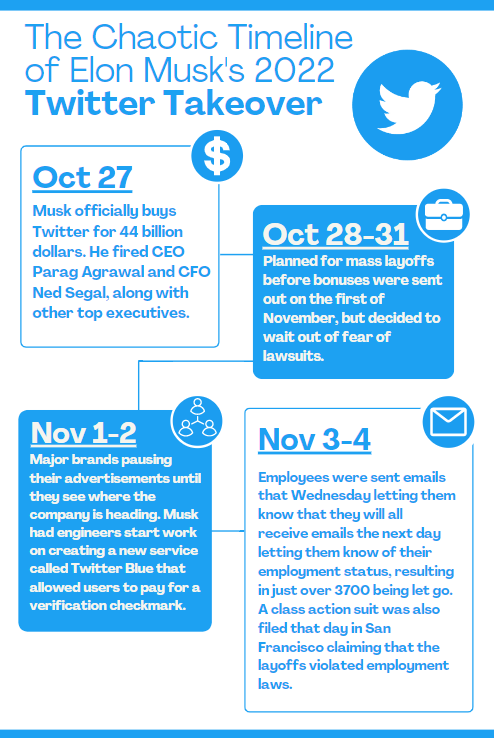
            Twitter is a social media application that allows users to post thoughts, images, and videos as “tweets”. Billionaire and multi-business owner Elon Musk was in talks to buy the company back in April 2022. However, it was not until October 27 of the same year that he officially bought Twitter for 44 billion US dollars. Musk’s vision for the app was to remove the censorship and bring back his version of free speech. Upon acquisition of the company, his first action as the new owner was to fire the top executives, including former CEO Parag Agrawal and CFO Ned Segal, just a glimpse of what was to come over the next month (Conger et al.). Purchasing Twitter at such an enormous amount, one that required taking on 13 billion in debt, had made the new CEO’s mission clear: reduce costs (Griffin).

The next day, Musk told the remaining executives to prepare for widespread layoffs before employee bonuses were sent out on November 1. However, he decided to push till after the issuances out of risks of potential lawsuits. On November 3, employees received an email letting them know that they will receive another email the next day with their employment status. However, some employees were locked out of their accounts before the day had ended. A class action lawsuit was filed against the company in San Francisco for violating California’s Worker Adjustment and Retraining Notification Act which says that employers must give at least a 60-day notice before mass layoffs. By the next day, almost half of the company’s 7500 global employees were gone. After receiving major backlash from the public, Musk said that all laid-off employees were getting 3 months’ severance, which is 50% more than the required amount (Palmer). Major companies including General Motors and Volkswagen Group pause their advertisements until they see what direction the company is heading (Vranica et al). Musk later tweeted that Twitter is losing 4 million dollars a day. Meanwhile, the remaining employees were tasked with creating a paid subscription that allowed their users to become verified. Musk imposed strict deadlines, with some employees going as far as to sleep at the office to reach them (Conger et al.). By November 9, the subscription Twitter Blue was rolled out to iOS users for 8 dollars a month. Problems arose quickly, with widespread impersonations afflicting the app and having major real-life consequences. One account impersonating insulin manufacturer Eli and Lilly Company tweeted out that insulin was now free of charge. After a couple of hours, the tweet was removed, but the damage was already done. Eli and Lilly’s stock price plummeted, with an estimated loss of 15 billion dollars to their market cap (Barr). With mass impersonations and misinformation spreading, Twitter Blue was removed from the app only two days after its launch.

Timeline continued
The following week saw another wave of layoffs. Contract workers in engineering, marketing, and customer service were the first to be let go this week. Musk issued an ultimatum to the remaining employees, having them choose between either working long, intense hours or accepting the severance package (Kolodny et al.). He also removed the ability to work from home, which would prove to be a mistake. Two more class actions were filed; the first lawsuit claims that removing the ability to work from home goes against the Americans with Disabilities Act (ADA), while the other one claims employment laws were violated in the layoffs for contract workers (Wiessner). By the next week, Twitter was estimated to have lost another 1000-1200 employees (Mac et al.). Musk announces that an improved version of Twitter Blue will come back once the impersonations stop. The newer version of the subscription will have different color verification depending on whether the account belongs to a brand, government official, or an individual (including celebrities and people with Twitter Blue), making it easier to identify a possible impersonator. As a part of Musk’s goal to make Twitter a more free, less restrictive space, previously suspended accounts are being brought back. The COVID-19 misinformation policy, which labeled certain tweets that talked about the virus as misleading, was also removed, with experts saying it could have serious consequences (Ivanova).

STAKEHOLDERS

Any party that is affected by the decisions of Elon Musk would be considered a stakeholder. This would include all Twitter employees, their user base, and shareholders invested in Musk’s other publicly traded companies, including Tesla. From the first day Musk took ownership of the company, top executives were fired. Massive layoffs caused over half of the company’s global employees, an estimated 4,800, to be let go. Twitter Blue allowed anybody with 8 dollars to impersonate a person or company, spreading misinformation to anyone who sees that account not knowing they are the official account. The COVID-19 policy getting removed only further increases the spread of misinformation. The consequences are unfathomable when you realize Twitter usage is at an all-time high of 254 million active users a day (Best). Musk’s other multi-billion dollar company Tesla has seen a major hit to its stock price, with it reaching a 52-week low this past week (Raymond).

INDIVIDUALISM

Twitter Headquarters in San Francisco
Under individualism, the goal of the company is to maximize its profits for the owners of the business in a legal way. From the beginning, all of Elon Musk’s decisions have been to maximize profits. He has laid off over half of Twitter’s workforce, as well as created the subscription service Twitter Blue to bring in more revenue. However, not all of the actions to maximize profit have been within the law. In California, where Twitter’s headquarters reside, it is illegal to execute mass layoffs of employees without at least a 60-day warning under the California WARN Act. Musk also remove the remote work policy, in hopes that going into the office would increase the productivity of workers. This also violates laws set by the ADA, which allows remote work as an acceptable accommodation as long as it put no significant hassle on the employer (Wiessner). He also stopped the purchase of Twitter Blue two days after its launch, something that could have increased profits if left available to purchase for longer. The bad press that comes along with these actions has stopped many major companies from using Twitter for advertising, ultimately making the actions lose more money.

To an Individualist, these actions taken by Musk would be considered ethically wrong. Individualism stresses that, “it is the aim and the responsibility of businesses to maximize their profits” (Salazar 17). Increasing profit in one area just to lose profit in another would not go work for an Individualist, especially if those actions were illegal. If Musk were to have given a warning to its employees within the legal limit, as well as kept the remote working policy, he would still be able to cut costs while staying within the law which is ethical under Individualism.

UTILITARIANISM

Utilitarianism stresses the importance of happiness. A Utilitarian considers an action ethical as long as it creates more overall good than bad. In other words, for an action to be ethical under utilitarianism, it would have to, “maximize happiness in all affected parties in the long-term” (Salazar 20). In the case of Elon Musk and his actions as CEO, Utilitarians would consider his actions unethical.

The efforts Musk has implemented over his first month as the owner goes against everything Utilitarians value. Laying off over half of his workforce leaves an estimated 4,700 unhappy people without jobs and one person happier as they have fewer costs. Twitter Blue may supply some happiness to individuals impersonating brands or celebrities, but for every account impersonating, there is a person or company whose reputation is possibly being damaged. Then there are all the people absorbing the misinformation by the impersonators who are now worse off than they were before. Forcing all employees, including ones with disabilities, to come back to the office only makes Musk happy, while the employees, some who physically cannot get to the office, are stuck with having to a severance package over their job. The strict deadlines and intense working hours create a harsh environment for the workers whose job was much easier just over a month ago. These actions all only benefit one person, Elon Musk, while leaving thousands of employees and millions of Twitter users less happy than before Musk came into power, something a Utilitarian would heavily disagree with.

KANTIANISM

An ethical action under Kantianism is rational and has the right motivations. To determine whether or not an action is rational or not, a series of tests known as the Categorical Imperative are used to find out if the action is permissible or impermissible. We can apply these tests to the actions Elon Musk has employed over his first month as CEO of Twitter to figure out if his actions, under Kantianism, are ethical.

Manager Esther Crawford Sleeping at the Office

The first of the Categorical Imperative tests is the Formula of Universal Law, which tests if it would be possible if everybody in the world to follow through with the same action. If we were to consider the mass layoffs Musk gave his employees, it would fail the test. If every company in the world was to lay off half of its employees without giving proper notice, billions of people would be left without jobs and unable to provide for their families. Not to mention the countless lawsuits brought up because of it. Another way to test for rationality would be through the Formula of Humanity, which asserts that, “it is wrong to use people as a mere means to get what you want” (Salazar 22). Considering all the major actions Musk put his employees and users through, they would fail the test. Creating a subscription service to increase revenues is using the user base simply as a means to get more money. The layoffs also fail this test, as Musk is laying off employees as a means to reduce overall costs. The final test in the Categorical Imperative is the Formula of Autonomy, stating that we must abide by the actions we place on others. When applying this to the strict deadlines and harsh working conditions Musk puts on his employees, we have to ask whether or not Elon himself would like to have to sleep at the office to meet those deadlines or have to work long hours at high intensity. If any of the tests yielded a permissible action, it would not have the correct motivation. The actions Musk implemented in the first month as the owner were to help himself, not the employees or the user base, leading any Kantian to believe that his actions were, in fact, unethical.

VIRTUE THEORY

Virtue theory emphasizes acting with virtuous traits and in doing so will lead you to live an overall better and flourishing life. A virtue is a positive characteristic allowing things to run better. This ethical theory is different from the other three as they, “analyze individual actions whereas virtue theory analyzes a person’s character” (Salazar 23). The four cardinal virtues one can possess are courage, temperance, justice/fairness, and honesty, along with one intellectual virtue known as prudence. Looking at Elon Musk during his new reign over Twitter, a virtue theorist would find him to be unethical.

We can see Musk not acting on good virtue the day he bought Twitter. One could say that Musk buying the company was courageous but looking at what he had to do to make up for it, such as taking on 13 billion in loans, Musk would have been considered to act rashly and impulsive, which are both vices. Vices are the opposite of virtues and lead a person’s life in the opposite direction of what virtue theorists would accept. Musk would also not possess the justice/fairness virtue. It is not fair to the employees who have been working at Twitter for a long time to all of sudden be laid off by someone who just took over. Even if you did nothing wrong, you could have been laid off and stuck with having to find a new place to work. Musk also does not show the intellectual virtue of prudence, or the ability to make rational decisions considering the future. It is unlikely that he would have bought Twitter for such a high amount knowing the major effects of it, including having to lay off over half the workforce, companies pausing their advertisements, and a major toll on his other company’s stock Tesla, just to name a few. Musk acting with more vices than virtues not only will lead to a worse, dull life but is also considered unethical under virtue theory.

JUSTIFIED ETHICS EVALUATION

Popular Tweet Denying Facts about COVID-19
            From my perspective, I believe Elon Musk is in the wrong. He should have known that 44 billion dollars were too much for the company, and now he is taking it out on the employees. Musk should have given a 60-day warning before the mass layoffs to not only be following the law but also to be a decent person and help the employees out; giving them more time to look for a job. Imposing strict deadlines to the point where workers had to sleep at the office crosses the line. Taking away the remote work possibility not only affects employees with disabilities who struggle to come to the office but also hurts the workers who signed up as remote workers and have never been to the office. I thought Twitter Blue was okay in concept, but the execution was a disaster. It was clear from the announcement of the service that it would be heavily abused from the get-go. His reforms around freedom of speech can cause more harm than good, especially with the removal of the COVID-19 misinformation policy and the addition of previously suspended accounts. I think freedom of speech is a good thing, except when it is used to hurt people or a demographic, such as hate speech or misinformation. I believe the three lawsuits filed against Twitter are in good faith and have a higher chance of winning over Musk. When reviewing the facts of the case, it is clear that the actions exhibited by Elon Musk were highly unethical.

CONCLUSION

Elon Musk has made many questionable decisions since he acquired Twitter back in October. He laid off over half his staff without a proper warning. Misinformation was able to spread through his new policies as well as through his new service Twitter Blue. According to each of the ethical theories, including Individualism, Utilitarianism, Kantianism, and Virtue Theory, Elon Musk and his actions are unethical. I, along with probably most of you reading this, believe that Musk is clearly in the wrong, and only time will tell how the law agrees with us too.

REFERENCES

Barr, Kyle. “How Much Did Twitter's Verification Chaos Cost Insulin Maker Eli Lilly and Twitter Itself?” Gizmodo, Gizmodo, 14 Nov. 2022, https://gizmodo.com/twitter-eli-lilly-elon-musk-insulin-1849779323.

Best, Paul. “Elon Musk Says Twitter Sign-Ups at All-Time High, Predicts One Billion Monthly Active Users One Year from Now.” Yahoo! News, Yahoo!, 27 Nov. 2022, https://news.yahoo.com/elon-musk-says-twitter-sign-230445301.html?guccounter=1&guce_referrer=aHR0cHM6Ly93d3cuYmluZy5jb20v&guce_referrer_sig=AQAAAG9iS5aYvEzHbhJP4Xhp-KHZ52-YhgbMRFTeyMshEL99TJcixwFYML7snCVIscfTNPxmA38Wgq97Nh8NGBEk9Ud3P17v572tmZhuKamKkcq7ckGpYSNJUBkLIBqMqWPRTVz16vE1RnkS_OoayOn_0TcNZYURk4S2md3UkudGolXaqWPRTVz16vE1RnkS_OoayOn_0TcNZYURk4S2md3UkudGolXa.

Conger, Kate, et al. “Two Weeks of Chaos: Inside Elon Musk's Takeover of Twitter.” The New York Times, The New York Times, 11 Nov. 2022, https://www.nytimes.com/2022/11/11/technology/elon-musk-twitter-takeover.html.

Griffin, Allie. “Elon Musk to Lay off Half of Twitter's Staff, Enforce Return-to-Office Policy: Report.” New York Post, New York Post, 3 Nov. 2022, https://nypost.com/2022/11/02/elon-musk-to-lay-off-half-of-twitters-staff-enforce-return-to-office-policy/.

Ivanova, Irina. “Twitter Stops Enforcing Its Covid Misinformation Policy.” CBS News, CBS Interactive, 30 Nov. 2022, https://www.cbsnews.com/news/twitter-covid-misinformation-policy-ends/.

Kolodny, Lora, and Jason Abbruzzese. “New Wave of Resignations Hits Twitter after Musk Ultimatum.” CNBC, CNBC, 19 Nov. 2022, https://www.cnbc.com/2022/11/17/new-wave-of-resignations-hits-twitter-after-musk-ultimatum.html.

Mac, Ryan, et al. “Elon Musk's Twitter Teeters on the Edge after Another 1,200 Leave.” The New York Times, The New York Times, 18 Nov. 2022, https://www.nytimes.com/2022/11/18/technology/elon-musk-twitter-workers-quit.html.

Palmer, Annie. “Twitter Sued by Employees after Mass Layoffs Begin.” CNBC, CNBC, 4 Nov. 2022, https://www.cnbc.com/2022/11/04/twitter-sued-by-employees-after-mass-layoffs-begin.html.

Raymond, Art. “As Elon Musk Fiddles with Twitter, Tesla Stock Tanking and on Track for Worst Year Ever.” MSN, Desert News, 22 Nov. 2022, https://www.msn.com/en-us/autos/news/as-elon-musk-fiddles-with-twitter-tesla-stock-tanking-and-on-track-for-worst-year-ever/ar-AA14qXAp.

Salazar, Heather. The Business Ethics Case Manual: The Authoritative Step-by-Step Guide to Understanding and Improving the Ethics of Any Business. Print.

Vranica, Suzanne, and Patience Haggin. “Twitter's Advertising Exodus Accelerates, despite Outreach from Elon Musk.” The Wall Street Journal, Dow Jones & Company, 14 Nov. 2022, https://www.wsj.com/articles/twitters-advertising-exodus-accelerates-despite-outreach-from-elon-musk-11668262920?mod=Searchresults_pos1&page=1.

Wiessner, Daniel. “Disabled Employee Sues Twitter over Musk's Ban on Remote Work.” Reuters, Thomson Reuters, 17 Nov. 2022, https://www.reuters.com/business/disabled-employee-sues-twitter-over-musks-ban-remote-work-2022-11-17/.


Twitter: Elon Musk Clashes with Advertisers (2022)

ABSTRACT

Twitter Application
 Logo

    Twitter is a phenomenally successful social media platform, but new leadership may just be driving it into the ground. Elon Musk, a familiar name to most, just recently bought and become the new owner of Twitter. Elon Musk has shown extreme behaviors, did not hesitate to change guidelines, and granted Twitter account access back to previously banned controversial users. Behind closed doors, Musk is demanding employees commit to intense hours of work and threatened consequences if employees do not conform. Advertisers quickly became wary of his strategy and unsure of his leadership. Musk is now trying to convince advertisers to stay at the company and continue working for him. His actions are not only affecting himself, but the employees, advertisers, and the community of Twitter users as well.

This case will be reviewed under various ethical theories including Individualism, Utilitarianism, Kantianism, and Virtue Theory. Individualists would argue that Elon Musk is unethical because he is willing to express behaviors, even at the risk of profit. Utilitarianists would claim that Elon Musk is unethical because he is not prioritizing the happiness of employees or other Twitter users. Kantians would argue that Elon Musk is unethical because he has the wrong motivations and a lack of rationality. Virtue Theory would claim that Elon Musk is ethical because he is looking to use Twitter to its full potential. Personally, I say Elon Musk in relation to Twitter is unethical because of his extreme behavior and treatment of others.

ETHICS CASE CONTROVERSY

Twitter has been one of the most popular social media platforms for the better part of the last fifteen years. Twitter is a platform in which users can “tweet” their thoughts, share posts with friends, and see the news. Of course, like any other social media website, Twitter has set regulations and guidelines for limiting the content to keep it appropriate for all users. Twitter, in the past, banned users and controversial figures that failed to follow guidelines and was distributing posts that may not be appropriate for many. Musk has taken over Twitter and made changes regarding those banned accounts. Twitter advertisers think that the new leadership may be causing Twitter to take a turn for the worst.

Timeline of Elon Musk's
Twitter Takeover

    In January 2022, Elon Musk began buying shares of Twitter. On April 4, 2022, Musk became Twitter’s biggest shareholder, owning just over 9% of the company in shares. On October 27, 2022, Elon Musk officially bought Twitter and fully owned it through a $44 billion deal. Within 48 hours after his takeover, Musk posted, then quickly deleted, a tweet with anti-LGBTQ content. Since then, guidelines have been edited and “far-right figures [began] to test Twitter’s boundaries for anti-LGBTQ speech” (Wile). Musk denied making the changes and because of this, advertisers have claimed they will back away from the company due to being unsure about Musk’s strategy. These actions are ethically controversial because Musk is allowing for more freedom of speech and expression, but this can be hurtful or inappropriate to other users that may be sensitive to such subjects, or just not mature enough yet.

Musk has also shown close to no remorse for the employees at the company. On November 16th, Musk sent out an email to the entire company that demands the employees to commit to longer hours of higher intensity work. He stated those that do not conform to the new expectations, or support his ideas, will receive three months of severance. Elon Musk did not hesitate to make alterations in the company’s staff, as he fired an engineer, top executives, and up to twenty others. Those he fired included ones that criticized him and his tactics for what he is calling “Twitter 2.0”, the new and updated version of Twitter. The treatment of employees is alarming and does not follow the ethical lines of certain theories. Not only is this treatment intimidating to advertisers, but it is also unfair and can cause them to walk away. Watching a business lose bunches of employees at a time is not something a partnering company wants to experience. They want to be able to trust their partner company, but Elon Musk is making it extremely difficult for advertisers to do so.

In political fairness views, Elon Musk has been exposed to fact checking democratic party members and even posted content speaking against the democratic party. Though there may not being anything wrong with expressing one’s political favors, Elon Musk’s speech was strong and aggressive. Being such a big figure that collects a lot of attention, speaking out with political opinions can be controversial. One must be careful when going about this because the wrong words can offend someone viewing it and may even be taken the wrong way. Musk is trying to create a platform that respects all free speech, but a certain algorithm to his madness has been detected. Before his takeover, Twitter was mainly only fact checking republicans. Now that Musk has control, he wants all political parties to get fact checked and seems to be targeting the democrats. This includes fact checking United States President, Joe Biden, about tax claims. Recently, the White House “was forced to delete a tweet that credited [Biden] for an increase in Social Security payments after being flagged by Twitter as being inaccurate” (Tillison). These political interactive behaviors of fact-checking democrats, tweeting against the democratic party, and changing Twitter’s boundaries in favor of republicans is a controversial approach. People feel passionately about their political views, and with Twitter clawing at only one party, people quickly become unhappy, and advertisers do not want unhappy people.

Twitter’s advertisers quickly noticed Musk’s approach strategy and became wary. The top twenty advertisers of Twitter are even “urging their leaders to pull ads unless Musk agrees to crack down on hate speech” (Barrabi). The new behaviors of Twitter are unpleasing to advertisers and are causing them to pull away from associating with the platform. Advertisers are not sitting comfortably with the political and social tactics of the new guidelines. All kinds of attention are being drawn towards the clash between Elon Musk and advertisers, but the ethical aspects of it are also playing a significant role in the dynamics.

STAKEHOLDERS

    This case intertwines several groups of people in diverse ways. First, there is Elon Musk. He is the owner of Twitter, makes all the decisions, has people working for him, and is catching all the blame. Next, there are Twitter users, who are being affected by the change in guidelines. Then, there are Twitter employees, who are being overworked, ordered to commit to intense hours of work, and are threatened with being fired. Lastly, there are the advertisers, who are highly affected by Twitter activity and business decisions. As a result of Musk’s tactics, advertisers are pleading that their leaders opt out of working with Twitter any longer. Some advertisers, like Coca-Cola and Kellog’s, have already stopped working with Twitter. Each of these groups and individuals play a part in this case and can make a difference in the result. Musk can make better decisions, users of Twitter can remain respectful on the app, employees can do their best to work with one another to keep Twitter under control, and the advertisers can decide whether Twitter is the best business partner for them. Each of these people are involved and affected by whatever types of changes are being made through Twitter. But Elon Musk is the single defendant.

INDIVIDUALISM

Individualists would consider Elon Musk to be unethical because he is not prioritizing Twitter’s profit. He is making choices that are dragging the profit down. In early November, “Musk admitted that Twitter has seen a ‘massive drop in revenue’ since he took over the company” (Barrabi). In an individualist’s perspective, this is unacceptable because being ethical is about prioritizing profit for one’s business. Elon Musk is not doing that. He makes whichever choices he wants, even if they are being disagreed with and looked down upon. The profit for the platform boldly reflects it, but Musk is not making many alterations to fix this. Musk opened and took a poll on whether the previous United States President, Donald Trump, should be invited back to Twitter. This poll collected over fifteen million responses and close to fifty-two percent of them voted “Yes” to allowing Trump back onto the site (MSN). Aside from this poll, there is not much Elon Musk has done to consider the thoughts of users. Musk is thinking of himself first, and this is losing Twitter loads of profit.

Elon Musk (left), newest owner of Twitter, 
and Tim Cook (right), CEO of Apple.

    One of the largest companies on Twitter, Apple, recently stopped advertising on the site. On November 28, 2022, Musk stated that Apple has threatened to take Twitter off the app store. This would tear down the platform. In response, Musk publicly tweeted about the incident, saying that Apple has threatened the removal but without giving a reason. He then posted a following tweet “insinuating the company may hate free speech in the US” (Oparada). Rather than managing an issue and finding a solution, Musk brings it to the public light, knowing the risks. It has become clear that Elon Musk is more concerned with transforming the app how he wants to, rather than focusing much attention on the platform’s profit. Musk is knowingly losing money but carrying on with statements instead of solutions. An individualist would claim it is unethical because it is not what is best for the company.

UTILITARIANISM

Because the recent Twitter activity has been bothersome to many, a utilitarian would claim that Elon Musk is extremely unethical. A behavioral tactic that is uncomforting to many people is the alteration of language that is allowed and the fact checking of certain parties. When Musk posted the anti-LGBTQ content, and far-right figures began doing the same, many were bothered by this and the lenience. Those in the LGBTQ community, or those with sensitive feelings towards it, find this disrespectful. The so-called “hate speech” is very upsetting to many people and the utilitarian perspective would observe this overall lack of happiness as unethical, thus concluding the ethical deficiency lies in the fault of Elon Musk.

The strategy of heavily fact checking liberal posts is pleasing and rejuvenating for the republican party but is discomforting for democrats. When Musk’s new algorithm fact checked the White House account, found their content inaccurate, and made them delete the Tweet, “the administration was humiliated” (Tillison). This can be shaky since politicians are expected to give true information, so the tactic can be justified. Republicans will find joy in this correction made by Twitter. But not everyone is happy and that is what a utilitarian would focus on. If not every specimen capable of feeling happiness is happy, then a utilitarian is not pleased.

The main group in this case, the advertisers, are not happy at all. They are watching Twitter spiral downward and have “increasingly balked at the billionaire’s handling of the social media site and raised concerns about whether it will remain ‘brand safe’ for companies” (Barrabi). Elon Musk is making it difficult for advertisers to feel safe with using Twitter as a source and this can become stressful. Advertisers are unhappy with the recent developments, so much so that they are pulling away from the app and deciding to find other ways of advertising. Utilitarians notice the general unhappiness and conclude Elon Musk as unethical.

KANTIANISM

Due to his motives not coming from goodwill and treating others simply as a means, the Kantianism perspective concludes Elon Musk is unethical. The business decisions made by Musk are shaky and questionable, but his reasons behind these choices are not much better. Targeting the democratic party and plainly favoring the republican side is not the result of wanting to make things “fair”, but it is simply the reflection of Musk’s own political opinions. Continuously making minor decisions that turn a cold shoulder to just liberals is selfish and controversial. For the republicans, it is “a glorious sight to behold” (Tillison) and they can find satisfaction in this, but anyone with different opinions or thoughts than Musk can be irritated. Musk is selfishly making these political actions, not necessarily for the best sake of the site.

Elon Musk has not shown any compassion towards the staff, advertisers, or humanity of the workforce. Firing many employees was not only triggered by a selfish motive but was also a step he took to turn the Twitter staff into his own personal supporters. Elon Musk is firing the employees that disagree with him and by doing such, he is using people and affecting their lives to get what he wants: his own Twitter army. Musk does not care for the employees and lacks compassion for their well-being. His manner of handling the employees is not to directly manage who is working and the quality of work; it is a part of his process in benefitting himself and getting what he wants. He does not consider the impacts this has on advertisers and is still pleading them to stay at Twitter. This contradicts the formula of humanity in Kantianism, which preaches treating humanity as an end and not as a means. Musk is treating the employees, users, and advertisers as a means, not an end. Because Musk’s skills in management contradict the formula of humanity and show poor motives, Kantians would declare he is unethical.

VIRTUE THEORY

Elon Musk is handling Twitter very unethically by the four business virtues. First, Elon Musk lacks courage. He is not willing to support what’s right. Instead of making the political approach fair or allowing employees to be entitled to their own opinions, Musk is doing what he wants to do with his own interest in mind. People can have their own ideas and thoughts, and just because an employee’s ideas might disagree with Musk’s, they get fired. He does not stand for the ethically right ideas and actions. He does what he thinks is best for himself.

Secondly, he has no honesty regarding employee treatment, Twitter users, and advertisers. Musk ensured he would develop Twitter for the better, but he is terminating employees and advertisers are detecting the danger in pairing with the site. He is dishonest with the employment status, as he fires staff for invalid reasons. Musk has also publicly reported false information, then fired an employee for exposing him. Musk is not upholding the honesty virtue.

The third virtue Musk fails to display is temperance, the virtue of reasonable expectations and desires. Elon Musk wants Twitter to be run in ways that only agree with his personal views and thoughts, including politically and socially. That is not reasonable because the social media platform was made for all people with all sorts of different ideas. Furthermore, he is expecting employees to commit to extreme, long, hard hours of work and has threatened consequences, if not. His expectations for staff and desires for the site do not follow the temperance virtue.

Lastly, Musk lacks the justice virtue. He is reducing the quality of Twitter, his newly owned product, and is not using good ideas or fair practices. His ideas are irrational, and his practices are not fair for all, let alone most. His algorithms are unfair, his ideas are too controversial, the quality of Twitter is decreasing, and he is ultimately having people work harder so he does not have to. Thus, he does not follow the justice virtue. Because Elon Musk fails to cooperate with every single one of the virtues, the virtue theory claims he is unethical

Elon Musk is promoting more free 
speech on Twitter for all users

JUSTIFIED ETHICS EVALUATION

The ethics being displayed by Elon Musk are poor. When managing a business, and being in full control, there is more to ethics than one may think. Business morals and ethics are not just about benefitting oneself or one’s own business, but also doing what benefits others, including employees and, in this case, Twitter users. Elon Musk has not done a whole lot to benefit anyone than himself.

The well-being and sake of others are not a priority of Musk’s. He has fired people that need their job to make a living, allowed language that is offensive to many people, and targets certain groups of people. In the political aspects, no matter any personal political stance, the heavy fact checking of only one party is not fair. All politicians tend to post and distribute content that they want people to see, rather than the full truth. Targeting one party upsets people, can heavily impact elections, and makes things more difficult. Politics is one of the messiest subjects to be involved in. Elon Musk is stirring the political pot and advertisers are not pleased.

People need to work to make a living and afford a comfortable life. For Elon Musk to come in and fire top executives and engineers, only because they disagreed with him, is selfish and incredibly unethical. A valid reason for termination of an employee is not because they disagree with ideas. Elon Musk fires employees because they do not agree, and he also fact checks democrats because they do not agree. He is selfish in those ways. Disrespecting the simple opinions of others is unethical and an unacceptable approach for business.

The advertisers of Twitter will not be kept happy, for the few and far that are even still happy. Advertisers and companies that have already detached from Twitter are ahead of the game. Advertising and promoting on an app where people are rowdy, unhappy, and aggravated is not good for any company. As a business owner, it is important to remember the audience and keep in mind all the collaborations that are involved. Companies using Twitter to advertise is a type of collaboration. By not doing what is best for Twitter’s partners, Musk is forcing advertisers out the door without even knowing it. He makes decisions selfishly and shows no charisma for others involved. Elon Musk is unethical and is inconsiderate of the advertisers.

CONCLUSION

Through the takeover of Twitter by Elon Musk, there have been significant shifts in the social media site. Users are unhappy with many of the alterations, politicians are being targeted unfairly, employees are being terminated and threatened, and Elon Musk’s leadership is heavily being questioned. For all these events to be occurring, advertisers are uncertain of Musk’s management skills and are pulling away from the app. Not only is it a business issue, but it is an ethical issue as well. Advertisers are urging their bosses and executives to detach themselves from Twitter because it is no longer a good advertising resource for their companies. Now, seeing a brand team up with Twitter is not the best image for any company. There is still a lot that can happen and change the game for Twitter at any moment, but the pleasure of advertisers is always subjective to change.


REFERENCES

Barrabi, Thomas. “Elon Musk to Meet with Twitter Advertisers as Tensions Rise: Report.” New York Post, New York Post, 9 Nov. 2022, https://nypost.com/2022/11/09/elon-musk-to-meet-with-twitter-advertisers-as-tensions-rise-report/.

Hsu, Tiffany. “Will Elon Musk Be Able to Keep Twitter’s Advertisers Happy?” NY Times, 28 Oct. 2022, https://www.nytimes.com/2022/10/28/technology/musk-twitter-advertisers-general-motors.html.

“Jack White Deletes Twitter Account after Elon Musk Invites Donald Trump Back to Platform.” MSN, 22 Nov. 2022, https://www.msn.com/en-gb/entertainment/other/jack-white-deletes-twitter-account-after-elon-musk-invites-donald-trump-back-to-platform/ar-AA14oxNL.

Oparada, Pascal. “Apple May Remove Twitter From App Store, Elon Musk Kicks.” Legit.ng - Nigeria News., 30 Nov. 2022, https://www.legit.ng/business-economy/technology/1506807-apple-remove-twitter-app-store-elon-musk-kicks/#:~:text=Apple%20May%20Remove%20Twitter%20From%20App%20Store%2C%20Elon,cent%20before%20they%20get%20listed%20on%20the%20store.

Tillison, Tom. “Biden White House Hit with Yet Another Glorious Twitter Fact Check.” BizPac Review, 25 Nov. 2022, https://www.bizpacreview.com/2022/11/23/biden-white-house-hit-with-yet-another-glorious-twitter-fact-check-1311795/.

Wile, Rob. “A Timeline of Elon Musk's Takeover of Twitter.” NBCNews.com, NBCUniversal News Group, 17 Nov. 2022, https://www.nbcnews.com/business/business-news/twitter-elon-musk-timeline-what-happened-so-far-rcna57532.