Showing posts with label Twitter Blue. Show all posts

Friday, December 2, 2022

Twitter: Elon Musk’s Acquisition Harms Employees and User Base (2022)

ABSTRACT

Twitter CEO Elon Musk
            Elon Musk’s 44 billion dollar acquisition of social media company Twitter has had the public talking. The new billionaire CEO has laid off over half of his workforce, as well as both, directly and indirectly, allowed the spread of misinformation in just the first month since purchasing the company. An Individualist would argue for the case to be unethical as Musk is not maximizing the profit of the company within the law. Under utilitarianism, his actions would be considered unethical due to the harm of his actions outweighing the little happiness they provide. Kantianism would classify Musk’s actions as unethical due to their failure to lack rationality. A Virtue Theorist would consider Musk an unethical person from the lack of virtues shown in his behavior. I, and hopefully you once you finish reading this, believe that the actions of Elon Musk toward Twitter employees and users are heavily unethical.

ETHICS CASE CONTROVERSY

Twitter Under Musk Timeline

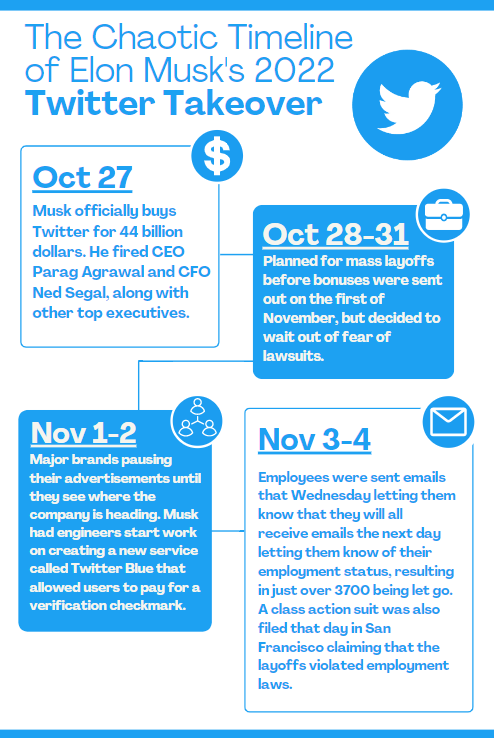
            Twitter is a social media application that allows users to post thoughts, images, and videos as “tweets”. Billionaire and multi-business owner Elon Musk was in talks to buy the company back in April 2022. However, it was not until October 27 of the same year that he officially bought Twitter for 44 billion US dollars. Musk’s vision for the app was to remove the censorship and bring back his version of free speech. Upon acquisition of the company, his first action as the new owner was to fire the top executives, including former CEO Parag Agrawal and CFO Ned Segal, just a glimpse of what was to come over the next month (Conger et al.). Purchasing Twitter at such an enormous amount, one that required taking on 13 billion in debt, had made the new CEO’s mission clear: reduce costs (Griffin).

The next day, Musk told the remaining executives to prepare for widespread layoffs before employee bonuses were sent out on November 1. However, he decided to push till after the issuances out of risks of potential lawsuits. On November 3, employees received an email letting them know that they will receive another email the next day with their employment status. However, some employees were locked out of their accounts before the day had ended. A class action lawsuit was filed against the company in San Francisco for violating California’s Worker Adjustment and Retraining Notification Act which says that employers must give at least a 60-day notice before mass layoffs. By the next day, almost half of the company’s 7500 global employees were gone. After receiving major backlash from the public, Musk said that all laid-off employees were getting 3 months’ severance, which is 50% more than the required amount (Palmer). Major companies including General Motors and Volkswagen Group pause their advertisements until they see what direction the company is heading (Vranica et al). Musk later tweeted that Twitter is losing 4 million dollars a day. Meanwhile, the remaining employees were tasked with creating a paid subscription that allowed their users to become verified. Musk imposed strict deadlines, with some employees going as far as to sleep at the office to reach them (Conger et al.). By November 9, the subscription Twitter Blue was rolled out to iOS users for 8 dollars a month. Problems arose quickly, with widespread impersonations afflicting the app and having major real-life consequences. One account impersonating insulin manufacturer Eli and Lilly Company tweeted out that insulin was now free of charge. After a couple of hours, the tweet was removed, but the damage was already done. Eli and Lilly’s stock price plummeted, with an estimated loss of 15 billion dollars to their market cap (Barr). With mass impersonations and misinformation spreading, Twitter Blue was removed from the app only two days after its launch.

Timeline continued
The following week saw another wave of layoffs. Contract workers in engineering, marketing, and customer service were the first to be let go this week. Musk issued an ultimatum to the remaining employees, having them choose between either working long, intense hours or accepting the severance package (Kolodny et al.). He also removed the ability to work from home, which would prove to be a mistake. Two more class actions were filed; the first lawsuit claims that removing the ability to work from home goes against the Americans with Disabilities Act (ADA), while the other one claims employment laws were violated in the layoffs for contract workers (Wiessner). By the next week, Twitter was estimated to have lost another 1000-1200 employees (Mac et al.). Musk announces that an improved version of Twitter Blue will come back once the impersonations stop. The newer version of the subscription will have different color verification depending on whether the account belongs to a brand, government official, or an individual (including celebrities and people with Twitter Blue), making it easier to identify a possible impersonator. As a part of Musk’s goal to make Twitter a more free, less restrictive space, previously suspended accounts are being brought back. The COVID-19 misinformation policy, which labeled certain tweets that talked about the virus as misleading, was also removed, with experts saying it could have serious consequences (Ivanova).

STAKEHOLDERS

Any party that is affected by the decisions of Elon Musk would be considered a stakeholder. This would include all Twitter employees, their user base, and shareholders invested in Musk’s other publicly traded companies, including Tesla. From the first day Musk took ownership of the company, top executives were fired. Massive layoffs caused over half of the company’s global employees, an estimated 4,800, to be let go. Twitter Blue allowed anybody with 8 dollars to impersonate a person or company, spreading misinformation to anyone who sees that account not knowing they are the official account. The COVID-19 policy getting removed only further increases the spread of misinformation. The consequences are unfathomable when you realize Twitter usage is at an all-time high of 254 million active users a day (Best). Musk’s other multi-billion dollar company Tesla has seen a major hit to its stock price, with it reaching a 52-week low this past week (Raymond).

INDIVIDUALISM

Twitter Headquarters in San Francisco
Under individualism, the goal of the company is to maximize its profits for the owners of the business in a legal way. From the beginning, all of Elon Musk’s decisions have been to maximize profits. He has laid off over half of Twitter’s workforce, as well as created the subscription service Twitter Blue to bring in more revenue. However, not all of the actions to maximize profit have been within the law. In California, where Twitter’s headquarters reside, it is illegal to execute mass layoffs of employees without at least a 60-day warning under the California WARN Act. Musk also remove the remote work policy, in hopes that going into the office would increase the productivity of workers. This also violates laws set by the ADA, which allows remote work as an acceptable accommodation as long as it put no significant hassle on the employer (Wiessner). He also stopped the purchase of Twitter Blue two days after its launch, something that could have increased profits if left available to purchase for longer. The bad press that comes along with these actions has stopped many major companies from using Twitter for advertising, ultimately making the actions lose more money.

To an Individualist, these actions taken by Musk would be considered ethically wrong. Individualism stresses that, “it is the aim and the responsibility of businesses to maximize their profits” (Salazar 17). Increasing profit in one area just to lose profit in another would not go work for an Individualist, especially if those actions were illegal. If Musk were to have given a warning to its employees within the legal limit, as well as kept the remote working policy, he would still be able to cut costs while staying within the law which is ethical under Individualism.

UTILITARIANISM

Utilitarianism stresses the importance of happiness. A Utilitarian considers an action ethical as long as it creates more overall good than bad. In other words, for an action to be ethical under utilitarianism, it would have to, “maximize happiness in all affected parties in the long-term” (Salazar 20). In the case of Elon Musk and his actions as CEO, Utilitarians would consider his actions unethical.

The efforts Musk has implemented over his first month as the owner goes against everything Utilitarians value. Laying off over half of his workforce leaves an estimated 4,700 unhappy people without jobs and one person happier as they have fewer costs. Twitter Blue may supply some happiness to individuals impersonating brands or celebrities, but for every account impersonating, there is a person or company whose reputation is possibly being damaged. Then there are all the people absorbing the misinformation by the impersonators who are now worse off than they were before. Forcing all employees, including ones with disabilities, to come back to the office only makes Musk happy, while the employees, some who physically cannot get to the office, are stuck with having to a severance package over their job. The strict deadlines and intense working hours create a harsh environment for the workers whose job was much easier just over a month ago. These actions all only benefit one person, Elon Musk, while leaving thousands of employees and millions of Twitter users less happy than before Musk came into power, something a Utilitarian would heavily disagree with.

KANTIANISM

An ethical action under Kantianism is rational and has the right motivations. To determine whether or not an action is rational or not, a series of tests known as the Categorical Imperative are used to find out if the action is permissible or impermissible. We can apply these tests to the actions Elon Musk has employed over his first month as CEO of Twitter to figure out if his actions, under Kantianism, are ethical.

Manager Esther Crawford Sleeping at the Office

The first of the Categorical Imperative tests is the Formula of Universal Law, which tests if it would be possible if everybody in the world to follow through with the same action. If we were to consider the mass layoffs Musk gave his employees, it would fail the test. If every company in the world was to lay off half of its employees without giving proper notice, billions of people would be left without jobs and unable to provide for their families. Not to mention the countless lawsuits brought up because of it. Another way to test for rationality would be through the Formula of Humanity, which asserts that, “it is wrong to use people as a mere means to get what you want” (Salazar 22). Considering all the major actions Musk put his employees and users through, they would fail the test. Creating a subscription service to increase revenues is using the user base simply as a means to get more money. The layoffs also fail this test, as Musk is laying off employees as a means to reduce overall costs. The final test in the Categorical Imperative is the Formula of Autonomy, stating that we must abide by the actions we place on others. When applying this to the strict deadlines and harsh working conditions Musk puts on his employees, we have to ask whether or not Elon himself would like to have to sleep at the office to meet those deadlines or have to work long hours at high intensity. If any of the tests yielded a permissible action, it would not have the correct motivation. The actions Musk implemented in the first month as the owner were to help himself, not the employees or the user base, leading any Kantian to believe that his actions were, in fact, unethical.

VIRTUE THEORY

Virtue theory emphasizes acting with virtuous traits and in doing so will lead you to live an overall better and flourishing life. A virtue is a positive characteristic allowing things to run better. This ethical theory is different from the other three as they, “analyze individual actions whereas virtue theory analyzes a person’s character” (Salazar 23). The four cardinal virtues one can possess are courage, temperance, justice/fairness, and honesty, along with one intellectual virtue known as prudence. Looking at Elon Musk during his new reign over Twitter, a virtue theorist would find him to be unethical.

We can see Musk not acting on good virtue the day he bought Twitter. One could say that Musk buying the company was courageous but looking at what he had to do to make up for it, such as taking on 13 billion in loans, Musk would have been considered to act rashly and impulsive, which are both vices. Vices are the opposite of virtues and lead a person’s life in the opposite direction of what virtue theorists would accept. Musk would also not possess the justice/fairness virtue. It is not fair to the employees who have been working at Twitter for a long time to all of sudden be laid off by someone who just took over. Even if you did nothing wrong, you could have been laid off and stuck with having to find a new place to work. Musk also does not show the intellectual virtue of prudence, or the ability to make rational decisions considering the future. It is unlikely that he would have bought Twitter for such a high amount knowing the major effects of it, including having to lay off over half the workforce, companies pausing their advertisements, and a major toll on his other company’s stock Tesla, just to name a few. Musk acting with more vices than virtues not only will lead to a worse, dull life but is also considered unethical under virtue theory.

JUSTIFIED ETHICS EVALUATION

Popular Tweet Denying Facts about COVID-19
            From my perspective, I believe Elon Musk is in the wrong. He should have known that 44 billion dollars were too much for the company, and now he is taking it out on the employees. Musk should have given a 60-day warning before the mass layoffs to not only be following the law but also to be a decent person and help the employees out; giving them more time to look for a job. Imposing strict deadlines to the point where workers had to sleep at the office crosses the line. Taking away the remote work possibility not only affects employees with disabilities who struggle to come to the office but also hurts the workers who signed up as remote workers and have never been to the office. I thought Twitter Blue was okay in concept, but the execution was a disaster. It was clear from the announcement of the service that it would be heavily abused from the get-go. His reforms around freedom of speech can cause more harm than good, especially with the removal of the COVID-19 misinformation policy and the addition of previously suspended accounts. I think freedom of speech is a good thing, except when it is used to hurt people or a demographic, such as hate speech or misinformation. I believe the three lawsuits filed against Twitter are in good faith and have a higher chance of winning over Musk. When reviewing the facts of the case, it is clear that the actions exhibited by Elon Musk were highly unethical.

CONCLUSION

Elon Musk has made many questionable decisions since he acquired Twitter back in October. He laid off over half his staff without a proper warning. Misinformation was able to spread through his new policies as well as through his new service Twitter Blue. According to each of the ethical theories, including Individualism, Utilitarianism, Kantianism, and Virtue Theory, Elon Musk and his actions are unethical. I, along with probably most of you reading this, believe that Musk is clearly in the wrong, and only time will tell how the law agrees with us too.

REFERENCES

Barr, Kyle. “How Much Did Twitter's Verification Chaos Cost Insulin Maker Eli Lilly and Twitter Itself?” Gizmodo, Gizmodo, 14 Nov. 2022, https://gizmodo.com/twitter-eli-lilly-elon-musk-insulin-1849779323.

Best, Paul. “Elon Musk Says Twitter Sign-Ups at All-Time High, Predicts One Billion Monthly Active Users One Year from Now.” Yahoo! News, Yahoo!, 27 Nov. 2022, https://news.yahoo.com/elon-musk-says-twitter-sign-230445301.html?guccounter=1&guce_referrer=aHR0cHM6Ly93d3cuYmluZy5jb20v&guce_referrer_sig=AQAAAG9iS5aYvEzHbhJP4Xhp-KHZ52-YhgbMRFTeyMshEL99TJcixwFYML7snCVIscfTNPxmA38Wgq97Nh8NGBEk9Ud3P17v572tmZhuKamKkcq7ckGpYSNJUBkLIBqMqWPRTVz16vE1RnkS_OoayOn_0TcNZYURk4S2md3UkudGolXaqWPRTVz16vE1RnkS_OoayOn_0TcNZYURk4S2md3UkudGolXa.

Conger, Kate, et al. “Two Weeks of Chaos: Inside Elon Musk's Takeover of Twitter.” The New York Times, The New York Times, 11 Nov. 2022, https://www.nytimes.com/2022/11/11/technology/elon-musk-twitter-takeover.html.

Griffin, Allie. “Elon Musk to Lay off Half of Twitter's Staff, Enforce Return-to-Office Policy: Report.” New York Post, New York Post, 3 Nov. 2022, https://nypost.com/2022/11/02/elon-musk-to-lay-off-half-of-twitters-staff-enforce-return-to-office-policy/.

Ivanova, Irina. “Twitter Stops Enforcing Its Covid Misinformation Policy.” CBS News, CBS Interactive, 30 Nov. 2022, https://www.cbsnews.com/news/twitter-covid-misinformation-policy-ends/.

Kolodny, Lora, and Jason Abbruzzese. “New Wave of Resignations Hits Twitter after Musk Ultimatum.” CNBC, CNBC, 19 Nov. 2022, https://www.cnbc.com/2022/11/17/new-wave-of-resignations-hits-twitter-after-musk-ultimatum.html.

Mac, Ryan, et al. “Elon Musk's Twitter Teeters on the Edge after Another 1,200 Leave.” The New York Times, The New York Times, 18 Nov. 2022, https://www.nytimes.com/2022/11/18/technology/elon-musk-twitter-workers-quit.html.

Palmer, Annie. “Twitter Sued by Employees after Mass Layoffs Begin.” CNBC, CNBC, 4 Nov. 2022, https://www.cnbc.com/2022/11/04/twitter-sued-by-employees-after-mass-layoffs-begin.html.

Raymond, Art. “As Elon Musk Fiddles with Twitter, Tesla Stock Tanking and on Track for Worst Year Ever.” MSN, Desert News, 22 Nov. 2022, https://www.msn.com/en-us/autos/news/as-elon-musk-fiddles-with-twitter-tesla-stock-tanking-and-on-track-for-worst-year-ever/ar-AA14qXAp.

Salazar, Heather. The Business Ethics Case Manual: The Authoritative Step-by-Step Guide to Understanding and Improving the Ethics of Any Business. Print.

Vranica, Suzanne, and Patience Haggin. “Twitter's Advertising Exodus Accelerates, despite Outreach from Elon Musk.” The Wall Street Journal, Dow Jones & Company, 14 Nov. 2022, https://www.wsj.com/articles/twitters-advertising-exodus-accelerates-despite-outreach-from-elon-musk-11668262920?mod=Searchresults_pos1&page=1.

Wiessner, Daniel. “Disabled Employee Sues Twitter over Musk's Ban on Remote Work.” Reuters, Thomson Reuters, 17 Nov. 2022, https://www.reuters.com/business/disabled-employee-sues-twitter-over-musks-ban-remote-work-2022-11-17/.


Thursday, December 1, 2022

Twitter: Elon Musk's Command Off to Rocky Start (Oct. 28th, 2022-Present)

        Abstract
Twitter CEO Elon Musk

Twitter, a social media company created in San Francisco in 2006, has had five total CEOs in its life up until the middle of autumn this year. In mid-April, Tesla CEO Elon Musk began the acquisition of Twitter. Despite Musk finding some minor wording in the deal displeasing, Musk finalized the acquisition after over half a year.    


               On October 28th, Twitter was bought out by Tesla’s CEO Elon Musk for an enormous $44 billion. Since Musk has taken over, there have been multiple ethical controversies between him and his employees as well as the general public. His massive layoffs and continued radical discussion of free speech have put Twitter in a tough spot. Individualistically, Musk seemed to be the perfect person to take over Twitter due to his great success at Tesla, but so far it hasn’t appeared that way. Musk does not fall into the utilitarianism ethics category as he is not in it to maximize happiness. He is a businessman with strong personal opinions to guide him. Musk also doesn’t follow the ideas of Kantianism as his continued Tweets regarding politics have scared away partners of Twitter. Overall Musk doesn’t have great balance with any of the four main virtues in the virtue theory and thus has seen the backlash against his company because of it. In my own opinion, I believe Musk is a clear individualist and while I may not believe with all his decisions, I don’t think some are as bad as the media makes them out to be. Ultimately, I think he will turn Twitter around. He’s put too much money into the company to not make it work and because of that I am interested to see what happens with the company moving forward.


Ethics Case Controversy

            Twitter and Elon Musk have had many ethical controversies in the short time since he has taken over the company.  His first and foremost ethical controversial decision comes on October 28th (the first day he took over the company) with the idea to lay off half the company. He discusses doing this urgently because many employees are due for bonuses at the end of the month. Musk insists that these employees must be laid off before November 1st and stated that he is used to going to court over similar issues. This decision by Musk was changed after realizing the true cost it would be to go to court rather than paying the bonuses (Conger). But the question arises, was this an ethical thought? It certainly doesn’t agree with utilitarianism, but is it in line with individualism? Was he trying to make this decision to save the company some money and allow it to be reinvested into the company? Ultimately, we don’t know because the decision was changed. However, the decision to still lay off half of all employees at the company after November 1st certainly posed ethical questions. 

            Following this big slash in Twitter’s employment figure, Musk lost multiple executives; some through his own firing and others by choice of departure. Musk then made steep demands of his employees still left, including getting a new premium subscription service called Twitter Blue out to the public within one week. Starting from scratch, the project team spent countless hours in the office to make sure the product launched when their supervisor demanded it. Ultimately Twitter Blue did launch on time, but due to the rushed process, there were flaws in the development of the service and it backfired dramatically and was pulled from app stores within a week (Kolodny). Twitter Blue developers and team members thought once the software was completed and released their long days would halt, at least for some time. Musk demanded the opposite, proposing an ultimatum to all employees left: Work long days at a high pace or leave. This also would be frowned upon from the standpoint of utilitarianism ethics, as it is not bringing happiness to the people Musk has put in this difficult decision. But the question keeps arising: As such a successful businessman, is Musk doing what is necessary to make Twitter the best its ever been and thus supporting other ethical points of view? So far, it doesn’t appear that way. 


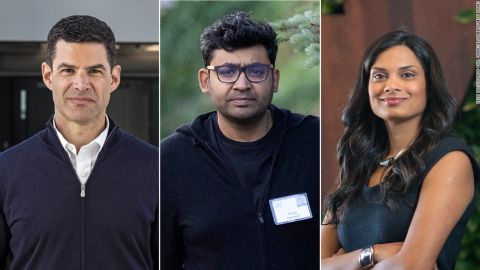
Fired Twitter executives Ned Segal, left, Parag Agrawal, center, and Vijaya Gadde, right, leave the company with $187 million of Elon Musk's money.

Fired Twitter executives Ned Segal, left, Parag Agrawal, center, and Vijaya Gadde, right


            Musk also continued to make headlines as he uses Twitter to voice his own opinion on various different subjects, including politics. Musk, a once liberal-leaning individual, has shifted in recent years more and more toward a right-wing approach. Since acquiring Twitter, Musk has made several different comments on the platform that have been quite controversial for himself and his newly bought company. His continuous advocation for free speech and extremism of statements have caused partnering companies to not want to be affiliated with Twitter to save their own public image. Furthermore, his actions as Twitter CEO to restore and grant amnesty to banned accounts like Donald Trump’s has caused an uproar from some people, leading them to use other forms of social media in protest (Thorbecke). This is an ethical controversy because Musk is trying to do what he believes is right, but in doing so, he risks the health and well-being of his company and its future. 

His actions have created repercussions for his company such as losing big revenue sources from partnered companies that shared their advertisements on Twitter. Without the partnerships and deals with advertisements, Twitter is at a huge loss of income which can have severe implications for its future. Musk is not ignorant of the fact that the company has not been off to a great start since he arrived, and he understands that they need to turn a profit soon. If they don’t, he reportedly told staff that bankruptcy could be high (Allyn). Bankruptcy could be one of the final stages in this adventure for Musk, but experts believe he won’t give up easily and will try to find a way to turn the company around. 


Timeline of events since Elon Musk took over Twitter.
Stakeholders

            With Twitter becoming a privately traded company again, it is difficult to find who still are stakeholders in the company. However, the top five Stakeholders in Twitter prior to going private and who are thought to still be stakeholders include The Vanguard Group Inc., Elon Musk, Morgan Stanley, BlackRock Inc., and State Street Corp. The Vanguard Group, Inc. has the largest stake in Twitter through various mutual funds, exchange-traded funds, and retirement products. As of March 31st, they owned 82.4 million Twitter shares. Elon musk, Twitter’s CEO, is the second largest stakeholder, holding 73.5 million shares and 9.2% stake in the company. Morgan Stanley, another investment bank and asset manager holds 67 million shares used in mutual funds like The Vanguard Group. BlackRock Inc. is another investment manager that owns a little over 50 million shares that are used in its exchange-traded funds and other investment vehicles. Lastly, State Street Corp. offers a broad variety of investment management services that may include some of their 36.4 million Twitter shares. All of these groups have big stakes in Twitter and, depending on how the company performs with Musk leading the company, can see big gains or drastic falls in their portfolios (Reiff). 


Individualism

            The individualist theory states that the goal of a business is to maximize profit for the stakeholders and act in their best interests within the law (Salazar 17). Part of the deal that Elon Musk agreed to when he acquired Twitter was that the company would no longer be a publicly traded company. Rather, it would be private. Because of this, there is no financial information available to the public at this time to see how Twitter is doing financially since Musk has taken over. However, prior to going private, Elon Musk was the second largest stakeholder in the company. Therefore, it would make sense that he acts in an individualist way to maximize his own wealth as well as the wealth of other stakeholders. In the deal to acquire Twitter, Musk made sure that the company would no longer be a publicly traded company, reversing the IPO of Twitter. This action makes it very difficult to tell how the company is doing with regard to its stock price and equity value, but we can infer based on other information that the company is not doing well since Elon Musk has taken over. Immediately cutting half of the employees at the company is a dangerous move. While it may mean Twitter is cutting down on costs, it doesn’t mean it can sustain its revenues. In fact, Twitter has lost many of its main revenue sources (advertisers) due to Musk’s comments regarding Twitter and his political stance (Thorbecke). They have either canceled their deals with Twitter or have them on hold to try and preserve their company’s public image. These actions go against individualism and likely hurt the wealth of the stakeholders dramatically. 


Chevrolet, Jeep, Chipotle Mexican Grill, and Ford were the first major companies to halt their advertisements on Twitter.


Utilitarianism 

            The utilitarianism theory states that an action is deemed ethical if it promotes happiness to the maximum number of people possible and yourself as well as minimize suffering. Pleasure and happiness should be brought to all beings that can feel it and it should be done impartially (Salazar 19-20). It has been clear with the actions of Elon Musk that he has not acted in line with the utilitarianism theory. Within 24 hours of acquiring Twitter, Musk discussed the layoff of nearly half the company. Specifically, Musk wanted to do this prior to November 1st so he wouldn’t have to pay bonuses set to be paid on that date. When told this would cause an uproar and employee lawsuits, Musk said he was used to going to court and paying penalties (Conger). This action and statement are almost the antitheses of utilitarianism. Layoffs of that size are unnecessary within the first 24 hours of running a company. Furthermore, trying to do it specifically before a certain date so people don’t get the bonus, they worked for isn’t promoting happiness to the maximum number of people possible. If anything, it’s only promoting happiness to himself, and therefore is not ethical by Mill’s standards. 

Another example of how Musk hasn’t followed utilitarianism is by giving employees an ultimatum: work 12-hour days at a high pace or leave (Conger). This doesn’t bring happiness to the employees at Twitter because for most people that’s a difficult decision. Many can’t afford to work 12-hour days or don’t want to consistently at a high pace. Working these hours means sacrificing nearly everything in life besides work, and many don’t want that.  However, some also can’t afford to be jobless. Some have to support a family and if they don’t have a job, they cannot put food on the table for their children. This, therefore, shows that Musk is once again not being ethical by the standards set in utilitarianism. 


Kantianism

            Kantianism focuses on four main points, all of which revolve around rationality, respect, and motivation to do the right thing. This ethical theory also talks about how it is wrong to manipulate and exploit people for your own advantage (Salazar 21-22). Musk hasn’t thought that way since his buyout of Twitter. His actions to cut half of the employees at Twitter does not, at least from an external point of view, seem to be rational and make sense as the right thing to do. That doesn’t mean that a layoff of some kind wasn’t necessary, but half of the employees was irrational and disrespectful to both the people getting laid off and also the employees who are still with Twitter because they have to pick up the work that their former coworkers were doing. 

            Furthermore, there are reports of Musk using Twitter as his somewhat own personal platform to push his own agenda. He has recently been talking a lot about free speech on Twitter but in a radically right-wing way. In one tweet as recently as Monday night, Musk stated,” This is a battle for the future of civilization. If free speech is lost even in America, tyranny is all that lies ahead,” as well as “The Twitter Files on free speech suppression soon to be published on Twitter itself. The public deserves to know what really happened …” (Musk). Everyone is allowed to voice their own political opinion, but Musk doing so in such a public manner is irrational. It has cost him many sources of revenue for Twitter and is not the right way to try and handle the situation. He may believe he is motivated to do the right thing for the people of the United States, but he is not just an individual on the platform. He is the leader of the company, and he needs to be motivated to do what’s right for the company. 

Musk has further sent the country into a frenzy by reactivating the accounts of several individuals that were banned from the app, including Donald Trump. Trump was banned from the app nearly two years ago after inciting the attack on the Capitol on January 6th, 2021 through Twitter. With Trump as well as others granted access to the app again, Musk and Twitter are facing heavy pressure and the repercussions, including more advertisers leaving Twitter and others protesting the use of the app. 


Photos from the January 6th riots at the Capitol (left) and the 45th president of the United States Donald Trump (right).


            Kant also states that the formula of humanity is to act in such a way that you treat humanity, whether in your own person or in the person of another, always at the same time as an end and never simply as a means. Elon Musk also doesn't appear to follow this formula as he does look more at a company and its employees as entities rather than human beings, especially with massive layoffs early on as well as aggressive deadlines. He looks to push employees to the limit to get the most out of them like they're machines. Some argue that to be an effective CEO you can't let emotion sway you, but there is a balance that can be had between both. 


Virtue Theory

            There are four main virtues developed by Aristotle in the virtue theory. They include courage, honesty, temperance, and justice (Salazar 23).  In this ethical dilemma, Elon Musk seems to be acting with a lot of courage. He isn’t afraid of what others think of his decisions, but this courage seen early on now looks to be rashness, as the company talked about trying to hire back employees they laid off (Conger). 

In Elon Musk’s short time with Twitter, he has had times where he has been somewhat secretive and dishonest. When first hired he had a meeting in the war room with human resources executives to discuss immediate layoffs. When he finally went through with it, all his did was send an email and lock access to their company emails and message board (Thorbecke). Furthermore, Musk taking the company private makes it difficult to see how they’re doing and further keeps people in the dark about the status of the company. However, he has been quite open about his plans to give free speech on Twitter as well as publicly voicing his political opinion. 

Being a businessman, Musk will push his employees to get the most out of them. Because of this, he does not have great temperance with his employees. Asking for Twitter Blue to be up and running within a week was a tall task to ask of his employees. Furthermore, asking all employees to begin to work 12-hour days is slightly unreasonable (Conger). However, his desires for the company are for it to be great and that is why he’s putting into place these requests. 

Musk isn’t one who cares much for justice. When discussing the layoff of half the employees at Twitter, he wanted to do so prior to their bonus date. He added that he didn’t mind going to court over it rather than paying the bonuses. However, Musk is a hard-working man who tends to ask the employees the same as he asks of himself. Musk also has produced quality products with Tesla and has great ideas for the future. 


Justificatied Ethics Evaluation

            Overall, I think what Elon Musk has done so far with Twitter is unethical. I understand the need to cut expenses to help increase profits. It’s a common practice in the business world and expenses for Twitter primarily come from paying employees. Layoffs happen to some companies, but I don’t think it was necessary to cut half the staff. I think laying off 25% of the staff to start would’ve been better and then reassessing more layoffs if necessary. Furthermore, trying to do it prior to their bonus date and initially not caring about going to court over it is very unethical in my opinion. Those people worked hard for their money and deserve it. 

            On top of that, Musk has asked the remaining employees to work long hours. This is definitely something worth debating the ethicality of, but I don’t see too much wrong with it so long as it’s not a long-term change. Many people work multiple jobs and have other tasks to complete daily, and I feel that it’s more common today for people to work more than a typical 9-5. Musk also does give an alternative to those who don’t want to work under those circumstances. He offers all who decide to leave a three-month severance package. Leaving is difficult, but I feel like someone who once worked for Twitter can find employment elsewhere relatively quickly, so I don’t see this ultimatum as unethical. 

            Lastly, when talking about how Musk has handled voicing his own political opinion and its impact on Twitter, I don’t think it was unethical, but I do think there was a better, more professional way to go about it. Using media outlets to voice your opinion is okay, and using a social media platform you just acquired makes sense, especially since it has drawn attention and buzz to the app. But his actions and statements have caused many to not want to be associated with Twitter because he is now the owner. This has caused a huge loss of profits for the company, and this is the main issue because it’s a trickle-down effect. Loss of revenues may mean more people out of jobs and if that’s the case then Elon Musk is at fault for that. If he wanted to voice his opinion, he should’ve done so through a more professional outlet and voiced his opinion in a more professional way. 

Conclusion

            Ethical controversies in the business world have been happening forever and will continue to happen for the rest of time. There will always be situations difficult to navigate these situations and it is up to us to educate ourselves to the best of our ability to make proper decisions. It is interesting to see how many ethical controversies have arisen already for Twitter and Elon Musk in such a short period of time. From layoffs to new products, politics to bankruptcies, Musk and Twitter have dug themselves a hole financially that they must do work to get out of. However, despite all the news and decisions made, broadly speaking Elon Musk is an individualist. He wouldn’t sink $44 billion dollars into a company just to see it die. He will continue to try and make Twitter better than it’s ever been. How he does so may not be perfect in the eyes of all ethical philosophers, but ultimately, he seems to be business oriented and looking to turn a profit for himself and the people around him. 


References

Allyn, B. (2022, November 12). Elon Musk says Twitter bankruptcy is possible, but is that likely? NPR. Retrieved November 29, 2022, from https://www.npr.org/2022/11/12/1136205315/musk-twitter-bankruptcy-how-likely 

Conger, K., Isaac, M., Mac, R., & Hsu, T. (2022, November 11). Two weeks of chaos: Inside elon musk's takeover of Twitter. The New York Times. Retrieved November 29, 2022, from https://www.nytimes.com/2022/11/11/technology/elon-musk-twitter-takeover.html 

Kolondy,Lora. S. P. (2022, November 11). Twitter pauses paid verifications after users abuse service to impersonate brands and people. CNBC. Retrieved November 29, 2022, from https://www.cnbc.com/2022/11/11/twitter-blue-subscription-disappears-from-app.html 

Musk, Elon. “This Is a Battle for the Future of Civilization. If Free Speech Is Lost Even in America, Tyranny Is All That Lies Ahead.” Twitter, Twitter, 29 Nov. 2022, https://twitter.com/elonmusk/status/1597404771618430976?cxt=HHwWgICl7aTLj6ssAAAA. 

Musk, Elon. “The Twitter Files on Free Speech Suppression Soon to Be Published on Twitter Itself. the Public Deserves to Know What Really Happened ...” Twitter, Twitter, 28 Nov. 2022, https://twitter.com/elonmusk/status/1597336812732575744?cxt=HHwWgMCj2cfX8KosAAAA. 

Reiff, N. (2022, November 22). Top 5 twitter shareholders. Investopedia. Retrieved November 29, 2022, from https://www.investopedia.com/articles/insights/060916/top-3-twitter-shareholders-twtr.asp 

Salazar, Heather. The Business Ethics Case Manual. n.d.

Thorbecke, C. (2022, November 27). Layoffs, ultimatums, and an ongoing saga over Blue Check Marks: Elon Musk's first month at Twitter | CNN business. CNN. Retrieved November 30, 2022, from https://www.cnn.com/2022/11/27/tech/elon-musk-one-month-twitter/index.html