Showing posts with label Meal Delivery. Show all posts

Friday, December 10, 2021

Doordash: Customers are Being Overcharged on Orders (2020 - 2021)
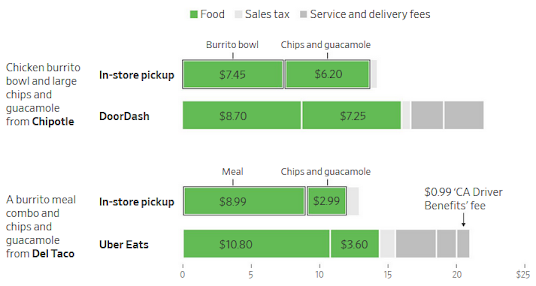
Doordash: Customers are Being Overcharged on Orders (2020 - 2021)

Price Differences when using DoorDash

Case Controversy

    DoorDash is one of the pioneers among a new and fast-growing breed of delivery apps with an increasing popularity especially over the past year. When the covid-19 pandemic hit the United States in the early months of 2020 many restaurants closed and the few that remained open could not allow sitting in as a dining option for safety reasons. Since this happened more and more people began relying on food delivery services like Doordash, Grubhub, Uber Eats, and Postmates. As of March 2020 Doordash has been reported to have a market share of 42% in the meal delivery industry (Farviar). However, the source of the company's financial success has been at the stake of its customers. Many Doordash customers have reported that they are being charged ridiculous fees on orders without their knowledge. 

    Doordash hides tax and extra service costs into the bill. The typical item costs nearly 49% more when brought through a food delivery app, not always including tip or delivery fees (Chen). Delivery fees alone are an additional 20%to 30% charge on an order (Farviar). For example, at Subway two six-inch turkey breast sandwiches costs $12.58 plus a sales tax of $0.63 totaling  $13.21 for the entire order. However, when ordered through Doordash the two six-inch turkey breast sandwiches cost $14.78 plus a delivery fee of $1.99, a service fee of 1.20 and a sales tax of $1.29 totalling $19.26. That is a 46% markup on the original price (Chen). But this is not a specific occurrence with chain restaurants. MakiMaki, a Japanese restaurant charges customers $12.95 for a particular item. The same item purchased through Doordash costs $14.80 (Stamm).
As a delivery service Doordash takes 13% to 40% of revenue from each order, while the average restaurant’s profit ranges from 3% to 9% of revenue (Dolmetsch). In order to try to ease the impact of fees customers have to pay, several cities have pushed back against Doordash by capping commissions at 15 % of the total cost of orders. By December of 2020 73 caps were put in place nationwide and 5 more by March of 2021. In response to the caps on commissions Doordash established a regulatory response fee. This additional fee is a fixed charge of $1 to $3 on top of existing delivery fees, service fees and sometimes small order fees (Forman).
On August 27th, 2021 the city of Chicago announced it was filing a consumer protection lawsuit against DoorDash and its competitor, GrubHub. Chicago policy makers, sued Doordash over their deitiful pricing and unnecessary charges on customer orders in July 2021. Regulators looking into the many hidden fees on Doordash recipes have also discovered a “Chicago fee”.  This was a fee imposed by Doordash disguised as a fee from the city of Chicago to appear unrelated to their service fees. DoorDash has denied all of these claims, however, a hearing for this case is scheduled for December 27th, 2021. Spokesmen for the company have since then relabeled these charges as more regulatory response fees (Rana).

 

Timeline of events

Stakeholders

    The stakeholders in this case that are the key decision makers are the people in charge at doordash, including CEO Tony Xu. These are the people that decide what percent markup there is on the original price of a food item, the additional delivery, service and other fees that are not clearly stated when customers order using this app. The stakeholders affected were the shareholders and customers. Tony Xu and shareholders are affected as the profits of DoorDash belong to them and as such, any impact on them directly impacts the amount of money a shareholder makes from owning DoorDash, in addition, the public image and quarterly reports of DoorDash have a significant impact on the value of their investment in DoorDash. Millions of doordash customers that have been overcharged even if they haven’t realized it yet and the hundred of thousands of restaurants that are robbed of revenues and have been forced to use doordash to stay in business after the pandemic caused so many to close doors. Customers that have recognized that they are being overcharged are less likely to purchase food through Doordash again as it would be cheaper to pick up food from restaurants directly, doing away with the additional fees on top of delivery charges. The future customers of doordash are also at stake. Existing customers are likely to give Doordash a poor recommendation based on previous experience.

Individualism

    An Individualist view of the DoorDash conflict reveals that DoorDash’s actions are at the very least morally questionable and would become morally wrong if Chicago’s lawsuit finds DoorDash to be in violation of the law. Under Individualism, businesses should maximize their profits while staying within the bounds of the law. While this is easily viewed from a short-term perspective the long-term perspective is also included as important according to Individualism. This long-term perspective is what makes DoorDash’s actions morally questionable.
    Individualism places almost no responsibility in the hands of the shareholders and considers them exterior to the moral decisions made by employees of the company. Under individualism, the employees carry most of the responsibility, and as such most make decisions that maximize profits, or else the theory considers them to be stealing from their shareholders. From this perspective and considering the fact that DoorDash has stated that they believe they have not done anything illegal, it can be reasonably believed that the employees believed themselves to be acting as morally as possible. The only fact that calls this into question is that of long-term profits, has taking these actions harmed DoorDash’s ability to make money in the future? Government involvement throughout the DoorDash cases shows that the company may have hurt its future revenue by inciting the government to pass new legislation which would be immoral to violate. DoorDash’s reputation is also harmed by the negative press, damage to relationships with restaurants, and by the high prices as many consumers may now regard the service as too expensive. The long-term harm to the company makes this morally questionable, however, if it is determined that the company committed acts there were illegal, the situation becomes morally wrong.
    Individualism’s view on this case will not become clear until a court makes a decision on their legality. However, due to negative long-term effects, the actions of DoorDash are at best morally questionable and quite possibly morally wrong.

Utilitarianism

    When observed through an ethical lens, the one that most highlights the impermissible acts of the company is utilitarianism. This theory heavily relies on the fact that happiness is the only value, it is okay to do something immoral if it benefits more people. Utilitarianism decides if something is good for society or bad for society, and it does not leave a grey area. It can also be defined as: the ‘right’ action is the action that benefits the most people in society or a business, even if that action is not morally right.  
    Utilitarianism proves the actions of Door Dash as impermissible because not only is it bad for society, but Door Dash was also taking advantage of people during COVID-19 when money was tight for a lot of families. Meanwhile, Door Dash was pocketing the money of innocent people and making the community unhealthy and unhappy. Utilitarianism is the best theory to analyze this case because it highlights how many people were treated poorly because of the scandal. When analyzing through a utilitarian lens, it is apparent that many people were taken advantage of and harmed because they were being charged more than what they should have been paying for products. Utilitarianism is the best lens to examine the case.  
    The actions of the stakeholders were impermissible because they were fully aware of the unethical treatment of the customers. They were aware that they were stealing money from them, they knew it was wrong, but continued to do so. It is not morally right and is not making most customers happy because they are being charged extra for products priced far lower than what they are paying.
The actions of the DoorDash drivers are permissible because they had to keep their jobs and were not 100 percent aware of the fact that the company was being dishonest with the public. Even if they did know some of the details, they still were doing what they thought was best for the residents of Chicago; they delivered their food and worked their jobs.
    The city of Chicago’s actions were morally required. However, it is not permissible because they needed to use taxpayer money to combat the company. This is because the city was aware of the injustices happening to the Chicagoans and how they were being taken advantage of and being overcharged. It was morally required for the city to take action against DoorDash to defend the people.


Kantianism

    Kantianism is an ethical theory that requires everyone to act rationally, help others make rational decisions, respect people's autonomy and individual needs, and be motivated by good will. Kantianism follows the categorical imperative which is the supreme law of a reason. It enables us to determine if our actions are rational or irrational. Irrational actions are impermissible therefore wrong and immoral. Rational actions, on the other hand, are permissible, allowed as they are morally correct. Kant states “Act in such a way that you treat humanity, whether in your own person or in the person of another, always at the same time as an end and never simply as a means”. This is the formula of humanity under the categorical imperative which means to never treat humans as mere means, always as an end.
To determine if an action is permissible or impermissible Kantianism utilizes the formula of universal law. The first step is to formulate a maxim-for-action. In this instance of Doordash it is overcharging customers to increase commission on orders. The second step is to universalize the maxim. If Doordash is able to charge unnecessary fees to customers then all companies can add unnecessary charges for profit. The following step is to check for contradictions and charging additional unclear fees to customer orders in order to increase profit is deceitful. Therefore these actions are impermissible because Doordash is being deceitful. They tack on additional fees and overcharge product prices without customer knowledge. When doordash was called out for these fees a cap was placed on the amount of commissions doordash can take from orders and doordash lied and added an additional fee labeled as something else “regulatory response fee” to gain more profits. Doordash was also motivated by self interest. The company was not honest with their customers to gain a greater profit and Kant claims that it is only morally acceptable to be motivated by good will. For these reasons Kant would not believe that the actions of doordash are morally correct.

Virtue Theory

    Virtue Theory is a theory that was created by Aristotle that focuses on rationality and whether a person is virtuous or not. Virtue Theory uses four cardinal virtues in determining if someone is virtuous. These four cardinal virtues are courage, honesty, temperance, and justice. According to Aristotle, rationality is what differentiates the characteristics of people. In order to live a virtuous life, people need to act rationally. He also states that you need to act rational to function well and therefore, people who function well live virtuous lives (Salazar, pg23).  
    From the point of view of Virtue Theory, DoorDash hasn’t displayed the 4 cardinal virtues, Courage, Temperance, Honesty, and Justice. They are not courageous in the sense that they are not standing up for the right ideas and actions within their business. Taking a risk like upcharging customers by large percentages is not right. When coming under fire with lawsuits, they didn’t display honesty by not commenting on the multiple hidden fees and higher pricings and instead dodged the questioning. The temperance, or realistic expectations and desires, of DoorDash was not displayed either. Even though they may have seen this as maximizing profit, it wasn’t realistic to expect consumers to not notice the inflation of meal cost on their platform. The final virtue, Justice, was never present with DoorDash. Their practices were unfair and are not a product of hard work and good ideas.


Action Plan
New York City "Dasher" in december.

    Since the start of the covid-19 pandemic within the U.S. in early 2020, Doordash has been found to overcharge their customers by adding and hiding fees. Doordash did this to gain more profit on each order and got away with it because people did not have many other choices for food delivery services. In this process, however, Doordash was stealing from their customers. In order to become a more ethical company and maintain business Doordash needs to start removing all markups on original prices, the price on the restaurant menu should be the price the restaurant charges for the items. At this point in the ordering process the fees that are paid to Doordash should be fixed and laid out clearly. Driver compensation should be completely separate and DoorDash should not be entitled to any of the amount paid in that section. When purchasing through Doordash there should also be a clear location that allows the customer to tip the driver and restaurant separately, once again DoorDash should not be entitled to anything paid in this section. This makes it clear to the customer where their money is exactly going. The most crucial thing Doordash needs to do is clearly state each fee on the receipt. All charges should be laid out before the customer makes their purchase.
    Having a new mission statement could be helpful in guiding Doordash to becoming a more ethical company. For example, Doordash could have a mission statement that the company strives to give customers a more convenient and honest way to enjoy their favorite meals while living a busy life. To maintain this mission statement Doordash should keep some core values in mind. These values could be service, trust, reputation, and safety. DoorDash's core business is a service and as such must be a leading core value to compete in such a market. Customers should feel they received the best service possible, an experience that leaves them with the food they desired and without any frustrations. Trust is an important factor in DoorDash’s business, restaurants, drivers, and customers must all trust that DoorDash has fairly handled the exchange and is not cheating any of the parties involved. Eroding this trust could have disastrous consequences for DoorDash’s business as all of these parties are required for their operation. A solid reputation is essential to DoorDash as it is what allows them to draw in more customers, drivers, and restaurants that are vital to the operation and growth of their marketplace. As a core part of DoorDash’s business involves having customers and drivers meet for the exchange, DoorDash must ensure this is done safely and dangerous individuals are not able to exploit their platform or risk damage to their business.
    In order to maintain these values and ensure that the company does not start to practice unethical habits again there are some procedures that should be followed. It would be beneficial and productive for management to review the new conditions with employees and regularly inform of updates. The best thing that Doordash can do to prevent what has happened from occurring again is to regularly monitor how much customers are being charged on orders and analyze if it is realistic to pay that price. If any changes need to be made to the fees then these need to be clearly stated for customers to see that they do not feel robbed again. Since Doordash has tained their relationship with previous customers as a result of their unethical actions it is important for the company to have a new marketing strategy. This strategy specifically needs to be targeted towards customers that have been wronged by Doordash in the past. This marketing should focus greatly on the changes that Doordash is implementing which will reinforce the new mission statement. This new plan of action, if carried out correctly, will allow Doordash itself to stick to their own values to ensure that any existing and future customers receive the quality of service they hope to bring. Doordashes' new mission statement stresses the importance that the company strives to give customers more convenient and honest service. These things conform to the core values of service, trust, and reputation in a positive way. Ensuring that DoorDash is doing the right things will promote these core values and in turn, bring more customers and profits. This plan should push past customers to feel more comfortable using Doordash, in turn increasing the number of people that use the service. Although there are less fees, if Doordash can restore its relationship with the customers they have pushed away they can increase overall productivity. 
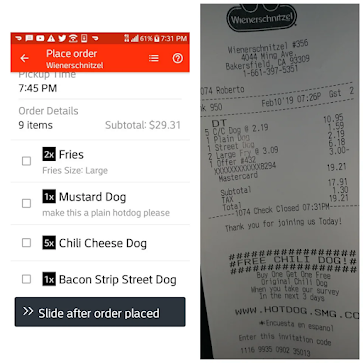
The cost of using doordash, the price the customer paid vs coast charged by restaraunt.

Jared Crawford, Ryley Gianni, Bella Arias, and Ethan Simard

References

Chen, Brian X. “Up to 91% More Expensive: How Delivery Apps Eat up Your Budget.” The New York Times. The New York Times, February 26, 2020. https://www.nytimes.com/2020/02/26/technology/personaltech/ubereats-doordash-postmates-grubhub-review.html.

Dolmetsch, Chris. “Lawsuit Alleges Grubhub, Uber Eats Are Driving up Meal Cost.” Time. Time, April 14, 2020. https://time.com/5820429/grubhub-uber-eats-doordash-lawsuit/.

Farviar, Cyrus. “DoorDash Pushes Back against Fee Delivery Commissions with New Charges.” NBCNews.com. NBCUniversal News Group, March 28, 2021. https://www.nbcnews.com/tech/tech-news/doordash-pushes-back-against-fee-delivery-commissions-new-charges-n1262088.

Forman, Laura. “Food-Delivery Regulation Is a Drama Worth Watching.” The Wall Street Journal. Dow Jones & Company, March 4, 2021. https://www.wsj.com/articles/food-delivery-regulation-is-a-drama-worth-watching-11614859201.

Rana, Preetika, and Heather Haddon. “DoorDash and Grubhub's Tussles with Regulators Heat up Following Pandemic Sales Boost.” The Wall Street Journal. Dow Jones & Company, September 11, 2021. https://www.wsj.com/articles/doordash-and-grubhubs-tussles-with-regulators-heat-up-following-pandemic-sales-boost-11631352780.

Salazar, Heather. “The Business Ethics Case Manual: The Authoritative Step-by-Step Guide to Understanding and Improving the Ethics of Any Business.”


Stamm, Stephanie, Preetika Rana, and Heather Haddon. “Why Doordash and Uber Eats Delivery Is Costing You More.” The Wall Street Journal. Dow Jones & Company, May 8, 2021. https://www.wsj.com/articles/why-doordash-and-uber-eats-delivery-is-costing-you-more-11620466200.

DoorDash: Lawsuit from the City of Chicago due to divisive tipping policy (May 2019)


DoorDash: Lawsuit from the City of Chicago due to divisive tipping policy (May 2019)


Case Controversy

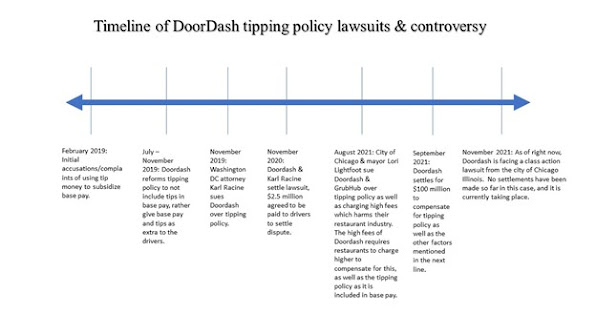
    As of September 2021, DoorDash is the largest food delivery service in the United States, delivering 57% of the United States’ food delivery orders in September.  However, prior to July of 2019 DoorDash had been using a deceptive tactic in terms of their tipping policy to pay less out of pocket to their drivers.  This policy was not only taking away tip money from drivers but was also making it so that DoorDash had to pay less base salary per delivery and would profit even more off of each order.  Since November of 2019, they have changed this policy to allow tips to be on top of the base salary, rather than a direct part of it. 

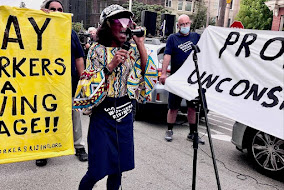
DoorDash Drivers knock on CEO's door to protest wages
            In February of 2019, DoorDash began to receive the initial complaints over the tipping policy on a mass scale.  This led to an investigation into the policy, as well as a boycott by employees and tech workers.  The investigation also included other food delivery services such as Amazon Flex and Instacart, who were both accused of this same tipping deception, and Instacart would be the first to change its policy on February 6th of 2019.  However, in February of 2019, Amazon Flex and DoorDash had still not changed their policy to follow suit with Instacart and stood by their decision to not do so.  This is due in part to a private market, as DoorDash is allowed to handle its own policies unless there is governmental intervention.  This allows DoorDash to stick with its initial tipping policy rather than changing it immediately. 

            This would lead to DoorDash changing its tipping policy over the course of July to November of 2019.  Rather than subsidizing tips into base payment, they would follow the traditional method of tips being on top of base salary.  The new tipping policy ensured that “Dashers wouldn't earn less as a result of customers not tipping, DoorDash increased the amount it chipped in per delivery. The company now pays $2 to $10 per delivery out of its own pocket to cover the minimum payment.”  (Fortune.com) After this change, there were multiple lawsuits regarding the previous tipping policy, and paying the drivers for tipping money that was subsidized up to that point.

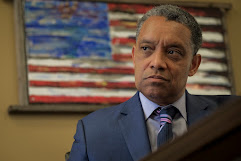
Attorney General Karl Racine
            The first lawsuit would come in November 2019 from the city of Washington D.C. and Attorney General Karl Racine.  This lawsuit would be filed under the charge that DoorDash misled consumers in Washington D.C. about how tips were being paid to the drivers.  This lawsuit would be settled a year later in November of 2020, in favor of Karl Racine and the city of Washington D.C.  The settlement would be $1.5 million to DoorDashers in a relief format, then $750,000 to Washington D.C. and $250,000 to local charities.  This totals up to $2.5 million, as well as Karl Racine requiring DoorDash to change their tipping policy to make sure all workers got their base pay amount even with tips.  While this tipping policy was already being implemented as of the prior year, the lawsuit began the same month they changed the policy so this was to ensure the policy would be used fully.   

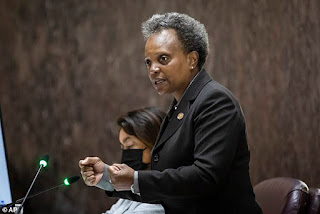
Chicago Mayor Lori Lightfoot
            Then the City of Chicago, Illinois, and mayor Lori Lightfoot would sue DoorDash in August of 2021.  This lawsuit was filed under the pretenses that DoorDash, among other food delivery services, was, “using unfair and deceptive tactics to take advantage of restaurants and consumers who were struggling to stay afloat.” (Lori Lightfoot) This lawsuit is based on multiple issues, one of which being DoorDash charging higher prices for items compared to the restaurant with the new tipping and payment policies.  They were also accused of delivering food without the prior authorization of the restaurants, which is believed to cause customer unhappiness with the restaurant rather than DoorDash even though it may not be their fault.  As of November 2021, this lawsuit is still being investigated and is on trial until a conclusion comes to fruition. 

Stakeholders

    The stakeholders involved with the DoorDash case would be the DoorDash as a Company, Employees of DoorDash, Previous Consumers of DoorDash, Future Customers with DoorDash, Future Shareholders, and the General Public.  The delayed actions of DoorDash to change their policy will affect how their employees and the general public view them in the future.  Prior to the change of policy, it was reported that 80% of DoorDash workers prefer the old pre-2019 model over the pre-2017 model, the pre-2017 model being nearly identical to the new one.  A statement from DoorDash also says that “Since we implemented our pay model in 2017, Dasher satisfaction has increased while average delivery times have fallen.” (DoorDash Spokesperson)  These two factors will heavily affect how stakeholders view this situation, as the change back to the earliest policy goes against what the majority of employees want.  The future customers of DoorDash are affected by this as they now have to read through the new policies, and likely will have higher prices to even out the amount of money lost by DoorDash without tip subsidization.  In terms of future shareholders, they have to consider these policies as well, and since DoorDash was very delayed in changing these policies until they were forced to, how will they handle events such as these in the future.  The general public is affected as DoorDash currently holds 57% of the online food delivery service orders, and this impacts a large number of people around the United States.  How these stakeholders are affected and the ties to Utilitarianism with this are explained in the next section.

Individualism

            Individualism as it pertains to DoorDash, Friedman’s individualism where “the only goal of business is to profit, so the only obligation that the business person has is to maximize profit for the owner or the stockholder within the law of the land.” Applying this to DoorDash we can see how the company was using the extra tips to cover the losses they are taking on the mandated tip rate. This is unethical, the employee is entitled to at least know they are losing out on the tip and make a choice if they would want to continue to work for DoorDash instead of thinking they are getting fair treatment. The customer is also entitled to know that if a tip is required then where directly is the money going. To mislead someone so drastically by advertising you are tipping the driver when it's really you’re covering the losses the company has placed on themselves clearly falls into the impermissible category. Regarding Machan’s Individualism “the only direct goal of business is to profit, and the primary obligation of the business person is to maximize profit within the law but: the direct goal of profiting may need to be met by indirect goals and not aimed at profiting, business people may have other goals and those goals may at times be prioritized over the goals of profit-maximizing.”

            The impacts the DoorDash lawsuits by the business should worry about the profits yes, but also worry about employees and customers, it may come as a loss but are you a company of enough morals to look at these potential losses and say it’s better for us to lose the tip money or lose the customers and employees. To an extent, DoorDash should be concerned with the profit and the return they are receiving. The company had every opportunity to come clean and say they made a mistake and grew too big to continue this guarantee. Instead, they decided to try and cover it secretly. They gambled and lost. Was it more important to cover a deal they offered to employees or the respect and moral integrity of the company? With these impermissible acts, they are facing a more drastic loss, the customer.

Utilitarianism

    A utilitarian would view this situation as the least ethically beneficial, including how DoorDash handled it and the situation itself.  The primary goal of utilitarianism is happiness for the majority of all parties involved.  To specifically quote the ethical rule of utilitarianism, “Business actions should aim to maximize the happiness in the long run for all conscious beings that are affected by the business action.” (Salazar 19) Salazar (19) also notes that “The basic method is to analyze the costs and benefits of a particular course of action.”  In the case of DoorDash, the happiness of all groups was not maximized, but rather the opposite, which includes the following groups:

DoorDash Company: DoorDash in ultimately every sense lost in this scenario, due to the many different factors involved in this situation.  They had to give up over $100 million in lawsuits during this course of time, had to change their policy on tipping subsidization which makes them less money, and lost future customers and employees due to their lack of change until they were required to do so.  The slow initiative of DoorDash to pay their workers more, which is still ongoing as of November 2021, will harm them in the long term financially and in terms of future employment opportunities.

Employees of DoorDash: While the tipping policy was reversed so that now tips are not included in base pay, this will likely negatively impact the employees long term.  The settlement by DoorDash to give money back to the employees only gave roughly $130 to each member, which is much more than the tipping amount that was subsidized (DoorDash Class Settlement)  This also negatively impacts DoorDash employees in the future, as the prior 2017-2019 policy was preferred by 80% of employees, so this does not maximize their happiness.

Customers of DoorDash: The previous customers of DoorDash will not have maximized happiness with this situation, as their tips were not given to the drivers in the normal sense.  The customers would be tipping to show appreciation to the driver for them bringing their food, not to subsidize their base pay and pay off their salary.  Then in terms of future customers, they would have to deal with potential price heightening from DoorDash, which has already been reported by the Chicago lawsuit, to cover for the tipping money they are not subsidizing. 

Future Shareholders: Future shareholders would have trouble trusting the company first off, due to their delayed fixing of company policies regarding tipping.  This also applies to the currently pending lawsuit against DoorDash for their policies, and the potential loss of employees and customers gradually over time.  The future of the company, especially with the new policy that the majority

Kantianism

            Kantianism is based on making and respecting ethical, rational decisions. Ethics is a sense of what is right and remaining loyal to those who work from you and purchase from you. This also means that the person themselves is not above the law or being ethical. Kantianism is in a sense “practice what you preach” what you would preach is making smart and ethical choices based on facts and reasons while helping others to do the same.

            Kantianism was not followed when comparing it to the DoorDash tipping policy. The first thing that shows that it does not follow the theory is the ethics part of the theory. Keeping a tip that was promised to someone when you are a billion-dollar company I would argue is extremely unethical. As already stated, these delivery drivers usually do not make a lot of money delivering orders to the customers, so those tips are highly important to them and their livelihood. Another reason why Kantianism would find this impermissible is that DoorDash is not letting its customers make a rational choice when it comes to tipping. Kantianism is big on helping others make rational choices with all the right information available to them. If DoorDash is giving their customer, the right to tip their delivery driver on the app the customer is under the impression that the driver is the one receiving the tip they are giving. This was obviously not correct and was misguiding the customer to tip DoorDash themselves and not the person handling their order. This is not letting the customer make a rational choice since they do not have accurate information on where the tip would be going. Overall, The DoorDash tipping controversy will be deemed unethical by Kantianism.

Virtue Theory

            A Virtue Theorist would look at the way DoorDash handled this situation as ethical. In the views of Virtue Theory, for a business to be ethical they must focus more on the process of getting the goal rather than strictly caring about achieving the goal. With the old tipping model, DoorDash would be considered very unethical according to those 4 virtues.

            With the Courage Virtue, it is important to find the middle ground between rashness and cowardice. DoorDash took a risk by not giving out the maximum amount of money to their workers. DoorDash was seeking to maximize their profits which a company should be striving to do so but by taking money out of their worker's pockets is not a good middle ground to settle in. The new tipping policy gave DoorDash room to grow in the Courage Virtue by finding a good middle ground of a larger tip will not decrease the base pay paid by DoorDash.

            When it comes to the Honesty Virtue it is key to be transparent with the public about the treatment of employees, customers, business partners in all aspects of the business. By unknowingly using tips to pay some of the base pay, this allows DoorDash to pay out less money to workers in return making them more money. The only issue is DoorDash wasn’t telling people that’s how it worked, they were working in silence. This is the biggest change DoorDash had when it came to the new policy. The settlement forcing DoorDash to be completely transparent with their workers and consumers allows them to put them back on the ethical side of the Honesty Virtue.

            The Temperance Virtue is to have reasonable desires and expectations. I think in this case DoorDash has reasonable desires when it comes to them seeking to maximize the money made for the company but their expectations of taking tips away from drivers would never fit into any business model. The Temperance Virtue is the only virtue DoorDash really didn’t change after the settlement because their desires and expectations had nothing wrong with them.

            The Justice virtue is hard work, quality products, good ideas, and fair practices. The employees of DoorDash were very hard workers and produces quality products but the practices done on the end of the company were unfair. Taking tips away from people is the same as taking money out of their pocket. Knowingly doing this to your employees is wrong. After the settlement, DoorDash had improved the Justice Virtue to become much more ethical than before. The new tipping policy shows good new practices compared to their old bad ones.

Action Plan

            The current issue displayed by DoorDash, in this case, is that they are being extremely unethical towards their employees and customers in a multitude of ways.  Firstly, the subsidization of tips to pay for their employees base wages, without notifying them that this is what they were doing.  This also impacts their customers, as the tips they are giving are intended to go to the driver directly for exemplary service, not just to pay their base salary.  To truly acknowledge this issue, DoorDash needs to be able to admit that they were using deceptive payment methods to their drivers, which they still have not done.  The choice to take accountability for what they did will show that DoorDash is aware of what they did and will give them the image they hope to have in that they have responsibility for their actions.  Next, they would need to pay reparations to those employees affected by this, and they should receive the sum amount of tips taken and used towards their base pay.  This would be the most surefire way to show the company has evolved and would prove that they care about the employees over profit. 

            The next step would be a rebrand of the company, firstly starting with their mission statement.  Their mission statement currently says, “We're working to empower local communities and in turn, creating new ways for people to earn, work, and thrive. We believe in delivering goods by connecting people and possibility.”  (DoorDash).  There are a few ways this mission statement can be improved after the case, one of which is adding a section regarding deceptive tactics.  A new example of such would be, “We’re working to empower local communities and in turn, creating new ways for people to earn, work, and thrive.  We believe in delivering goods by connecting people and possibility, while also using fair and honest values to do so.”  This new mission statement is not a far cry from the initial, however, it shows they are focusing on the addition of fair and honest methods to help their company thrive. 

            The new core values for them to follow are commitment, honesty, fairness, respect, and accountability.  To improve upon the company, DoorDash will have to be committed to finding a way to improve the company standards and help their employees thrive, not just the company.  They will need to be honest, and make sure employees clearly understand how they are being paid, and customers understand where their tip money goes.  They will need to change their policy on this payment method to further benefit the employees for their hard work, and make sure tips are directly being used for their initial intent.  Fairness to employees is a huge issue and can be addressed the same way, as the employees are not being treated fairly compared to other delivery services due to this case.  Respect and accountability finally, which come from DoorDash admitting to their deceptive tactics and building a new future to improve the lives of all people involved.  If they can go above and beyond by not just improving the company, but also the employees’ and customers’ experiences, then they can truly move forward from this case.

            To prevent this from happening again, they should focus on fully implementing the new tipping utilization so that it is never used for base wages again.  They should focus on creating new rules within the company to prevent any more deceptive tactics from forming, and whichever employees can stick to this and come up with a way of doing so can receive promotion.  Training would also be beneficial as it would allow employees of DoorDash itself to understand how to be open and clear with the drivers and customers while still being helpful. 

            All of this will help promote profit and productivity, as it is enticing customers to tip so DoorDash will still be paying the base amount but there will likely be more orders.  With this, more drivers will apply to the company and take more orders, making the company profit, and increasing their outreach.  This conforms to the mission statement and core values as it is honest and being respectful of those who work for the company, and is fair to all employees across their network, which also ensures good ethics. 

Authors: Jeremy Trottier, Brian Wiener, Owen Stanton, Ryan Suprin, Grace Trembley


References
-Dickey, Megan Rose. “DoorDash Tipping Practices Prompts Lawsuit from DC Attorney General.” TechCrunch, TechCrunch, 19 Nov. 2019, https://techcrunch.com/2019/11/19/doordash-tipping-practices-prompts-lawsuit-from-dc-attorney-general/

-EntreCourier, Author. “Doordash Taxes Made Easy: A Complete Guide for Dashers.” EntreCourier, 4 Oct. 2021, https://entrecourier.com/delivery/delivery-contractor-taxes/how-taxes-work/doordash-taxes/

-Rapier, Graham. “DoorDash Uses a Shady Tactic That Stiffs Workers out of Some Tips and Customers Are Furious.” Business Insider, Business Insider, 22 July 2019, https://www.businessinsider.com/doordash-delivery-tipping-practices-under-fire-cash-2019-7

-Tran, Sheila. “The Ethical Delivery Dilemma.” SF Weekly, 9 Apr. 2021, https://www.sfweekly.com/dining/ethical-delivery-app-dilemma-food/

-Canales, Katie. “DoorDash Is Paying $2.5 Million to Settle a Lawsuit That Accused the Food Delivery Company of Stealing Drivers' Tips.” Business Insider. Business Insider, November 25, 2020. https://www.businessinsider.com/doordash-25-million-settlement-lawsuit-tipping-model-2020

-Ghaffary, Shirin. “Pressure Is Mounting on Food Delivery App Doordash to Change Its Controversial Tipping Policy.” Vox. Vox, March 8, 2019. https://www.vox.com/2019/3/8/18253378/doordash-tipping-food-delivery-gig-economy-worker-rights

-Kelso, Alicia. “DoorDash Settles Lawsuit over Old Tipping Model for $2.5M.” Restaurant Dive, November 25, 2020. https://www.restaurantdive.com/news/doordash-settles-lawsuit-over-old-tipping-model-for-25m/589702/

-Kerr, Dara. “DoorDash Settles Lawsuit for $2.5m over 'Deceptive' Tipping Practices.” CNET. CNET, November 25, 2020. https://www.cnet.com/tech/mobile/doordash-settles-lawsuit-for-2-5m-over-deceptive-tipping-practices/


Monday, November 30, 2020

Trifecta Nutrition: CrossFit Games Food Scandal (2017-2020)


Abstract

Trifecta Nutrition is an organic meal delivery service that offers classic, keto, paleo, vegetarian, and vegan plans. Trifecta states, on their website, that their meals are “Organic, premium, pre-made meals”. Their website also claims, “Every meal is made from scratch, just like you would prepare in your own home, only in much larger volume by professional chefs. Our amazing team of chefs use all organic ingredients, grass-fed meat and wild-caught seafood”. However, at the Crossfit Games that ran from August 3rd, 2017 to August 6th, 2017, Trifecta was found to have been using food from other restaurants such as IHOP, a local barbeque shack, and a Mexican restaurant, and others. This incident contradicts their previous statement about using all organic ingredients such as grass-fed meat and wild-caught seafood, and another statement about every meal being made from scratch. CrossFit is currently investigating allegations also about the 2018 games with Trifecta’s actions. Trifecta is chosen by many customers because of their fresh products that cater to different dietary preferences of customers. These allegations that the company is facing is not good for their publicity or consistent business because it shows that they cannot be trusted to supply the quality of food promised, or even their own products. This case will be looked at through the four different ethical lenses, Individualism, Utilitarianism, Kantianism, and Virtue Theory. Considering a utilitarian argument, more harm was done in this Trifecta scandal than bringing happiness. In fact, there is no happiness to be known of in this case, not from Trifecta employees, customers, athletes at the Crossfit games, alternative food sources, or Crossfit Games employees. Thinking of individualism, the Trifecta case was unethical because the company had passed alternative food sources off as their own. A kantian argument can be made that the Trifecta employees were not honest to the Crossfit Games staff, the athletes, or anyone in this scandal. And finally, a virtue theory is that this case was unethical because Trifecta did not meet any of the four characteristics of the virtue theory, which are courage, honesty, temperance, or justice.


Case Controversy:

In 2018, Trifecta Nutrition was involved in a food scandal involving the Reebok Crossfit Games, and some third party restaurants and food chains, such as IHOP, McDonald's, and a Mexican food restaurant. Trifecta is the main food supplier for the Crossfit Games, providing food for athletes, staff, and and consumers at the event. Trifecta promises fresh, healthy, and dietary specific meals for their customers. For the Crossfit Games, Trifecta had gone to third party food suppliers, mentioned above, and used their products to pass off as their own during the event. Two former Trifecta employees came forward to spread this news, and were later relieved of their roles in the company. Trifecta Nutrition was founded in 2015 by Greg Connolly, who is also the present-day CEO of the company. In an article written on July 25, 2018 by hugheyphillipsllp.com, the text reads, “Trifecta Nutrition, which won a high-profile competition for local startup businesses and struck partnerships with national sports organizations, is accused in a lawsuit of repackaging processed foods from chain and fast-food restaurants and passing it off as high-quality organic meals suitable for top-level athletes in training” [1]. This quote shows that before the incidents were found from the CrossFit Games, Trifecta was proved to be a big name in meal delivery, winning multiple competitions for startup businesses and collecting partnerships with well-known sport organizations. In another article, Morningchalkup, discusses how Trifecta sourced food from other businesses for events. A quote that shows this from the mentioned article is, “Trifecta also provides all the food for staff at Regionals, the Games, and to CrossFit HQ for those who wish to purchase it. The lawsuit alleges that Trifecta sourced food for the 2017 CrossFit Games from other restaurants — “IHOP, a local BBQ shack, and a Mexican restaurant, among others, as well as sourcing McDonalds hamburger buns” — and passed it off as their own” [2]. This lawsuit was filed by two former Trifecta employees. After the lawsuit was filed by the two Trifecta employees, they were fired a week later. Another quote that adds to the same case is also written by Morningchalkup. The two employees that filed the lawsuit were mentioned in the quote, “Jodi Charter and Scott Cooper, who were both fired on August 14, 2017, just a week after the 2017 CrossFit Games. Scott was hired July 1, 2016 and was formerly the marketing manager. He also holds a minority ownership in Trifecta (50,000 shares). Jodi was hired in September 2017, as a “Social Media & Marketing Intern” then promoted to full-time around May 2017” [5]. Also, according to Morningchalkup in the same article, in the next paragraph, “According to the lawsuit, both employees had received promotions days prior to being fired. Both former employees are seeking monetary damages in excess of $80,000 each” [6]. Jodi Charter and Scott Cooper, the two ex-Trifecta employees, did the ethical action by speaking up about Trifecta’s actions. Another paragraph from Morningchalkup says, “Morning Chalk Up also spoke with Dan Schneiderman, partner at Witan Law Group, the legal team representing Trifecta on this matter. He added, ‘This is an honest, hardworking company that's made its way from a concept to a start up to a successful company. We believe that the accusation and allegations in the complaint are ultimately trying to form an unfounded narrative to say that a certain culture exists at Trifecta that quite frankly does not exist in that manner. We believe that the allegations are unsubstantiated and are founded mostly out of retribution from two disgruntled employees’” [5]. The previous paragraph also stated, “‘Trifecta strongly opposes the allegations and claims present in the underlying lawsuit,’ Trifecta said in a statement. ‘While we cannot discuss the details of pending litigation nor provide specifics regarding the alleged claims at this time, we look forward to correcting the record regarding the salacious and misguided claims brought by these two disgruntled fired employees’” [4]. Both of these quotes from Morningchalkup state that Trifecta has denied these claims made by former employees, Jodi Charter and Scott Cooper, and preach their innocence on the incident involving CrossFit Games. The lawsuit against Trifecta was 141 pages long, from source Morningchalkup, and in the coming sentences, quotes and photos will be shown from this lawsuit. “‘The food was supposed to be Defendant Trifecta food, which is advertised as “90% lean or greater, and Organic, Gluten-Free, Soy-Free, Dairy-Free and Non-GMO,” but instead was McDonalds hamburger buns, IHOP pancakes, meat and egg products, pork and other meat products from local BBQ shack, etc. Not only were those food products not Defendant Trifecta’s, none of them are or were “90% lean or greater, and Organic, Gluten-Free, Soy-Free, Dairy-Free and Non-GMO’” [8]. Below I will include a photo incorporated into the lawsuit used as evidence against 


Trifecta.  


Individualism Argument:

An individualistic theory posses primary values of the business, or those involved, profiting. Now considering Trifecta Nutrition, the Trifecta case was not ethical to an individualistic argument because the company had passed alternative food sources off as their own, therefore not profiting. An excerpt from the lawsuit against Trifecta, displayed on Morningchalkup, reads, ““Another specific example involves eggs served to CrossFit competitors and attendees. Eggology is or was the sponsored egg product and provider for CrossFit, and Defendant Trifecta was supposed to prepare and serve Eggology eggs for breakfast each day. Defendant Liz Connolly first told Plaintiffs and others that IHOP refused to cook the eggs at their facility because it was against IHOP’s corporate policies and procedures. Shockingly, Defendant Liz Connolly’s solution, as she explained to Plaintiffs and others, was to instruct IHOP to literally throw out the thousands of cartons of Eggology eggs that Defendants sent to IHOP and have IHOP prepare and serve whatever eggs they desired. When Plaintiffs and others communicated to Defendant Liz Connolly their disappointment and disagreement with her approach, Defendant Liz Connolly changed her story and represented that IHOP suddenly changed its corporate policies and procedures and in fact agreed to prepare and serve the Eggology eggs” [9]. Another argument to consider to viewing Trifecta's case from an individualistic perspective, is that neither the athletes, nor anyone else involved in the food scandal have profited from this incident.


Utilitarian Argument:

A utilitarianism argument is happiness for all. Considering a utilitarian argument in the Trifecta food scandal, more harm was done in this Trifecta scandal than happiness brought. In fact, there is no happiness to be known of in this case, not from Trifecta employees, customers, athletes at the CrossFit games, alternative food sources, or CrossFit Games employees. Looking back on the comments made about Jodi Charter and Scott Cooper, these two employees were treated very unfairly. Also considering the dietary plans that CrossFit athletes are on, they have chosen specific meals from Trifecta with trust that they contain the exact nutritional facts to maximize their performance during events. As well as these athletes, any customer of Trifecta reasonably has distrust in the food provider now. Trifecta’s actions have disappointed many and it will take honesty and an action plan to turn their reputation around.


Kantian Argument: 

A Kantian argument is rational decision-making and honesty and freedom. A Kantian argument can be made that the Trifecta employees were not honest to the CrossFit Games staff, the athletes, or anyone in this scandal. As shown in the photos above, of text messages with the president of Trifecta Nutrition, it is clear that there was a lack of honesty from Trifecta. Trifecta was also unwilling to disclose what specific restaurants where they sourced food. With this being said, Trifecta did not consider a Kantian ethical theory in their business actions.


Virtue Theory:

Theory
Character traits that
promote wellness or
flourishing of
individuals within a
society
Theory
Character traits that
promote wellness or
flourishing of
individuals within a
society

Virtue theory is considering character traits that promote wellness or flourishing of individuals within a society. Trifecta did not meet any of the four characteristics of the virtue theory, which are courage, honesty, temperance, or justice. Trifecta did not follow these four characteristics in the slightest way. In fact, it was courageous of them to risk their reputation over a situation that was very controllable from their own ability.


Personal Opinion:

            Speaking on my personal opinion of this Trifecta Nutrition scandal, I believe Trifecta to be guilty and in wrongdoing. CrossFit Games have been around since 2007, and it is a very respected and popular event. Athletes work extremely hard every year to be featured in the event, a miniature Olympics if you will, and Trifecta’s actions have foreshadowed that they do not take the event seriously, the athletes seriously, the athletes training seriously, or even have respect for their own business or values, to stick to their statements about, “Every meal is made from scratch, just like you would prepare in your own home, only in much larger volume by professional chefs. Our amazing team of chefs use all organic ingredients, grass-fed meat and wild-caught seafood” and “Organic, premium, pre-made meals”. What would be a great action plan for Trifecta, is to show the meal delivery business that they are now striving to be what they have lacked to be during this time. What I am referring to is Trifecta should show the public, and CrossFit Games, that they can be trusted from now on, and that nothing but Trifecta products will be distributed. The two terminated employees, Jodi Charter and Scott Cooper, should be compensated for their termination, and also, Trifecta should re-evaluate their upper-level management, because an ethical president would not allow such actions to be performed.


Action Plan:

     The current issue, is that Trifecta has been dishonest about what food they are providing to consumers, and have denied all claims against them, despite the evidence produced against the company. With the detailed and strong evidence against Trifecta, a mission statement should include a public apology from Trifecta, to consumers, the Crossfit Games, and the athletes participating in the Crossfit Games, as well as a plan moving forward to prove their future honesty to consumers. Some core values that are important are honesty, customer satisfaction, and quality assurance of the products being produced and distributed. I believe that some upper level management should be fired for allowing these actions to take place, and for a quality assurance worker to be hired or a quality assurance team, to make sure that the products being distributed are Trifecta's own products, as well as that they are to their own quality standard. With Trifecta's dishonesty towards passing off other vendor's food as their own, they have received poor publicity which has to be rebuilt by building a positive reputation with big names. Trifecta has continued to be the provider for Crossfit Games, which shows consumers that the air has been cleared between the nutrition company as well as Crossfit Games. With this plan of showing how trustworthy of a company Trifecta can be moving forward, their business will hopefully return to having an outstanding reputation. 


Work Cited

About The Author Amy Gesenhues Amy Gesenhues was a senior editor for Third Door Media, and Amy Gesenhues Amy Gesenhues was a senior editor for Third Door Media. “A CMO's View: How IHOP Keeps Winning the Love & Affection of Its 3.5M Facebook Fans.” Marketing Land, 16 Aug. 2016, marketingland.com/cmos-view-ihop-keeps-winning-love-affection-3-5m-facebook-fans-187900. 

“According to Text Messages, Trifecta Coordinated with IHOP for 2017 Games.” Morning Chalk Up, 2018, morningchalkup.com/newsletters/according-to-text-messages-trifecta-coordinated-with-ihop-for-2017-games/. 

Danger, Jessica. “Lawsuit Filed Against Trifecta by Two Former Employees.” Morning Chalk Up, 28 July 2018, morningchalkup.com/2018/07/27/lawsuit-filed-against-trifecta-by-two-former-employees/. 

“How to Win the CrossFit Open (Even If You Come In Last).” VeloPress, 22 Aug. 2017, www.velopress.com/how-to-win-the-crossfit-open-even-if-you-come-in-last/. 

Lofranco, Justin. “According to Text Messages, Trifecta Coordinated with IHOP During 2017 CrossFit Games.” Morning Chalk Up, 30 July 2018, morningchalkup.com/2018/07/29/according-to-text-messages-trifecta-sourced-ihop-food-for-2017-crossfit-games/. 

Maria, Meghan De. “14 Menu Items McDonald's Employees Won't Eat.” Eat This Not That, Eat This Not That, 6 July 2020, www.eatthis.com/mcdonalds-foods-employees-wont-eat/. 

Nutrition, Trifecta. “How It Works.” Trifecta Nutrition, 2020, www.trifectanutrition.com/how-it-works. 

Rodd, Scott. “Organic Food Delivery Company Accused of Serving Chain Restaurant Products.” Bizjournals.com, 2018, www.bizjournals.com/sacramento/news/2018/07/25/organic-food-delivery-service-accused-of.html.