ETHICS CASE CONTROVERSY
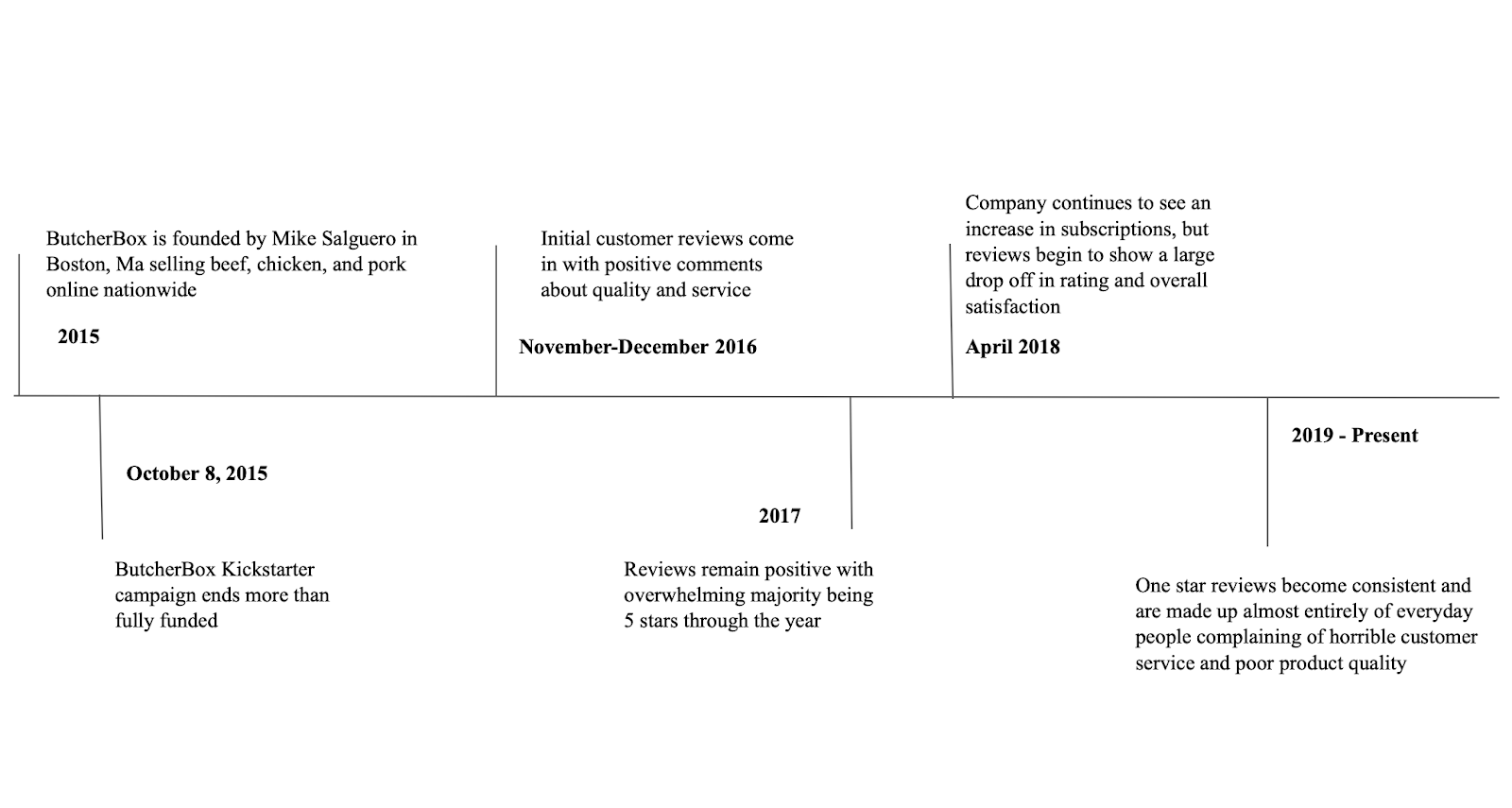
ButcherBox is an online subscription-based meat delivery service that offers consumers high quality meats without having to have a local butcher shop. The company was founded in 2015 in Boston, Ma by Mike Salguero and Mike Filbey. Since then, the company has grown to over 160 employees and have generated an estimated revenue of $43.5M per year (Growjo).
In the early stages of their company through today, the founders have intentionally limited the stakeholders in their company as much as possible. ButcherBox founder and CEO, Mike Salguero, states that, “Even before the success of our Kickstarter campaign, we wanted… farmers, the supply chain, employees, and ButcherBox members to be the only stakeholders to whom we answer. Because of that belief, we haven’t raised money from outside investors” (Salguero 1). As a result, there is the highest level of dependence on their sales revenue from their customers in order to survive. Being a very relatively new company, they are looking to attract customers who have likely never heard of their name who have little prior knowledge of their reputation. A 2017 survey on consumer behavior revealed that, “93% of consumers say that online reviews have an impact on their purchase decisions” (Fullerton, 1). This means that consumers will not want to blindly choose to join their service. Potential consumers then must determine their trust almost entirely on online reviews. For ButcherBox, online reviews can either make or break their company.
In the early years of operation for ButcherBox, their service was a growing success and the reviews reflected as such. This allowed their operation to expand as well. Over the past year, their reviews have become much more mixed. The nature of these reviews has been very suspicious and may be an indication that their “honest reviews” may not be exactly what they seem. On the popular review site, Influenster, ButcherBox has a seemingly unalarming average star rating of just over 3.5/5 stars. I looked closer into how this average was distributed and reading into the responses of consumers in addition to if these reviews come from people who are recognized by the site to be experts with a high number of reviews. It became clear that the reviews are significantly favoring either one star reviews or five star reviews. This is a common occurrence because it is often the passionate consumers that take the time to leave reviews, their passion leaning to passionately good or passionately bad. The site allows viewers to see the total number of reviews the particular person has left on their site. When looking through good and bad reviews, what is extremely unordinary is the distribution of responses from experienced reviewers (as acknowledged by the site) and those who have ButcherBox as their only review. The site distinguishes reviewers based on their amount of reviews posted throughout their time on the site. This is to give their viewers more trust in particularly experienced reviewers’ judgement. Those who are reviewing for their first time can be seen as the most likely ‘honest reviews’ because it wouldn’t make sense for a company to pay or incentivize for good ratings from reviewers with no experience or credibility.
Of all 80 of ButcherBox’s one star reviews left on this site, 75 of them are from first time reviewers and only 3 come from “experts”. On the opposite side, of all 162 five star reviews, only 6 were from first time reviewers and 46 come from “experts”. It is alarming that only 3% of the highest reviews (5 star ratings) come from the reviewers who have no likelihood of having any incentives, but yet 94% of the worst reviews (1 star ratings) come from reviewers with no likelihood of having any incentives. This indicates that the common consumers, those who’s reviews have no extra influence to potential customers, make up almost all of ButcherBox’s bad reviews and represent the most honest experience. If all of the reviews were honest, based solely on the consumer experience, and not influenced by the company at all, it would make sense that the people with the most influence have the same response as those with the least influence, but this is not the case. There are over 15 times more “Foodie Experts” who left 5 stars than 1 star (Influenster).
The high quantity of low reviews from everyday people draws scepticism about full length articles written about the service over the same timeline. Within public sites that contain a large number of reviews by normal customers, again referencing Influenster for example, nearly 25% of the hundreds of reviews gave ButcherBox the lowest possible score. Yet, through the multiple highly regarded full length articles, there is no mention of any issues experienced by such a large quantity of normal customers. These professional reviews only contain the highest recommendations and no complaints. It makes it clear that the professional bloggers would not have identified any problems if there were any because they were being paid to review this way. If this were not the case, professional reviews/articles would be a reflection of the average responses, which were not perfect by any means.
ButcherBox, being a new, relatively unknown company with virtually no capital being generated from outside investment, as stated by the CEO, has to operate off of their sales from subscriptions alone. Those subscriptions are dependent on their reviews on popular sites such as Influenster. One unhappy customer review describes this experience in saying, “I really just thought that the customer service was the worst experience that I have ever had as a consumer”, and another stating simply, “Terrible experience- Lack of customer service and care” (Influenster, 1). Increasing quantities of bad reviews would be enough to severely diminish the company’s income as a result of potential new consumers being deterred by these reviews. ButcherBox then may have needed to balance this out by paying expert reviewers to leave positive ratings for their company as it would help to keep a good enough average star rating and have far more influence than those who have no review experience to encourage new customers to join. The tactic of paying for good reviews has become a very large market for many companies as they are able to do so without getting caught. Like most companies, ButcherBox has not been caught for this despite their online reviews indicating this.
ButcherBox, being a new, relatively unknown company with virtually no capital being generated from outside investment, as stated by the CEO, has to operate off of their sales from subscriptions alone. Those subscriptions are dependent on their reviews on popular sites such as Influenster. One unhappy customer review describes this experience in saying, “I really just thought that the customer service was the worst experience that I have ever had as a consumer”, and another stating simply, “Terrible experience- Lack of customer service and care” (Influenster, 1). Increasing quantities of bad reviews would be enough to severely diminish the company’s income as a result of potential new consumers being deterred by these reviews. ButcherBox then may have needed to balance this out by paying expert reviewers to leave positive ratings for their company as it would help to keep a good enough average star rating and have far more influence than those who have no review experience to encourage new customers to join. The tactic of paying for good reviews has become a very large market for many companies as they are able to do so without getting caught. Like most companies, ButcherBox has not been caught for this despite their online reviews indicating this.

STAKEHOLDERS
The stakeholders involved in this controversy are the users of ButcherBox who are at risk of wasting their money on a service that is unsatisfactory for what they expected to be paying for as a result of reading dishonest reviews prior to their purchase. The owner of the company, Mike Salguero and the company itself have their money and sales revenue at stake and have this as their primary motivation to tamper with reviews in such a way. The potential customers who look at online reviews to help them make their purchasing decisions have stake in this controversy because potential customers are likely researching whether or not it is worth their hard earned money and they are influenced by such reviews. The food bloggers that write articles about the service have their reputations at stake if they describe an inaccurate representation of the experience. The final stakeholders in this controversy would be the butchers who source the meat to this service. These local butchers have their reputation at stake if they are associated with an unsatisfactory service provided by ButcherBox.
INDIVIDUALISM
The act of paying for positive reviews is unethical in terms of Milton Friedman’s concept of individualism. This ethical theory states, “that responsibility is to conduct the business in accordance with their desires, which generally will be to make as much money as possible while conforming to the basic rules of the society, both those embodied in law and those embodied in ethical custom” (Friedman, 1). By this principle, a decision made by a business to increase profits is ethical and it is the responsibility of the executives to make such decisions, assuming that they abide by the law of the land.
In the case of ButcherBox, paying for positive reviews would not be considered ethical by Friedman’s views because this action, although a strategy intended to benefit profit, does not obey the law of the land as it goes against federal laws and those embodied in ethical custom. In the case of federal legislation, “Under 15 U.S. Code § 45, the Federal Trade Commission (FTC) has the power to stop and penalize parties ‘using unfair or deceptive acts or practices in or affecting commerce.’ This makes it a crime to break official rules imposed by the FTC. And the FTC forbids the use of fake testimonials” (Stemler, 1).
In the case of ‘laws’ from the perspective of ethical customs, the action of paying for good reviews is unethical as it is dishonest and can essentially trick people into spending their money on a service that they otherwise may have decided was not worth the financial cost. The act of paying for reviews could also be argued as unethical from the perspective of improving profit as well because it would not increase long term profit because customers would join because of good reviews, be disappointed with the service, and cancel the order and likely leave another bad review. It would be more profitable long term if ButcherBox used whatever money may have been contributed to these reviews and instead put it towards their customer service. This would then be an improvement in customer experience, improve customer retention, and likely result in good honest reviews.
UTILITARIANISM
From a utilitarian perspective, ButcherBox executives are acting unethical. Utilitarianism wants business actions aimed at maximizing happiness for in the long run for all conscious human beings affected by that business action (Salazar 19). The act of paying for good reviews does not maximize happiness for any party involved. For the customers who subscribe to the service, they will not be happy with the customer service or overall experience as it would not meet their expectations based on the dishonest reviews that they read. Since the act of paying for reviews is not yet proven in this case because it is very easy to get away with this, even when considering all reviews to be honest, customers are showing that they are being led to believe the quality and service is much higher than when they join. New customers are unhappy and subscriptions are cancelled.
For the ButcherBox executives, it may initially seem as if paying for good reviews would improve happiness for them, but it would not be the ethical utilitarian solution because it would not maximize happiness. The amount of happiness that they gain from the paid review is not going to equal the happiness that they would feel if they knew the reviews were truthful and genuine. They would then know that they are doing a great job and that customers who subscribe based on those reviews will not be let down because they would have an accurate idea of the quality of service. Paying for reviews also puts the company at risk of being caught which would certainly have a negative impact on their sales and subsequent happiness. Whether there is a future scandal exposed from these reviews or not still means that there is a higher expectation going into the experience than what is received. Since the misleading reviews contribute to customer unhappiness, the butcher shops that source the products used by ButcherBox would be unhappy because the quality of their meats may be completely overlooked by the customer and their products would only be associated with a service that created a negative customer experience for them. This would look bad for their reputation as a result, even though their products may be very high quality.
In addition to the consequences of paid reviews, the consequences of the poor service and care would go against utilitarian views. Customers would be unhappy with the disregard for customer service and would then also be unhappy with the difference between what they read online and what the actual experience was like. For the company, their poor customer service could be considered to make them happy because they likely don’t want to suffer the financial expense of hiring more customer service staff or reimbursing customers to their satisfaction. Despite this, the financial burden of improving service quality would be an investment that maximizes their long term happiness as it would improve business and reviews over time and likely result in a higher number of new customers and profit.
KANTIANISM
Although the case of ButcherBox would also not be ethical through the Kantian perspective, Kantianism differs from utilitarianism in terms of decision making. Utilitarianism makes decisions based on consequences while Kantianism bases decisions on goodwill (Salazar 21). This theory focuses on the intention and motivation behind the action rather than the result of the action.
In the case of ButcherBox the act of paying for reviews would have the intention of being deceitful to the customers/potential customers who read the fake reviews in order to convince them to pay for the service. This would have been a deliberate attempt to profit off of a lie at the expense of the unsuspecting customer. This would be the opposite of actions based on goodwill. This comes across as them trying to cover up their own incompetence rather than actually addressing the issues that may be causing the customers to have such a negative experience with their product. This is an attempt to gain profit short term as the good reviews and articles may help them gain new customers, but these new customers would have higher expectations than what they are going to experience because their expectations were based on dishonest accounts of the company. These new customers would then not return to the service going forward and likely would express their dissatisfaction in the form of an honest bad review. This would ultimately do more harm than good for the company. The correlation to kantianism from this comes from the business’s intention to be dishonest and gain a positive reputation the cheap way rather than providing that level of quality. This would mean that they did so without considering the impact on their customers and the company as a whole that is not going to benefit in the long term. That motivation would deem this unethical from a kantian perspective.
VIRTUE THEORY
The virtue theory is another way to determine the ethical nature of an event based on the character of the parties involved. Virtue theory evaluates the actions based on how it reflects who they are. ButcherBox has failed to demonstrate the virtues of honesty, justice, and intelligence. Beyond this, their actions reflect the vices of greed and selfishness.
When looking at the virtue of honesty, ButcherBox goes against this with the deceitful reviews of their service. This action is something that ButcherBox has not faced consequences or backlash for as they have yet to be accused of this. While the reviews draw great suspicion of this, even if it is not the case, ButcherBox is still being dishonest because they are willingly providing customers with service that is not a reflection of how they perceive themselves and are being perceived by bloggers and expert reviewers. The reviews bring in new customers so they get their profit, but they do not care to provide the quality of service that the customer was led to expect.
This case demonstrates ButcherBox’s failure to satisfy the virtue of justice. The company benefits from reviews that are not a representation of the service that they are willing to provide. This gives the public the perception that they are much more considerate than they have proven themselves to be through the honest reviews of bad service. The virtue of justice would be met had they acknowledged how they are regarded in these reviews and blogs and demonstrated an equal level of service that accurately represents how they are being portrayed. Instead, they are benefiting from the positive articles that when compared to the reality of the reviews from everyday people it is clear that they are undeserving of their praise and the profit it generates. There would be justice for the customer if the service reflected the high praise from the articles or if the articles represented the poor quality of the service.
The ButcherBox case does not reflect the virtue of intelligence as they are setting themselves up to suffer in the long term. If they were intelligent, the profits generated from the subscriptions would go further into maximizing the quality of customer service. This would create a better overall consumer experience and honest positive reviews would result. These reviews would encourage new members to join where they would be met with that same level of satisfactory service thus creating a cycle of positive customer experiences that encourages the growth of the brand. Instead, they neglect to put the necessary attention towards their customer service which would save money, but severely hurt future income. All of these actions demonstrate the vices of greed and selfishness because they would rather save their earnings than improve their service and the experience of their paying customers who are let down as a result. The customers are left to feel as though they had been lied to as the company just takes their money.
When looking at the virtue of honesty, ButcherBox goes against this with the deceitful reviews of their service. This action is something that ButcherBox has not faced consequences or backlash for as they have yet to be accused of this. While the reviews draw great suspicion of this, even if it is not the case, ButcherBox is still being dishonest because they are willingly providing customers with service that is not a reflection of how they perceive themselves and are being perceived by bloggers and expert reviewers. The reviews bring in new customers so they get their profit, but they do not care to provide the quality of service that the customer was led to expect.
This case demonstrates ButcherBox’s failure to satisfy the virtue of justice. The company benefits from reviews that are not a representation of the service that they are willing to provide. This gives the public the perception that they are much more considerate than they have proven themselves to be through the honest reviews of bad service. The virtue of justice would be met had they acknowledged how they are regarded in these reviews and blogs and demonstrated an equal level of service that accurately represents how they are being portrayed. Instead, they are benefiting from the positive articles that when compared to the reality of the reviews from everyday people it is clear that they are undeserving of their praise and the profit it generates. There would be justice for the customer if the service reflected the high praise from the articles or if the articles represented the poor quality of the service.
The ButcherBox case does not reflect the virtue of intelligence as they are setting themselves up to suffer in the long term. If they were intelligent, the profits generated from the subscriptions would go further into maximizing the quality of customer service. This would create a better overall consumer experience and honest positive reviews would result. These reviews would encourage new members to join where they would be met with that same level of satisfactory service thus creating a cycle of positive customer experiences that encourages the growth of the brand. Instead, they neglect to put the necessary attention towards their customer service which would save money, but severely hurt future income. All of these actions demonstrate the vices of greed and selfishness because they would rather save their earnings than improve their service and the experience of their paying customers who are let down as a result. The customers are left to feel as though they had been lied to as the company just takes their money.
JUSTIFICATION ETHICS EVALUATION
I don't see ButcherBox to be ethical in the way that they do business. The perspective of utilitarianism, kantianism, and virtues theory demonstrate this conclusion and from three different angles, the services provided by ButcherBox are unethical. Even though the suspicion of illegally paying for dishonest reviews has yet to be identified by a court or the justice system, Their poor service is showing that they are profit motivated at the expense of the customers and a willing lack of maximizing happiness as a result. The kantian perspective sees their incompitent service as a reflection of their intent to screw over the customer because it saves them money and would deem them unethical. The short and long term unhappiness for the customers, company, and suppliers that would come as a consequence of their actions makes the utilitarian view deem them unethical as well. Individualism states that their only obligation is to maximize profit, but yet they only do this in the short term by banking on overly generous reviews whether they prove to be paid for or not. By failing to sufficiently meet such expectations due to their neglect for customer service, they create their own problem of bad reviews and reputation which turns current customers away due to unhappiness, and potential customers away who read the reviews.
COMPANY ACTION PLAN
ButcherBox has the opportunity to take action and refocus their priorities to better ethically operate. They are at risk of digging a further hole for themselves. The action plan to address the issues begins with a prioritization of customer service. This will require them to focus a much larger amount of funds towards this part of their operation. The company, at this point, likely does not feel as though they have the extra funds from sales to put towards customer service in the way that would be necessary to eliminate a vast majority of the bad customer experiences that it creates. The improvement to their customer service will result in an increase in positive reviews coming from regular people who have satisfactory experiences with their communication with the company. It is poor customer service that is most likely to provoke people to leave a bad review because it is oftentimes very frustrating as it makes customers feel as if they are not valued. The positive reviews that will result from this will be a big factor in getting an increasing number of new members that likely all looked for validation in customer reviews prior to their purchase. The new increase in subscriptions means an increase in revenue that can be used to maintain higher funding for this department so there aren't future issues. As a result, putting the extra funds into customer service will be an investment that could allow them to be more ethical. The new funds generated by this action will pay for the higher customer service funding to continue and build upon itself.
In order to begin this process, ButcherBox will require more capital to put towards this without taking away from another important aspect of the business. To do this, ButcherBox should look to outside investors to provide the capital in return for stake in the company. This is a common factor in almost all entrepreneurial ventures, but is something that CEO, Mike Salguero, has intentionally avoided since the start of the business. This means that those within the company have 100% ownership. I believe that in order to be profitable in the future, the company will need to be able to put far more funds towards customer service than they are able to at this moment. If Salguero is willing to sell a small portion of ownership for a large sum of new capital in order to begin this action plan, the benefits that the company will see to their business as a result will make his now smaller stake in his company worth far more than what 100% would be worth without significant change.
How does this action and result affect the ethics of ButcherBox? The increase in funding towards customer service changes the company’s character. They would be showing that they are willing to spend their income for the purpose of maximizing happiness for consumers. This will maximize profit for the company and in return maximize happiness for the company as well. As the happy customers then translate their experiences into positive reviews, new customers are influenced to join with the expectations set by the good reviews. The new action by the company will allow them to actually meet the expectations set by the reviews which only repeats that process as the new customers share their experiences online. This is how happiness can be maximized for future customers as well.
This action can be beneficial for all stakeholders as the company will do this with the motivation to increase future profit rather than save current funds. This action will be within the confines of federal and common ethical law which would satisfy the ethical view of Friedman’s theory on individualism. The plan will have a consequence of an increase in happiness for all stakeholders which would satisfy a utilitarian perspective. That will be done with the motivation of bettering the success of the company and increasing the quality of customer experience and consideration. This would be a demonstration of how they would be acting on goodwill and improved character, thus satisfying the ethical views of kantianism. Finally, it will satisfy the virtues that they currently lack, as it will be an honest and intelligent action that demonstrates justice for themselves, their customers, and their suppliers. Their reviews and service will be an accurate representation of one another and will both set and satisfy consumer expectations. This will also shift their focus towards a better experience for those who decide to subscribe to their service. As a result, ButcherBox can eliminate the vices of greed and selfishness within their operation as they will begin to value their customers above their own success and in turn both can create maximum happiness for all.
REFERENCES
In order to begin this process, ButcherBox will require more capital to put towards this without taking away from another important aspect of the business. To do this, ButcherBox should look to outside investors to provide the capital in return for stake in the company. This is a common factor in almost all entrepreneurial ventures, but is something that CEO, Mike Salguero, has intentionally avoided since the start of the business. This means that those within the company have 100% ownership. I believe that in order to be profitable in the future, the company will need to be able to put far more funds towards customer service than they are able to at this moment. If Salguero is willing to sell a small portion of ownership for a large sum of new capital in order to begin this action plan, the benefits that the company will see to their business as a result will make his now smaller stake in his company worth far more than what 100% would be worth without significant change.
How does this action and result affect the ethics of ButcherBox? The increase in funding towards customer service changes the company’s character. They would be showing that they are willing to spend their income for the purpose of maximizing happiness for consumers. This will maximize profit for the company and in return maximize happiness for the company as well. As the happy customers then translate their experiences into positive reviews, new customers are influenced to join with the expectations set by the good reviews. The new action by the company will allow them to actually meet the expectations set by the reviews which only repeats that process as the new customers share their experiences online. This is how happiness can be maximized for future customers as well.
This action can be beneficial for all stakeholders as the company will do this with the motivation to increase future profit rather than save current funds. This action will be within the confines of federal and common ethical law which would satisfy the ethical view of Friedman’s theory on individualism. The plan will have a consequence of an increase in happiness for all stakeholders which would satisfy a utilitarian perspective. That will be done with the motivation of bettering the success of the company and increasing the quality of customer experience and consideration. This would be a demonstration of how they would be acting on goodwill and improved character, thus satisfying the ethical views of kantianism. Finally, it will satisfy the virtues that they currently lack, as it will be an honest and intelligent action that demonstrates justice for themselves, their customers, and their suppliers. Their reviews and service will be an accurate representation of one another and will both set and satisfy consumer expectations. This will also shift their focus towards a better experience for those who decide to subscribe to their service. As a result, ButcherBox can eliminate the vices of greed and selfishness within their operation as they will begin to value their customers above their own success and in turn both can create maximum happiness for all.
REFERENCES
Crawford, Elizabeth. “5 Tips for a Successful Kickstarter Campaign from Grass Fed Meat
Delivery Startup Butcher Box.” Foodnavigator.com, William Reed Business Media Ltd., 1 Oct. 2015, www.foodnavigator.com/Article/2015/10/01/5-tips-for-a-successful-Kickstarter-campaign-from-Butcher-Box.
Delivery Startup Butcher Box.” Foodnavigator.com, William Reed Business Media Ltd., 1 Oct. 2015, www.foodnavigator.com/Article/2015/10/01/5-tips-for-a-successful-Kickstarter-campaign-from-Butcher-Box.
Friedman, Milton. “A Friedman Doctrine‐- The Social Responsibility Of Business Is to Increase
Its Profits.” The New York Times, The New York Times, 13 Sept. 1970, www.nytimes.com/1970/09/13/archives/a-friedman-doctrine-the-social-responsibility-of-business-is-to.html.
Fullerton, Laurie. “Online Reviews Impact Purchasing Decisions for over 93% of Consumers,
Report Suggests.” The Drum, The Drum, 27 Mar. 2017, www.thedrum.com/news/2017/03/27/online-reviews-impact-purchasing-decisions-over-93-consumers-report-suggests.
Salazar, Heather. The Business Ethics Case Manual. N.d.
Salguero, Mike. “Mike Salguero, Author at ButcherBox.” ButcherBox, 24 Jan. 2018,
www.butcherbox.com/author/mikes/.
Stemler, Sam. “Are Paid or Fake Testimonials Illegal?” Boast, 18 Feb. 2020,
https://boast.io/paid-fake-testimonials-illegal/.
Vavala, Lauren. “July 2019 ButcherBox Review.” Delicious Little Bites, 8 July 2019,
https://deliciouslittlebites.com/july-2019-butcher-box/.