DoorDash’s Pricey Fees For Restaurants During Pandemic (2020-2021)
CASE CONTROVERSY
DoorDash is a billion-dollar powerhouse company for being one of the top competing third-party intermediaries in the U.S. Their private service is all done online and on their app for cellphone users. This service being independent contractors, non-employees, also known as civilians, delivering orders from local restaurants to people who ordered through the DoorDash database. DoorDash’s bottom line is delivering foods from restaurants that maybe don’t have delivery as an option, to the people who ordered through them. This can only be done by a restaurant partnering with DoorDash in a co-opt business venture allowing their food order systems to be connected, so it's no surprise that they’re currently in over 4000 cities and during the pandemic their orders went up over 200%. This service can be accessed by anyone who has smartphone and it can be used to order food from partnered food spots or be a way of part-time income as DoorDash depends on civilians to fill those roles with one of their virtues of just getting a little extra money on the side as their hours are entirely up to the Dasher or driver whenever they please. The process seems easy, DoorDash enters into partnerships with restaurants and DoorDash gets a commission on all the sales they generate for that local restaurant. Then customers order on the DoorDash app, and receive their meal from their favorite food joint and all the while, they don't even have to leave the house. Like all things that are too good to be true, this company’s actual bottom line is offering businesses a lifeline, a partnership that would only hopefully produce more profit from delivery orders but in actuality, DoorDash’s commission is costing the business at a rate that is concerning. Ultimately the real one on top is DoorDash because the restaurants are operating under the safety net that their partnership will automatically improve their sales but this isn’t always the case.
 |
| Food delivery service from DoorDash |
The numbers are, 37% of restaurant operators say that third-party apps/websites hurt their on-premise dinner sales, 27% said third-party apps/websites were denting their on-premise lunch sales, 79% of the operators who use these apps/websites said there is profit to be made but the vast majority said the services were only ‘slightly profitable’, and 21% said that they were ‘not at all profitable.’ DoorDash and other delivery services give restaurants another means of income but at a hefty cost. DoorDash takes a cut from the restaurant’s profit, which hurts their bottom line. On top of that, some restaurants can’t keep up with the orders or afford the profit cut. DoorDash can take as much as 15% to 20% per order from partnered restaurants. For instance, Boom Wanvisa, managing director of Farmhouse Kitchen and Daughter Thai Kitchen in the San Francisco Bay Area and Portland, said that when a customer ordered the food through DoorDash delivery service, her restaurant had to pay 20% in commission; if the customers chose to pick the order up by themselves, the charging fee was 12%. Another example is the Adda Indian Canteen of Roni Mazumdar, who had to fork over 24% of the sale to DoorDash (Bloomberg).
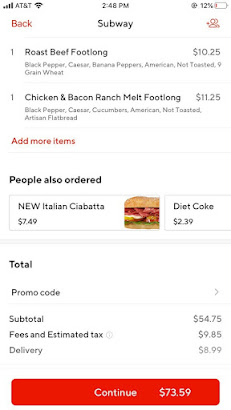
The Pricey Fees of DoorDash per order |
It may benefit the restaurant more to order directly from them when possible. Ordering for pickup ensures all the profits go directly to the restaurant and its team. There are cases too of restaurants using DoorDash and other delivery apps running into a wide array of problems, one being some restaurants have received orders when they aren’t using the service. Other issues include specific experiences that illustrate employees or delivery drivers having to waste their own time sometimes with canceled orders and getting slighted on tips since there is no check. DoorDash isn’t blind to the fact that they were experiencing a profit explosion during the pandemic when restaurant dining, churches, and workplaces were shut down. They knowingly enter these partnerships with the bottom line being that their investment will benefit their company and ultimately choke out the restaurants.
The rise of complaints from restaurateurs eventually attracted the attention of the state and local governments. They noticed the business growth and power expansion of DoorDash and other delivery companies, who gradually became the key part of society, along with the pricey fees set up for restaurant owners and customers, had negatively impacted the market. Hence, many city governments such as San Francisco and New York enacted the commission caps that DoorDash could charge the restaurant as the highest as 15% and 23%, respectively (WSJ). Consequently, DoorDash had to face 32 commission caps from several city governments in August 2020, and at the end of the year, the number of caps increased to 73. They also conducted many investigations about DoorDash's business activities. In September 2020, three members of Congress asked the Federal Trade Commission for an investigation due to the concern about DoorDash business (NBC News). The Chicago investigation revealed that many restaurant owners reported finding their restaurant's menu and advertisement on the DoorDash app without their consent. Although DoorDash had removed it from their platform after the calling, the owners said that this experience still upset them since this incident could harm their reputation to customers. On August 27, 2021, Chicago sued DoorDash for deceiving customers and unfair practices toward restaurants (CNBC).
 |
| Timeline of the case |
STAKEHOLDERS
In this case, the stakeholders include DoorDash company, the restaurateurs that allied with its app, the customers who used its service, and the regulators. The pandemic was perfect timing for DoorDash to grow its business and earn more profits. It was proven by the company's $32 million in profit in the first quarter of 2020. However, due to the competition with other two major delivery companies, UberEats, and Grubhub, in the food delivery market through marketing, DoorDash was still in debt. Therefore, instead of maintaining a good relationship with the restaurants and customers, DoorDash decided to exploit them by charging high fees (10% to 30%) and adding an additional fee. This led to the enactment of the caps from city governments later, which reduced the company's order volume and ended up with the loss of $355 million in the third and fourth quarters of 2020. Moreover, DoorDash also had to face a lawsuit from the city government, which accused it of deceiving customers and unfair practices toward restaurants. The restaurant side, such as Boom Wanvisa and Roni Mazumdar, who was supposed to be supported by Doordash to survive and thrive through this period like what it said in the mission statement, struggled to cover the pricey fees from DoorDash. Although DoorDash helped them maintain their restaurant business when the Stay-at-Home order was enacted throughout the country, they barely survived with these high commissions and expensive service fees and generated almost no financial profit. They fell into a disadvantage when the choice was limited to either depending on delivery service from the third party or closing the business. It was tough to find independent drivers willing to work with the local restaurants since most of them had already joined delivery platforms like DoorDash. Also, the restaurateurs were not able to deliver all the orders in the wide range. Furthermore, DoorDash also used unfair business practices by advertising and selling their menu without their consent or arbitrarily adding their restaurant into the DashPass service to charge a higher rate. Consequently, the pricey fees that DoorDash applied to the restaurants forced them to raise their menu price, which led to the effect on the customer side, another stakeholder. The customers now had to pay a higher price for the same order they had before the outbreak of pandemics, such as the $14 avocado toast now increased to $19.40 in the Grand Lake Kitchen example. The price per order that the customer needed to pay kept rising after the regulators enacted the commission and service fees caps in many cities that restricted the cost DoorDash could charge the restaurant. DoorDash charged the customers an additional Regulatory Response Fee per order to make up for these losses from the caps. The regulators from several city governments such as Denver, New York, and Chicago, decided to get involved after noticing the unacceptable commissions and service fees rate that DoorDash set up. They restrict it by establishing the fees caps and doing many investigating about DoorDash. However, after passing the caps, some city governments also got sued by the company.
DoorDash's Pricey Fees during the Pandemic
INDIVIDUALISM
Individualism's view of this situation overall would say that it is unethical and impermissible, which is hurting the company. The theory behind individualism is to maximize profits for the stockholders within the law. DoorDash was doing all these unethical doings against the law because they wanted to maximize the profits for their stockholders. But at the same time, tarnishing their reputation with their customers and drivers. Which is bad for business and will reflect on mass profits. There will be a harder time finding drivers since now drivers want to go join the competition and get a better pay. They’re going to be losing customers as customers will see them as cheaters and liars. No one wants to pay extra for things that are cheap. They’re going to be paying lawsuits, which is going to bring money out of their pockets. When you have millions of people who are investing in your company. At the end of the day, you want to win for them. DoorDash went exactly against that when they decided to do these unethical doings.
The DoorDash lawsuit was classified as a class-action lawsuit, which permits one or more plaintiffs to file and prosecute a lawsuit on behalf of a larger group which in this case was the drivers. DoorDash agreed to a 100-million-dollar settlement for Massachusetts and California drivers. Door dash shares recently soared as the company bought a brand-new food delivery startup, Wolt Enterprises, for 8 billion. So even with all the controversies, they remain the top dog in the food delivery system.
UTILITARIANISM
A utilitarian view of this situation overall would say it is unethical and impermissible. The theory behind Utilitarianism is to Maximize happiness for yourself and others in both the long term and short term. Happiness is defined as pleasure and is the only thing of intrinsic value. The reason that this situation would be viewed as impermissible is because it does not benefit the majority of the people. In fact, the majority of people in this situation are upset, which would be the opposite of the goals of utilitarianism. That’s because when DoorDash steals tip money, it only benefits the company. The majority of people (customers and drivers) will be unhappy. The only way this controversy could be seen as permissible is if it was being viewed strictly from the point of view of the company. That’s because everyone within the company will be happy that revenue is increasing. Therefore, a utilitarian would see that the majority is happy and say it is a permissible action. When the controversy is viewed from a larger overall perspective, it is clear that the majority of people are not happy and it’s impermissible. The drivers are unhappy throughout the entire controversy because they’re losing out on money that they believe they deserve. The customers are unhappy with the controversy as well because their money is not being given to the people it was intended for. The handling of the controversy by CEO Tony Xu would also be viewed as unethical. Tony Xu claimed he had a new payment model that would be implemented yet many drivers say the model was unchanged and the complaints never stopped. Therefore Xu’s actions lead to the majority of people in the situation being unhappy and would be viewed as impermissible by a utilitarian.
KANTIANISM
Kantianism has four basic principles. The first principle is to act rationally, which means acting consistently and not considering yourself exempt from the rule. Secondly, allow and help people to make rational decisions. The next principle is respecting all autonomous beings, and the last one is motivated by good will, which is the only thing that is truly under our control (Salazar, 5). To determine if the action is permissible or impermissible, Kantian uses the formulas of the Categorical Imperative. "An imperative is a command or duty; categorical means that it is without exception" (DesJardins, 38). When we analyze the DoorDash case under Kantianism's view, we see that the actions of Doordash are strongly impermissible.
First, let's analyze it under the Formula of Universal Law. The Formula of Universal Law focuses on Kantianism's first principle that does not consider yourself exempt from the rule. "Act only according to that maxim whereby you can at the same time will that it should become a universal law" (Salazar, 7). Under the Formula of Universal Law, we first need to create a Maxim-for-Action statement, which tells people what you are going to do to achieve what purpose, and then universalize this statement to see if it can answer the question "Is it possible for everyone to do it?". If the answer is yes, then it means the action is consistent and permissible. In this case, DoorDash said it charged a higher rate of commissions and service fees to cover the expensive operating cost and maintain its business during the pandemic. If we use this as a Maxim-for-Action statement and universalize it to "Everyone charged a higher rate of commissions and service fees to cover the expensive operating cost and maintain their business during the pandemic," I believe that this is an impossible thing to do universally. Let's say if every business starts to increase the fees they charge the others, the customers and partners will gradually not be able to buy the product from the market or pay the fees from the contract since they will run out of money. Without the cash inflow to the company, the owners do not have enough money to maintain the business. When there are no business activities, there is no operating cost to cover. Therefore, this maxim statement is contradictory and inconsistent, which also means impermissible.
Secondly, if the actions of DoorDash are analyzed under the Formula of Humanity, I believe the result is still the same as the Formula of Universal Law, which is impermissible. This formula focuses on the third principle, which is respecting all autonomous beings. "Act in such a way that you treat humanity, whether in your own person or in the person of another, always at the same time as an end and never simply as a means" (Salazar, 9). According to this formula, humanity is the rational power of each individual and the only thing that is valuable in itself because rationality allows people to make decisions for themselves, to evaluate what is right and wrong, and determine their own person (Salazar, 9). Rationality cannot be possessed by others; therefore, we must respect others' rationality and treat them as an end, never as a mere means, including yourself. However, DoorDash took away the rational power of its customers and the restaurant partners in the case. It took advantage of the pandemic when people had to rely on its delivery service to exploit people. DoorDash knew that restaurants and customers had limited choices during the pandemic, so it set a high rate of commissions and service fees to make more profit for its company. This means DoorDash used other people as a means to achieve its own purpose, rather than an end, which is valuable in-itself. Another action of DoorDash showed that the company did not respect the rationality of others that it advertised and sold the food on the menu of some restaurants without the owners' consent. The company also arbitrarily added restaurants to the premium service DashPass, which would charge a higher rate of commissions and service fees than the regular membership. DoorDash never sent any message or letter about this to the restaurant owners, and they always had to figure it out by themselves. The company even deceived customers by placing a misleading name on a new fee after regulators enacted the caps. DoorDash did not respect people's ability to make rational decisions about things and also did not allow them to do it. Therefore, those actions could not be considered permissible and ethical actions.
VIRTUE THEORY
Virtue theory’s bottom line is to achieve fulfillment or completeness and to become all that you can as a human being reaching full potential. People must incorporate strong values and virtues that can define them in their mannerisms and characteristics of life choices. Determining what are things purposes, exercising rationality in order to perform well whether it’s by yourself or with others. The more able one is to flourish with society the easier it is to feel complete and achieve fulfillment. Business goals are flattened if character traits and virtues are not up to the trends and likings of society. The monopolistic capital culture in today's world has made ethical thinking a brush over concept in the business world because their end goal is always consistent in making money. DoorDash isn’t just in the hot seat for falsely entering business partnerships under the preconceived notion of automatic benefit, but also their failure to exercise temperance, courage, honesty, and justice. Without fulfilling these requirements, DoorDash is labeled as a cash grab company only in pursuit of their own goals and by any means. They are cowards in their deception to hardworking and struggling restaurants who are desperate for more traffic that their new partnership will help the place get out of debt and into better days, but we know that isn’t the case. In the honesty department, they have none, DoorDash is supposed to be a partner but is actually costing its partners money that they don’t have. This trend is continuous and they fail to improve margins for restaurants or even improve pay for drivers, they continue to practice their methods which evaporates their temperance hope. Justice wise and making sure everything is morally right they failed to acknowledge drivers as independent contractors and were forced to give out over 3.5 million dollars. Basic legislation is completely undermined because they’re motivated by money. DoorDash is completely unethical in their operations with other restaurants, they take more than they give but disguise their agreement as a way to drive more traffic to their app and less to the businesses who actually make the food.
Virtue theory isn’t just based around getting a good or likable outcome, but acting in such a way that is morally good and the way a person should be. Doordash should be paying drivers a much higher rate due to the personal labor involved and having a history of network crashing, drivers not being paid, and other violations of hiring. The bosses should be conversing about the possible ways they can still operate doing financially profitable things but they must be permissible in that they are inherently good and they should be good because their duty is to provide quality service while performing the duties of being a good employer as well. Bosses should want to lead by example because they are leaders by the structural design of position hierarchy and in turn should hold the highest of responsibilities and furthermore an elitely positive perspective for their employees to admire and mirror, which results in better productivity. Doordash’s deliberate negligence to provide a more established work contract with its drivers, as well as their failure to inform their partner restaurants without deviation, the specific benefits each company gains during the deal and if beneficial at all. Restaurants deserve to be told that the venture they think will help drive more traffic to their store and boost their revenue but in the end of it all this agreement will actually end up costing them money putting these restaurants in a loss. The ethical thinking to this company and their current business arrangements is solely on gaining the most by any means possible with no regard for external consequences.
ACTION PLAN
For the step by step plan, first and foremost, Doordash needs to clearly state business deals between partner restaurants, which means fees, upfront costs, and other expenses that may arise from the partnership, what will the restaurants get out of being partners with them. Their service is built on voluntary private employees delivering food and that’s a fulfilled order. They should have a system so that delivery drivers should be given the chance to see exactly how much they are going to make from a delivery. Another area of improvement that would seem effective thing they can do DoorDash can reduce the marketing costs, they can be more profitable if they go back on the advertising and promotional aspects so that they can then have more fair deals with other businesses but still turnout a profit, DoorDash is a very renowned company mostly because it’s in a private delivery service market that isn’t very saturated.
DoorDash said in its mission statement: "At DoorDash, we’re working to empower local communities and in turn, creating new ways for people to earn, work, and thrive." For a company to work more efficiently and effectively, a clear and meaningful mission statement is important. It is not only guiding the employees to do work and understand the goal of their jobs but also showing the customers and partners the promise and value that DoorDash can bring to them in the long term. The current mission statement of DoorDash is not a bad statement; however, this is not clear and good enough. Therefore, we suggest DoorDash's new mission statement, which is built based on its original one: “To empower local restaurants to be able to reach and serve customers regardless of their demographics and commitment in terms of respect, fairness, and honesty for everyone.” We believe this new statement still sticks with the original values and goals of the company but also provides the company with a clearer path for DoorDash to achieve its mission ethically. This mission statement differs from the original statement, which includes that all customers should be served regardless of their demographics. This shows the guarantee that the availability of good food can reach all the communities that it’s a part of and not only select areas. Besides that, DoorDash also ensures that they will do this mission based on respect, fairness, and honesty, which can benefit everyone and prevent wrongdoing from happening again in the future.
- Trustworthy - To build a strong and long-lasting relationship, DoorDash needs to gain the trust of its partners and customers. In the business world, positive relationships with partners and customers are one of the important things that can help one business to be able to grow and prosper in the long run. Therefore, the company has to guarantee its trustworthy value to others which can keep people stay with them.
- Respect - A good and ethical business is one that respects the decisions of others. When the restaurateurs have respect from DoorDash, they will have the feeling that they are a part of the great business and want to cooperate and stick with it more, which can bring benefits to both sides. Also, by respecting people, DoorDash shows that it treasures customer value, which helps it gain more new customers and build loyalty in old ones.
- Fairness - In order for the company to flourish and be sustainable in the long run, DoorDash needs to ensure fairness in its business practices toward people, including its partners and customers. The company's action has to align with this value since it can encourage and enhance respect and trust between DoorDash and others.
After establishing a new mission statement and having a set of core values, DoorDash needs to make sure that it can successfully implement and follow them. Therefore, new systems and policies are required in the company to prevent the problem from happening again in the future. Firstly, DoorDash needs to state clearly how much fee and commission it will charge the restaurants and for what reason when they agree to join DoorDash's service on the contract. If necessary, a third party may be involved in the contract to ensure fairness between restaurants regardless of the size or location. Secondly, DoorDash can train a professional team that works directly with the partners, who will listen to the problems from the other side, consult and guide new partners that currently join the service, and deal with the controversy during the business in time. Besides that, DoorDash can also hire skillful managers to manage the company's finances and create reasonable spending plans to avoid the loss that leads to an increase in service fees.
Doordash is a marketing leader in the food delivery industry as a private external third party. Their modus operandi is finding the cheapest route to profitability and that included skimming drivers and cloaking their business proposals as all profitable when they already understood the preconceived assumption which was that they’d make way more than their partnership restaurants would. The framework of approach to partnering should be remodeled, in that Doordash must not shield any information that the restaurants ought to know prior to signing an agreement. There is however the idea that altering their current practices to something new and most likely less valuable, but that isn’t the case. Doordash can still make a substantial profit if they’re open to new concepts of working. Doordash can grow their delivery business into a flourishing new restaurant of its own, building the franchise, establishing a physical store for consumers to have a closer relationship with the brand instead of the quick exchange DoorDash has with their target market over the phone. Opening a location that is an actual kitchen of its own will create a long-lasting role in whichever metropolitan city is chosen, which will greatly benefit the company because people love new gags. Another avenue DoorDash can take is, pursuing more major sponsoring deals for sports teams or other sport-themed restaurants. Buffalo Wild Wings or Bdubs as its most commonly known, is a very popular chain of restaurants who doesn't deliver but has decked our locations with flat screens of sporting events and games and excellent food. a vast majority of people would rather watch the game from the comfort of their own home. If Doordash was listed as a sponsor of BWW, on commercials, or even if we have a little signage next to theirs, then consumers would order from BWW using the DoorDash service because they know they can access BWW food without having to go out. This would make Doordash synonymous with BWW and associating popular brands and crossovers are almost always profitable. This will also help with Doordashes ethical thinking, because a partnership with BWW will have to be mutually agreeable and open, so Doordash has to learn how to cooperate correctly with outside businesses or partners. This practice of cooperation and good faith in partnership will rub off into their employing techniques, hopefully improving the system in which drivers work and giving more promotional chances and the ability to work for them for good pay. Happy employees will improve productivity resulting in an improvement in their public reputation thus improving their franchise building efforts.
ConsumerGravity.com, 2021, “Is DoorDash Bad For Restaurants in 2021?”
Is DoorDash Bad For Restaurants in 2021? (consumergravity.com)
Dwyer, Ben. CardFellow Credit Card Processing Blog. April 6, 2020, “Is the DoorDash Delivery App a Good Choice for Your
Restaurant?” https://www.cardfellow.com/blog/doordash-for-restaurants/
Farivar, Cyrus. March 28, 2021. “DoorDash pushes back against fee delivery commissions with new charges." NBC News.
Feiner, Lauren. August 27, 2021. “Chicago sues DoorDash, Grubhub for allegedly deceiving customers.” CNBC.
https://www.cnbc.com/2021/08/27/chicago-sues-doordash-grubhub-for-allegedly-deceiving-customers.html
Huet, Ellen. December 8, 2020. “DoorDash, Chasing $3 Billion IPO, Is a Powerful Ally and Foe to Restaurants.” Bloomberg.
https://www.bloomberg.com/news/articles/2020-12-08/dash-ipo-doordash-is-a-power ful-ally-and-foe-to-restaurants
Rader, Doyle, Forbes, June 21, 2020, How DoorDash's Partnership With The Dallas Mavericks Is Supporting Local Restaurants,
https://www.forbes.com/sites/doylerader/2020/03/29/doordash-dallas-mavericks-partnership-coronavirus-response-support-local-restaurants/?sh=19bf3ea225ab
Russell, Nicole. May 17, 2021, “Are DoorDash, Uber Eats, and Grubhub hurting restaurants? Chef Andrew Gruel says yes,” MSN.com
https://www.msn.com/en-us/travel/tips/are-doordash-uber-eats-and-grubhub-hurting-restaurants-chef-andrew-gruel-says-yes/ar-BB1gP0HF
WallStreetZen. November 13, 2021, “NYSE: DASH DoorDash Inc Statistics & Facts.” DoorDash Statistics-DoorDash Facts, Stats, Trends & Data (2021) | WallStreetZen
DesJardins, Joseph. An Introduction to Business Ethics. New York City: The McGraw-Hill Companies Inc, 2014.
Salazar, Heather. Kantian Business Ethics. n.d.


