Showing posts with label pandemic. Show all posts

Saturday, December 11, 2021

DoorDash’s Pricey Fees For Restaurants During Pandemic (2020-2021)

DoorDash’s Pricey Fees For Restaurants During Pandemic (2020-2021)


CASE CONTROVERSY

    DoorDash is a billion-dollar powerhouse company for being one of the top competing third-party intermediaries in the U.S. Their private service is all done online and on their app for cellphone users. This service being independent contractors, non-employees, also known as civilians, delivering orders from local restaurants to people who ordered through the DoorDash database. DoorDash’s bottom line is delivering foods from restaurants that maybe don’t have delivery as an option, to the people who ordered through them. This can only be done by a restaurant partnering with DoorDash in a co-opt business venture allowing their food order systems to be connected, so it's no surprise that they’re currently in over 4000 cities and during the pandemic their orders went up over 200%. This service can be accessed by anyone who has smartphone and it can be used to order food from partnered food spots or be a way of part-time income as DoorDash depends on civilians to fill those roles with one of their virtues of just getting a little extra money on the side as their hours are entirely up to the Dasher or driver whenever they please. The process seems easy, DoorDash enters into partnerships with restaurants and DoorDash gets a commission on all the sales they generate for that local restaurant. Then customers order on the DoorDash app, and receive their meal from their favorite food joint and all the while, they don't even have to leave the house. Like all things that are too good to be true, this company’s actual bottom line is offering businesses a lifeline, a partnership that would only hopefully produce more profit from delivery orders but in actuality, DoorDash’s commission is costing the business at a rate that is concerning.  Ultimately the real one on top is DoorDash because the restaurants are operating under the safety net that their partnership will automatically improve their sales but this isn’t always the case.
Food delivery service from DoorDash 

    The numbers are, 37% of restaurant operators say that third-party apps/websites hurt their on-premise dinner sales, 27% said third-party apps/websites were denting their on-premise lunch sales, 79% of the operators who use these apps/websites said there is profit to be made but the vast majority said the services were only ‘slightly profitable’, and 21% said that they were ‘not at all profitable.’ DoorDash and other delivery services give restaurants another means of income but at a hefty cost. DoorDash takes a cut from the restaurant’s profit, which hurts their bottom line. On top of that, some restaurants can’t keep up with the orders or afford the profit cut. DoorDash can take as much as 15% to 20% per order from partnered restaurants. For instance, Boom Wanvisa, managing director of Farmhouse Kitchen and Daughter Thai Kitchen in the San Francisco Bay Area and Portland, said that when a customer ordered the food through DoorDash delivery service, her restaurant had to pay 20% in commission; if the customers chose to pick the order up by themselves, the charging fee was 12%. Another example is the Adda Indian Canteen of Roni Mazumdar, who had to fork over 24% of the sale to DoorDash (Bloomberg).
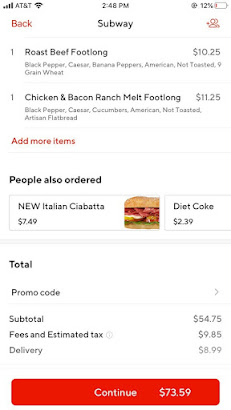
The Pricey Fees of DoorDash per order

     It may benefit the restaurant more to order directly from them when possible. Ordering for pickup ensures all the profits go directly to the restaurant and its team. There are cases too of restaurants using DoorDash and other delivery apps running into a wide array of problems, one being some restaurants have received orders when they aren’t using the service. Other issues include specific experiences that illustrate employees or delivery drivers having to waste their own time sometimes with canceled orders and getting slighted on tips since there is no check. DoorDash isn’t blind to the fact that they were experiencing a profit explosion during the pandemic when restaurant dining, churches, and workplaces were shut down. They knowingly enter these partnerships with the bottom line being that their investment will benefit their company and ultimately choke out the restaurants.

    The rise of complaints from restaurateurs eventually attracted the attention of the state and local governments. They noticed the business growth and power expansion of DoorDash and other delivery companies, who gradually became the key part of society, along with the pricey fees set up for restaurant owners and customers, had negatively impacted the market. Hence, many city governments such as San Francisco and New York enacted the commission caps that DoorDash could charge the restaurant as the highest as 15% and 23%, respectively (WSJ). Consequently, DoorDash had to face 32 commission caps from several city governments in August 2020, and at the end of the year, the number of caps increased to 73. They also conducted many investigations about DoorDash's business activities. In September 2020, three members of Congress asked the Federal Trade Commission for an investigation due to the concern about DoorDash business (NBC News). The Chicago investigation revealed that many restaurant owners reported finding their restaurant's menu and advertisement on the DoorDash app without their consent. Although DoorDash had removed it from their platform after the calling, the owners said that this experience still upset them since this incident could harm their reputation to customers. On August 27, 2021, Chicago sued DoorDash for deceiving customers and unfair practices toward restaurants (CNBC).

Timeline of the case 

STAKEHOLDERS

    In this case, the stakeholders include DoorDash company, the restaurateurs that allied with its app, the customers who used its service, and the regulators. The pandemic was perfect timing for DoorDash to grow its business and earn more profits. It was proven by the company's $32 million in profit in the first quarter of 2020. However, due to the competition with other two major delivery companies, UberEats, and Grubhub, in the food delivery market through marketing, DoorDash was still in debt. Therefore, instead of maintaining a good relationship with the restaurants and customers, DoorDash decided to exploit them by charging high fees (10% to 30%) and adding an additional fee. This led to the enactment of the caps from city governments later, which reduced the company's order volume and ended up with the loss of $355 million in the third and fourth quarters of 2020. Moreover, DoorDash also had to face a lawsuit from the city government, which accused it of deceiving customers and unfair practices toward restaurants. The restaurant side, such as Boom Wanvisa and Roni Mazumdar, who was supposed to be supported by Doordash to survive and thrive through this period like what it said in the mission statement, struggled to cover the pricey fees from DoorDash. Although DoorDash helped them maintain their restaurant business when the Stay-at-Home order was enacted throughout the country, they barely survived with these high commissions and expensive service fees and generated almost no financial profit. They fell into a disadvantage when the choice was limited to either depending on delivery service from the third party or closing the business. It was tough to find independent drivers willing to work with the local restaurants since most of them had already joined delivery platforms like DoorDash. Also, the restaurateurs were not able to deliver all the orders in the wide range. Furthermore, DoorDash also used unfair business practices by advertising and selling their menu without their consent or arbitrarily adding their restaurant into the DashPass service to charge a higher rate. Consequently, the pricey fees that DoorDash applied to the restaurants forced them to raise their menu price, which led to the effect on the customer side, another stakeholder. The customers now had to pay a higher price for the same order they had before the outbreak of pandemics, such as the $14 avocado toast now increased to $19.40 in the Grand Lake Kitchen example. The price per order that the customer needed to pay kept rising after the regulators enacted the commission and service fees caps in many cities that restricted the cost DoorDash could charge the restaurant. DoorDash charged the customers an additional Regulatory Response Fee per order to make up for these losses from the caps. The regulators from several city governments such as Denver, New York, and Chicago, decided to get involved after noticing the unacceptable commissions and service fees rate that DoorDash set up. They restrict it by establishing the fees caps and doing many investigating about DoorDash. However, after passing the caps, some city governments also got sued by the company.

DoorDash's Pricey Fees during the Pandemic
INDIVIDUALISM

    Individualism's view of this situation overall would say that it is unethical and impermissible, which is hurting the company. The theory behind individualism is to maximize profits for the stockholders within the law. DoorDash was doing all these unethical doings against the law because they wanted to maximize the profits for their stockholders. But at the same time, tarnishing their reputation with their customers and drivers. Which is bad for business and will reflect on mass profits. There will be a harder time finding drivers since now drivers want to go join the competition and get a better pay. They’re going to be losing customers as customers will see them as cheaters and liars. No one wants to pay extra for things that are cheap. They’re going to be paying lawsuits, which is going to bring money out of their pockets. When you have millions of people who are investing in your company. At the end of the day, you want to win for them. DoorDash went exactly against that when they decided to do these unethical doings.

    The DoorDash lawsuit was classified as a class-action lawsuit, which permits one or more plaintiffs to file and prosecute a lawsuit on behalf of a larger group which in this case was the drivers. DoorDash agreed to a 100-million-dollar settlement for Massachusetts and California drivers. Door dash shares recently soared as the company bought a brand-new food delivery startup, Wolt Enterprises, for 8 billion. So even with all the controversies, they remain the top dog in the food delivery system.


UTILITARIANISM

    A utilitarian view of this situation overall would say it is unethical and impermissible. The theory behind Utilitarianism is to Maximize happiness for yourself and others in both the long term and short term. Happiness is defined as pleasure and is the only thing of intrinsic value. The reason that this situation would be viewed as impermissible is because it does not benefit the majority of the people. In fact, the majority of people in this situation are upset, which would be the opposite of the goals of utilitarianism. That’s because when DoorDash steals tip money, it only benefits the company. The majority of people (customers and drivers) will be unhappy. The only way this controversy could be seen as permissible is if it was being viewed strictly from the point of view of the company. That’s because everyone within the company will be happy that revenue is increasing. Therefore, a utilitarian would see that the majority is happy and say it is a permissible action. When the controversy is viewed from a larger overall perspective, it is clear that the majority of people are not happy and it’s impermissible. The drivers are unhappy throughout the entire controversy because they’re losing out on money that they believe they deserve. The customers are unhappy with the controversy as well because their money is not being given to the people it was intended for. The handling of the controversy by CEO Tony Xu would also be viewed as unethical. Tony Xu claimed he had a new payment model that would be implemented yet many drivers say the model was unchanged and the complaints never stopped. Therefore Xu’s actions lead to the majority of people in the situation being unhappy and would be viewed as impermissible by a utilitarian.


KANTIANISM

    Kantianism has four basic principles. The first principle is to act rationally, which means acting consistently and not considering yourself exempt from the rule. Secondly, allow and help people to make rational decisions. The next principle is respecting all autonomous beings, and the last one is motivated by good will, which is the only thing that is truly under our control (Salazar, 5). To determine if the action is permissible or impermissible, Kantian uses the formulas of the Categorical Imperative. "An imperative is a command or duty; categorical means that it is without exception" (DesJardins, 38). When we analyze the DoorDash case under Kantianism's view, we see that the actions of Doordash are strongly impermissible.

    First, let's analyze it under the Formula of Universal Law. The Formula of Universal Law focuses on Kantianism's first principle that does not consider yourself exempt from the rule. "Act only according to that maxim whereby you can at the same time will that it should become a universal law" (Salazar, 7). Under the Formula of Universal Law, we first need to create a Maxim-for-Action statement, which tells people what you are going to do to achieve what purpose, and then universalize this statement to see if it can answer the question "Is it possible for everyone to do it?". If the answer is yes, then it means the action is consistent and permissible. In this case, DoorDash said it charged a higher rate of commissions and service fees to cover the expensive operating cost and maintain its business during the pandemic. If we use this as a Maxim-for-Action statement and universalize it to "Everyone charged a higher rate of commissions and service fees to cover the expensive operating cost and maintain their business during the pandemic," I believe that this is an impossible thing to do universally. Let's say if every business starts to increase the fees they charge the others, the customers and partners will gradually not be able to buy the product from the market or pay the fees from the contract since they will run out of money. Without the cash inflow to the company, the owners do not have enough money to maintain the business. When there are no business activities, there is no operating cost to cover. Therefore, this maxim statement is contradictory and inconsistent, which also means impermissible.

    Secondly, if the actions of DoorDash are analyzed under the Formula of Humanity, I believe the result is still the same as the Formula of Universal Law, which is impermissible. This formula focuses on the third principle, which is respecting all autonomous beings. "Act in such a way that you treat humanity, whether in your own person or in the person of another, always at the same time as an end and never simply as a means" (Salazar, 9). According to this formula, humanity is the rational power of each individual and the only thing that is valuable in itself because rationality allows people to make decisions for themselves, to evaluate what is right and wrong, and determine their own person (Salazar, 9). Rationality cannot be possessed by others; therefore, we must respect others' rationality and treat them as an end, never as a mere means, including yourself. However, DoorDash took away the rational power of its customers and the restaurant partners in the case. It took advantage of the pandemic when people had to rely on its delivery service to exploit people. DoorDash knew that restaurants and customers had limited choices during the pandemic, so it set a high rate of commissions and service fees to make more profit for its company. This means DoorDash used other people as a means to achieve its own purpose, rather than an end, which is valuable in-itself. Another action of DoorDash showed that the company did not respect the rationality of others that it advertised and sold the food on the menu of some restaurants without the owners' consent. The company also arbitrarily added restaurants to the premium service DashPass, which would charge a higher rate of commissions and service fees than the regular membership. DoorDash never sent any message or letter about this to the restaurant owners, and they always had to figure it out by themselves. The company even deceived customers by placing a misleading name on a new fee after regulators enacted the caps. DoorDash did not respect people's ability to make rational decisions about things and also did not allow them to do it. Therefore, those actions could not be considered permissible and ethical actions.


VIRTUE THEORY

    Virtue theory’s bottom line is to achieve fulfillment or completeness and to become all that you can as a human being reaching full potential. People must incorporate strong values and virtues that can define them in their mannerisms and characteristics of life choices. Determining what are things purposes, exercising rationality in order to perform well whether it’s by yourself or with others. The more able one is to flourish with society the easier it is to feel complete and achieve fulfillment. Business goals are flattened if character traits and virtues are not up to the trends and likings of society. The monopolistic capital culture in today's world has made ethical thinking a brush over concept in the business world because their end goal is always consistent in making money. DoorDash isn’t just in the hot seat for falsely entering business partnerships under the preconceived notion of automatic benefit, but also their failure to exercise temperance, courage, honesty, and justice. Without fulfilling these requirements, DoorDash is labeled as a cash grab company only in pursuit of their own goals and by any means. They are cowards in their deception to hardworking and struggling restaurants who are desperate for more traffic that their new partnership will help the place get out of debt and into better days, but we know that isn’t the case. In the honesty department, they have none, DoorDash is supposed to be a partner but is actually costing its partners money that they don’t have. This trend is continuous and they fail to improve margins for restaurants or even improve pay for drivers, they continue to practice their methods which evaporates their temperance hope. Justice wise and making sure everything is morally right they failed to acknowledge drivers as independent contractors and were forced to give out over 3.5 million dollars. Basic legislation is completely undermined because they’re motivated by money. DoorDash is completely unethical in their operations with other restaurants, they take more than they give but disguise their agreement as a way to drive more traffic to their app and less to the businesses who actually make the food.

    Virtue theory isn’t just based around getting a good or likable outcome, but acting in such a way that is morally good and the way a person should be. Doordash should be paying drivers a much higher rate due to the personal labor involved and having a history of network crashing, drivers not being paid, and other violations of hiring. The bosses should be conversing about the possible ways they can still operate doing financially profitable things but they must be permissible in that they are inherently good and they should be good because their duty is to provide quality service while performing the duties of being a good employer as well. Bosses should want to lead by example because they are leaders by the structural design of position hierarchy and in turn should hold the highest of responsibilities and furthermore an elitely positive perspective for their employees to admire and mirror, which results in better productivity. Doordash’s deliberate negligence to provide a more established work contract with its drivers, as well as their failure to inform their partner restaurants without deviation, the specific benefits each company gains during the deal and if beneficial at all. Restaurants deserve to be told that the venture they think will help drive more traffic to their store and boost their revenue but in the end of it all this agreement will actually end up costing them money putting these restaurants in a loss. The ethical thinking to this company and their current business arrangements is solely on gaining the most by any means possible with no regard for external consequences.


ACTION PLAN

    For the step by step plan, first and foremost, Doordash needs to clearly state business deals between partner restaurants, which means fees, upfront costs, and other expenses that may arise from the partnership, what will the restaurants get out of being partners with them. Their service is built on voluntary private employees delivering food and that’s a fulfilled order. They should have a system so that delivery drivers should be given the chance to see exactly how much they are going to make from a delivery. Another area of improvement that would seem effective thing they can do DoorDash can reduce the marketing costs, they can be more profitable if they go back on the advertising and promotional aspects so that they can then have more fair deals with other businesses but still turnout a profit, DoorDash is a very renowned company mostly because it’s in a private delivery service market that isn’t very saturated.

    DoorDash said in its mission statement: "At DoorDash, we’re working to empower local communities and in turn, creating new ways for people to earn, work, and thrive." For a company to work more efficiently and effectively, a clear and meaningful mission statement is important. It is not only guiding the employees to do work and understand the goal of their jobs but also showing the customers and partners the promise and value that DoorDash can bring to them in the long term. The current mission statement of DoorDash is not a bad statement; however, this is not clear and good enough. Therefore, we suggest DoorDash's new mission statement, which is built based on its original one: “To empower local restaurants to be able to reach and serve customers regardless of their demographics and commitment in terms of respect, fairness, and honesty for everyone.” We believe this new statement still sticks with the original values and goals of the company but also provides the company with a clearer path for DoorDash to achieve its mission ethically. This mission statement differs from the original statement, which includes that all customers should be served regardless of their demographics. This shows the guarantee that the availability of good food can reach all the communities that it’s a part of and not only select areas. Besides that, DoorDash also ensures that they will do this mission based on respect, fairness, and honesty, which can benefit everyone and prevent wrongdoing from happening again in the future.

    Core values:
  • Trustworthy - To build a strong and long-lasting relationship, DoorDash needs to gain the trust of its partners and customers. In the business world, positive relationships with partners and customers are one of the important things that can help one business to be able to grow and prosper in the long run. Therefore, the company has to guarantee its trustworthy value to others which can keep people stay with them.
  • Respect - A good and ethical business is one that respects the decisions of others. When the restaurateurs have respect from DoorDash, they will have the feeling that they are a part of the great business and want to cooperate and stick with it more, which can bring benefits to both sides. Also, by respecting people, DoorDash shows that it treasures customer value, which helps it gain more new customers and build loyalty in old ones.
  • Fairness - In order for the company to flourish and be sustainable in the long run, DoorDash needs to ensure fairness in its business practices toward people, including its partners and customers. The company's action has to align with this value since it can encourage and enhance respect and trust between DoorDash and others.

    After establishing a new mission statement and having a set of core values, DoorDash needs to make sure that it can successfully implement and follow them. Therefore, new systems and policies are required in the company to prevent the problem from happening again in the future. Firstly, DoorDash needs to state clearly how much fee and commission it will charge the restaurants and for what reason when they agree to join DoorDash's service on the contract. If necessary, a third party may be involved in the contract to ensure fairness between restaurants regardless of the size or location. Secondly, DoorDash can train a professional team that works directly with the partners, who will listen to the problems from the other side, consult and guide new partners that currently join the service, and deal with the controversy during the business in time. Besides that, DoorDash can also hire skillful managers to manage the company's finances and create reasonable spending plans to avoid the loss that leads to an increase in service fees.

    Doordash is a marketing leader in the food delivery industry as a private external third party. Their modus operandi is finding the cheapest route to profitability and that included skimming drivers and cloaking their business proposals as all profitable when they already understood the preconceived assumption which was that they’d make way more than their partnership restaurants would. The framework of approach to partnering should be remodeled, in that Doordash must not shield any information that the restaurants ought to know prior to signing an agreement. There is however the idea that altering their current practices to something new and most likely less valuable, but that isn’t the case. Doordash can still make a substantial profit if they’re open to new concepts of working. Doordash can grow their delivery business into a flourishing new restaurant of its own, building the franchise, establishing a physical store for consumers to have a closer relationship with the brand instead of the quick exchange DoorDash has with their target market over the phone. Opening a location that is an actual kitchen of its own will create a long-lasting role in whichever metropolitan city is chosen, which will greatly benefit the company because people love new gags. Another avenue DoorDash can take is, pursuing more major sponsoring deals for sports teams or other sport-themed restaurants. Buffalo Wild Wings or Bdubs as its most commonly known, is a very popular chain of restaurants who doesn't deliver but has decked our locations with flat screens of sporting events and games and excellent food. a vast majority of people would rather watch the game from the comfort of their own home. If Doordash was listed as a sponsor of BWW, on commercials, or even if we have a little signage next to theirs, then consumers would order from BWW using the DoorDash service because they know they can access BWW food without having to go out. This would make Doordash synonymous with BWW and associating popular brands and crossovers are almost always profitable. This will also help with Doordashes ethical thinking, because a partnership with BWW will have to be mutually agreeable and open, so Doordash has to learn how to cooperate correctly with outside businesses or partners. This practice of cooperation and good faith in partnership will rub off into their employing techniques, hopefully improving the system in which drivers work and giving more promotional chances and the ability to work for them for good pay. Happy employees will improve productivity resulting in an improvement in their public reputation thus improving their franchise building efforts.


Sean Lanzillo, Tram Lu, Jake Chiasson, Lesly Theodore


References

ConsumerGravity.com, 2021, “Is DoorDash Bad For Restaurants in 2021?”  

    Is DoorDash Bad For Restaurants in 2021? (consumergravity.com)

Dwyer, Ben. CardFellow Credit Card Processing Blog. April 6, 2020, “Is the DoorDash Delivery App a Good Choice for Your 

    Restaurant?” https://www.cardfellow.com/blog/doordash-for-restaurants/

Farivar, Cyrus. March 28, 2021. “DoorDash pushes back against fee delivery commissions with new charges." NBC News. 

    https://www.nbcnews.com/tech/tech-news/doordash-pushes-back-against-fee-delivery-commissions-new-charges-n1262088

Feiner, Lauren. August 27, 2021. “Chicago sues DoorDash, Grubhub for allegedly deceiving customers.”  CNBC. 

    https://www.cnbc.com/2021/08/27/chicago-sues-doordash-grubhub-for-allegedly-deceiving-customers.html

Huet, Ellen. December 8, 2020. “DoorDash, Chasing $3 Billion IPO, Is a Powerful Ally and Foe to Restaurants.” Bloomberg.   

    https://www.bloomberg.com/news/articles/2020-12-08/dash-ipo-doordash-is-a-power ful-ally-and-foe-to-restaurants

Rader, Doyle, Forbes, June 21, 2020, How DoorDash's Partnership With The Dallas Mavericks Is Supporting Local Restaurants, 

    https://www.forbes.com/sites/doylerader/2020/03/29/doordash-dallas-mavericks-partnership-coronavirus-response-support-local-restaurants/?sh=19bf3ea225ab

Russell, Nicole. May 17, 2021, “Are DoorDash, Uber Eats, and Grubhub hurting restaurants? Chef Andrew Gruel says yes,” MSN.com 

    https://www.msn.com/en-us/travel/tips/are-doordash-uber-eats-and-grubhub-hurting-restaurants-chef-andrew-gruel-says-yes/ar-BB1gP0HF

WallStreetZen. November 13, 2021, “NYSE: DASH DoorDash Inc Statistics & Facts.” DoorDash Statistics-DoorDash Facts, Stats, Trends & Data (2021) | WallStreetZen

DesJardins, Joseph. An Introduction to Business Ethics. New York City: The McGraw-Hill Companies Inc, 2014.

Salazar, Heather. Kantian Business Ethics. n.d.


Thursday, December 10, 2020

3M: Their Pandemic Failure (2020)

 3M: Their Unethical Pandemic Failure (2020)

3M Company is one of the world leaders in producing N95 masks, the masks that are in very high demand due to the pandemic. The Corona Virus forced 3M to double their global production of N95 masks in response to fight this airborne disease. Before the pandemic, an N95 mask costed $1.25 on pharmacy shelves, then increased to as high as $8 at the height of the pandemic, which led to many questions regarding price gauging. 3M was failing to hold their resellers accountable for jacking up prices during an emergency, these actions benefitted stakeholders such as the investors and the resellers while it hurt customers in need of these masks. Individualism is the business ethics theory that says business actions should maximize profits for the owners of a business, but do so within the law, an individualist would say 3M was acting ethically by maximizing profits for busines owners. Utilitarianism requires that business actions should aim to maximize the happiness of all beings, from this point of view 3M acted unethically by failing to maximize happiness of customers allowing high prices. Kantianism values rational decision making, the autonomy of individuals, and honesty. From a Kantian perspective, 3M was unethical by using the customers as a means to an end. Virtue theorists care more about the character of an individual or company more than anything else and follow the four cardinal virtues of prudence, justice, courage, and temperance, under this theory 3M did not act ethical. In my opinion, 3M did not act ethical and failed to act for many individuals in a time of need. Many will say it is the resellers fault, but taking actions such as distributing the masks themselves or holding resellers accountable could have helped the situation. 3M should first focus on being honest with the public and then handle the distribution to diffuse the situation.

Ethics Case Controversy 

3M N95 Mask 
3M Company started in 1902 in Two Harbors, Minnesota, starting out as a mining company, but over the years started shifting their focus more to scientific products. They are a manufacturer, developer, and supplier of many products worldwide, but they have recently been in the news for their involvement in the worker safety and US health care realm. For many years 3M has been a worldwide leader in medical and surgical supplies along with the equipment needed in these health care areas. Since the company works with health, they quickly became a very important piece in controlling the SARS-CoV-2 virus also known as the Corona Virus (COVID-19). 

Their major contribution to the virus is the manufacturing of N95 masks, which are referred to by health experts as the most effective mask for fighting the virus. These masks prior to the pandemic were mainly used by health workers in hospitals and other offices around the world. Certainly, there are other companies that manufacture these N95 masks, but 3M is the world leader in manufacturing and distributing these masks throughout the United States as well as to other parts of the world including Canada and Latin America. The company is heavily relied upon by many big corporations and of course hospitals to have their equipment ready and easily accessible for use. 

Companies that deal with scientific and medical equipment typically stay out of the public eye and avoid any type of pressure from the media, that is until there is a worldwide pandemic and people’s lives are at stake. 3M company does not have a squeaky-clean record as they were sued by the state of Minnesota in 2018 for acting negligently and polluting groundwater with damaging compounds after their own study in 1970 showed that they would harm the environment (The Intercept). 3M eventually settled the suit for $850 million and admitted to covering up their findings and acting negligently, as you will see in the upcoming case, it is evident that 3M has not learned their lesson from just two years ago.

            On March 11, 2020 the World Health Organization (WHO) declared the novel coronavirus outbreak a global pandemic. On March 13, 2020 President Donald Trump declared a national emergency and left the nation questioning what was going to come next. Around this time most of the world was introduced to Anthony Fauci, the director of the National Institute of Allergy and Infectious Diseases, and he, along with the Centers for Disease Control (CDC) started telling the public to wear a mask to fight this airborne disease. While all of this was going on, 3M was starting to ramp up their N95 mask production in anticipation of a major uptick in sales. 3M doubled its global production of N95 masks to about 100 million a month and projected to produce 2 billion within 12 months (CNBC). 

            While many people were starting to look for these N95 masks due to their high demand, they started to notice a very big jump in price and people started accusing 3M of price gauging. Before the pandemic, a N95 mask could be bought at pharmacies for $1.25 and at the height of the pandemic were going for $8 a mask. Local laws may have their own rules and regulations on price gauging but for example California law “prohibits raising the price of many consumer goods and services by more than 10% after an emergency has been declared” (State of California Department of Justice). The masks being sold on the shelves saw over a 600% increase on prices and way over most price gauging laws. It seems like it would be a no brainer to accuse 3M of price gauging in this scenario but the truth is they aren’t directly on the hook for it. 3M sells their masks through a network of resellers who then are just trying to maximize their profits and have no obligation to sell to hospitals or people in health care. 

Mark Cuban, Billionaire Dallas Mavericks Owner
            Mark Cuban, the 61-year-old billionaire and star on ABC’s Shark Tank, started to do his part at the beginning of the pandemic by trying to get hospital workers more protective equipment. Cuban was working with a non-profit group when he noticed the spike in prices and couldn’t hold his tongue as he said in an interview, “3M lists all its distributors online, the ones buying and selling these things, and these distributors are making as much money as they possibly can. It’s wrong, it’s criminal.” (Bloomberg) The problem is not directly traced back to 3M, but they can easily stop this problem by holding these distributors much more accountable. 3M has not specifically raised their prices but the resellers have and keep requesting more quantities of masks so 3M isn’t going to complain, which is unethical. 

            A statement was released by a 3M representative when they started to face backlash and said that they have not changed their prices and can’t control the price the other retailers set for them. Many, including Cuban, responded with questions as to why they don’t distribute the masks themselves or approach the resellers and say “If you don’t sell the inventory to hospitals, we will never let you buy more of our product?” It was becoming evident that the profits coming in are more important to 3M than the major problem they could solve in our world. At the end of March, the 3M CEO Mike Roman said he was “disappointed” to see these N95 masks at retail stores rather than hospitals where they are necessary. (CNBC)

Stakeholders

            The stakeholders in the 3M case include the investors, the executive team, the resellers, and most importantly the customers. At the beginning of 2020, before the pandemic, 3M’s stock price was at $177 and in March when the Corona virus came to the US, 3M’s stock price fell to $117 (Bloomberg). Since then, the stock price started climbing back and investors must have been happy to see a resurgence, but it is safe to say that these investors are affected by the business. The executive team with CEO Mike Roman along with many other corporate officers have a lot at stake and need the company to succeed for their own business careers. The resellers of the masks are also certainly at stake here because if 3M decided they did not like what they were listing the masks for they would lose a lot of business. And most importantly the customers because these are the ones who need these masks during very difficult times especially hospital workers. If the prices keep raising and these workers cannot receive these masks, they are at an even higher risk of contracting the virus. 

Individualism

            Individualism is the business ethics theory that says business actions should maximize profits for the owners of a business, but do so within the law (Salazar 17). The Father of Economics Adam Smith first developed this theory and then it was Milton Freidman who said that it is the aim and responsibility of business to maximize their profits. Many people believe this theory to be a selfish one and in response to that Milton Freidman says “Managers are ethically obliged to maximize profits” (Desjardins 54). The other ethical theories can be more generally compared to life context but this theory is specifically related to business and Freidman says if you are not trying to maximize profits you are acting unethically. 

            In the 3M case, an individualist would say that they were acting ethically and did nothing wrong. 3M focused on their profits more than anything else and put their self-interest above all, they did all of this within the law so it fits in with this business ethics theory. By ramping up their production of masks during the pandemic and giving them to resellers, they were maximizing profits for the stockholders. Even though the resellers were price gauging the masks and 3M had the opportunity to stop them and avoid the situation they chose the profits. This theory values the business, the owner’s choices, and the business profits, there is no better case to describe this theory than the 3M case.

Utilitarianism

            Utilitarianisms ethical rule is that “business actions should aim to maximize the happiness in the long run for all conscious beings that are affected by the business action” (Salazar 19). Utilitarianism can look at life decisions and effects which differs from individualisms strict business context. “Utilitarianism tells us that we can determine the ethical significance of any action by looking to the consequences of that act” (Desjardins 29). By simply evaluating a decision and seeing if the decision maximized happiness for everyone involved you can figure out utilitarian business ethics. Utilitarianism aims to maximize happiness for everyone not just business owners like individualism, so there are more stakeholders that need to be looked at when examining utilitarian business ethics. Utilitarianism takes on a stakeholder approach while the individualist model takes on a stockholder approach. 

            In the 3M case, from a utilitarian’s point of view, the company fails to maximize happiness in all beings. The business owners, as mentioned in the individualism section, all profited from the resellers price gauging and 3M’s failure to stop them. Their happiness was maximized by making profits and having no repercussions for their failure to act. The stockholders were certainly happy as well after they saw a bounce back in the company’s stock price once all these masks started to get distributed. The only ones who were left unhappy were the customers who were not able to obtain these N95 masks because of ridiculously high pricing. The hospitals and millions of health care workers around the world were left unhappy due to the decision made by 3M to not act on their reseller’s decisions. Due to the customers being unhappy, a utilitarian would say that 3M acted unethical.

Kantianism

            Kantianism values rational decision making, the autonomy of individuals, and honesty. Immanuel Kant believes that it is wrong to manipulate, exploit, or use people, and he believes this is wrong all the time. These values are portrayed through the formula of humanity which states that you don’t use people as means but rather as ends in themselves, to me this means do not take advantage of anyone or see them/use them as simply an object. Utilitarian’s say the end justifies the means to get there, Kantian says the means are the most important no matter the outcome. Kant says that no matter what you should not lie, cheat, or harm others just to get your way, instead, you should be honest with all parties and get rational consent. (Salazar 20)

            3M put their customers in a very tough spot when they allowed resellers to raise prices so high that it is hard to get a mask. In the middle of a pandemic where masks are mandated in several parts of the country, the company saw an opportunity and used the people as a mean. If 3M wanted to treat the customers and everyone else involved and treat them as an end rather than a mean they would have ensured prices would stay a fair amount. A quote from Heather Salazar’s The Case Manual sums it up perfectly when she says “They will not attempt to manipulate or exploit employees or consumers, but rather they will attempt to work together with others to create products and services that anyone can agree make good choices available in the marketplace.” If you support Kantian business ethics, you would say that what 3M did is unethical based off of the standards of Kantianism. The customers were exploited and nobody deserves to be treated like they were. 

Virtue Theory

            A virtue theorist cares more about the character of an individual than anything else. A person who believes in this ethical theory values traits that promote the wellness of individuals within a society (Salazar 22). To follow the ethical theory, you must follow through with good character traits and avoid those traits that are considered bad. This theory differs from the previous three ethical theories because virtue theory does not specifically look at the action of an individual or company, rather they analyze a person’s character. To see if a person or company was acting ethically by the virtue theory, we must examine if they were following the four cardinal virtues which are prudence, justice, courage, and temperance. 

            Prudence is thinking about things from your future self’s perspective and being cautious in your character, when 3M decided to not stop resellers from price gauging their masks they were not looking ahead and thinking about the impact it could have on them in the future. Justice is about practicing empathy and truthfulness; 3M was truthful throughout the process and never lied but could have done a better job showing empathy for the millions of people in need of the masks. Courage is the ability to say yes to the right things and no to the wrong things no matter what and the company failed to do so by their lack of action. Lastly, temperance is self-restraint and the ability to control yourself, something the company directly couldn’t do with their mask distribution tactics. A virtue theorist would say that 3M did not act ethically because it failed to meet the cardinal virtues, you can’t have one of the cardinal virtues without the others and the company had none of them. 

Justified Ethics Evaluation

            In my opinion, 3M acted unethically and could have done something to avoid this whole situation. Obviously, price gauging is a serious situation and there are opportunities to increase profits but in the midst of a global pandemic and serious emergency is not the time to turn a blind eye to it. The obvious objection to my opinion will be that 3M was not the company who was changing the prices and that they could not control it. Although a portion of the statement is true and they were not the ones price gauging, they could have been stepped in as the supplier and put a halt to it. The only way 3M acted ethically was by maximizing profits for business owners and doing so within the law, besides that there were many actions taken by the company that had a negative impact on others.

            It is hard to say whether other companies would have acted the same way in this situation, but it is very possible that it could happen again because the draw for money is so strong. Price gauging is not the most uncommon business action this scenario was just so unique with the pandemic and resellers involved. Hopefully we do not have a similar story like this along with a global pandemic anytime soon, but it is something to keep an eye out for with other companies as the virus is not completely gone yet. 

Action Plan

            In this case, the problem at hand is that 3M did not decide to stop the price gauging of their resellers when they had the opportunity to. The company knows who they are selling to and what the resellers are marking up their prices at, but they failed to address it and only publicly made a statement when they faced backlash. To fix the issue that they have created for themselves, they can act upon a few steps to make everything better. First, the company needs to acknowledge that they knew the resellers were price gauging the masks and that they didn’t have a problem with it because they were making money, that would be 3M telling the truth. Instead, they argued that they cannot stop resellers from raising prices and that it is out of their hands, which leads to the next step. Second, the company should handle their own distribution directly to most importantly hospitals and then other outlets such as pharmacies and health buildings. The CEO of 3M claimed to have been disappointed at the lack of their N95 masks in hospitals, but didn’t act to take matters into his own hands and have the company distribute themselves. And lastly, the company needs to force resellers to lower their prices and create an ultimatum of “If you don’t lower the prices, we will never do business with you again”, that would be the ethical thing to do in a time of crisis. 

            3M’s current mission statement is “3M is committed to actively contributing to sustainable development through environmental protection, social responsibility, and economic progress.” A new mission statement that could guide 3M better would be “3M is dedicated in providing customers with the best possible product or service no matter the circumstances”. This new mission statement would embody what the company needs to stand for especially in a time of need. This mission statement focuses more on the company’s character and promotes core values such as integrity, honestly, loyalty, and reliability. These core values ensure customers that they can trust 3M no matter the situation or circumstance they may find themselves in. 

            In the future, I believe that if a situation were to arise similar to this one, the CEO should be held accountable by other employees to do the right thing. There does not have to be extra training or new hires involved to fix this situation, just a better understanding of what is at stake and how important it is to help others when you have the ability and power to. The bad publicity was the only reason 3M made a statement and, in the future, they should practice good ethics by having their public relations make a statement before anyone else and be honest about the problem and their handling of it. This plan aims to better business relations with future customers and partners, along with maximizing profits within the law and not cutting any corners. 

3M Controversy Timeline

Graham Topor

References

Lerner, Sharon. “3M Knew About the Dangers of PFOA and PFOS Decades Ago, Internal Documents Show.” The Intercept, 31 July 2018, theintercept.com/2018/07/31/3m-pfas-minnesota-pfoa-pfos/. 

“3M Company (MMM) Company Profile & Facts.” Yahoo! Finance, Yahoo!, 20 Nov. 2020, finance.yahoo.com/quote/MMM/profile?ltr=1. 

Deb, et al. “N95 Mask: 14 Things You Need To Know Before Buying.” Terry Cralle, 31 Oct. 2020, www.terrycralle.com/n95-mask/. 

“3M CEO: 'Disappointing' to See N95 Respirator Masks at Retail Stores Instead of Hospitals.” CNBC, CNBC, 23 Mar. 2020, www.cnbc.com/2020/03/23/coronavirus-3m-ceo-says-its-disappointing-to-see-n95s-at-stores.html. 

Chappell, Bill. “Slammed By Trump, 3M Says N95 Mask Exports From U.S. Should Continue.” NPR, NPR, 3 Apr. 2020, www.npr.org/sections/coronavirus-live-updates/2020/04/03/826629472/slammed-by-trump-3m-says-n95-mask-exports-from-u-s-should-continue. 

“Mark Cuban Aiding in Pandemic.” Bloomberg.com, Bloomberg, www.bloomberg.com/news/articles/2020-03-28/mark-cuban-aiding-mask-effort-says-3m-fails-to-stop-profiteers. 

“FAQs on Price Gouging.” State of California - Department of Justice - Office of the Attorney General, 8 Apr. 2020, oag.ca.gov/consumers/pricegougingduringdisasters. 

Monday, November 30, 2020

(Amazon) vs. Third Party Sellers Price Gouging (2020)


Amazon was founded in 1994 in Bellevue, WA. Amazon has a current net worth of more than $1.7 trillion dollars. Amazon is known for offering millions of products, and thousands of “trusted” third-party sellers offering more the 350 million products. Amazon had begun to notice third-party sellers were price gouging certain products that were in high demand due to the pandemic and other sellers scamming customers who were looking for products to help prevent, fight, and even cure the Coronavirus. 

This case study analyzes the behavior and action of the third-party sellers and if Amazons action were ethical or not using the four ethical theories Individualism, Kantianism, Utilitarianism, and the four cardinals of Virtue theory. In the ethical theory of Individualism under both Milton Friedman and Tibor Machan Amazon’s action against third-party sellers pass their ethical perspective since the third-party sellers are not profiting within the law of the land and not profiting met by indirect goals not aiming at profiting; respectively. Utilitarianism focuses on maximizing happiness in yourself and others and because third party sellers are taking advantage of amazon’s platform and customers by manipulating, lying, and scamming. In result, Utilitarianism would side with Amazon and their decision. Kantian’s basic principles include being rational and of goodwill and since these third-party sellers were not being rational and of goodwill by doing what is right because it is the right thing to do Amazon’s decision to suspend and remove third party sellers from their platform was morally permissible. Virtue theory includes courage, honesty, justice, and temperance. Amazon had the courage to come forth and rectify the situation by suspending as well as removing the third-party sellers from the platform. Third party companies that were selling products claiming it can cure or prevent COVID-19 were not being honest. Amazon was being honest because they are exposing the fake products sold by third party sellers on their platform. The justice was unjust for those accounts that were able to get around the policies or able to appeal the decision for being suspended or removed from the platform. Temperance includes what it means to be reasonable. When you are being in good faith of the customer by selling them products at an appropriate price including, products that do what they are designed to do then you are being temperate. Since the third-party sellers fail in both situations, Amazon’s response was reasonable and because they acted within temperance they are seen as a virtuous company. 

 Ethics Case Controversy 

$75.5 Billion in revenue Amazon made in their first quarter of 2020. During that first quarter, a global outbreak called Coronavirus 2019 had made its way into the United States. The virus alone had begun to spread rapidly infecting millions of people. People were not prepared for this type of situation or even how to handle it. The United States Government caused the American people to panic. The United States government began to shut down cities, towns, and all nonessential businesses such as, malls, salons, movie theatres and restaurants. People were believing that stores would then shut down because this virus was becoming uncontrollable and the fact that this virus can spread through the air (airborne) really scared people. Grocery stores had soon become limited on products because people had begun overloading on food, household supplies and many other things so they can quarantine. Quarantining is when you isolate yourself in your home for a period of time. In result, there had become shortages on food, house hold supplies, cleaning supplies and many other items. With the demand of these items that people could not find in stores, people were turning to the internet for the necessities. 

Over priced hand sanitizer

Amazon, a place where you can find everything for a decent price or even cheaper than instore had begun to see an increase in price for certain products. The demand for N-95 mask, hand sanitizer, disinfecting wipes, and many other products that will help protect you from the virus had now become impossible to find. Amazon had begun seeing third parties who sell the particular items such as N-95 mask, hand sanitizer, disinfecting wipes and latex gloves raise their prices as much as 3-4x times or more than what it cost a month ago. Some face mask was being sold for $195.00 compared to original prices at $24.99 for a 20 box of them. Hand sanitizer was another price gouged product in which the original cost varies between $20.87 and $35.00 to astronomical price of $79.99 to $129.99 for 2-liter bottles of named brand hand sanitizers. 

Price gouging is when a seller attempts to take advantage of the customer by selling them something more than 20% of what the original cost was because of a disaster such as the pandemic and the demand for the product is higher than usual. Price gouging laws vary by state some may not have price gouging laws at all but when a state governor declares a state of emergency the enactment of the price gouging laws go into effect immediately.

Price gouging face mask

When the CDC had then posted guidelines about how to protect yourself from the virus. Some of the most important part of the guidelines the CDC put out were to avoid close contact with others, wash your hands constantly, use and carry hand sanitizer, wear a face mask in public and at work. Keeping a safe distance of six feet between yourself and others. Cleaning surfaces before and after you touch them by using disinfecting wipes will also help kill the bacteria within the virus. The most important thing a person can do as well is to monitor your health daily and compare your symptoms as to what the COVID symptoms are. On the CDC website it states, “Avoid touching your eyes, nose and mouth with unwashed hands”. The CDC stands for Center for Disease Control and Prevention. The CDC is the nation’s health protection agency; they help save lives and as well protect people’s lives from health threats. The CDC is also funded by the U.S congress with annual budget of $11.1 billion a year.

Amazon a company that makes an average $638.1 million dollars were called on by the U.S senators and the attorney general to act against these third-party companies. 

Amazon than begun to implement stronger policies, that will help prevent these-party sellers from taking advantage of customers during a pandemic. Amazon had begun to ban and suspend certain third parties that were price gouging the high in demand products. Amazon had sent out messages to more than 3,900 third-party sellers informing them that they are being banned for what they are doing or have done that now goes against a new policy called “Fair pricing policy. “Amazon defines their “fair pricing policy” as sellers need to be responsible for setting their own prices, “setting a price on a product or service that is significantly higher than recent prices offered on or off Amazon”. Violating any part of the fair pricing policy may result in Amazon’s ability to remove the buy box, offer, suspend the account, or even terminating the seller’s account. 

Amazon has also removed third party companies that were selling fake products that had claimed it could prevent the virus or even cure COVID-19. Amazon had begun to crack down on these third-party companies removing tens of thousands of items due too false claims about a product and price gouged products. The reason why Amazon has implemented the fair pricing policy is to protect the customer’s trust in fair pricing of products and that they shouldn’t be paying for a product that is higher than what it did cost prior to the increase of demand for the product. 

            Amazon has been targeting these third-party businesses since the beginning of the outbreak and because they could harm the trust of its customers and when their company is on the line of being known to sell fake products and go against laws that enactment of price gouging laws it can damage their reputation and many customers will lose their trust in them and cancel their Amazon account. For instance, in result three companies Mobile Rush, EMC Group and Northwest- Lux were fined by a New York attorney for price gouging hand sanitizer’s and selling more than 1,000 units at prices that were 10% to 50% more than the original cost because the product was in high demand, they believed that they could charge customers because they think that they can and get away with it. 


Stakeholders

Amazon is the major stakeholder and because of the popularity that amazon does currently have it is more beneficial for amazon to do whatever is necessary to maintain a good image as a major cooperation. The next stakeholders are most definitely the customers because they are the ones that are being treated unfairly and being taken advantage of the third-party sellers. Third party sellers are the next ones who are stakeholders because they have something to lose especially having the ability to sell on amazon and if they lose their ability to sell on the platform them and Amazon will not be able to profit legitimately. There are also people who invest (stockholders) into the company and when a company is losing money because their reputation is on the line people will sell their stocks and go elsewhere which will in turn hurt Amazon.

Individualism

When analyzing this case under Milton Freidman’s individualism he expresses that “the only goal of business is to profit, so the only obligation that the business person has is to maximize profit for the owner or the stockholders within the law of the land”. (M. Freidman) Friedman’s theory is saying that when a business is profiting lawfully, they are doing it with in good faith, but if they are not maximizing profit within the law then they are going against the theory of Individualism. Laws that are set in place that become active in result of an emergency the theory of individualism applies to it as well because it is considered a law. When these third-party sellers begun price gouging their products by more than 10% than the original cost it was breaking price gouging laws. In Massachusetts for instance, “Selling any petroleum product” at an unconsciously high price during any market emergency” is considered price gouging and could result in “a civil penalty of $5,000 per violation.” In result to these third companies were being fined by the state they may have also lost their privileges to sell on Amazon’s marketplace. Amazon’s ability to stop the profit of those sales that were going against the price-gouging laws made this theory of individualism favor with Amazon. Individualism’s ethical theory would have disagreed if Amazon had not stopped these third-party sellers and allowed them both to profit while price-gouging their products.

Tibor Machan’s view on individualism differs from freedom’s ethical theory based on the fact that Friedman’s “is overly restrictive to business owners and sometimes limits long-term profits that enable owners to determine whether they want to spend money and resources in ways that will detract from profits” (Salazar 17). Machan’s views are more lenient and tend to favor the business side a little bit more but as long as they are doing it within the law. Even though Machan’s theory is less strict these third-party sellers are not operating within the law therefore Machan’s view would not approve of these companies’ behavior in price gouging their products and selling fake products.

Utilitarianism

            Maximizing happiness for in all that are involved is an important aspect of what it takes to operate a business that rely heavily on the support of consumer consumption. Transparency in between the business and its customers determine the success of the company’s ability to become successful. In the mist of this pandemic there have been many problems like businesses taking advantages of their customers by selling them overpriced necessities that help fight and protect themselves from contracting the virus. 

Third-party sellers have been taking advantage of amazon customers looking for last resorts of masks, hand sanitizers, latex gloves, and other things such as disinfecting wipes. So, many stores were cleaned out, but Amazon’s third-party sellers were able to get the product or even produce their own product for a higher price which really caused hurt and turmoil for people that really needed these products, and they were unable to afford them because these third-party sellers were selling them at top dollar. For instance, at one-point face masks in March of 2020 were being sold at $195.00 So, the question is whose happiness is really being maximized? is it just the sellers and not everyone because that would be egoism? According to the Ethical rule “business actions should aim to maximize the happiness in the long run for all conscious beings that are affected by the business action” (Salazar 17). 

When these third-party sellers had begun to raise their prices on products that customers really needed it had resulted in unhappy customers, the government, and Amazon. If the product had been sold at a normal price the seller would remain happy as they received a sale but the importance of this is the customer’s overall happiness. Another problem was that third party sellers were being untruthful to Amazon customers stating that their product could prevent or even cure the virus. In conclusion these third-party sellers did not seem to care about the happiness of its customers rather more focused on their own happiness by taking advantage of the customers and not caring about their happiness in regard to pricing of the product and fake product claims saying it may cure the virus. Therefore, third-party businesses did not aim to maximize the happiness of its customers long term because the businesses action was seen as going against the view of Utilitarianism. 

Kantianism-

            Kantianism is more modern of the ethical theories “it does not make decisions based on consequences, but rather on what Kant calls the Good Will” (Salazar 17). When applying Kantian’s Formula of Humanity, he states that you should “act in such a way that treat humanity, whether in your own person or in the person of another, always at the same time as an end and never simply as a means” (Kant, MM 429). What Kantian is trying to say that do not use someone to get what you want. Kantianism recognizes people as if they are valuable and says that if you use someone or something that is of value to get what you need or want then you are simply using them as a means. When applying the Kantian’s ethical theory to this case he would agree that these third-party sellers are using its customer’s a means by not telling the customer the truth regarding the products ability to cure the virus and in this case, they would not pass the test therefore they are impermissible. 

Kantian also goes further into detail and has four basic principles including being rational, not to be inconsistent or think you are exempt from the rules, also to guide others to make rational decisions, respect others and to be motivated by goodwill and to do what is right because it is the right thing to do. When Kantian analyzes this case, he applies his theories to evaluate an action and in the case of third-party sellers and their ability to respect the customers, as well as amazon’s platform by doing the right thing and that right thing is to not sell products at an unusual price or even a product that doesn’t work. Amazon’s part in this matter they resort to doing right by the customers by removing the products as well as the overpriced products that go against company’s policy. These third-party companies believed they were exempt from the rules when they were price-gouging their products on Amazon’s platform. In conclusion these third-party sellers were acting irrational and inconsistent of Kantian’s ethical theory. Kantian’s theory would side with Amazon’s decision to remove and suspend those accounts who are inconsistent with the basic principles of Kantianism. 

    Virtue Theory

            In order for one to be Virtuous it must contain all aspect of Honesty, Courage, Justice, and temperance. Amazon was the only ones being honest with not just the customers but also with the third-party sellers by being upfront with them about what they were doing and sending them a message in regard to why their seller account was being removed or suspended from the platform. On, the other hand third-party customers were not being honest with their products they were offering to customers advertising fake products that knowingly didn’t actually cure or prevent the virus. Amazon again is the only one having the courage to be upfront about the situation and to put a halt to these prices gouging transactions and selling of fake products and reprimanding the third-party sellers because they deserve it for trying to take advantage of the customers and their needs. What is seen here is that so far amazon is being virtuous, and the third-party sellers are not. When it comes to justice the question remains because so far, the virus is still going on there seems to be the problem that sellers are able to appeal the decision that amazon has made to remove their account or suspend it. The justice for Amazon was served but these seller accounts are able to find loopholes such as creating new seller accounts to get back into selling again and when they start off with price gouging and selling fake products, they will end up in result makes it unjust. 

Although, Amazon is still fighting it as much as possible it is difficult because of how many third-party sellers are. Concluding with what it means to be temperance it has to do with desires, expectations of one and for it to be reasonable. Can we say that the third-party sellers are being reasonable in any with its customers such as pricing for the product, selling them fake products or even having reasonable desire to do right. The last virtue theory temperance would not agree with the behavior of the third parties because they showed no self-restraint when it comes to being reasonable with the pricing of their products during a pandemic especially when the products were in such high demand. 

These third parties had no desire to act accordingly especially when some sellers were selling fake products that claimed it could cure or prevent the virus. Amazon profits off these third-party sellers but because of their ethical values and their desire to be a reasonable company that acts responsible as a company they would rather lose out all for keeping trust within the customers. In conclusion, amazon became temperate for the sake of the customers trust and willingness to want them to pay what it should cost for the product. In conclusion Amazon’s actions, had shown what it takes to be a Virtuous business by showing what it means to be honest, courageous, seek justice and be temperate all at the same time. 


2020 Price Gouging COVID-19 Timeline

Justified Ethics Evaluation 

            Amazon’s ability to do what is right for the customers really surprised me especially how they became really addiment about how they want to be perceived as a company. I agree with how Amazon handled the situation with the party sellers. Amazon likes offering lower prices than most other competitors because they are able to make more sales that generate more revenue for the company. Even though Amazon makes less profit they make more money than other businesses in the same industry. The way Amazon conducts business with the customers are generally transparent but when the customers purchase through a third-party the transparency tends to lack even when it is on amazon’s platform. In my opinion Amazon acted ethically within the four ethical theories. 

Ethical theory Individualism concludes to maximize profit within the law of the land. Amazon had proven they were serious about how they profit within the law of the land and any seller on their platform must follow their policies and laws in regard to profiting legally. Evaluating Amazon as a whole they were able to pass the theory of Utilitarianism which focuses on maximizing happiness and what amazon had the ability to do was protect the customers happiness by not allowing third parties to scam, lie, manipulate its customers which would affect their majority of people and their happiness. In conclusion and evaluation of Immanuel Kant’s ethical theory of Kantianism he looks at people with of value and that no such person should be used as a means to get what they want. Also, that evaluating the actions from goodwill which are being rightly motivated and right rational. We discussed his four basic principles and which I whole heartly agree with the ethical theory of Kantianism. Especially doing the correct thing in this case Amazon did and therefor their action was permissible. When they created the policies, suspended or removed the third-party accounts they passed the test of Kantian’s ethical theory of Kantianism. I agree with the outcomes of amazon’s actions taken against the third-party companies because I am an amazon customer, and I wouldn’t appreciate purchasing a fake product that claimed it can cure the virus or to buy a mask that is $195.00. In conclusion, the ethical decision’s Amazon made were justified by their actions. 

Action Plan 

The current issue is that third-party sellers are price gouging certain products during a pandemic where millions of people are losing their jobs and unable to afford certain necessities and what these third-party sellers are doing is raising the prices on these products where it becomes too expensive to afford. It is still currently happening with products even with lack of discounts on products. Scarcity is real and so many people are going broke just trying to buy food, and other household supplies because the stores don’t have the products. These third-party companies are able to sell these necessary items online but for huge markup because they know they know people are in desperate need of these products. The issue is that these third-party companies are able to sell anywhere on the internet even if the price-gouging laws are in effect. 

The first thing that can be done to resolve this current issue is to set restrictions for the third-party sellers online. Create laws for these third-party sellers where they are controlled by government. Create a limited space for third-party sellers and their ability to sell anywhere they like. Setting price comparisons on the products to prevent price gouging. For all products that are manufactured need to be approved by the FDA or other types of legislative authority in order to sell online. The results of these actions could help prevent future problems with third parties having the freedom to price-gouge their products and selling products that are proven false results. In the case of Amazon, they have followed through with creating the fair pricing policy which limits third-party sellers the ability to price-gouge their products and sell fake products. Amazon also included consequences for those that violate the policy which would be investigated thoroughly, reviewed and then a decision will be made to either suspend or remove their account. The steps that Amazon had done to deal with this situation was a smart move to protect its customer’s trust. 

Although there are many third-party sellers, I am going to focus on a mission statement that would be great for Amazon would be “Our transparency connects us with the world, offers unlimited safe products and services, fulfilling the customers every need, in every success story “transparency leads to Profitability” “A to Z leads unlimited possibilities.” Amazon’s current mission statement is long and forgetful. “We aim to be Earth’s most customer centric company. I believe my statement differs from theirs’s is that they also include “empower businesses and content creators to maximize their success.” (Amazon). It really speaks more to the businesses and telling them to do whatever they want to maximize their success. Amazon’s mission statement doesn’t seem customer based and to maximize their happiness over the businesses. If there were some core values that Amazon could incorporate were to transparent, honest, reliable, trustworthy and commitment to customers. While the company is one of the largest in the world, they could become more transparent with the customers about how these third-party sellers are able to sell on their website, as well be more honest with not just the customers about their affairs but letting the customers know that these third-party sellers are trying to sell fake items and overpriced items. If Amazon were to become committed to its customer over its third-party sellers, they would be more trustworthy. 

There could be some major improvements for Amazon’s ability to market their trusted third-party sellers as to incorporate some sort of verification approval within their seller account to show their authenticity. Amazon could advertise the third-party companies that are good companies and help them become more profitable. With the help of all the core values that Amazon would obtain it could make room for more loyal customers. Amazon would have gained the trust and reliability of new customers by becoming a more reputable company that does right by its customers. As Amazon continues to commit being transparent with its customers, they are able to become even more successful than they already are. With the company becoming more accepted as ethical customers will have a harder time finding other companies that are more trustworthy. 


References 

Rivera, Josh. “Amazon Removes More than 3,900 Seller Accounts from US Store Due to 'Coronavirus-Based Price Gouging'.” USA Today, Gannett Satellite Information Network, 24 Mar. 2020, www.usatoday.com/story/money/2020/03/23/coronavirus-amazon-price-gouging-removed-accounts/2904729001/. 

https://www.usatoday.com/story/money/2020/03/23/coronavirus-amazon-price-gouging-removed-accounts/2904729001/

Palmer, Annie. “Jeff Bezos Is Now Worth More than $200 Billion.” CNBC, CNBC, 26 Aug. 2020, www.cnbc.com/2020/08/26/amazon-ceo-jeff-bezos-worth-more-than-200-billion.html.

https://www.cnbc.com/2020/08/26/amazon-ceo-jeff-bezos-worth-more-than-200-billion.html

Dayton, Emily. “10 Fascinating Amazon Statistics Sellers Need To Know in 2019.” The BigCommerce Blog, 6 Nov. 2020, www.bigcommerce.com/blog/amazon-statistics/. 

https://www.bigcommerce.com/blog/amazon-statistics/

Palmer, Annie. “Amazon Sellers Fined for Price Gouging Hand Sanitizer amid Coronavirus Pandemic.” CNBC, CNBC, 17 Nov. 2020, www.cnbc.com/2020/11/17/amazon-sellers-fined-for-coronavirus-price-gouging-hand-sanitizer.html. 

https://www.cnbc.com/2020/11/17/amazon-sellers-fined-for-coronavirus-price-gouging-hand-sanitizer.html

“How to Protect Yourself & Others.” Centers for Disease Control and Prevention, Centers for Disease Control and Prevention, www.cdc.gov/coronavirus/2019-ncov/prevent-getting-sick/prevention.html. 

https://www.cdc.gov/coronavirus/2019-ncov/prevent-getting-sick/prevention.html

“GP.” Amazon, Goettsche Partners, 2011, sellercentral.amazon.com/gp/help/external/G5TUVJKZHUVMN77V. 

https://sellercentral.amazon.com/gp/help/external/G5TUVJKZHUVMN77V


Salazar, Heather. The Business Ethics Case Manual


Images Source Reference -

https://www.vox.com/recode/2020/3/5/21164622/coronavirus-amazon-hand-sanitizer-price-gouging