Showing posts with label banks. Show all posts

Wednesday, December 2, 2020

Deutsche Bank having some money problems?

 Company Overview 

Deutsche Bank Joins JPMorgan's Crypto Payments Network - CoinDeskDeutsche was founded on March 10, 1870, in Berlin Germany. The reasoning for the bank back in the 1800s was its use as a helper in financing foreign trade and helping boost the promotion of German Exports. Deutsche Bank is a German multinational investment bank and financial services company headquartered in Frankfurt, Germany, and dual-listed on the New York Stock Exchange and the Frankfurt Stock Exchange. The bank spans from Europe, Asia, and the Americas spanning 70 countries. Deutsche Bank has over 2500 branches making it one of the largest in the world. Deutsche Bank is considered a universal bank meaning they provide a wide variety of comprehensive financial services, including those tailored to retail, commercial, and investment services.

Over the last few years, they have been in big trouble resulting in a lot of money being paid by the bank due to their criminal activities. These activities included money laundering and other illegal affairs. 


Case  Controversy

Deutsche Bank has been caught laundering dirty money and they aren't doing much to stop it. The CEO of the bank Christian Sewing, is trying to flip the bank around by changing a lot of things Deutsche Bank acts like being caught isn't a big deal but for other companies it is. Deutsche keeps sweeping the allegations under the rug and pretending that nothing is happening when if they are found doing it again they could be shut down.” Deutsche kept profiting from powerful and dangerous players even after U.S. authorities fined these financial institutions for earlier failures to stem flows of dirty money.” (ICIJ)



Deutsche Bank And Google To Form Strategic Global, Multi-Year Partnership  To Drive A Fundamental Transformation Of Banking

Deutsche has continued to wave payments that are not legal even though they promised the government that they would stop. Deutsche bank had over $1.3 trillion in transactions between 1999 and 2017 that were flagged by financial institutions’ internal compliance officers as possible money laundering or other criminal activities.   

 They take on these big clients and expect to get away with what they are doing. Deutsche had one ruthless client who would go to places and if he wasn't happy he would take care of it. “Ihor Kolomoisky, a Ukrainian billionaire who\was engaged in a massive laundering scheme that funneled cash into the American heartland. Deutsche Bank moved $240 million from December 2015 to May 2016 for a shell company registered in the British Virgin Islands that was controlled by Kolomoisky and a business partner. (ICIJ) The clients that Deutsche worked with were not nice people either and did not help their cases against the US prosecutors. 


Stakeholders

A stakeholder is an individual or group that has an interest in any decision or activity of an organization, the stakeholders in this would be themselves, employees, and the clients. The clients and employees are the most important part of keeping the bank moving. Deutsche has a lot of high-end clients including Jeffery Epstein the sex offender and president Donald Trump. Epstein was a trader with the bank up until 2019 when things didn't work out with both parties. 

With the current pandemic, the employees aren't doing well. The bank is planning on removing more than 18,000 workers which would be a 20% blow in the number of workers at Deutsche. A lot of banks put a hold on the removal of employees due to the coronavirus and allowing those who need to work to make money, but now that things are starting to move again the Deutsche bank feels its time to get rid of the employees they don't need in efforts of their restructuring plans for the future. Deutsche Bank returns to profit as bond trading surges | Financial Times
The employees are being treated unethically and here's why.  In this case, it's been seen that the bank wants its employees to do these illegal things which from the outside makes the employees look bad. Another thing is it's a very hard time for a lot of people with the pandemic happening and the way the bank is treating those who will be out of a job in the future is making their lives harder as it will be very hard to find somewhere else to go.  

Now with the releasing and firing of all these employees, the workload that was spread out evenly will be even greater with a smaller group of workers. It's a lose-lose situation for the employees with either being let go or you will have more work to now complete. 


Individualism 

The first way to view Individualism according to Milton Friedman says that the only goal of business is to profit within the constraints of the law. Individualism is the focus on each employee as an individual with strengths and talents, over collectivism, or the focus on the company as a whole rather than on the members of that company.

When it comes to the Deutsche Bank, individualists would say that they followed the theory which was making money. The bank was moving money left and right and doing a good job at keeping it quiet. However, what was being done was wrong since it is against the law and an individualist wouldn't be happy with seeing them break the law the way they are. 


Utilitarianism

Utilitarianism by definition “the doctrine that an action is right insofar as it promotes happiness, and that the greatest happiness of the greatest number should be the guiding principle of conductA utilitarianism would say that an action is right if it results in the happiness of the greatest number of people in a society or a group. In other words “The main goal of Utilitarianism is to maximize happiness in yourself and in others” (Salazar). 

Based on this statement you could say that employees, in the long run, will be most affected. With the Bank cutting jobs, many will be without one during these times with a pandemic going on. 

The employees aren't happy. They are constantly breaking the law just to make sure that the bank is profiting and the others will take care of the problems that come up. 


Kantianism

According to the Kantian business ethic theory, rational decisions need to be ethical. The

decision you make needs to be motivated by your duty and not self-interest. Being ethical

means pertaining to the rules or standards for right conduct or practice. A Kantian is someone who respects people, does the right thing, and acts rationally. The Deutsche banks didn't do any of that. The employees were not doing the right thing with its clients, the way they were hiding the money laundering and other criminal activities were not rational. In this case, a Kantian would not be happy with what the Deutsche bank was doing over the last few years. 


Virtue Theory

Virtue Theory was developed by Aristotle.  Virtue Theory focuses on rationality

and whether a person is virtuous or not.  There are 4 main virtues that include courage,

honesty, temperance, and justification. Everyone involved with the bank was the opposite of having the four virtues. 

The opposite of virtues is vice and vice means being immoral. Examples of vices include dishonesty, greed, and selfishness. (Salazar, 22-23) The employees acted with greed fed to them by their bosses and the dishonesty that was told to the US when their cases were being looked at. 

The bank wasn't honest with the authorities when dealing with money laundering. They kept a lot of things quiet and tried to get away with too much. The “justification” with the bank was just to keep doing what they were doing and pay the fines that they kept getting and as long as they had enough money to pay the fines then they could keep moving along.


Action Plan

The action plan based on what the bank CEO said is they are going to start fresh. They are removing any employees that had prior problems with the allegations of money laundering whether it was helping the banks or hurting the banks. However, with the history that the bank has, it will be really hard to start fresh with the number of situations that went on over the last few years. 

If they want to move forward and make sure that these types of things don’t happen again they will have to have a much stricter policy, the clients that they would work with in the future should be checked before taking them in because if the checked on what Kolomoisky the billionaire was capable of then they might not want to work with him. The employees could and should be monitored and if something doesn't look right they should be held accountable. The object of the game is to make money and if they keep doing the things they are doing then they will eventually run out of their own money. A spokesperson for the Bank said they have enough money put aside for any other situations that come up, but if they lay down the new policies and stop the shady laundering stuff then they can keep that money in the long run. 

Overall it's not a very good company to be with. They are still doing things they shouldn't and I wouldn't want to get in trouble for following the “rules” that the company will have in the future. It will only get worse with the history that this company has. 


Citations 


Bloomberg.com, Bloomberg, www.bloomberg.com/news/articles/2020-05-12/deutsche-bank-resumes-staff-cuts-as-bosses-forgo-one-month-s-pay.  

Icij. “Global Banks Defy U.S. Crackdowns by Serving Oligarchs, Criminals and Terrorists.” ICIJ, International Consortium of Investigative Journalists, 16 Nov. 2020, www.icij.org/investigations/fincen-files/global-banks-defy-u-s-crackdowns-by-serving-oligarchs-criminals-and-terrorists/.   

Economic Theory. “Deutsche Bank Money Laundering Scandal Could Create Greatest Economic Crisis in History.” MR Online, 23 Sept. 2020, mronline.org/2020/09/23/deutsche-bank-money-laundering-scandal-could-create-greatest-economic-crisis-in-history/.  

“Deutsche Bank.” Wikipedia, Wikimedia Foundation, 17 Nov. 2020, en.wikipedia.org/wiki/Deutsche_Bank.  

Warren, Tom. “How Deutsche Bank Let Crooked Clients Run Rampant.” BuzzFeed News, BuzzFeed News, 14 Oct. 2020, www.buzzfeednews.com/article/tomwarren/deutsche-bank-money-laundering-mirror-trades.  

News, Bloomberg, et al. “Money-Laundering Report Alleges Banks Profited by Aiding Criminals.” American Banker, American Banker, 21 Sept. 2020, www.americanbanker.com/articles/money-laundering-report-alleges-banks-profited-by-aiding-criminals.  

Salazar, H. (2014). The Case Manual (pp. 1-24, Rep.). Springfield, MA: Heather Salazar. 


Wells Fargo: Fires more than 100 employees for fraud! (2016-2020)


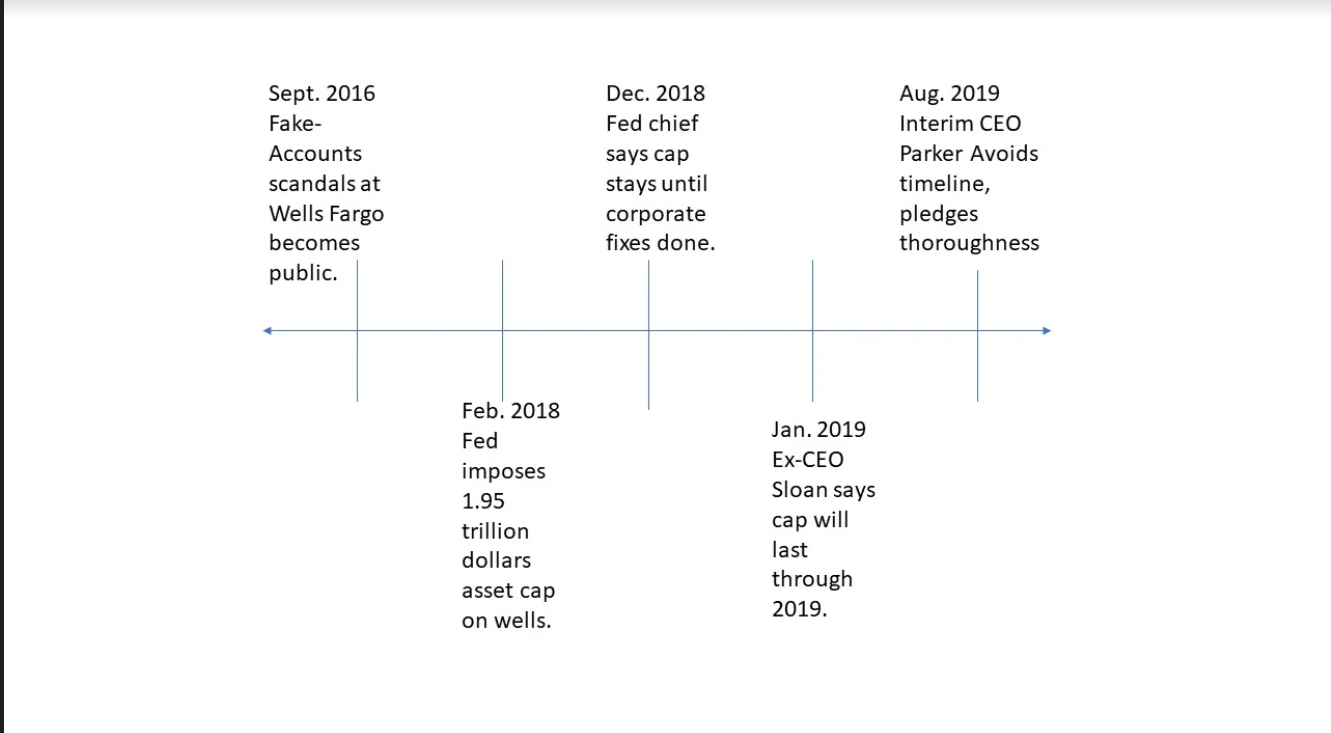
Wells Fargo has had many scandals throughout their company with employees making fake accounts for costumes to meet their company quotas. This was a big scandalous problem that all began in 2016 with them signing them up for loans and ruining their customers credits. This all became one of the biggest issues in banking history in 2020 because they had to pay 3 billion dollars in fees. Ethical theories would look at Wells Fargo as very unethical. Individualists theory would look at all of the manager’s and their ethical responsibility. They are supposed to increase the wealth of the owners within the law. An individualist wouldn’t hold  Wells Fargo responsibility for the ethics fallout. They would hold them responsible for the capital they lost due to their stupidity that they performed on customers. Utilitarians are to  require people maximize happiness for the most people. They would view Wells Fargo's issues as unethical on two problems. One problem is the lack of risk that they had when opening the accounts, and the second problem is that they had a lack of consideration for the stakeholders when they all opened up these accounts. Kantians would use actions by the way people make decisions. Also by people analyzing the motivations behind each one. Virtue Theory would cite the vices of a lack of moderation, disrespect, self-interest, greed and dishonesty. Particularly in Wells Fargo they had to pay 3 billion dollars in legal fees for their consciences of the issue that they had started. 


The Case Controversy 

Wells Fargo Company has fired 100-125 employees for going against the U.S. Small Business Administration (SBA) for taking out loans to help small businesses. There was another company that had the same issues with employees falsely taking out loans for Small businesses during COVID-19, this company was JPMorgan Chase. This source also talks about other additions to funding like the 670 billion dollars for the Paycheck Protection Program (PPP) to keep small businesses afloat. The federal government's CARES Act allocated another 10 billion dollars  to the existing Economic Injury Disaster Loan (EIDL) program also. JPMorgan chase had also fired 500 employees for similar acts like Wells Fargo have had. 

Borrowers  are now suing Wells Fargo for placing their home loans in forbearance during the coronavirus without their permission. Forbearance is a special agreement between the lender and the borrower to delay a foreclosure. The literal meaning of forbearance is "holding back". So what Wells Fargo was doing was they were putting the customers in this forbearance when they would call the bank if they were experiencing stress during covid and not being able to afford their monthly mortgage payments even when the customers didn't ask them too. During the coronavirus the federal Coronavirus Aid, Relief, and Economic Security Act would allow borrowers whose mortgages are backed by government-sponsored entities to opt for forbearance by requesting so from their banks. But the law doesn’t allow banks to do it for the. 

Troy Harlow, a man that always paid his mortgages on time he never missed a payment he said that “he pays it because he knows it needs to be paid”. He had to get a kidney transplant at the beginning of the Covid pandemic so with this it has halted his working and it also got affected by the Covid Pandemic. So what he did was contacted the bank of Wells Fargo and asked if they could stop it and they had other plans for him. This was they Wells Fargo has wrongly claimed that borrowers asked to pause their mortgage payments in forbearance plans. The lawyers have also found that the bank put through secondary requests for forbearance on behalf of homeowners who had asked to participate in the program initially but who no longer wanted to. In some cases, the bank withdrew the improper forbearance notifications after borrowers' attorneys alerted them to the errors. But Wells Fargo didn't take responsibility for the mistakes as the court documents show. This also talks about how in 2017 the bank was accused of  having made unauthorized changes to some borrowers' mortgages. Then it goes on and talks about other customers' loan issues.

Wells Fargo is one of our nation's fourth largest banks and is paying a 3 billion dollar fine to the Seattle civil lawsuit on the fake account scandals. These scandals were taking place all the way back to 2016 when they were opening up checking and saving accounts in the customers names. They were doing this so that they could meet their sales quotas, this all lasted for over a decade. It also had been carried out by thousands of employees there that ended up leading to multiple terminations. They were doing things like forging signatures and didn't let the other employees contact them for the surveys on how they liked it. It also says in the sources that none of this money that is being paid to the government is being given to the customers for compensation. Wells Fargo has separately made efforts to compensate victims for potential losses such as fees they might have been charged or harm to their credit ratings. The Justice Department agreed to not criminally prosecute the bank during the three-year term of the agreement only if Wells Fargo continues to cooperate with government investigations. Once the agreement was reached with the bank itself not with any individuals responsible for the fraud. But last month, the bank's former chief executive, John Stumpf, was fined 17.5 million dollars.

Wells Fargo website talks about all of the outcomes that happen to a person when they give out their information or have these phishing emails that are sent to the email and click on them because they think they are real. It tells you what wire transfers are, Money transfers, and checks are. These three things you should always look out for when you are reading a tempting email about your bank info because you couldn't just lose your money you can lose more valuable information. It also tells you what debit card and credit card scammers are doing and how they are getting into your accounts. You would read the source and ask yourself why are they telling us all this but still stealing peoples money and all their information.  


Wells Fargo to resume making emergency small business loans

Stakeholders

There is a future that is going to depend on how Wells Fargo's relationship with customers will have to increase. With all of the issues they had with the customers and taking their information from them they will need to work on their customer service and the security of the business. The people that were involved in the case are the CEO who resigned when all of the news broke out. The other people that were involved were the 100 plus employees that have gotten fired or asked to leave. The people that got most affected were the customers that are suing Wells Fargo for the fraud that they did and put them all in debt. 

Individualism  


Wells Fargo employees were stealing from their owners through this failure.  “Friedman argued that management was responsible for maximizing business profits and any action taken without considering profit is stealing from the owners of the company” (Salazar 17). The biggest failure in a company's business is when you are failing your customers and stealing their information to “maximize profit”. Wells Fargo wasted so much money in the long run with them stealing money,  they added to the long-term damage to their banking company. They wanted to meet their loan quotas; they did this by stealing other people's information. This is the failure to individualism by keeping the proper checks and balances was unprofessional to the company. The company has to pay about 3 billion dollars in law fees because of all of the fake accounts that they had set up for multiple people. 

This was unethical in all means because they were trying to beat out other banks by stealing information and making fake accounts. They had a lack of safety breaches that should be looked over so this doesn't happen again. The checks and balances should be overviewed by Wells Fargo so that they don't let this too keep happening in the company or eventually they will not have any customers that want to work with them with loans or any credit that they need help with. An individualist would be ethically responsible for wasting money by setting up fake accounts and putting people on a forbearance on mortgages. This will be ruining customer relationships by misleading their customers and wanting to go elsewhere because they were trying to “maximize their company profit”. 

Utilitarianism  

A utilitarian wants to maximize their happiness in Wells Fargo there by doing the opposite of that to their customers. The would view this Wells Fargo incident by looking over the ethical issues by the consequences of the company. Before Wells Fargo's controversy like right at the beginning of it they had employees that wanted to do the right thing and look into some of the people's accounts but the higher ups would tell them not to worry about it. How this works with the utilitarian: the employees wanting to do the right thing wanted to maximize the happiness and not watch customers get screwed over. This would also go against a utilitarian because they don't care about how the customers feel if they are doing this to them; they only care about the “profit and happiness” that the company was gonna have. In your case manual you said on page 17 that  “Business actions should aim to maximize the happiness in the long run for all conscious beings that are affected by the business action”. The company should have wanted to  maximize pleasure and minimize pain with a complete stakeholder approach. This is one of the main approaches in utilitarianism in my opinion. 

Actions surrounding these fraudulent acts caused the company to lose lots of employees. They have lost about 100-125 employees during all this including the CEO. They have had many lawsuits filed against them which are losing way more money in the long run for the company. So far they paid about 3 billion dollars in lawsuit fees. What a utilitarian wants to do is avoid short sighted thinking that will boost their profits momentarily but leads to a huge loss in the long term. Wells Fargo did the opposite of this that's why they would be going against a utilitarian.   

Kantianism  

Kantians would be concerned about the entire scandal that the bank that the bank did, they would also be concerned about the customers as well. There was a lack of informed decision making on all sides of the Wells Fargo scandal and when the incident hit social media they tried to eliminate it by firing lots of employees. The difference between a Kantian and utilitarian they would view on the issue by looking at the consequences. A Kantian would make a decision based on the consequences of the act. They like to make their decision in this case the CEO of Wells Fargo at this time. When Wells Fargo started to perform the scandalous acts they were going against many laws and they tried to hide it by not letting other people ask the “customers” for feedback on their accounts. In our textbook it said that “Kant tells us that we should act only according to those maxims that could be universally accepted and acted on” (DesJardins 38). In Kantianism this is the primary rule that they follow, they also use this as a question to themselves when they try to figure out consequences. 

They could have stopped all of these scandals by letting their people actually look at these acts and not let their boss or CEO scare them from looking into the issues. I think if they did this it would be impossible for a banking customer to sue a company. If this was put into play they wouldn't have to worry about the bank closing down in the near future for no one wanted to take out loans or open accounts. They also would have to pay so much in legal fees for all the mistakes that they have made. 

Virtues Theory 


Virtues Theory usually follows the same approach as a Kantian would they like when people are focusing on others. The only difference they focus on the ending more than a Katian would. In Wells Fargo for virtues theory they would care too much about the outcome of the issues they want it to come to the end with the right possible outcome. In your case manual you said “Act so as to embody a variety of virtuous or good character traits and so as to avoid vicious or bad character traits”. Wells Fargo had a terrible act with this because they were stealing the information of their employees to meet their mean. 

Wells Fargo had numerous violations to the Virtue Theory with the scandals that they performed on others. They were very unethical and unprofessional in business by trying to meet their quota deadlines. There was a lack of people wanting to take out loans and the bank felt like it was falling apart so they decided as a company to do the false acts. What comes into play here is the selfishness of their customers. When opening these accounts without the proper legal way they acted out of their own self-interest with zero respect for any of their stakeholders. Honesty and trustworthiness were also impacted here. Honesty was broke because they didn't let any of their employees find out that they were doing this and they wouldn’t let them investigate. Trustworthiness was affected because the people that gave them their information too actually opened up real loans for them; they used it to open up fake accounts for them and forged their signature. If you want to have a successful company and not have a bad reputation you want to build trust with customers now that you did all this too then they are going to refuse to sign up or tell their friends about the bank. 


Action Plan 


Wells Fargos has many problems that they are facing with being sued, legal fees, and firing employees. How the company can be ethical is they can follow the four values in a business these are Excellence, Empathy, Customer Well-being and Trust. With Excellence you can do things like work on how you are sending out the information to people so they know what you are trying to achieve and how it can benefit them. With empathy you can also work on the relationship with the customers in Wells Fargo they would send people feedback on how their accounts where and how they like the bank. I think that this was a good way to stay in good touch with the customers. What they can do to improve their feedback is ask them to recommend people that would be a good fit and get in contact with the bank to start a new relationship. The customer's well-being they need to work on how to fix what the customers don't want and improve on how the customer gets their information. If they can build more trust they shouldn't ask for more information than they need, I know you need to have a lot of information but once you get it made it disclosed so now one can get into it without a customer pin. How they can increase their profit is by not saving so much information they can give them pins so no one can log in besides them. This will help with the security and then more people will open up accounts and they will meet quotas and make more money in the long run instead of losing. This plan will be very confusing but with the pin being needed to open up someone's account that no one has besides them and their computer systems will really help with the security. This will also help with more people opening accounts because they will know that their information is going to be in a safe place and they won't have to worry about fraud. 

Self evaluation

This case has brought out many issues for the Wells Fargo company. I believe that it was morally and unethical of them to perform the stunts they did. I say this because they were taking other people's information and ruining their loans or putting them where they don't want to be. I believe in the near future that Wells Fargo will go bankrupt because of these acts, people will stop showing up and they will go to another bank that is better and has more secure issues for them. 


Reference


Desjardins, Joseph. An Introduction to Business Ethics. New York City: The McGraw-Hill Companies Inc, 2014. 

Morgenson, G. (2020, July 19). Troy Harlow has always made sure to pay his mortgage on time. Wells Fargo had other plans for him. Retrieved November 16, 2020, from https://www.nbcnews.com/business/personal-finance/troy-harlow-has-always-made-sure-pay-his-mortgage-time-n1233635 

Salazar, Heather. The Business Ethics Case Manual. N.d. 

Sonnemaker, T. (2020, October 14). Wells Fargo has fired more than 100 workers for lying in order to get COVID-19 relief funds. Retrieved November 16, 2020, from https://news.yahoo.com/wells-fargo-fired-more-100-222700075.html 

Staff, T. (2020, August 31). Wells Fargo Sued Over Mortgage Forbearance Policy. Retrieved November 16, 2020, from https://therealdeal.com/2020/08/31/borrowers-sue-wells-fargo-over-forbearance-policy/ 

Williams, P. (2020, February 22). Wells Fargo to pay $3 billion over fake account scandal. Retrieved November 16, 2020, from https://www.nbcnews.com/news/all/wells-fargo-pay-3-billion-over-fake-account-scandal-n1140541 

(n.d.). Retrieved November 16, 2020, from https://www.wellsfargo.com/privacy-security/fraud/bank-scams/


Monday, November 30, 2020

Flint Sues JPMorgan Amid Water Crisis (2014-2020)


Flint Michigan sues JPMorgan Chase over water crisis (2014-2020)

JPMorgan Chase & Co. is a relatively new bank founded in 2000, and it is an American multinational investment bank and financial services holding company that is ranked by S&P Global as the seventh-largest bank in the world and largest bank in the United States based on total assets. But even banks like JPMorgan Chase are not always perfect. They might be far from it mainly because of a lawsuit from the city of Flint Michigan. Flint had been using the same water supply as Detroit had been using, but after JPMorgan underwrote a bond sale that financed and enabled Flint’s participation in the Karegnondi Water Authority pipeline instead, things started to go downhill for Flint residents. This water compared to the water that Detroit was receiving was significantly different; the flint river water was unfiltered, untreated, and contained dangerous components like legionella bacteria along with lead. 


Through the analysis of this case, this paper will describe JPMorgan Chase’s actions that cost some people their lives, while looking at the case through a few different ethical theories, which includes Individualism, Utilitarianism, Kantianism, and Virtue Theory. This will be done to decide if the case is ethical or unethical according to each different view. For example, an Individualist could claim that what JPMorgan Chase did was ethical because underwriting a bond sale to make more of a profit is a completely legal action to take. On the other hand, a Utilitarian would argue that what they did was unethical because not even the majority of people were happy with the actions that these banks took, in fact, the majority of people were not happy with these actions. Similarly, a Kantian would agree that JPMorgan was unethical, they treated the city of Flint as a mere means to profit off of them. Lastly, using the virtue theory, it would also deem banks actions to be unethical, because JPMorgan was not honest, they did not have the courage to tell people, and they knew what they were doing was wrong.


Ethics Case Controversy:


            On April 25, 2014, Flint, Michigan officials switched the water supply from Detroit’s Water and Sewerage Department to the Karegnondi Water Authority, claiming to be for a cost-cutting measure for an economically struggling city. But before going more in-depth with what happened, the background information for the city of Flint is vital to the story. It was said that the Flint River had essentially been a waste dump for many industries nearby, and as most people know, the automobile industry was centered around Michigan, which means during those times, profits and income continually were rising. But by the 1980s, oil prices and automobile imports were rising, which meant incomes had been slowly dropping, and that led to many houses being deserted, people fleeing the city, and Flint being in millions of dollars in debt.


Since the city was in so much debt, officials had to find a way to start cutting costs and get the city back on its feet. So, in the early 2010s, the decision was made to switch the city’s water supply from the treated water of Detroit to the unfiltered water of Flint River until a new pipeline was created. When this switch occurred, families started receiving the unfiltered, untreated water and many people were exposed to chemicals that were not safe to be in the water. Although this switch was supposed to save the city millions of dollars, this water supply, as stated previously, led to countless cases of lead poisoning, kids were exposed to legionella bacteria, and many lives were permanently changed (this ultimately led to many residents filing lawsuits against each of the three banks). 


            So, according to the lawsuit, it states that without the money from the banks, Flint residents still would have to use Detroit water because they would not be able to afford this deal. With the money from the banks, Flint was able to join the Karegnondi Water Authority; the KWA would construct a 63-mile pipeline from the water in the lake to Flint and two pup stations, in total the cost would be around $300 million, and the bond allocated was $85 million. In other words, residents say that without the bond financing, Flint wouldn't have been able to join the KWA, in turn meaning the KWA would not have been able to commence construction, and these cases of lead poisoning and so on would have been easily prevented. Ultimately, more than 2,000 victims of the Flint water crisis sued J.P. Morgan Chase & Co, Wells Fargo and Stifel, and Nicolaus & Co in Flint federal court for their alleged role in the Flint water crisis. From the lead leached pipes, 12,000 children had been exposed to dangerous levels of lead and caused at least 12 deaths.


Stakeholders:


            Stakeholders within this controversial mess would include JPMorgan Chase, Wells Fargo, Nicolaus & Company, people who had shares in either of the three banks, officials of Michigan like the governor, and pretty much the entire city of Flint (whoever had to use the unsafe water supply)

(Jamie Dimon, CEO of JPMorgan)

            First of all, residents of Flint easily suffered the most because of the actions taken by the three banks. As stated before, if these banks did not provide Flint with the extra needed money, then they would have kept using the Detroit water supply, and in turn, there would have been no cases of lead poisoning or legionella bacteria. Also, the governor played a major role, because he had to of known about the waste dumping that occurred in the Flint River, in other words, that the water was simply not safe for people to be consuming. As for the banks themselves, every higher-up employee ranging from the top of the chain, or CEO’s, to any other employee that is involved in making decisions, must have been involved in this specific decision. It was said that the banks and the governor knew that the water was untreated and that it could hurt many people, yet everyone involved in this decision still seemed to be okay with that. Along with the banks’ decision-makers, people involved with the banks’ finances and accounting were likely involved because they manage the money aspect, so without involving them they wouldn’t be able to supply the money. 


Individualism:


Friedman’s individualism states that “the only goal of business is to profit, so the only obligation that the business person has is to maximize profit for the owner or the stockholders within the law of the land.” From this view, it is easy to say that JPMorgan Chase was well within the requirements of Individualism, as the only goal of the business is to profit, as long as it is within the law. It is not against the law to underwrite a bond sale or provide money to eventually gain money, and they are trying to make a profit for themselves and their stockholders, so when thinking of it that way, it is completely ethical. On the contrary, if people deem supplying unfiltered/untreated water as against the law, or that because JPMorgan knew the risks of their actions and still proceeded with them, then it is against the law, then yes this could also be seen as unethical and not following the idea of Individualism. 


Utilitarianism:

(Flint/Detroit Water Appearance)   

            Utilitarianism is said to be an ethical tradition that directs us to make decisions based on the overall consequences of our acts. In other words, a Utilitarian believes that the most ethical choice is the one that will be the most beneficial for the greatest number, or the choice that makes everyone happy with the result. So, if someone is not happy, then a Utilitarian would most likely not deem the act as ethical. On the business side, everyone is happy that they are going to be making money because of the actions committed. When only looking at the businesspeople impacted, then it would be considered ethical. But that is not the case, the whole picture is needed in this case especially. Yes, maybe the banks and people involved are happy with the result of making more money, but the entire city of Flint is unhappy with this decision to switch water supplies from a safe source to a deadly source. Put differently, JPMorgan and the other two banks would not meet the Utilitarian requirements, and a Utilitarian would easily deem JPMorgan’s actions to be unethical. In this case, not even a majority of the people would be happy with the end result.


Kantianism: 


            Kantianism is an ethical theory that states everyone should be treated as an end, and not as a mere means, and it uses the formula of humanity to supply its structure. JPMorgan Chase and the two other banks decided that in order to make a profit here, they essentially have to use the city of Flint. These banks knew the Flint River was not safe, yet they still supplied the money to make this switch happen. In short, a Kantian would mark this case as unethical because the banks used Flint to profit off of them, or they used the city as a mere means. Banks and businesses around the world are always just trying to profit, and in this case, to a large extent, is just JPMorgan trying to make money despite knowing the possibilities of people’s lives permanently changing. As for the city, they were trying to do what is right, but at the cost of saving money, so when this opportunity to cut into the debt arose, city officials had to jump in and join the decision. In conclusion, a Kantian would say that the banks’ actions were unethical because they treated the city of Flint as a mere means to profit off of them, knowing the consequences that would potentially come with it. 

Virtue Theory:


            Virtue theory uses the four cardinal virtues of courage, honesty, justice, and temperance to evaluate if an act was ethically correct or not, and also uses these virtues to determine the development of good character traits. In using the four virtues to determine if JPMorgan Chase was within ethical boundaries, it was discovered that what the banks did was greatly unethical. First, using the virtue of courage, the banks showed this in the wrong way. Flint officials had courage because they wanted to cut the amount of debt that they were in to help the city of Flint, and even banks had courage because they knew the consequences that would occur if they were to supply the money, but they did not have the courage or will to tell people that this water was not safe to use. Additionally, and similarly, the banks showed no bit of honesty, as they all knew that the water was unsafe for people, yet they still did not tell anyone and kept denying any claims against them, even if they were true. In terms of temperance, JPMorgan Chase did not refrain from supplying the money for the pipes to be built, or for the water source to switch from safe water to unsafe water, when they easily could have stepped back and realized that what they were doing was wrong. And lastly, the banks provided people with absolutely no justice, as many Flint residents, especially younger residents, were severely hurt because of the actions these banks went through with. 


Justification Ethics Evaluation:


            It does not take the smartest human on earth to realize that what JPMorgan did was completely out of line and unethical. Everyone involved in this decision knew the risks that came with switching the water supply while building the new pipes, yet no one seemed to care enough to stop this transaction from taking place. These banks had a decision to make, either one, provide money now and profit off of it later, or two, find somewhere else to invest that money, and save Flint residents the terrible times that would be ahead of them using water that was not safe. 

(Causation of Unsafe Water)

Most people, and definitely enough people, knew that Flint River was a waste pile. So how could companies like these banks still go ahead with this decision of temporarily switching to the Flint River as a water supply? Money. As stated earlier, most banks and businesses just want to profit, and they don’t care what the side effects may be from their actions. In this case, it cost Flint residents a lot more than just a few dollars. 


Company Action Plan: 


            Flint at the time (before the bond was written) was a struggling city that was in millions of dollars in debt, and they couldn’t stay in debt for too long. This led to the city governor having the difficult task of cutting the city’s debt fast, and when the opportunity popped up, it was increasingly hard to say no to cutting into that debt. Obviously, no one wants to harm people just because, but with cutting debt came the issue of what happens because of this action. Well, it must not have been discussed very much, because the only focus at the time was to save money, and at the same time that this would help the residents of Flint because the city would hopefully be debt-free much sooner. 


JPMorgan Chase is one of the most trusted and elite investment banks, and it would come as a shock if they intended for people to get hurt because of a bond they underwrote. Either way, they were involved in a huge crisis, and as a leading bank in the world, that cannot help the company overall very much. From this, customers could easily lose all trust within the bank, because JPMorgan was not honest to the people of Flint, they did not provide them with anything but a small donation as of lately, and each of the three banks still try to deny the claims set against them. The only way for them to turn this massive negative into a positive is to use it as an example of what not to do. Below are two of the business principles of JPMorgan Chase:


EXCEPTIONAL CLIENT SERVICE 

-       We focus on the customer

-       We are field and client-driven; we operate at the local level

-       We build world-class franchises, investing for the long term, to serve our clients

A COMMITMENT TO INTEGRITY, FAIRNESS, AND RESPONSIBILITY

-       We will not compromise our integrity

-       We face facts

-       We have fortitude

-       We foster an environment of respect, inclusiveness, humanity, and humility

-       We help strengthen the communities in which we live and work


JPMorgan Chase must admit to their fault if they stand by these principles, as they say, they face facts, have fortitude, focus on the customer, and help strengthen the communities in which they live and work. JPMorgan did not admit to their wrongs, they have not faced facts, and they definitely did not strengthen the community of Flint by allowing them to drink unsafe water. Although in 2016, they made a $150,000 donation while offering to match donations up to a total of $350,000. This is a step in the right direction, but still not enough for the Flint residents, or even people who are apart of JPMorgan. For them to make things right, they would need to admit to their wrongs, use this as a reason in the future not to put people at any type of risk, and help the city of Flint climb out of their debt. This would provide Flint residents and JPMorgan customers with the needed trust they may have lost during the crisis and would allow JPMorgan to say; look at what we did to help the city of Flint after admitting what we did was wrong, we did not shy away from our wrongs, and we will improve every day for our customers knowing that we can always be better. This would keep customers, and even attract new ones, as they would be seen as a bank that makes mistakes like every other human, but does not run away from it, and instead makes things right because of it. Whether it be providing more money to flint, or cleaning the river to make it safe, JPMorgan owes a public apology for harming so many lives. 


References: 

Alcorn, Chauncey. “Flint Residents Sue Investment Banks over Water Crisis.” CNN, Cable News 

Network, 8 Oct. 2020, www.cnn.com/2020/10/08/business/jpmorgan-wells-fargo-flint-

water-crisis/index.html. 

Bennett, Courtney. “Lawsuit Filed on Behalf of Flint Residents Claiming Banks Contributed to 

Water Crisis.” WEYI, 7 Oct. 2020, nbc25news.com/news/local/lawsuit-filed-on-behalf-of-

flint-residents-claiming-banks-contributed-to-water-crisis. 

Dimon, Jamie. “Business Principles.” Who We Are: Business Principles, 2020, 

www.jpmorganchase.com/about/our-business/business-principles.

DesJardins, Joseph R. An Introduction to Business Ethics. McGraw-Hill/Irwin, 2014. 

Malo, Sebastien. “Flint Water Crisis Victims Sue Chase, Wells Fargo.” Reuters, Thomson Reuters, 

7 Oct. 2020, www.reuters.com/article/usa-environment-lawsuit/flint-water-crisis-victims- sue-chase-wells-fargo-idUSL1N2GY2I3. 

Palmer, Gianna. “Flint Water Crisis: Living One Bottle of Water at a Time.” BBC News, BBC, 22 

Jan. 2016, www.bbc.com/news/magazine-35376517. 

Ruble, Kayla. “Flint Residents Sue Investment Banks, Accuse Them of Helping Create Water 

Crisis.” The Detroit News, The Detroit News, 7 Oct. 2020, www.detroitnews.com/story/news/michigan/flint-water-crisis/2020/10/07/flint-residents-blame-water-crisis-investment-banks-lawsuit/5912871002/.