Ozy Media’s Executive Dishonesty: YouTube, A&E, and Viewership (February 2021)
Case Controversy
When Ozy Media was launched in September 2013 by Carlos Watson and Samir Rao, they envisioned themselves as “the new and the next”. They wanted to differentiate themselves by creating an unconventional media company that would focus on topics that would appeal to a diverse group of millennials. Watson and Rao set out to supply content not provided by mainstream news organizations. While going against the grain in an industry can result in innovation and success, it can also result in failure. Unfortunately, in the case of Ozy Media, going against the traditional model for a news organization resulted in failure. Dishonest leadership repeatedly landed Ozy Media in hot water and eventually led to the company ceasing all operations on October 8, 2021.
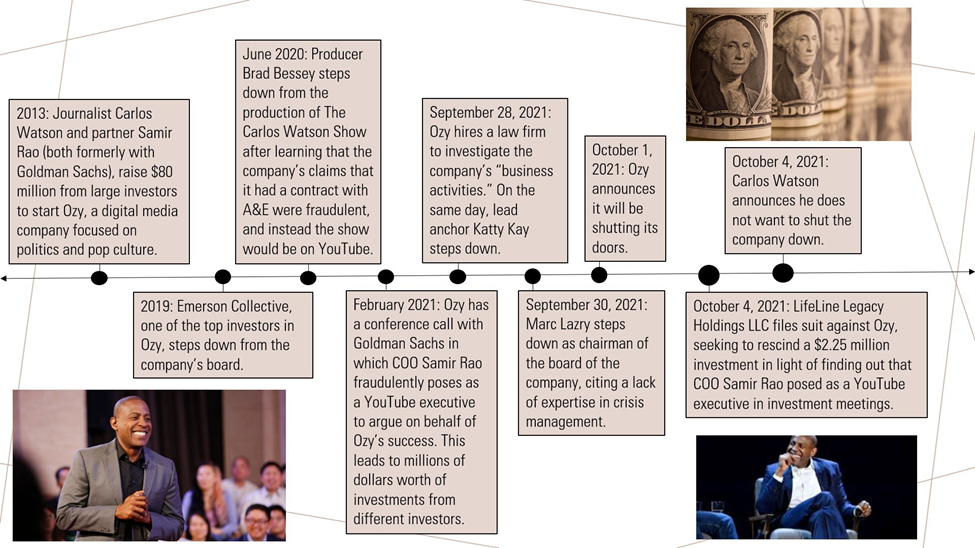
Looking back on Ozy Media’s brief history, it is easy to see from the very beginning how this company ended up where it is today. Just two years after they began operations, questions surrounding Ozy’s viewership began to arise within the company. Eugene Watson, one of Ozy’s first employees, kept hearing Chief Executive Officer (CEO) Carlos Watson boast of Ozy’s high viewership. When he heard the figures, he thought they seemed high, and he decided to compare Watson’s claims to public sources of audience data. From this comparison, he concluded that Ozy was a “Potemkin village” (The New York Times). This obvious deception was only the beginning of the lies perpetuated by Ozy executives. Shortly after these questions were raised Ozy came under fire from BuzzFeed in the summer of 2017. They reported that Ozy was among several companies buying web traffic from fraudulent sources. Ozy published a group of articles in collaboration with JP Morgan. They were soon ranked among Ozy’s most-viewed articles, but much of the traffic to these articles was fraudulent according to industry standards. The traffic was purchased and delivered by a system that automatically loaded specific webpages and redirects traffic between participating websites to quickly rack up views without any human action (BuzzFeed). Ozy also bought a portion of its audience from ad networks that specialized in pop-under browser windows that are opened on users when they visit other websites (BuzzFeed). When this information was brought forth, Ozy claimed they were unaware that the audience was invalid when they purchased it. Ozy also stated that the traffic was not counted as part of their campaign with JP Morgan, and that they used the paid traffic to try to grow an email subscription list.
These responses from executives did not seem in line with what Ozy was doing regarding the traffic numbers. On the company’s website, it said that they were reaching an aggregate of 40 million people per month through various channels. However, data from Quantcast, a public service Ozy was using to measure their traffic, said the website was reaching only 2.5 million people per month (BuzzFeed). It was also revealed that between June and October 2017, roughly 2 million visits came from domains connected to a company called ScreenRush. This traffic was sent to specific articles on Ozy, many of which were part of the JP Morgan campaign. Investigations into this traffic have determined that ScreenRush is an invalid and fraudulent source of traffic. When this information was brought forth, Ozy immediately stopped working with ScreenRush and experienced a significant drop in desktop referral traffic. These inconsistencies between what management was reporting and what was going on within the company was a major red flag, but Carlos Watson’s charisma and influence helped Ozy maintain support from powerful investors.
The questions surrounding Ozy’s traffic numbers lingered for the next few years. Ozy maintained a respectable public image due mainly to the charm of Carlos Watson, but in the summer of 2020 the first major controversy plagued the company. In June 2020, Ozy began working on “The Carlos Watson Show,” a daily half-hour interview program hosted by the Ozy CEO. This show would feature prominent celebrities and politicians with the goal of having meaningful conversations about important social justice issues. In order to ensure that the show was high quality, Watson and Rao sought out an experienced executive producer. This led them to Emmy-winner Brad Bessey. Bessey was eager to make an impact socially in the wake of COVID-19 and George Floyd, so he happily agreed to produce the show. He was told by Watson and Rao that the show would appear in prime time on A&E in August 2020. This was an amazing opportunity for Bessey, but some red flags arose early in the production process.
To start, Bessey had no contact with A&E executives during the making of the show. Watson and Rao claimed that A&E only wanted to talk to them, but Bessey knew several executives at A&E. He offered to reach out to them, but Watson and Rao insisted he did not. The second warning sign that something was amiss was that A&E had scheduled the show “Hoarders” for the time slot that was supposedly meant for “The Carlos Watson Show.” Despite these concerns, Bessey continued working with Ozy because he was so eager to make an impact. Watson’s guests were always told that the show would air on A&E, and longtime writer Heidi Clements was also told this when she started working on “The Carlos Watson Show.” When Bessey finally acted on his suspicions and reached out to A&E at the end of July, he was informed that they had said no to the show before taping began. Shortly after this, Bessey and Clements resigned and said goodbye to Watson and Rao. In Bessey’s farewell email to the executives, he wrote, “You are playing a dangerous game with the truth. The consequences of offering an A&E show to guests when we don’t have one to offer are catastrophic for Ozy and for me (The New York Times).” He informed the rest of the show's staff that he was leaving during a Zoom call in which Watson was present. He also revealed that the show would not appear on A&E, to which Watson responded that the show would “eventually” end up on the network.
Ozy managed to recover from this incident, and operated problem-free until January 2021 when Goldman Sachs began talks with Watson about a potential $40 million investment in the company. The Ozy executives had boasted to the Goldman bankers that they had a large audience and a great relationship with YouTube. A video conference call was arranged by Ozy for February 2, 2021, to speak with the Goldman Sachs asset management division and YouTube. Alex Piper, the head of unscripted programming for YouTube Originals, was scheduled to represent YouTube. He said he was running late to the call, so he suggested that the meeting be moved to a call with no video. Once everyone had made the switch, Piper told the Goldman team all the things they wanted to hear so that they would make the decision to invest in Ozy. This sounded great, but as he spoke, the Goldman team seemed to think that his voice sounded digitally altered.
After the meeting, one of the Goldman bankers reached out to Piper’s assistant at YouTube via email. Piper, confused by the email, told the Goldman banker that he had never spoken to her before. Someone else had been on the call impersonating him in order to get the investment. YouTube’s security team began investigating immediately. Within days Watson apologized profusely to Goldman Sachs, and Samir Rao, Ozy’s Chief Operating Officer (COO) was outed as the impersonator. Watson attributed this incident to Rao’s mental health issues. After the call, Goldman Sachs took no further action, but the security team at Google determined that a crime may have been committed. Google alerted the FBI and Goldman Sachs received an inquiry from federal law enforcement officials. There are real legal implications for Ozy in this situation. Tricking potential investors while raising capital would be grounds for criminal charges of wire fraud and securities fraud, as well as a potential civil suit from the Securities and Exchange Commission (The New York Times).
This phone call was the controversy that led to the end of Ozy Media. Shortly after the New York Times reported on this incident at the end of September 2021, the chairman of the Ozy Board resigned. Ozy’s top anchor Katty Kay left the company, and key advertisers including Facebook and Walmart, hit the brakes on their spending with Ozy. After this backlash from the news of the call, Watson and Michael Moe, Ozy’s other remaining board member, concluded that the company would be unable to recover. A farewell statement was issued by an Ozy spokeswoman, and Ozy Media officially ceased operations.
Stakeholders
Stakeholders within Ozy include Carlos Watson and Samir Rao, Investors (and Former Investors) like the Emerson Collective and Goldman Sachs, Employees of the Company (reporters, editors, columnists, anchors, etc.), and Media Consumers. Stakeholders represent entities or people that have a direct interest in the success of a business. Watson and Rao would clearly have an interest in the success of their own company, hoping to profit off it. Investors fall into a similar category, hoping to turn their investments into profit for themselves. Their ability to profit off their investment comes with the need for the business they are investing in to profit itself. In the Ozy scandal, investors hold a larger stake since they seem to be the victim of Ozy’s fraudulent actions. Employees hold a stake in the company because their ability to keep their jobs comes as a direct need for the company to stay alive. Furthermore, with Ozy’s employees being a collection of journalists, the success of the company will also affect the success of the employees’ popularity in journalism. Lastly, consumers of the content that Ozy produces hold a stake. Consumers are likely to consume content if the company that produced it is ethical and if their work is consumable. These stakeholders will be considered in a utilitarian analysis of Ozy.
Individualism
Individualism states that companies should maximize profits for stockholders within the constraints of the law. This is best said by Milton Friedman “there is one and only one social responsibility of business—to use its resources and engage in activities designed to increase its profits so long as it stays within the rules of the game, which is to say, engages in open and free competition, without deception or fraud” (DesJardins 2014). My theory, individualism would interpret the Ozy media case in terms of profit and the boundaries of the law such as deception and fraud.
So, does Ozy media maximize its profits? In the short-term when they started most definitely, they maximized profits by lying and being deceitful about their subscribers, readers, views, and engagement in the company overall. This led to investors thinking that they were much bigger of a company than they actually were. In the long-term people started to catch on, and they did not maximize profits. They couldn’t maximize profits because their reputation has been damaged from being deceitful and in turn Ozy is stopping production and shutting down which leads to no more profits.
Is it within the law? Hasn’t been fully determined if they are within the law yet. Ozy is being investigated for acts of fraud and being sued by companies such as Lifeline Legacy Holdings “claiming that it was misled when it made an initial $2 million investment in the company earlier this year” (Ellison, Sarah, & Barr 2021). Even with lawsuits Ozy media is innocent until proven guilty in US court systems, but they appear to be breaking the law.
From an individualism view it is unethical because they are probably breaking the law and definitely not maximizing profits for shareholders due to the fact that they are shut down. The only permissible action would be them being truthful and maximizing profit by doing so. Breaking the law and the whole scandal is impermissible because if everyone did this there would be a lot of investigations and fraud and in turn many shut down businesses and bad reputations leading to less investments. Less investments means less profit and money that a company can use to invest into itself and grow profits. If you cannot make money, you won’t have a business.
Utilitarianism
Utilitarians believe that actions are ethical and permissible if they maximize the overall good or, the word that most tend to hear, happiness. Actions are considered ethical if the consequences of those actions lead to most people impacted by them being left “happy.” In other words, happiness is pleasure, and it is the only thing of intrinsic value. John Stuart Mill, the founder of utilitarianism, recognizes that happiness may have a different definition for different people. He uses this notion to defend democracy, claiming that “the best means for attaining [maximized happiness] is an educated citizenry making decisions through a majority-rule democracy” (DesJardins 2014, pg. 32). It is also important to note that utilitarianism functions as a consequential theory, recognizing both the short term and long-term consequences of actions. The actions that are best are those that leave the largest number of people “happy,” meaning that all available actions should be considered.
How does utilitarianism consider the Ozy scandal? After analysis, it will be found that Ozy’s actions are unethical. Readers may naturally assume such a statement – all forms of fraud should be inherently unethical. In application, utilitarianism will teach readers why such is the case.
When considering the Ozy scandal through the scope of utilitarianism, one must consider if the business’ activities resulted in a happy majority. In the short term, Ozy’s fraudulent actions certainly generated happiness. The company was able to grow, consumers got to enjoy the content, investors saw profit, and employees held their jobs at a recognizable media source. While the short term consequences yielded happiness for the majority, it is the long term consequences that lead to the conclusion that Ozy’s actions are unethical.
As a result of the fraudulent actions, Ozy inevitably lost lots of trust, investments, employees, and consumers. Investors, like LifeLine, sought to reclaim investments via legal action, signaling that they were unhappy with their investment and Ozy’s actions. Employees were certainly unhappy when the fraud came to fruition, as outlined by the anonymous allegations of email fraud and Fouriezos’ statement. Consumers were also certainly unhappy, as people tend to consume less of a product if they find out that that product was produced because of scandalous or fraudulent actions. With the fall of investors and profit to the company, Watson and Rao are also certain to be unhappy. This does not mean to say, however, that Ozy’s actions were at first ethical, and only became unethical when the fraud came into the public eye. Ozy’s actions were always unethical, but they were only able to be labeled as such once people recognized what the exact actions were.
While Ozy’s actions are unethical because they did not achieve the goal of maximizing happiness, utilitarianism says that one must also consider whether there was another option that could have produced more happiness. If no such action existed, then the actions taken by Ozy are ethical. However, as seen in this case, an alternative action did exist. If Ozy had decided to shut its doors earlier or if they had sought to continue practicing without committing fraud, there is a high likelihood that a majority of people would have been left happier.
If the use of simple utilitarianism does not suffice the reader in this instance, consider an alternative form of utilitarianism created by Louis Lyons. In his book Forms and Limits of Utilitarianism, Lyons outlines a distinction between simple utilitarianism and general utilitarianism. Determining whether an action is ethical based on the prior questions considered falls into the category of simple utilitarianism. Then what is general utilitarianism? Lyons defines it as a “concern [for] the total effects that could be produced if all acts similar to the one in question… actually were performed” (Lyons 1965, pg. 3). To this degree, general utilitarianism suggests that an action is ethical or unethical when it is considered through a general scope. In other words, if other entities were to perform a similar action, would happiness be maximized? Considering Ozy’s fraudulent actions, the answer would again be no. If all businesses participated in fraudulent actions, the collapse of the free market would likely be seen. With nothing but scandal running rampant in the markets, no person would want to engage with it, resulting in displeasure.
When applying utilitarianism to Ozy, through its many broad scopes, it can clearly be purported that their actions were unethical. Not many would question such a premise, but nonetheless, the Ozy scandal teaches why it is important to consider the broadness of utilitarian ethics. Utilitarianism does not always give a definitive answer, but that is the point. Actions that people view as ethical in the present may be viewed as unethical in the future. By following what makes the majority happy, utilitarianism allows for an action’s ethicalness to change with time. In recognizing the fraud in this case across Ozy’s eight years in business, and putting the business through the utilitarian wringer, it is thus concluded that the actions taken by Ozy are hereby unethical and impermissible under utilitarian standards.
Kantianism
A Kantian would view the actions of Ozy Media’s leaders as unethical and impermissible. Under Kantianism, you must never treat people as a mere means, but also as an end. This is a version of the “formula of humanity.” When an action fails the categorical imperative test, it is impermissible, and vice versa. Businesses should act in ways that respect and honor individuals and their choices. Lying, cheating, and manipulation are never valid ways to get what you want under Kantianism (Salazar, 17). When making decisions, consequences are not the most important, but rather the “Good Will.” Only people with freedom, the ability to reason, and the ability to think and act on their reasons can have Good Will (Salazar, 21). Having a Good Will requires that people have good intentions and use good reasoning to take actions that will make their intentions effective. In the case of Ozy Media, Carlos Watson and Samir Rao were extremely unethical and took many actions that are impermissible in the view of a Kantian.
When examining the lies that Carlos Watson told about Ozy Media’s viewership, it is easy to analyze and quickly conclude that these actions are impermissible from a Kantian perspective. Watson had always wanted to be a television star, so when he started Ozy, he wanted to do everything he could to make his dream a reality. However, when his company struggled to gain significant viewership, he lied about their numbers in order to keep investors on board and ensure that his company would not fail. His motivations are selfish, and he is not respecting the autonomy of his investors, because they are influenced by false information. The consequences for those who invest a lot of money into his company are not important to Watson.
The A&E controversy is also impermissible when examined through the lens of Kantianism. Watson knew from the very start that “The Carlos Watson Show” would never be on A&E. Despite this, in order to get a better production crew for his show, he told award-winning executive producer Brad Bessey that the show would appear on the network. Watson’s motivations are once again his own interests. He does not have any regard for Brad Bessey’s autonomy as an individual. He is clearly treating Bessey as a mere means to achieve a higher-quality production.
Finally, the Goldman Sachs and YouTube controversy is once again another impermissible action taken by Ozy executives. During the conference call, Samir Rao impersonated Alex Piper in order to get a $40 million investment from Goldman Sachs. This is another example of the Ozy executives treating people as means to their ends. By impersonating him and telling the Goldman Sachs executives things that would make them decide to invest. They show no regard for the autonomy of Alex Piper. He could have easily told the investors the truth himself, but Ozy exploited him for financial gain. They also show blatant disregard for the autonomy of Goldman Sachs. By lying about their viewers and their relationship with YouTube, they took away the Sachs teams’ ability to make their own decision based on the facts.
It is clear to see that these actions are impermissible from a Kantian perspective. The executives repeatedly used people to achieve their ends. Nothing they did was motivated by the Good Will that Immanuel Kant talked about when he originated his theory. All the exploitation was to make Ozy look good and to satisfy the selfish desires of Samir Rao and Carlos Watson.
Virtue Theory
Virtue theory focuses mainly on rationality regarding functioning well and living out your purpose. Based on functionalism, people or companies exercise rationality as a reason for existing and purpose and goodness based on virtues. These virtues are characteristics that allow us to be rational and flourish within society. To flourish in society, you must get along with everyone in society. People or companies who live good lives by functioning well will certainly also live happy lives. The four main virtues that enable functioning well and living out purpose are: courage, honesty, temperance/self-control, and finally justice/ fairness.
In terms of Virtue Theory and Ozy Media, the people working there fail to fit most of the main virtues. In terms of courage the only courageous action was when Watson changed his decision to close Ozy and referenced the scandal as a Lazarus moment (Simonetti 2021). He also called the incident tragic and that he did not know that his co-founder was going to impersonate the YouTube executive. This demonstrates courage as Watson stood up for what he believed in, that Ozy is a great company, in front of millions of Today Show viewers. In terms of honesty, this is the virtue that Ozy Media lacked the most. The biggest example of dishonesty was when it was discovered that the company’s co-founder and COO Samir Rao had impersonated a YouTube executive during a conference call. It is also unknown if Watson really was unaware of this, as he said he was, and it is up for interpretation. This wrongful impersonation also depicts the opposite of fairness virtue. It is unfair that Ozy Media tried to deceptively gain a $40 million investment using the tactics that they used. It is unfair to all the honest companies out there who go about investment processes in a fair and official manner. Lastly, in terms of self-control/ temperance, the rash decision by Watson to close Ozy’s doors right after the scandal came out showed that they lacked self-control and temperance because they were so quick to make that decision. Important executives were resigning, and Watson shut down the company all just to change his mind publicly, just days later on live TV. Ozy Media failed to enable their function in society, and they failed to exercise their rationality because they were not virtuous in their decision making, therefore people like Samir Rao are not virtuous, and in fact vicious.
Action Plan
Ozy Media's current issues revolve around the dishonesty of their executives.Carlos Watson and Samir Rao, the CEO and COO of Ozy respectively, have repeatedly inflated the viewership and engagement numbers on their articles and videos. Multiple employees have revealed that this has been a problem within the company since around 2015. Ozy also was involved in two major controversie. One involved Brad Bessey, an award winning executive producer, who was lied to by Watson about “The Carlos Watson Show” being aired on A&E. The second controversy involved Samir Rao impersonating a YouTube executive in order to attain a $40 million dollar investment into the company from Goldman Sachs.
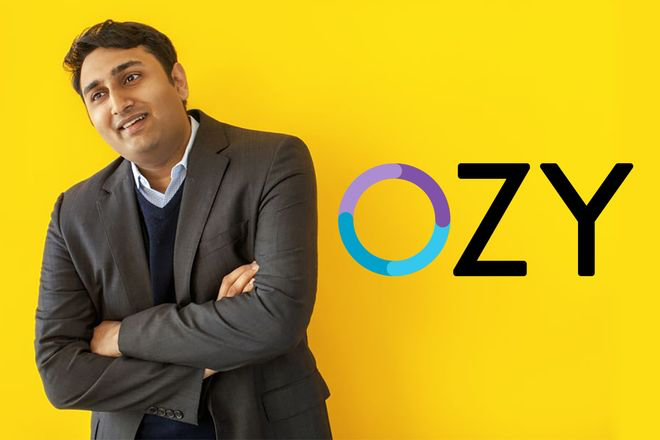
Ozy Media’s mission moving forward will be to captivate readers with the most fascinating stories the world has to offer without compromising the truth. Ozy’s mission remains the same, but we will not deceive the public in any way while trying to provide interesting news stories to curious people all over the world.
Some guiding values that Ozy should stick to as they progress forward and attempt to get back on their feet include honesty and integrity, universality, and accountability. As seen with the scandal, the biggest problem that the company must overcome is a tarnished reputation due to fraudulence in investing practices. If there is to be any change in the company, executives like Watson must swerved from fraudulent practices and show that they are trustworthy. By promoting honesty and integrity, Ozy can begin promoting new values that would please the community that has been disrupted as a result of the fraudulence. In terms of universality, the company’s original mission statement was to provide a range of content to all people to keep them informed in many aspects of the world, including, but not limited to, politics and pop culture. By committing to a value of universality, Ozy will display that they truly are dedicated to the mission that they have sought to accomplish. The last, and most notable, value that Ozy must follow is accountability. Thus far, Carlos Watson has attempted to downplay the scandal and undermine its importance. Instead of taking accountability, Watson has sought to keep doors open and move forward with little recognition of its practices. If Ozy is truly going to succeed as it moves on from these accusations, taking accountability will be necessary to regain trust from investors and consumers alike.
Ozy can ensure ethical productivity by hiring independent auditors to attend investment meetings and check up on the company's financial position quarterly. They can also utilize only one public source of viewership and engagement data so the public is actually informed about the real numbers. This way they can make the choice of whether to invest or not based on real information. Ozy can hold meetings with their current employees and set a new status quo regarding honesty within the company.
By being honest and not deceptive in their practices, business productivity will increase again. Customers and the general public will gain the trust of Ozy Media again, and profits will in turn be promoted. It is necessary for Ozy to follow their new values, in order to see positive results. By being honest with potential investors, Ozy will be more likely to fairly gain investments. It is also important for Ozy to not inflate their viewership statistics, as this was another unethical method of false publicity and deception.
Matthew Roath, Joe Shea, Owen Harding, Kyle Burnham
References
Associated Press, The. “After a Week of Scandal, the CEO of OZY Media Says He Now Hopes to Stay in Business.” NPR, October 4, 2021. https://www.npr.org/2021/10/04/1043168458/ozy-media-carlos-watson-plans-to-stay-in-business.
“Carlos Watson Show, The.” YouTube, YouTube, https://www.youtube.com/channel/UCyF0994XbriKL_Vss0fTUMw.
DesJardins, Joseph R. An Introduction to Business Ethics. New York, NY: McGraw-Hill Education, 2020.
Ellison, Sarah, and Jeremy Barr. “Ozy Media's Audience Was Mostly a Mirage. Even in Scandal, Founder Carlos Watson Is Looking for Opportunity.” The Washington Post, October 6, 2021. https://www.washingtonpost.com/media/2021/10/05/carlos-watson-ozy-media-today/.
Folkenflik, David. “Ozy Shuts down after Accusations of Deceit, as High-Profile Backers Peel Away.” NPR. NPR, October 2, 2021. https://www.npr.org/2021/10/02/1042547742/ozy-shuts-down.
Godoy, Jody. “Investor Sues Ozy Media for Fraud over Founder's Fake Call.” Reuters, October 5, 2021. https://www.reuters.com/legal/litigation/investor-sues-ozy-media-fraud-over-founders-fake-call-2021-10-05/.
Hayes, Dade. “Ozy Media to Shutter after Allegations of Fraud and Other Misdeeds.” Deadline. Deadline, October 1, 2021. https://deadline.com/2021/10/ozy-media-to-shut-down-carlos-watson-1234848287/#!
Jbursz. “Ozy Media CEO Claims His Scandal-Ridden Company Will Reopen, but Doesn't Explain How.” CNBC. CNBC, October 4, 2021. https://www.cnbc.com/2021/10/04/ozy-media-ceo-carlos-watson-says-the-company-isnt-shutting-down.html.
LifeLine Legacy Holdings LLC vs. Ozy Media (2021).
Lyons, David. Forms and Limits of Utilitarianism. Oxford: Oxford University Press, 1965.
McEvoy, Jemima. “Ex-Ozy Media Employees Say Company Used Dubious Tactics to Build Newsletter Following, Raising Legal Questions.” Forbes, October 8, 2021. https://www.forbes.com/sites/jemimamcevoy/2021/10/08/ex-ozy-media-employees-say-company-used-dubious-tactics-to-build-newsletter-following-raising-legal-questions/amp/.
McKenna, Francine. “Introducing Ozy Media: Following the Formula of ‘Fake It until You Make It’ Then Collapse in Alleged Fraud.” The Dig. The Dig, October 11, 2021. https://thedig.substack.com/p/introducing-ozy-media-following-the.
Mullin, Benjamin. “WSJ News Exclusive | OZY Media Board Announces Investigation of Business Practices.” The Wall Street Journal, Dow Jones & Company, 29 Sept. 2021, https://www.wsj.com/articles/ozy-media-board-announces-investigation-of-business-practices-11632865291?mod=Searchresults_pos6&page=1.
“Ozy Fest About.” OZY, https://www.ozy.com/ozyfestabout/.
“Ozy Media Suspends Samir Rao after Report of Fake Investor Call, and Katty Kay Resigns.” Ad Age, 29 Sept. 2021, https://adage.com/article/digital-marketing-ad-tech-news/ozy-suspends-samir-rao-after-report-fake-investor-call/2369551.
Salazar, H. The Business Ethics Case Manual. n.d.
Schwartz, Brian. “Sharon Osbourne Says Ozy Media Founder Carlos Watson Lied When He Claimed the Osbournes Invested in His Company.” CNBC. CNBC, October 2, 2021. https://www.cnbc.com/2021/09/30/ozy-media-founder-carlos-watson-lied-about-investment-sharon-osbourne-says.html.
Silverman, Craig. “These Publishers Bought Millions of Website Visits They Later Found out Were Fraudulent.” BuzzFeed News, BuzzFeed News, 27 Dec. 2017, https://www.buzzfeednews.com/article/craigsilverman/these-publishers-bought-millions-of-website-visits-they.
Simonetti, Isabella. “What You Should Know about the OZY Media Meltdown.” Observer. Observer, October 8, 2021. https://observer.com/2021/10/ozy-media-meltdown-carlos-watson-goldman-sachs/.
Smith, Ben. “Goldman Sachs, Ozy Media and a $40 Million Conference Call Gone Wrong.” The New York Times. The New York Times, September 27, 2021. https://www.nytimes.com/2021/09/26/business/media/ozy-media-goldman-sachs.html.
Smith, Ben. “Ozy Built a TV Show on a False Claim, Says Its Former Producer.” The New York Times, September 30, 2021. https://www.nytimes.com/2021/09/30/business/media/ozy-media-carlos-watson.html.
Smith, Ben, and Katie Robertson. “Ozy Media, Once a Darling of Investors, Shuts down in a Swift Unraveling.” The New York Times, October 1, 2021. https://www.nytimes.com/2021/10/01/business/media/ozy-media-carlos-watson.html.
Watson, Carlos. “A Modern Media Company.” OZY. Accessed November 13, 2021. https://www.ozy.com/pg/about-us/.


