Showing posts with label 2016. Show all posts

Wednesday, April 11, 2018

Disney's Nutrition Study Scandal (2016)


Controversy


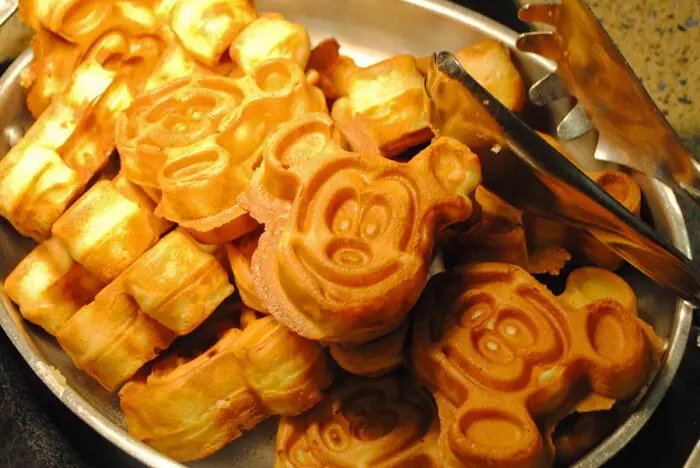
Mickey Mouse themed waffles served at Disney World
The Walt Disney Company has been a multi-media empire since its founding in 1923, and generates over $36 million in revenue a day. According to the Walt Disney Company website, their mission statement is "to be one of the world's leading producers and providers of entertainment and information. Using our portfolio of brands to differentiate our content, services and consumer products, we seek to develop the most creative, innovative and profitable entertainment experiences and related products in the world." Their business portfolio consists of media networks such as ABC, Freeform, and ESPN, while their parks, experiences, and consumer products consist of Disneyland Resort, Walt Disney World, Disney Cruise Line, and the Disney store, along with many other amusement park locations around the globe. 

On April 8, 2016, an article was published with information that the company had pressured an academic journal to withdraw a study children’s meal nutrition. According to the article, Disney was not worried about the contents of the study, but rather feared being associated with one of the study’s main authors, James Hill. Dr. Hill, a professor at the University Of Colorado School Of Medicine, had his last work, a project on sugary drinks and obesity funded by Coca Cola, opposed by fellow scientists in his field who felt that the results were tampered with.  This study had some bias in Coca Cola’s favor as Hill and his team determined that an increase of exercise could counteract eating and drinking sugary and fattening food.

STAT obtained emails between Disney and the study’s authors asking them to withdraw the meal study, regardless of an editor’s warnings of negative PR. Although no information has been revealed about Disney’s involvement with the study, if any at all, but this study shows how corporate sponsors and researchers interact with one another. When a Disney spokesman spoke on the issue, he wanted to reiterate that the questioning wasn’t about the study’s result, but rather Hill’s participation in the study.

Disney has their nutrition guidelines posted on their website now in 2018, which states that "Disney champions the happiness and well-being of kids, parents, and families, and will support healthy lifestyles for all ages by offering and portraying a balance of nutritious options." These guidelines later say that "virtually all of our food or beverage related promotions and sponsorships meet these Guideline. The few exceptions are generally a result of pre-existing contractual obligations." Although they state that they regularly re-evaluate their guidelines for nutrition, it is clear that other things have been done to meet these guidelines, and that they were not living up to the company's mission statement when they suppressed the study from being released.

Stakeholders

Dr. James O. Hill: Professor of Pediatrics & Medicine,
Director Center for Human Nutrition, Director of the
Colorado Clinical Nutrition Research Unit
Many different stakeholders are effected by the ethical dilemma extend far beyond the stockholders. Shareholders of Disney, however, trust the company to be truthful on its studies, including knowing the procedures about how to fund them. Regardless of the true implications, a company funded study should not be pressured into not releasing the results as it is unethical and can cause stakeholders to loose trust in the company. The customers who go to Disney’s amusement parks are also affected by these decisions. Many common diseases can be managed or avoided altogether, including (but not limited to) certain cancers, high blood pressure, obesity, heart disease, and type 2 diabetes. Most people have at least a fundamental understanding of nutrition, and people who are more likely to get these types of diseases pay attention to every detail about food they are eating. Especially while at a new location that serves food, people want to see the nutritional facts of the food they are are eating, and  they have a right to know so they can stay healthy. When nutrition studies are under pressure to be held from publication, it causes these customers to not trust companies.

Individualism


An Individualist would think this case is ethical. According to Friedman’s individualism theory the only goal of business is to profit, so the obligation that the business person has is to maximize profit for the owner and/or stockholders. By dissociating itself from Hill and his team, Disney was doing the profitable thing by trying to avoid itself from someone who was part of an ethical controversy with another company. Disney spent  $2 billion dollars on advertising in 2016, and when compared to the previous four years, is substantially higher. This increase in spending can be associated with this ethical dilemma and the need to keep people coming to their parks. This move by Disney paid off as they were able to generate $55.63 billion in global revenue in 2016, which can be attributed to both the increased spending in advertising and the disassociation of Hill.

This was also the ethical choice based on the reputation of the company. In 2016, Forbes named Disney the second most reputable company in the world, which is higher than their 2015 ranking at sixth. This shows that the Walt Disney company has a high reputation around the world, specifically between the sales of motion pictures and the attraction to the amusement parks. With the disassociation of Hill, and the company's ability to advertise more, this can still be considered ethical. Based on Hill's reputation with his Coca Cola scandal, Disney had no choice but to disassociate itself from the study. By asking the publisher into not releasing the study, Disney was saving money and its reputation, all while staying within the law.

Kantianism


Mickey Mouse themed oranges 
According to a Kantianist, this case is unethical because of it violates the basic principles that Kantianism is based on. These four principles are act rationally, allow and help people to make rational decisions, respect people, their autonomy, and their individual needs and differences, and be motivated by good will. Because Disney attempted to withhold information, both the results of the study and the association with those who conducted the study, they are not allowing people to make rational decisions, nor acting rationally as a company. To act ethically in this situation, it would have been better to release the study, but also announce the association with Hill and his team and that the company chose poorly in their decision to work with them. In this hypothetical situation, people would be able to make a decision on the study themselves and Disney would have been motivated by good will to stay true to publishing the results of the study and help people make the decisions they want.

With Kantian ethics in mind, it is important to note the formula of humanity. According to Kant, the formula of humanity refers to "act[ing] in such a way that you treat humanity, whether in your own person or in the person of another, always at the same time as an end and never simply as a means." In this sense, 'end' refers to something valuable in itself, for it's own sake, while 'means' refers to something that is valuable as a way to get something else. Disney compromised the study about nutrition by both hiring Hill in the first place, then again by suppressing the study's publication. By doing this, they are trying to get people to purchase food at their amusement parks that may be unhealthy for them, and has caused the nutrition details to be compromised overall.

Utilitarianism


Utilitarianism looks at the overall happiness of the stakeholders and attempts to maximize that happiness. With this decision to suppress the publication, the stakeholders would not be happy, thus it is unethical in this form of ethics. As mentioned above, the shareholders who hold stock in the Walt Disney company, this sort of scandal can cost thousands, even million of dollars in financial lost. The long term security that people try to achieve by investing in Disney can be dismantled by scandals like this. It raises the question "What else have they suppressed?" and "what will they suppress in the future regardless of them being caught once?" These types of questions can cause reputation to collapse and the benefit of shareholders investments to be stripped from the company.

More importantly, the customers who eat at the amusement parks can't trust the study's outcome, and with the publication being suppressed, they can't make decisions rationally. When people have diseases, or are trying to avoid diseases, that are depended on nutrition, scandals like this cause them to loose faith in the company, which in turn can cause them to avoid going to the amusement parks, cruises, resorts, and other themed locations that Disney owns. Disney, in turn, should have attempted to maximize happiness in both the stakeholders and the company by publicly denouncing the study with an explanation as to why they believe the study should be discredited. By doing this, customers would have the ability to be happy by making their own decisions, while the company would be happy by clearly separating themselves from Hill and his past scandals. 

Virtue Theory


The Virtue Theory is a theory based on Aristotle's ethics, and focuses around the the characteristics that allow things to function properly, or virtues as the name suggests. Virtues depend on the thing's function and the thing's circumstances, and to determine how to act in any situation, the mean between the extremes must be found, then acted upon. The four main characteristics are honesty, courage, justice, and temperance. 

Honesty can sway from absolute honesty and absolute dishonesty, and in this circumstance, Disney did not act honestly, but acted more towards the dishonesty side of the scale. By suppressing Hill's study from release by pressuring the publishing company, Disney was not honest towards their stakeholders. They attempted to withhold information about Hill's past and the association with Hill to begin with, and therefore were not acting according to this theory.  The extremes of courage range from cowardice to rashness, and in this situation Disney was acting rash in their decision to cover up the study. By acting quickly and not taking time to come up with a better solution, the company ended up digging themselves into a deeper hole with their stakeholders and could of caused some serious damage to the financials or their reputation. The courageous action would of been to make a public announcement explaining the situation with Hill and how, in the companies opinion, the study should be repealed and conducted with someone more credible as to allow the stakeholders to make their own decisions, while also gaining a better reputation for the company. With justice ranging from righteousness to corruption, it is clear to see that Disney was more towards the corruption side of the scale.

Even with temperance, Disney was not ethical in its decision making. Temperance, or self restraint, covers everything from abstinence to radicalness. Disney was radical in their decision to suppress the study's release, which goes against this theory and, again, could have acted in a more ethical way with some patience and a public announcement. Based off of these four basic virtues, it is clear that Disney was not ethical in their decision to pressure the the publisher about this study.
References

“About - Leadership, Management Team, Global, History, Awards, Corporate Responsibility.” The Walt Disney Company, www.thewaltdisneycompany.com/about/.

Center for Food Safety and Applied Nutrition. “Consumers - Using the Nutrition Facts Label: A How-To Guide for Older Adults.” U S Food and Drug Administration Home Page, Center for Food Safety and Applied Nutrition, www.fda.gov/Food/ResourcesForYou/Consumers/ucm267499.htm.

“Healthy Theme Park Meals?” Food and Brand Lab, 2016, foodpsychology.cornell.edu/JACR/Disney.

Kaplan, Sheila. “Disney Tried to Suppress Nutrition Study on Its Theme Park Meals.” PBS, Public Broadcasting Service, 8 Apr. 2016, www.pbs.org/newshour/health/disney-tried-to-suppress-nutrition-study-on-its-theme-park-meals.

O’Connor, Anahad. “Coca-Cola Funds Scientists Who Shift Blame for Obesity Away From Bad Diets.” The New York Times, The New York Times, 9 Aug. 2015, well.blogs.nytimes.com/2015/08/09/coca-cola-funds-scientists-who-shift-blame-for-obesity-away-from-bad-diets/.

Olinger, David. “CU Nutrition Expert Accepts $550,000 from Coca-Cola for Obesity Campaign.” The Denver Post, The Denver Post, 6 June 2016, www.denverpost.com/2015/12/26/cu-nutrition-expert-accepts-550000-from-coca-cola-for-obesity-campaign/.

Olinger, David. “CU Nutrition Expert Who Took Coca-Cola Money Steps Down.” The Denver Post, The Denver Post, 6 June 2016, www.denverpost.com/2016/03/23/cu-nutrition-expert-who-took-coca-cola-money-steps-down/.

Rucker, Robert B., and Michael R. Rucker. “Nutrition: Ethical Issues and Challenges.” Nutrition Research, Elsevier, 20 Oct. 2016, www.sciencedirect.com/science/article/pii/S0271531716302081.


Strauss, Karsten. “The World's Most Reputable Companies, 2016.” Forbes, Forbes Magazine, 13 Apr. 2016, www.forbes.com/sites/karstenstrauss/2016/03/22/the-worlds-most-reputable-companies-2016/#476025e23389.

Friday, April 6, 2018

DraftKings: Falsifying Advertisements (2016)

Controversy:

DraftKings' website home page
        DraftKings is a daily fantasy sports company in which players place bets daily on professional sports. People who play these games can bet directly on sporting events or they can choose lineups of athletes from professional sports and compete to see if their team can gain the most points. There are always opportunities to gamble each and every day because games are played on a daily basis. In America, this kind of gambling has become quite popular recently. The question that all players of DraftKings have is how much they can actually win by partaking in these gambling games. In the several weeks leading up to the 2015 National Football League season, DraftKings and its fantasy counterpart FanDuel “spent more on advertising than the entire American beer industry” as they attempted to grow larger (Van Natta Jr.). However, the information that DraftKings’ revealed in their ads was fudged in attempt to appeal to the general public. This information was inaccurate regarding the amount of money a person could actually win playing their games. In fact, “one DraftKings disclaimer cited by the attorney general’s office stated that the ‘average user’s winnings for the last 12 months [was] $1,263.’ But that figure failed to account for fees and losses” (Shen). With that, it was deemed that DraftKings did not properly advertise the significant advantages professional players have as well as the fact that they “fail[ed] to disclose the dangers of gambling addiction” (Lovett). Essentially, DraftKings was only displaying the winning figures, not the money that the average user had to spend in order to play the game nor was the money that they lost exhibited.

        The unethical advertisement strategies by DraftKings led to a six million dollar lawsuit ordered by the New York Attorney General Eric Schneiderman in October of 2016. The lawsuit was placed to resolve “false and deceptive advertising practices by the company” (Gouker).

        The stakeholders in this case include DraftKings as a company, the New York State Attorney General, the players of DraftKings along with their friends and families and even private bookmakers. All these people are affected by the lawsuit that occurred against DraftKings. In brief, the players are either losing money and becoming frustrated with the company that would result in the company losing some business or they are winning money and are thrilled. On the other hand, bookmakers could start seeing more people seeking them out for advice on what to bet on and how much to bet.


Individualism:

According to Individualism, a business' only concern is to maximize their profits while remaining within the realms of the law of society and human rights. It is deemed as a direct violation against stockholders if a business is not maximizing profits because a business has the duty of maximizing profit for those that hold stock in their company. In the case of DraftKings, their actions were unethical according to the theory of Individualism. With their false advertisements, they intended to maximize profits by marketing appealing prize money that a person could win. However, due to the fact that they “misled novice players about the substantial advantages that high-volume professional players had,” their advertisements were ethically impermissible under Individualism. Additionally, DraftKings “misled players about the likelihood that they would earn a positive return” (Drape). Although DraftKings attempted to maximize profits with their advertisements, the fact that they went against the law by falsely advertising their games makes these actions unethical according to Freidman’s Individualism.


Utilitarianism:
Drew Brees, one of the NFL's top quarterbacks.


        Utilitarianism has its main value focused on overall happiness. It says that actions taken by a business should aim at maximizing the happiness of all those who are affected and who are capable of feeling pleasure and happiness. In order to accurately analyze DraftKings’ actions based on Utilitarianism, all the stakeholders involved must be considered. Under Utilitarianism, the advertisements displayed by DraftKings are ethically impermissible. The players who are losing money to DraftKings are upset because they were lied to and expected to win at least something in return. Also, there is no happiness amongst the friends and family of the players of DraftKings because their loved ones are losing money. The lawsuit against DraftKings implies that DraftKings as a corporation is not happy both because they have a bad reputation now and it could affect the amount of people that play their games. In fact, DraftKings “briefly stopped operating in New York” after the lawsuit (Lovett). As a result, DraftKings lost some of their revenue on top of the six million dollar lawsuit they faced. The attorney general of New York is aggravated and annoyed by the actions of DraftKings because he does not want to see the people living in New York being lied to and cheated. The only other stakeholder that could benefit from this is a private bookmakers because they will make money off of those who seek their help for advice on what to bet on. This could also make the players of DraftKings even angrier because now they would have to spend even more money to be able to gamble more intelligently. Although there are some people that benefit and are happy with the actions of DraftKings, more stakeholders are upset and bothered because they are losing money and being lied to. Because the overall feeling is dissatisfaction, the advertisements put out by DraftKings are ethically impermissible according to the beliefs of Utilitarianism.


Kantianism:

        Kantianism is an ethical theory that states that a business should act in ways that respect all individuals and the choices they make. Actions made by a business are considered ethical if they do the right thing for the right reason. In order for an action to be deemed permissible, companies must use informed and rational consent from all those who are involved. Under Kant’s Formula of Humanity, it is morally wrong to use people as a mere means to get what you want. Business entities should not exploit, deceive or harm any of their customers for their own benefit. The actions by DraftKings are considered morally wrong and ethically impermissible under Kantianism. The attorney general was quoted as saying “no company has a right to deceive New Yorkers for its own profit.” The fact that DraftKings lied to and deceived their customers directly violates Kant’s aforementioned Formula of Humanity. DraftKings intended to exploit their customers to gain revenue for their company by wrongfully advertising their fantasy sports games. Another important aspect to look at when discussing Kantianism is the fact that gambling is a severely addicting hobby. Making it more appealing to play, DraftKings removed the ability of those addicted to gambling to be rational because they believe that they can win a large quantity of money because that’s what was advertised to them.
Virtue Theory:
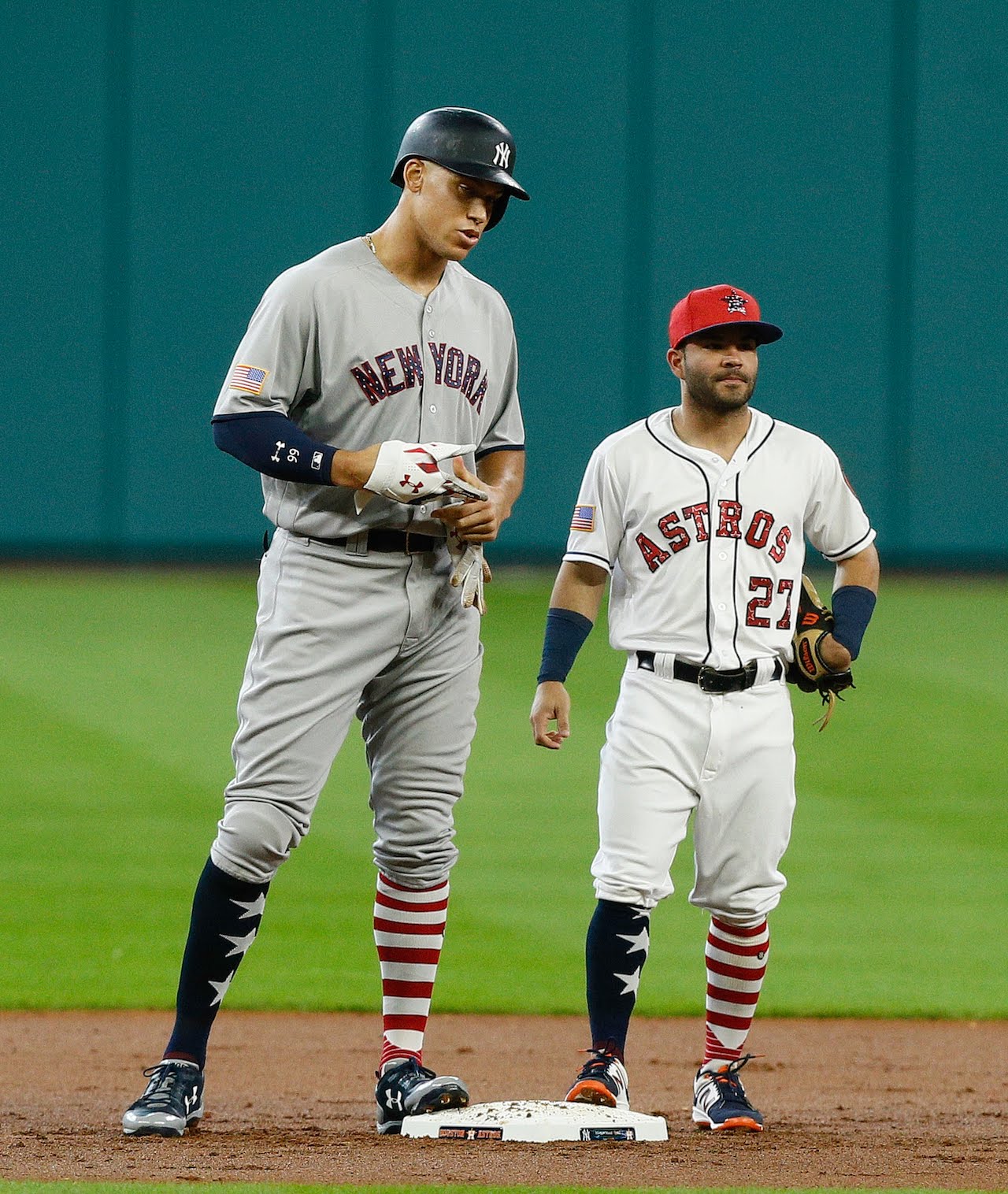
Aaron Judge (left) and Jose Altuve (right) are two
of the best players in the MLB. Players that
are often bet on by those playing DraftKings.
The Virtue Theory is based on four major virtue characteristics which are courage, honesty, temperance and justice. Courage relates to risk-taking and the willingness of a business to stand for the right actions. Honesty means that a business should be honest with all agreements that they make. Temperance ensures that a business maintains reasonable expectations and justice correlates to a business being fair in all their practices. For DraftKings, their unethical advertisements were intended to help them flourish by getting more people to play, thus more revenue for the corporation. However, under Virtue Theory, DraftKings’ advertisements are considered unethical and morally wrong. DraftKings may have flourished temporarily after they released their advertisements, but looking at it in the long run, their lawsuit and decrease in people who played their games reveal that the company did not flourish. By being unethical with their advertisements, DraftKings risked the company’s identity because now people who used to play might not want to play anymore because of the bad connotation that DraftKings has. It is also evident that DraftKings did not live up to their agreements because they advertised that people had an excellent chance of winning money, which was proved to be false. For these reasons, DraftKings was unethical according to Virtue Theory.
       
Bibliography
Shen, Lucinda. “DraftKings and FanDuel Settle New York Lawsuit for $12 Million.” Fortune, 26 Oct. 2016,
fortune.com/2016/10/26/draftkings-fanduel-settlement/.
Van Natta, Don. “The inside Story of the Quick Rise and Quicker Fall of DraftKings and FanDuel.” ESPN,
Gouker, Dustin. “DraftKings, FanDuel Pay $6 Million Each To Settle New York Case.” Legal Sports Report,
Lovett, Kenneth. “FanDuel, DraftKings to Pay $6M Each in Fines for Deceptive Ads.” NY Daily News,
Korman, Chris. “DraftKings and FanDuel Are Fun, Addictive, and Completely Unfair for Most Fans.” USA
Today, Gannett Satellite Information Network, 18 Sept. 2015, ftw.usatoday.com/2015/09/daily-fantasy-sports-football-drafkings-fanduel-commercials.


Drape, Joe. “DraftKings and FanDuel to Pay $6 Million Each to Settle New York Claims.” The New York
“DraftKings | Daily Fantasy Sports For Cash.” DraftKings - Daily Fantasy Sports for Cash,
Salazar, Heather. Western New England University. Spring Semester 2018 Class Notes.
Salazar, Heather. “The Business Ethics Case Manual: The Authoritative Step-by-Step Guide to
Understanding and Improving the Ethics of Any Business.”

Saturday, November 11, 2017

Tesla: A Tragic Loss, Autopilot Failure (2016)


Controversy:

At the heart of the race for technology stands Tesla, an American automobile, battery, and solar panel producer specializing in premium, all-electric SUVs and sedans. The company,  headed by CEO and founder Elon Musk, has been researching and implementing several semi-autonomous driving controls into their vehicles, with the hopes of creating fully autonomous, self-driven cars by 2019. In their current vehicles, Tesla offers semi-autonomous driving, including auto-park, adaptive cruise control, auto steering, any many other safety features. With all these revolutionary features, it seems as though Tesla has made driving safer for not only the driver any passengers, but other motorists.

Sadly, there are shortcomings to this technology, and many lessons that are still yet to be learned. On may 7th, 2016, a Tesla Model S Sedan t-boned a semi truck, causing the car to drive straight under the trailer, and careen off the road, before striking a power pole. The company's first instinct was to investigate, and find out whether or not the autopilot was being used during his travel. As investigations show, Joshua Brown had been using the autopilot feature. Both the car and driver failed to apply the brakes when the semi truck made a left turn across the lane, causing the Tesla car to drive full speed into the trailer. It is thought that the autopilot camera could not determine the difference between the white trailer and the cloudy white sky in the background, meaning the Tesla car thought there was only open road ahead.
Joshua Brown's Tesla Model S, after the fatal accident

Tesla's (and more importantly, Elon Musk's) reaction to this incident were somewhat questionable. On one side, the Tesla company as a whole were very considerate, apologetic, and remorseful. Tesla, from their twitter, shared a link to a blog titled "A Tragic Loss", where the Tesla Team wrote about the incident, how it occurred, and what measures are being taken to ensure it does not happen again. In the last paragraph, the Team wrote an homage to Joshua Brown, stating he was "a friend to Tesla...who spent his life focused on innovation...", closing with condolences given to his friends and family. The NHTSA (National Highway Traffic Safety Administration) also stated that they had the full compliance of Tesla, during the length of the investigation. Elon Musk, CEO and founder, tweeted the same article, yet followed it up with criticism towards the naysayers, retweeting a tweet stating "1 person dies in a Tesla on autopilot and people decry driverless cars are unsafe". Furthering this, Elon Musk claimed that "500,000 people would have been saved" in the last year if the autopilot feature was used by more manufacturers.

A diagram of the accident that occurred, the Model S hitting the semi truck,
before breaking through a fence and eventually hitting a telephone pole
The issue is not more of how Tesla and Elon Musk reacted to this tragedy in words, but rather in actions. This accident caused a significant revamp in the autopilot technology. Tesla's autopilot now relies on radar sensors primarily, rather than the cameras in place. Elon Musk even commented how big of an improvement this revision was, saying that had this system been in place, the fatal accident involving Joshua Brown would have most likely been avoided. With the new radar system, Musk says there will be improved abilities in fog, snow, and dust. Musk also estimates "probably a threefold improvement in safety" compared to human drivers. In addition, Musk and team made an improvement where the driver using the auto-pilot must periodically place their hands on the wheel, in order to maintain full attention. This had already been a feature (that Joshua Brown ignored), but now has more frequent reminders.

Tesla's autopilot feature, allowing hands free driving
Many investors lost money due to this incident, including stockholders, where stocks fell ~10% throughout June, and of course Tesla lost revenue, and invested much more funds into developing a more adaptive autopilot feature. Those who at the time owned similar Model S' now had to be more diligent with their autopilot, because accidents do happen. Overall, the Tesla team and Elon Musk did everything in their power to improve safety. The business as a whole acted on a very ethical, transparent scale, and Individualism, Utilitarianism, Kantianism, and Virtue Theory agree.

Individualism

Individualism is referred to as the ethical form of business where the only goal is to achieve profit, for the company and the shareholders. Now, with this case study, of course the price of Tesla stock went down, as it would with any tragic accident a company faces. However, the individualism comes in to play with how Elon Musk reacted to this. Musk, of course, gave his condolences to the family and friends of Joshua Brown, but rebutted arguments against Tesla's autopilot being "unsafe". Musk quoted many statistics showing automated driving to be safer than human driving, writing how this fatality is the first in over 130 million miles driven with the autopilot activated, compared to (on average) a fatal accident every 94 million miles with human drivers. The reassurance to his patrons, along with the development of an even safer autopilot system, caused Tesla Stock to increase roughly $200 over the course of the next year. Becasue of this, Elon Musk and the rest of the Tesla team preserved their profits, and actually increased the worth of their business, therefore abiding by the rules of Individualism. 

Utilitarianism

In the case of Tesla, Utilitarianism is applied to its fullest. Tesla is known to provide great customer service, and make their customers feel as if they are part of a family. According to utilitarianism, happiness and pleasure are the only two emotions that hold value. The common conception is, "the greatest good for the people", meaning the decision should be based on whether or not it is benefiting the most people. Before production, Elon Musk and the Tesla team did countless experiments on their 360 degree cameras in order to ensure the most safety for their consumers. Many failed attempts eventually led to what they envisioned to be the perfect auto-pilot feature. Tesla abode by every regulation and law put in place for consumer safety, showing that they cared for their customers, and wanted everyone to be safer. This would improve the overall happiness of the buyers. After the accident, Tesla took partial blame, since their autopilot system couldn't tell the difference between the trailer and the sky, and decided to revamp their systems. Because of this, many were relieved that something was being done to avoid another "freak accident". Overall, Tesla and Elon Musk have provided the greater good to the people, and limited the damage done by this incident.

Kantianism

Kantianism is thought of to run off of a certain set of principles, and relates to Utilitarianism. It is important in Kantian view to not act rash, to respect people, and to be motivated by good will. In terms of being motivated by good will, Tesla is constructed on good will. Elon Musk has stated several times he is afraid of the world to come, that eventually when we run out of fossil fuel we will be left with nothing. Because of this he has devoted his work to renewable energy, not just with rechargeable cars, but with high powered batteries, and solar energy. All of these things fall under the scope of Tesla, and a key factor in determining whether or not they are motivated by good will is by looking at the financials. Tesla reported ~$670 million loss in 2016. Clearly, with these numbers, Tesla and Elon Musk are not in it to make a fortune. The way Tesla's public relations handled the death of Joshua Brown shows that they have the utmost respect for their customers, and people in general. Creating a short excerpt in a blog to give an homage to Mr. Brown shows that they care, and have deep concerns for their drivers. Tesla creates a sense of a community with their cars, actively sharing posts by their customers on their twitter, to create a sense of unity. Hence, Kantian business ethics approve of how Tesla/Musk handled this situation.
Hundreds of dedicated Tesla supporters line up to buy the newest Model 3, sight unseen

Virtue Theory

The essence of virtue theory is to ensure a business acts ethically, portraying four distinct "virtues". These virtues include courage, honesty, temperance, and justice. If a company or organization follows these morals, then they are in fact acting ethically. Tesla had complete transparency with the media, it's customers, and shareholders during this fatal incident. They admitted the autopilot did not recognize there was a truck perpendicular to their lane of travel, causing the accident that killed Joshua Brown. As soon as it was determined what caused the accident, Tesla put out a blog on their website giving a complete overview of the investigation. This also is courageous, because being 100% transparent could have negatively affected their reputation, and put them out of business. What is even more courageous is that Elon Musk and his team decided to do an overhaul of the current autopilot to make it even safer. During this time, the share value had dropped, and of course Tesla expected this. Even still, they remained headstrong, determined to make up for it. If anything had been learned from the accident, it was that the autopilot system had its flaws, and the necessary corrections had been made, giving Joshua Brown the justice he deserves. In the sense of Virtue Theory, Tesla, Elon Musk, and their actions in response to the fatal accident were completely ethical.


Works Cited

Hook, Leslie. "Tesla revamps autopilot technology after fatal crash." Financial Times, Nikkei, 11 
     Sept. 2016, www.ft.com/content/3ddb43f0-785c-11e6-a0c6-39e2633162d5. Accessed 11 Nov. 2017. 
Howard, Bill. "Driver in Fatal Tesla Autopilot Crash Wasn’t Paying Attention: Feds." Extreme Tech, 
     Ziff Davis, 22 June 2017, www.extremetech.com/extreme/ 
     251299-dead-tesla-driver-wasnt-watching-dvd-wasnt-paying-attention-either. Accessed 11 Nov. 
     2017. 
Lopez, Napier. "Fatal Tesla crash investigation suggests Autopilot is still safer than humans." 
     The Next Web, 19 Jan. 2017, thenextweb.com/insights/2017/01/20/ 
     fatal-tesla-crash-investigation-suggests-autopilot-still-safer-humans/. Accessed 11 Nov. 2017. 
Mitchell, Russ. "U.S. ends investigation of fatal Tesla crash and finds 'no safety defects' in car's 
     Autopilot." Los Angeles Times, 19 Jan. 2017, www.latimes.com/business/autos/ 
     la-fi-hy-tesla-autopilot-20170119-story.html. Accessed 11 Nov. 2017. 
Singhvi, Anjali, and Karl Russell. "Inside the Self-Driving Tesla Fatal Accident." The New York 
     Times, The New York Times Company, www.nytimes.com/interactive/2016/07/01/business/ 
     inside-tesla-accident.html. Accessed 11 Nov. 2017. 
The Tesla Team. "A Tragic Loss." Tesla, 30 June 2016, www.tesla.com/blog/ 
     tragic-loss?utm_campaign=Blog_063016&utm_source=Twitter&utm_medium=social. Accessed 11 Nov. 
     2017. 
"(TSLA) Historical Stock Prices." NASDAQ, 10 Nov. 2017, www.nasdaq.com/symbol/tsla/historical. 
Woolf, Nicky. "Elon Musk Twitter rant a 'case study' in how not to handle a crisis, experts say." 
     The Guardian, 7 July 2016, www.theguardian.com/technology/2016/jul/07/ 
     tesla-elon-musk-autopilot-death-crisis-management. Accessed 11 Nov. 2017. 

Thursday, April 6, 2017

The Concussion Lawsuit Against The National Hockey League (2016)

The Concussion Lawsuit Against The National Hockey League (2016)

Controversy
The National Hockey League Logo
The National Hockey League was established in 1917 as the main professional hockey league in the world. Its focus has been to provide entertainment for fans, by displaying the world’s top hockey talent. The league draws many highly skilled players from all over the world and currently has players from approximately 20 different countries. Like any professional sports organization, the league thrives off this talent they put on display, and that is what has made the NHL so successful over the years.
In 2013, former National Hockey League players filed a lawsuit against the league for their neglect towards the issue of concussions in the NHL. The NHL has been fighting the validity of the case since it has been filed, but in 2016, a U.S. District judge in Minnesota refused to dismiss the case. (Dobuzinskis, 2016) This validates the case in a sense that the judge saw the actions by these former players as reason for legal recourse. For years, the NHL has tried to avoid addressing the issue of concussions in hockey. The reality is, hockey is a fast-paced, violent sport that can result in many serious injuries, concussions being the most common.        
Dr. Bennet Omalu
 We have seen concern regarding concussions emerge as years go on, especially in the National Football League, where Dr. Bennet Omalu discovered the correlation between playing football and concussions. His studies went on to show how concussions lead to a condition called CTE (Chronic Traumatic Encephalopathy) which is a degenerative brain disease derived from multiple concussions over time. This is the concern that the former NHL players have, that concussions players receive throughout their hockey careers could lead to permanent brain damage such as CTE. The Minnesota judge confirmed these players concerns as valid by refusing to throw out the case when appealed by the NHL. The NHL’s actions towards this lawsuit are reflective of how they have treated concussions and player safety over time. There has always been a sense of neglect when it comes to how active the National Hockey League is in taking care of the overall health of their players.
 Hockey players are known as ‘tough guys’, for example, players have been known to get injuries from play such as cuts stitched up during a game and return to that same game to play. We are talking about guys who get hit with 95+ mph slap shots in the face, and only miss part of that same game before returning. As a league, the NHL likes the idea of their players being known as these ‘tough guys’ because the fans and viewers at home know that hockey is a rough and tough sport. As tough as these players are, player safety is no joke, and the players themselves have spoken out more and more over the years about the league’s neglect towards player safety.


Stakeholders
Stakeholders are anyone who is affected by the actions of a company. The stakeholders in this NHL case are the league, the players, the players’ families, fans, and the teams. The league and the players are obviously the most directly affected by the situation, being the two who are  in the legal suit. Though, one must be mindful of all the people who branch off both the league and the players. For the league, the teams within the league are effected by concussions, losing players to injury quite often due to the length and seriousness of a head injury, teams can lose players that have a positive impact on their team’s ability. Missing these players could negatively affect team revenue, if the team is missing their star player then they could lose a percentage of fan interest. As for the player’s side, players and their families are both negatively affected by concussions, and even more-so if these concussions lead to brain damage later in life. Lastly, the fans are the ones who keep the league going, their support and opinions are what matter to the league because the fans are their source of income, this makes the fans a crucial stakeholder in this dilemma.

Individualism
            Individualism focuses on maximizing profits while staying within the constraints of the law. Individualism is very relevant in this case, obviously, like any business, the NHL’s goal is to maximize profits for their organization. Yet, the second part of individualism is tricky, is putting these players at risk of serious injury within constraints of the law? This is the issue that the former players filed the suit based on. The NHL makes money off these players going out on the ice and putting their well-being on the line. Many careers of players will be cut short due to injury, such as Marc Savard, a
Marc Savard playing for the Boston Bruins
player forced into retirement due to an excessive number of head injuries in 2010. He was considered to be one of the league's top players when he played for the Boston Bruins before his career came to an abrupt end due to concussions. The NHL would make the case that the danger they expose their athletes to is not illegal. The players are required to sign contracts to play in the NHL and the league would argue that the players know what they are signing up for. The players may make a case, however, that the NHL has not done extensive enough research to present the possible risk of head injuries involved with playing pro hockey. So, although it is certain that the NHL is maximizing its profits, whether or not they are abiding by the law is, to a degree, in question.

Utilitarianism

Passionate Fans Frustrated with the 2012-13 NHL Lockout
            Utilitarianism is based on happiness of stakeholders. Basically, the idea behind utilitarianism is to make decisions that don’t necessarily always bring in the highest profit, but rather make decisions that benefit all of your stakeholders. Because the ethical dilemma is between two stakeholders in the company, it is clear that utilitarianism was not being considered by the NHL. The players are arguably the largest stakeholder in the National Hockey League. Obviously, the reason this Concussion Suit was filed is because there is a large percentage of the players who are unhappy with the league’s concern for their well-being. If the NHL is neglecting a stakeholder, then clearly they are not working to try and make them happy. When the players and the league are in disagreement, it often results in none of the stakeholders being happy. The league and the players have had disagreements before, and these disagreements do not always go well, the last issue seen was an NHL Lockout in 2012-2013 which resulted in half of the hockey season being missed due to the failure to agree on a new Collective Bargaining Agreement. This situation left no stakeholders happy, so as you can see the NHL does not have the best history of keeping stakeholders happy, especially the players themselves. The players filing a lawsuit against the league is just another instance of the two disagreeing on crucial issues within the game of hockey.

Kantianism
            Kantianism is based around rational decision making, autonomy of individuals, and honesty and freedom (Salazar, 20). Kantianism focuses on good will, and not performing unethical actions under any circumstances, such as using people for your own personal gain. Overall, it seems that Immanuel Kant, the philosopher behind the idea of Kantianism, believed in being true to people while doing what is right.
            The NHL is not following Kantianism because of their use of their players. The players were not fully briefed on the long-term risks that come with head injuries from playing hockey. This can certainly be seen as the league using their players for their own personal gain, while the players are underinformed about the risks of injury. The league is not being true with their players and therefore they are not following the ways of Kantianism. This hinders the players’ ability to make rational decisions about playing hockey, or treating their head injuries. Often, players are more focused on getting back out and playing rather than resting when they are concussed, this is likely due to the league’s lack of informing players about the true dangers of concussions and long term brain damage.

Virtue Theory
            Virtue Theory judges a one’s character based on a variety of characteristics that are believed to make an individual virtuous. A person or entity has virtues which decide whether or not this person is succeeding or not. Such virtues can be characteristics such as intelligence, honesty, care, compassion and many more that contribute to a virtuous person. The reason these four characteristics are important in the disagreement between the NHL and its players are because these are characteristics that the league is not displaying by conducting themselves in the manner that they have been for years. They have not been intelligent about how to handle concussions and researching how to prevent concussions, they have not been honest with their players about the risk of concussions, and of course, this dishonestly leads to lack of care and compassion for their players, a major stakeholder in the organization.

Justified Ethics Evaluation
I personally believe the NHL is acting unethically in their lack of attention towards concussions and the risks that they include. Player safety seems to be a real issue within the league at the moment, and it seems as though instead of working with the players to achieve a safer environment, they are denying that concussions are even an issue. If there enough players stepping up to file a lawsuit against the league, it is clear that concussions are in issue that the NHL needs to address.


References:

Dobuzinskis, Alex. "Concussion Lawsuit against NHL Can Proceed: U.S. Judge in
Minnesota." Reuters. Thomson Reuters, 18 May 2016. Web. 06 Apr. 2017.

"NHL Concussion Litigation: Alleging National Hockey League Concealed Risks of   
Concussions." NHL Concussion Litigation: Alleging National Hockey League Concealed Risks of Concussions. Robbins Geller Rudman & Dowd LLC. Web. 06 Apr. 2017.

Salazar, Heather. "The Business Ethics Case Manual." The Authoritative Step-by-Step Guide to
Understanding and Improving the Ethics of Any Business (2014) Web. 06 Apr. 2017.

Active NHL Players Totals by Nationality ‑ 2011‑12 Stats." QuantHockey. Web. 06 Apr. 2017.

Wheeler, Scott. "Marc Savard on Health and Life after Hockey." Stanley Cup of Chowder.
Stanley Cup of Chowder, 26 Aug. 2016. Web. 06 Apr. 2017.